In a meeting room, a product manager doesn’t reach for a slide deck anymore. They open a terminal, type a question in plain language, and twenty seconds later hold an answer pulled straight from the product’s live data.
This isn’t a staged demo meant to impress a leadership committee. According to Colin Matthews, it’s an ordinary Tuesday for a handful of product managers who have quietly changed the nature of their job. This trainer, who says he has coached more than 40,000 product managers, designers and tech professionals, published a guide to AI for product managers in late June on Lenny’s Newsletter, the leading North American product management publication, and it traveled well beyond the usual circle of practitioners: three forms of leverage, that extra force a tool lends to whoever wields it, which artificial intelligence supposedly now offers to anyone who knows how to use it.

First leverage: no longer just writing, but delegating
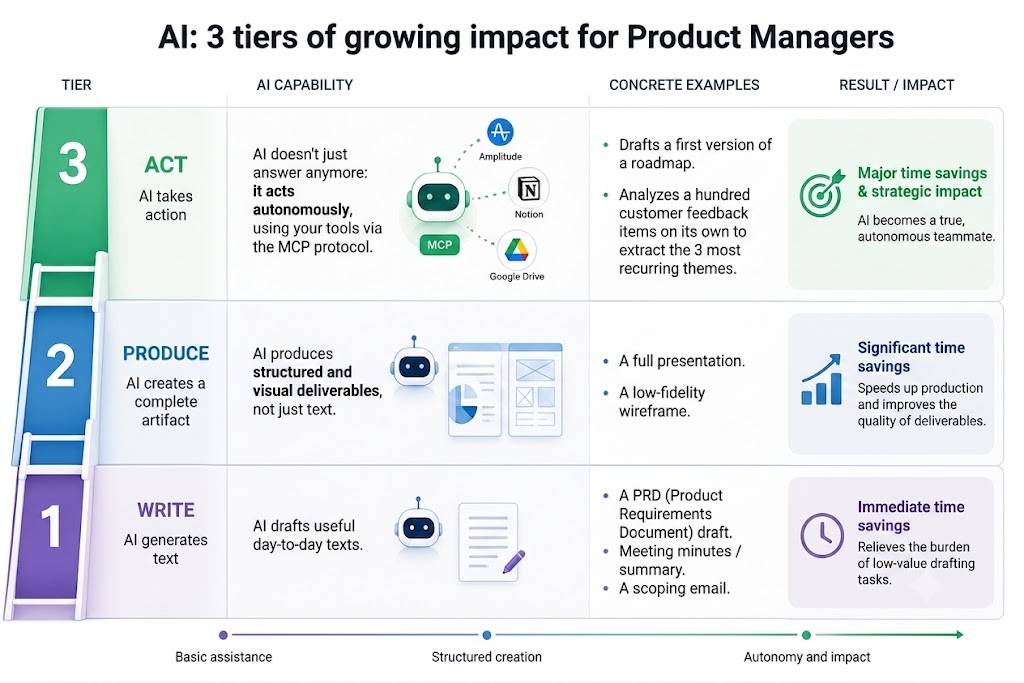
The first of these three leverages, personal, is the most common and the least spectacular. At its first rung, AI drafts things: a rough PRD (product requirements document, the brief that describes what a team must build and why), a meeting summary, a scoping email. At the second, it produces an entire artifact rather than plain text: a slide deck, a rough mockup. At the third and most advanced, it stops merely answering and starts acting. Connected by engineers to tools like Amplitude, Notion or Google Drive through a technical protocol called MCP (Model Context Protocol, a standard that lets an agent, a program capable of chaining several actions autonomously to reach a goal, consult and operate the tools a team already relies on), the AI drafts a first version of a roadmap or sorts through a hundred customer comments on its own to pull out the three themes that come up most often.
Atlassian’s 2026 State of Product report already described product managers with more power, but also more fear of failing. This first leverage doesn’t change that tension. It simply moves the moment fear shows up, from the drafting stage to the decision itself.
Second AI leverage for product managers: the prototype replaces the promise
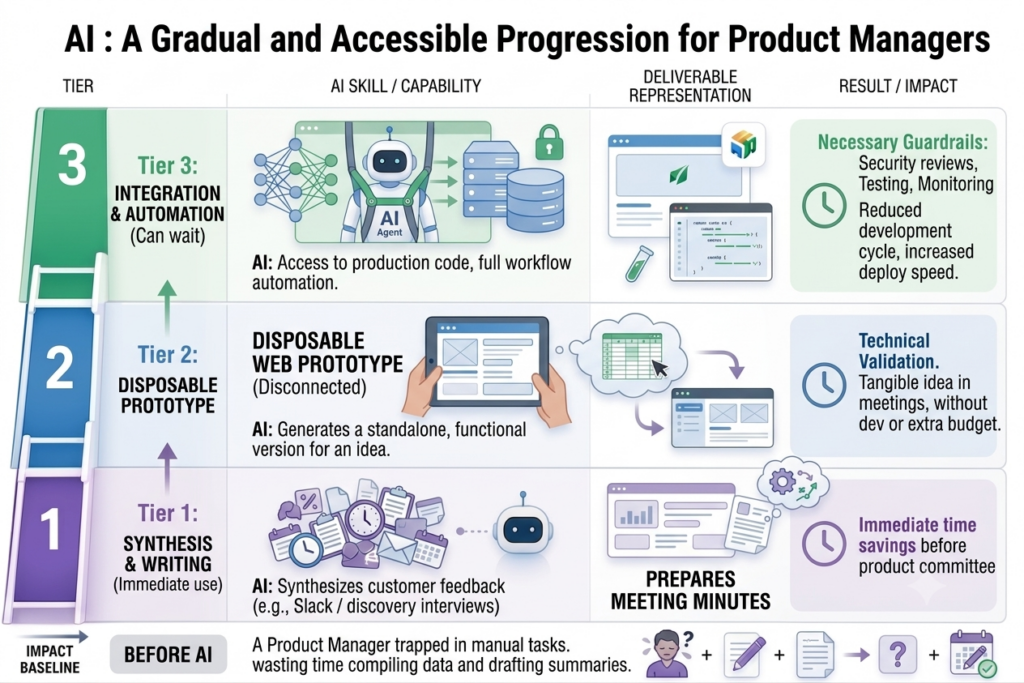
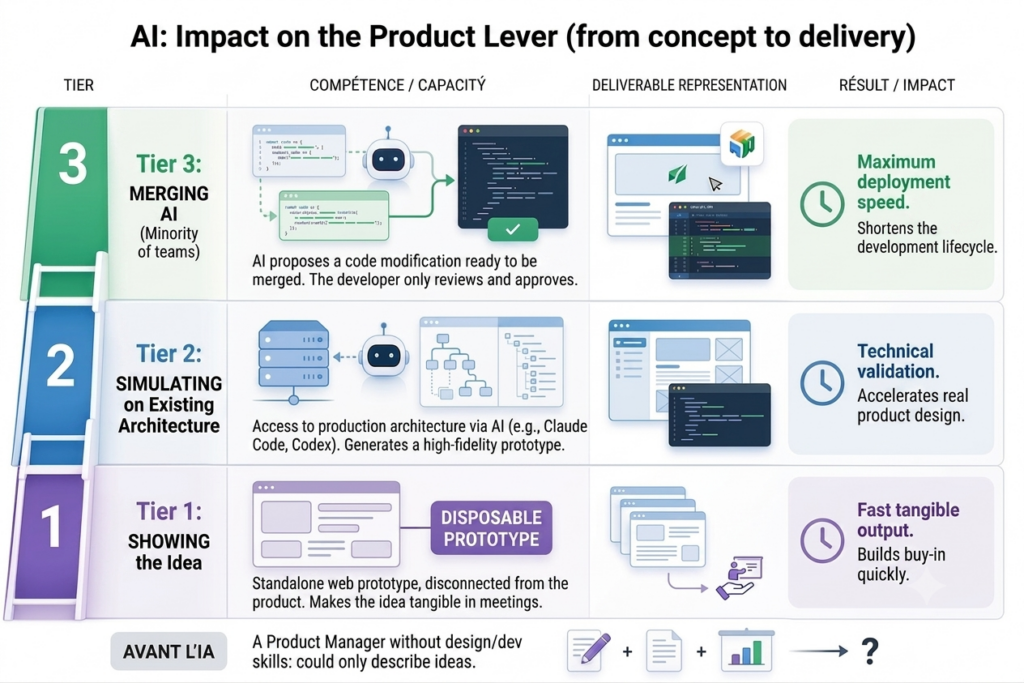
The second leverage, product, changes what a team can actually ship. A product manager without design or engineering chops could, until now, only describe an idea: a slide, a paragraph, an intention. Now they can show it. First rung: a throwaway web prototype, a working but disconnected version of the real product, useful only to make an idea tangible in a meeting. Second rung, more demanding: tools like Claude Code or Codex reach directly into the company’s actual codebase to generate a prototype grounded in the existing architecture, and therefore closer to something that could genuinely ship. At the very top of that ladder, and only among a minority of teams so far, the AI goes as far as proposing a code change ready to merge, one an engineer only needs to review before folding it into the product.
Third leverage: automating what repeats
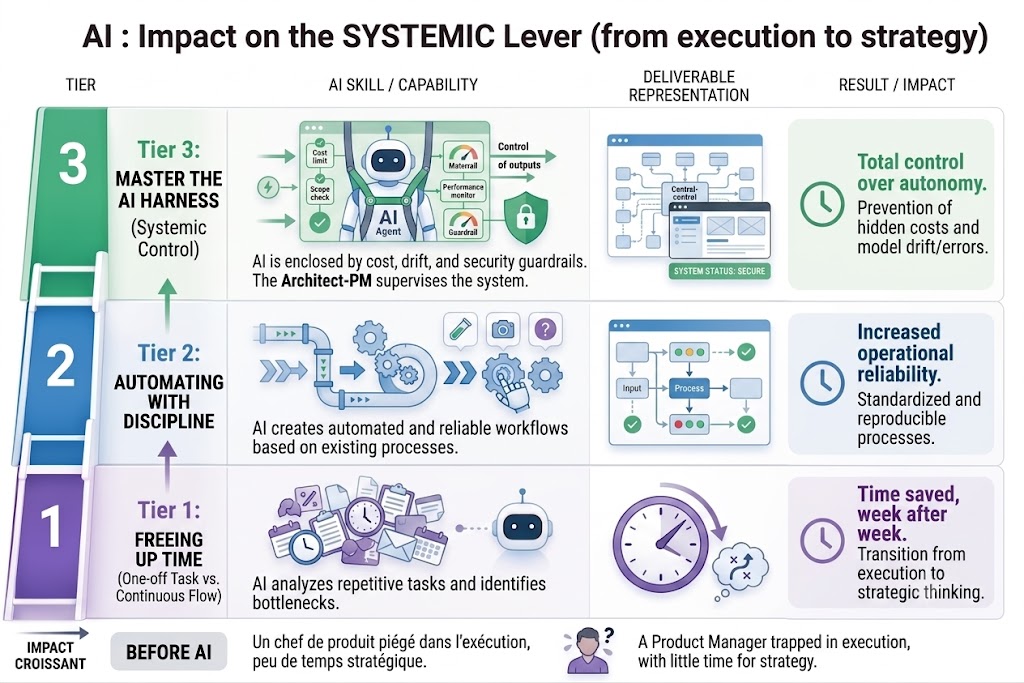
The third leverage, systemic, is the least documented of the three but the most ambitious: turning a one-off task into a reliable, automated workflow, freeing up time, week after week, for strategic thinking rather than execution. It is also the hardest to generalize, since it requires an engineering discipline, testing, documenting, monitoring, that few product managers have yet built. Governing these automated flows is a discipline we already covered in July: the harness that keeps AI agents from running away with themselves, costs and all.
The real risk isn’t writing bad code, it’s making the wrong call
This progression has a downside that Colin Matthews, whose business happens to rest on training product managers in exactly these tools, does not dwell on. Another influential voice in the field, Shreyas Doshi, makes a nearly opposite case. His argument: AI tools commoditize fast, so fast that mastering a specific tool, however impressive today, will soon stop being a competitive edge. What will separate one product manager from another, he writes, will no longer be the tool they wield but the judgment they apply to what that tool produces: empathy for the user, the ability to simulate the consequences of a decision, strategic thinking, taste, creative execution. A spreadsheet never made anyone a great analyst, he points out; an AI agent alone won’t make a great product manager either.
The two readings don’t cancel each other out, they correct each other. Knowing how to query your data or generate a prototype saves real, measurable hours of execution time. It doesn’t excuse anyone from knowing which question to ask, or from owning what gets shipped. We made a similar point about engineering teams: shipping code faster won’t make your organization faster. A prototype an AI produces from the company’s real codebase is still a change shipped without the security or architecture review an engineer would have demanded for the same modification. The speed gained on one side can be paid for, on the other, in technical debt or an incident, if nobody replays that check downstream.
Where to actually start
For a team discovering these practices, the ladder is useful precisely because it is gradual: there’s no need to aim for the top rung right away. A product manager can start this week by asking an AI assistant to summarize customer feedback piling up in an internal channel ahead of a product review, or to draft a first-pass summary after a round of discovery interviews (the exploratory phase where a team works to understand a user problem before deciding what to build). The next step, a throwaway prototype to test an idea in a meeting instead of a slide deck, requires neither an engineer nor much of a budget. The rest, wiring into the real codebase, automating entire workflows, can wait until the engineering team has put the necessary guardrails in place: security review, tests, monitoring.
Mind the Product noted, in its Summer 2026 roundup of product resources, an emerging split in the profession: on one side, product managers who build; on the other, those who keep writing documents about what others build. Leverage itself doesn’t choose which side of that line anyone lands on. It only speeds up whichever path someone was already on.
Sources
- How top PMs increase their leverage with AI · Colin Matthews, Lenny’s Newsletter (June 30, 2026)
- Tech For Product, Colin Matthews’ profile · Maven
- Why Product Sense is the only product skill that will matter in the AI age · Shreyas Doshi
- The top books and resources for Product people, Summer 2026 edition · Mind the Product
- Chefs de produit en 2026 : plus de pouvoir, plus de peur · Impact Factories
- Le harnais qui empêche vos agents IA de s’emballer · Impact Factories
- Coder plus vite ne suffit pas à faire avancer votre organisation · Impact Factories