One Friday in June, at Thiga, a consultant gets a very simple question from his management: how much does the application you’re building cost? Matthias has no answer. Five days earlier, he was still coding his project by hand; since then, he has delegated most of the work to an AI agent, and the bill has climbed without him noticing. This vertigo has a name, which appeared only a few months ago in engineering circles: harness engineering.

Matthias is what is now called a product builder, a hybrid profile who designs a product and codes it himself with the help of AI agents (programs able to chain several actions on their own, writing a function, testing it, fixing it, without a human approving each step), without depending entirely on an engineering team. He was driving his through the programming interface of Anthropic’s Claude model, where the bill is calculated per token (the unit that measures what a language model reads and writes, a bit like the minutes on a prepaid phone card), with no cap and no alert. In five days, without knowing it, he had spent 500 euros on tokens.
His story, told on Thiga’s media site, has become a textbook case. It illustrates on a small scale a vertigo that much bigger companies are discovering right now, at their own expense. According to internal dashboards obtained by the American outlet 404 Media and relayed in early July by British consultant Martin Fowler, one company saw its token bill climb from 5 million dollars in August 2025 to 15 million in May 2026, with a projected annual trajectory of more than 120 million. Accenture, for its part, had to take steps to limit its teams’ consumption. The problem, the same documents note, did not come primarily from code: it was employees using AI for trivial tasks, turning a PDF into a presentation, who made the meters explode.
Harness engineering, a term that did not exist in February
Martin Fowler describes the acceleration precisely. In February 2026, in Deer Valley, Utah, Thoughtworks brought together pioneering teams for a first retreat on the future of software development: the term did not exist yet, and the mood, according to one participant, Giles Edwards-Alexander, was one of hesitation, the conviction that there was something there, even if nobody knew yet what. At the end of June, in Engelberg, Switzerland, for the second edition of the same retreat, the tone had changed: the value is there now, and the term is on everyone’s lips. Another participant, Greg Herlein, sums up the shift: in February, everyone was theorizing; this time, everyone was doing it, shipping it, no more mere presentations, real production.
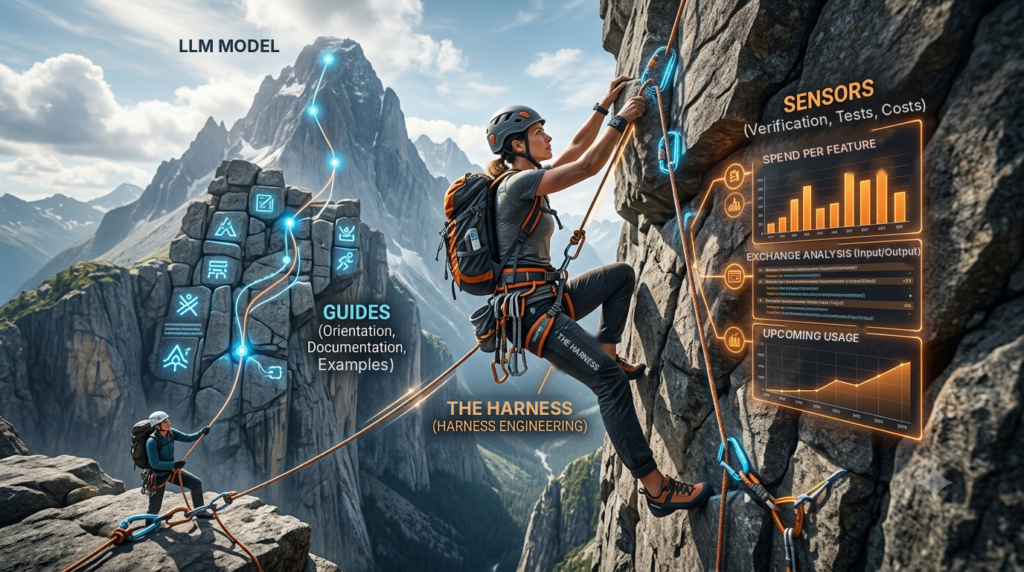
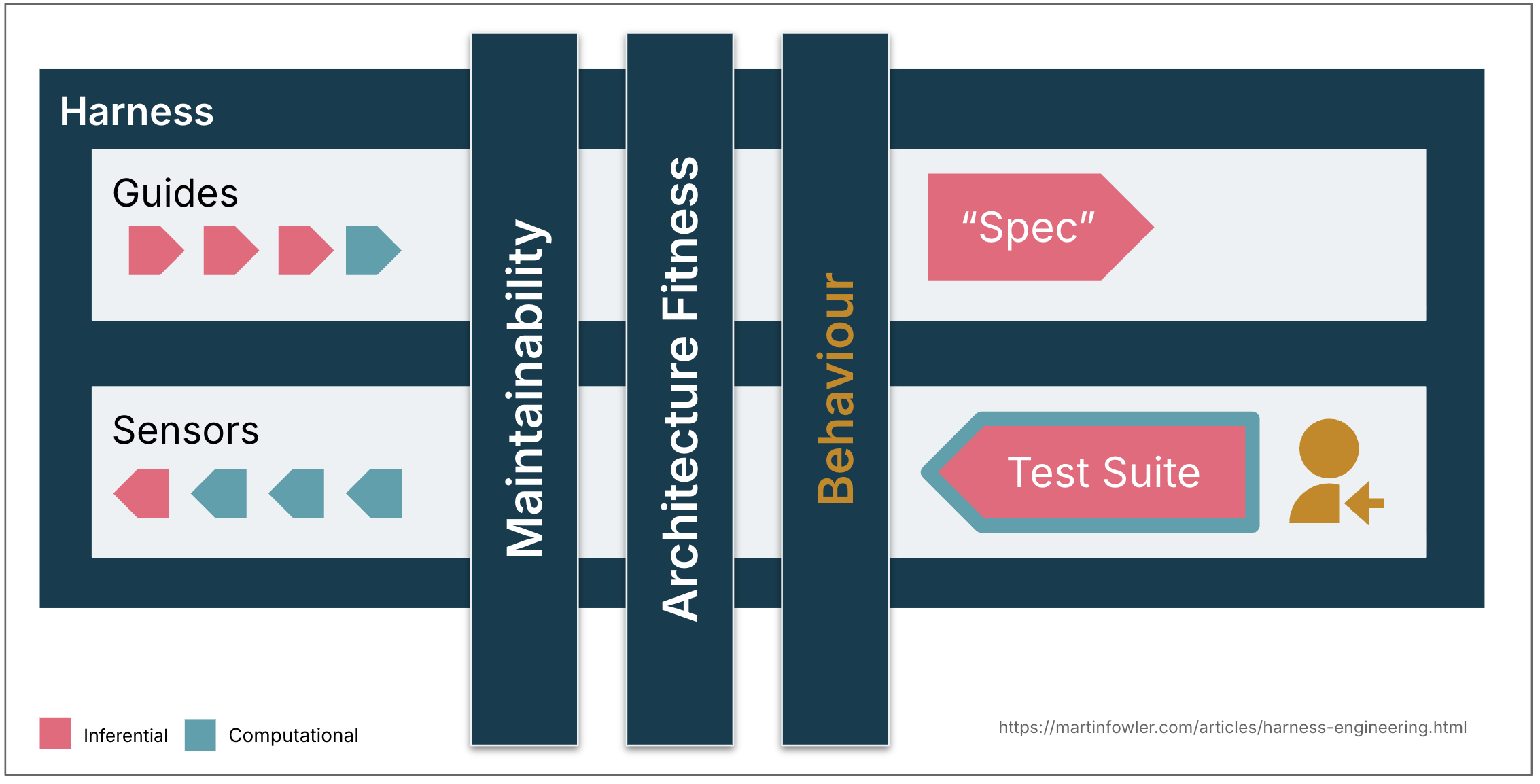
The concept comes from a memo published in February by Birgitta Böckeler, an engineer at Thoughtworks, then developed in a full article in early April. Her definition fits in one sentence: a harness is everything that surrounds a language model to make it usable with confidence, in other words everything except the model itself. The image is borrowed from climbing: a harness does not dictate where to climb, it catches the fall and guides the movement. Böckeler distinguishes two families of elements. Guides steer the agent before it acts: a written rule, reference documentation, an example to follow. Sensors check afterwards what it has produced: an automated test, a review by another agent, a cost dashboard. Without naming it, this is exactly what Matthias, at Thiga, ended up cobbling together on his own: a dashboard breaking down spending by feature, dissecting each exchange with the AI, projecting future consumption. A homemade sensor, built after the shock rather than before.

Illustration: diagram of the three families of harnesses (maintainability, architectural consistency, functional behavior), with guides and sensors layered on top (Birgitta Böckeler, Thoughtworks, martinfowler.com).
What changes for product teams
The stakes go beyond the engineering discipline alone. For months, the debate on generative AI focused on one question: which model to choose, GPT, Claude, Gemini? Harness engineering moves the question elsewhere: what system should be built around the model to make it reliable, predictable, and keep its cost under control? For Thiga, which has just published its own guide for French-speaking product teams, this is precisely the ground on which a lasting advantage is built: on a long task, it is the harness, not the model, that makes the difference between a project that holds and a project that goes off the rails.
It is a shift of responsibility that directly concerns product managers, as they themselves become product builders able to run agents without going through engineering. A product manager who prototypes with Claude Code or Cursor no longer has the luxury of leaving this topic to others: the rules they write before launching their agent, the way they check what comes out of it, the visibility they give themselves on costs, become a product skill in their own right, just like knowing how to frame a need or prioritize a backlog, the list of tasks and features still to be handled. It is a useful reminder: artificial intelligence is never an end in itself, but an accelerator serving a system whose culture and habits weigh as much as the tool.
The limits of a still young field
The picture is not as clear as it seems. Böckeler herself acknowledges that a whole part of the subject remains largely unsolved: checking that an agent produces functionally correct behavior, and not just code that compiles. “We still have a lot to do,” she writes, “to develop good harnesses that reduce supervision and manual testing.” The catalogs of practices gathered at the Engelberg retreat remain, by the participants’ own admission, emerging: no one can yet say with certainty what works, and in what context.
There is also a risk of the discourse being hijacked. Product essayist John Cutler published a warning at the end of June that is worth reading as a counterpoint: he disputes the very fashionable idea that AI has simply removed the software engineering bottleneck. For him, a product development system is never blocked by a single physical point; the real constraint most often lies in internal policies, habits or coordination failures, not in a tool. He points to a less avowable agenda behind some of this talk: consulting firms such as McKinsey, BCG or Deloitte are selling their clients 30% headcount reductions, justified by the productivity AI would supposedly bring. A sales promise, not a demonstration. The harness is a real and already useful tool; it is not, on its own, proof that the organization of work has changed in nature.
Where to start on Monday morning
In practice, a product manager or a manager who is already driving an AI agent to prototype, write a specification or explore an idea can act without waiting for the discipline to settle. Three reflexes, borrowed from the practitioners cited above, are within immediate reach: write your rules before launching the agent rather than after, in the form of a short reference document, reusable from one project to the next; set up, from day one, a minimum of visibility on consumption, since even a rough dashboard is better than a bill discovered at the end of the month; and distinguish, in what you check, what is mechanical and fast, a script, an automated test, from what requires human judgment or a second AI look, slower and more expensive, to be reserved for the decisions that really matter. It is a discipline found, in other words, in the review of the first test phase of Impact Factories: measure before generalizing, whatever the tool.

That is the whole point of the harness, Böckeler reminds us at the end of her article: not to remove the human from the loop, but to direct their attention where it matters most. At Thiga, Matthias no longer has a 500-euro surprise to justify: at 2.1% of his monthly quota, he has enough margin to multiply his usage by nearly fifty before hitting the cap. The energy he used to spend watching his bill, he now redirects toward what his users really expect: being able to work together on the same document. The harness did not slow his work down. It simply gave him back control.
Sources
- Birgitta Böckeler, “Harness engineering for coding agent users” · martinfowler.com, Thoughtworks (February 17 and April 2, 2026)
- Martin Fowler, “Fragments: July 6” · martinfowler.com (July 6, 2026)
- Thiga, “Harness engineering: the guide for your AI agents” · media.thiga.co
- Thiga, “500 euros of tokens in five days: managing the costs of an AI app” · media.thiga.co
- John Cutler, “TBM 427: The Bottleneck Strike Again!” · cutlefish.substack.com (June 26, 2026)









 CC BY-SA 4.0