

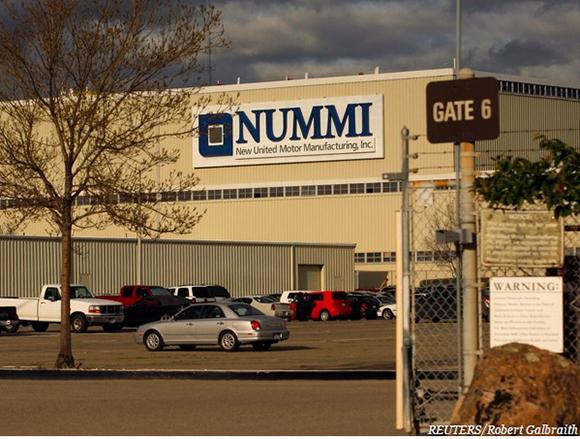
In the early 1980s, General Motors’ plant in Fremont, California, was the shame of the group. Absenteeism routinely ran above 20 %, wildcat strikes were a way of life, the quality coming off the line was the worst in all of GM, and the plant ended up idle. Toyota then partnered with General Motors to open a joint venture there, NUMMI, prepared as early as 1983. Same walls. Same workers, the old troublemakers included. Within a year, the plant was producing the best quality in the group and absenteeism had settled at 2 %.
John Shook, the first American to become a kacho, a section manager, at Toyota in Japan, was there. His account, published in the MIT Sloan Management Review in the winter of 2010 and awarded a prize the following year, comes down to one sentence every executive should write on a whiteboard: the only thing that had changed was the production and management system.
Org chart and workflow: the shed and the line
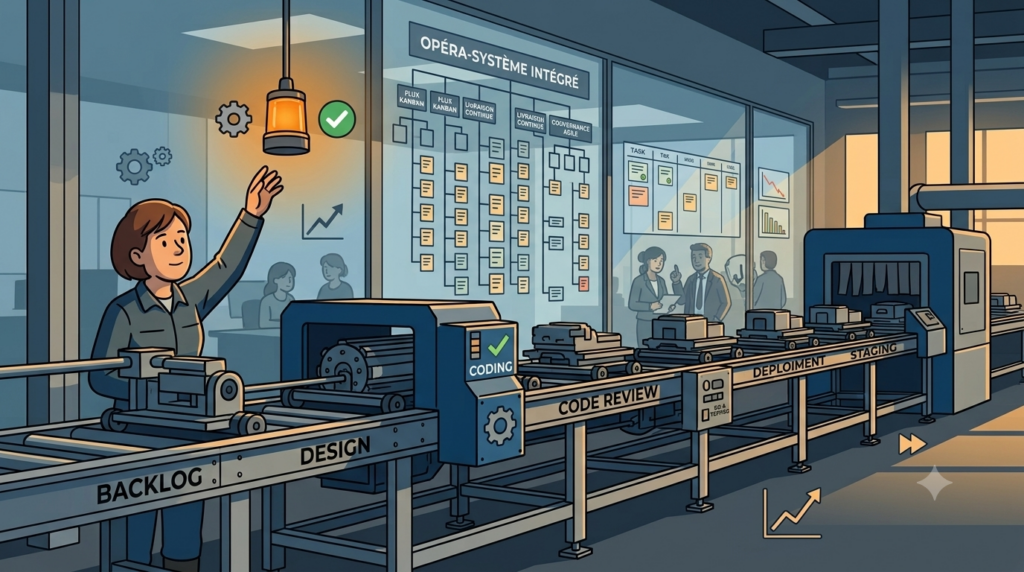
That is the natural experiment many organisations refuse to look in the eye. They hire skills, file them into boxes, connect the boxes with lines, and wait for value to come out. As though a factory were a shed plus workers. A factory is workstations, standards, a cadence, warning signals, an agreed way of handling problems. In other words a workflow: the actual path work takes, from the need spotted to the customer served, through every pair of hands it crosses. The org chart says who reports to whom; the workflow says how value gets made. Two different objects, and it is the second one that produces.
Someone will object that a craftsman does without all of this. That is to misunderstand the craftsman: he has mastered his art, his gestures, his tools, the order in which he reaches for them. What organisations describe when they let their teams “sort themselves out” is not craft, it is a workshop with no trade. Industry, for its part, settled the question long ago, through a sequence nobody argues with any more: execute, standardise, automate, optimise. In that order.
That is the wager this publication is named after. An impact factory is a team that does not just build a product but builds, every day, its own way of working. The metaphor makes tangible a kind of work we believe to be abstract because it leaves behind neither shavings nor the noise of machines.
Value flows sideways, careers climb upwards
James Womack, co-founder of the Lean Enterprise Institute and one of the MIT researchers who made the word lean famous in the West, has spent more than twenty years walking what he calls the value stream, the sequence of steps that turns a request into a satisfied customer. He always sees the same scene: intelligent managers, each busy optimising their own portion, each wondering why there is so much inventory and waste along the way.
His diagnosis, published on lean.org, is rare in its honesty: the problem starts with us. Our appraisals and our careers push us to look up, for fear of falling, rather than sideways. We are not bad people, he writes, we are good people caught in a bad management process. His first remedy costs nothing: walk the stream together, draw the map everyone can see, and post it. Not the org chart of the departments crossed, but the actual journey of the request.
Reorganising, or moving the deck chairs on the Titanic
The numbers show the scale of the misunderstanding. In a McKinsey survey published in 2014 of more than two thousand executives, 82 % said they had lived through a reorganisation, and three quarters of those efforts fail both to meet their objectives and to improve performance. The detail is crueller than the total: around 40 % of respondents cite, among the obstacles they hit, excessive attention paid to the org chart rather than to how the work itself would change. The rare successes, the survey notes, are the ones that went beyond the boxes, towards performance management, decision rights, culture and skills.
Marty Cagan, founder of the Silicon Valley Product Group, put it bluntly in July 2024: believing a reorganisation will fix a company’s problems amounts, most of the time, to rearranging the deck chairs on the Titanic. His distinction is useful to executives in a hurry. The org chart shows who reports to whom; the team topology shows what each team is answerable for and how its members collaborate to solve a problem. Reporting lines can change without touching the topology, and the other way round. This is no Californian fad: on woshipm.com, the large Chinese product management community, a 2022 piece on team structures sets out the same order, strategy, business model, processes, and the org chart last, to serve them.
What a manager does once they stop executing
If the organisation is the production tool, a manager’s job changes in kind. Allocating resources and reporting progress gives way to two more demanding tasks. Giving meaning, through vision, strategy and OKRs, those objectives paired with measurable results that tell a team not what to build but how it will know it has succeeded. And working on the way of executing at the same time as on execution itself.
The second point is the most misunderstood, because it undoes an old habit. Scientific management had separated those who think the method from those who apply it. The Japanese turn puts both back in the same place: quality is settled on the line, and everyone answers for their own patch. The manager is no longer the brain of the operation, they are the one who guarantees that the team has the time, the mandate and the information to improve its own tool.
The objection always lands in the same place: while you are improving the way you work, you are not shipping. True, and the upfront cost is real. NUMMI shows where the investment goes. The famous andon, the device that lets an operator flag an abnormality and stop the line, made GM’s managers wince. You intend to give these workers the right to stop the line? No, Toyota replied according to Shook: the obligation to stop it, whenever they find a problem. Behind the device sits an expensive promise from management: a team leader will come and help within the operator’s job cycle. That is the production tool. Not the shed.
The same shed, thirty years on
This building’s story does not end there, and what follows is a case study in its own right. NUMMI closed in April 2010, carried away by General Motors’ bankruptcy. A few weeks later, a fledgling electric carmaker bought the site: in its own filings with the American regulator, Tesla states that it signed the agreement in May 2010, completed the purchase in October, and paid 42 million dollars for 210 acres and the manufacturing facilities on them. The Fremont shed began its third life.
What came next is famous. To build the Model 3, Tesla bet on automation of unprecedented ambition, and found itself in what its chief executive would himself call production hell, missing targets quarter after quarter. In April 2018, Elon Musk walked Gayle King around the Fremont plant for CBS This Morning, the first time a network’s cameras were allowed onto the line. Had the robots slowed production down? Yes, he conceded, describing the insane network of conveyor belts that would not work and had to be ripped out altogether. Hours later he posted the admission the whole business press picked up: excessive automation at Tesla was a mistake, his own, and humans are underrated.

But the most useful line in that interview sits elsewhere, and it is a technical one. Tesla put too much new technology into the Model 3 all at once, Musk told CBS, and it should have been staged. Look at the order of operations. The same building has lived through three regimes: workers in a shed with no system, which failed; a work system with no new technology, which succeeded; then spectacular technology laid on top of a poorly established flow, which jammed. Nobody came along to disprove automation as such. Tesla simply inverted the order industry knows by heart: execute, standardise, automate, optimise. Automating work you have not first learned to execute and standardise is not acceleration, it is casting your waste in metal.
The objection that holds up
Here we must resist making Fremont say more than it says. Tesla did climb out of production hell, did reach mass production, and did become one of the most valuable carmakers in the world, without ever returning to the Toyota system. A hostile reading would conclude that the production system is not so decisive after all, and that a company can succeed while mistreating it. Honesty requires saying so: NUMMI is a controlled experiment, Tesla is not. The building is the same, everything else changed.

Yet the org chart is not scenery, and pretending otherwise would swap one naivety for another. Martin Fowler, one of the most listened-to voices in software architecture, recalls Conway’s law, formulated in 1968 by the computer scientist Melvin Conway: any organisation that designs a system will produce a design whose structure copies that organisation’s own communication structure. Splitting teams by activity, analysis on one side, development on the other, testing at the end, mechanically manufactures hand-offs between the idea and production. So the org chart does act on the flow, to the point that some manoeuvre it deliberately to obtain the architecture they are after. Fowler is categorical: the decomposition of the system and that of the human organisation must be done together, and must keep evolving together.
Womack himself defuses the dream of a flow that would manage itself. The person responsible for a value stream, he notes, has authority over almost none of the departments involved; without the senior leaders’ agreement and without compensation for those who would lose out, nobody will move. The vertical holds the flow hostage, because that is where the budget, the career and, more quietly, decision rights live. Cagan goes as far as to scratch the thesis: with the right people, he writes, a strong team succeeds whatever the structure, and the limiting factor remains the quality of the leaders and the product culture. The reasonable verdict sits there. The org chart makes nothing, but it decides what can be made; the flow produces the value, but it does not survive without a structure that permits and funds it.
That verdict also defuses the “it depends on the organisation” that surfaces the moment matrix structures or squads come up. Of course it depends. In Lean, only two things sit at the centre: what the product must accomplish for the customer, and the product itself. A matrix is an answer to variability, not an end in itself. A highly specialised team should expect to be reorganised when the product demands it. What is false is the reverse logic: here is how we know how to work, so here is how we will make the product, for ever.
Where the factory metaphor stops helping
The seam has to be named. A factory optimises the repetition of a known output; a product team spends part of its time in discovery, the exploration where you look for which problem deserves solving and which solution stands up. There, scrap is not a defect, it is information bought at a fair price. Measuring the cadence of ideas, punishing the experiment that fails, is betraying the metaphor while believing you are applying it. The factory serves to make work visible. It does harm the moment it is used to prove.
The number to ask for on Monday morning
An executive who wants to know where they stand does not need an audit, but a number their org chart is incapable of giving them: flow efficiency, the share of time during which a request is actually being worked on, set against the total time elapsed between the moment it is accepted and the moment it is delivered. On the Kanban University site, the practitioner Julia Wester reported in 2016 that the most generous estimate she had read puts common practice at around 15 %. So work spends roughly 85 % of its life waiting: for a sign-off, an arbitration, a dependency, a person busy elsewhere. David Anderson, the originator of the Kanban method, reckons that above 40 % you are doing well. These are field orders of magnitude, not study results, and that is what makes them useful. Ask for yours, from the opportunity logged to the release in production. Nobody will have it.
That missing number is the diagnosis. It says no post on the org chart owns the whole journey, and that everyone measures their own box. Three questions are then enough to pull the thread. How much time passes between the moment an opportunity is identified and the moment a user benefits from it? How many hands does it cross, and how often does it wait for a decision nobody formally has the power to take? How will we know it was a good idea, and who wrote that sentence down before we started? The day someone has the answers, the conversation will have changed in kind.
This is where artificial intelligence becomes a revealer rather than a remedy. It shortens the active time, the 15 %. It does not touch the remaining 85 %, made of waiting and decisions not taken, and it even fills them faster with started work nobody is waiting for: the revolution has not happened yet, the tool improves, the factory stays the same. Fremont has already taught the lesson twice. Once when workers written off as unmanageable became the best in the group without anyone replacing them, because they had been given the means to succeed at their job and the duty to stop the line. And once when the most technological company in the world discovered, inside the same building, that you cannot automate work you have not yet learned how to do. No box, in any org chart, could have written those two sentences.
Sources
- How to Change a Culture: Lessons From NUMMI, John Shook, MIT Sloan Management Review, winter 2010
- Becoming Horizontal in a Vertical World, James Womack, Lean Enterprise Institute
- The Product Model and Org Design, Marty Cagan, Silicon Valley Product Group, July 2024
- The secrets of successful organizational redesigns, global survey, McKinsey & Company, 2014
- Purchase of Tesla Factory and Assets, Tesla annual filing, U.S. Securities and Exchange Commission
- Elon Musk: Tesla CEO talks Model 3, interview with Gayle King, CBS This Morning, 13 April 2018
- Conway’s Law, Martin Fowler, martinfowler.com, 2022
- Flow Efficiency: A great metric you probably aren’t using, Julia Wester, Kanban University, 2016
John Shook’s account of NUMMI, awarded the Richard Beckhard Memorial Prize, is worth reading in the MIT Sloan Management Review.










 CC BY-SA 4.0