

Tuesday morning, 9:14 a.m. Three people around a shared screen: a product manager, a designer, an engineer. The opportunity is clear, it surfaced from five customer interviews conducted the week before. Someone proposes a solution. The other two nod. By 9:26, the meeting is over: the team has one idea to test. It never had a second one.
Product discovery coach Teresa Torres has watched this scene repeat itself across dozens of organizations. It is not a lack of good will. It is a flaw in method that social psychology has documented for nearly forty years, one that her work on product ideation, being reread this month by a global community of practitioners, now answers in part.

Brainstorming: an assumption that does not hold
Since 1948, and advertising executive Alex Osborn’s book Applied Imagination, the idea that a group thinking out loud produces more ideas than the same people working separately has become a managerial reflex. Book a room, hand out sticky notes, ban criticism for the length of the session: that is brainstorming, the collective pooling of ideas meant to surface solutions. The problem, documented since the 1980s by social psychology research, is that this assumption is wrong in most settings.
Psychologist Michael Diehl and his colleague Wolfgang Stroebe established this by compiling twenty-two studies on the question: groups that brainstorm together, out loud, actually produce fewer ideas, and not necessarily better ones, than the same number of people working alone and then pooling their lists. The mechanism behind it has a name: production blocking, the way having to wait your turn to speak interrupts the chain of associations behind an idea, while you hold onto, or simply forget, what you meant to say. Add to that the fear of being judged by colleagues in the room, and a form of social loafing, where each person unconsciously matches their effort to the group’s.
Product ideation, according to Teresa Torres
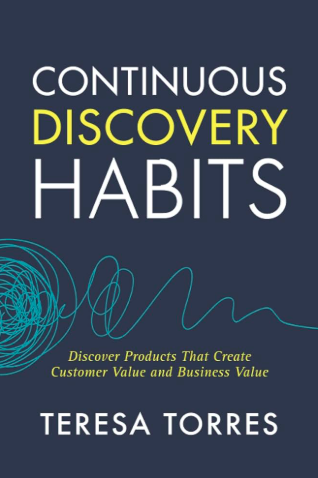
This research is what American practitioner Teresa Torres built into her method for product discovery: the phase of work where a team explores a problem and its possible solutions before committing to build anything. In Continuous Discovery Habits, published in 2021 and reread one chapter a month this year by the community she runs, for the book’s fifth anniversary, she devotes an entire chapter to what she calls “supercharged” ideation: a way of generating solutions that always starts alone, in writing.
The method is built for what Torres calls the product trio: the product manager, designer and engineer who own a decision together, rather than a lone product manager. Faced with an identified opportunity, a need or a frustration surfaced through customer interviews, each member of the trio first spends five to ten minutes writing, without discussing it with the others, a deliberately long list of possible solutions: fifteen to twenty ideas, allowing for the wildest ones, looking at what unrelated products do, imagining users with extreme needs. Only after this individual time does the trio share, compare and recombine.
Those lists then feed the opportunity solution tree, or OST: a diagram that visually connects a goal, the identified opportunities and the candidate solutions, to avoid jumping straight from a goal to a single solution. It is the tool Torres popularized to structure product discovery over time, rather than through a string of isolated meetings.
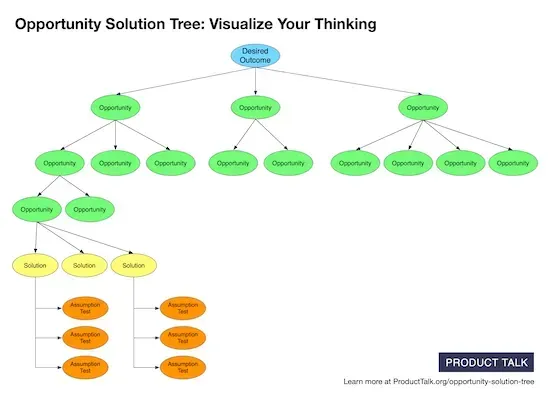
Illustration: the opportunity solution tree diagram (Product Talk), the tool Teresa Torres uses to visually map these options before testing them.
Comparing, rather than deciding yes or no
This shift changes the very nature of the decision. A team that starts from a single idea asks a binary question: do we build it, yes or no? A team that lines up twenty ideas side by side asks an entirely different question: which one best serves the opportunity? Torres calls this the shift from a “whether or not” decision to a “compare and contrast” one. The distinction sounds semantic. It is not. The first question invites people to defend their idea in front of the group. The second invites people to weigh a set of options against shared criteria, which moves the conversation away from ego and back toward the opportunity itself, and raises, along the way, the broader question of who decides what inside a product trio (in French).
For an organization, the stakes go beyond the quality of a single work session. The solutions that land in the backlog, the often long list of tasks and features a product team has identified but not yet built, are, most of the time, whatever idea came to mind first, never tested against alternatives. Systematically widening the range of solutions before choosing does not slow the decision down: it simply makes it less arbitrary, less dependent on whoever spoke first, or loudest, in the room. Seen from that angle, it is also another way of approaching prioritization, the moment when a team has to choose what to build first among everything it could build.
The limits of a good idea
This discipline requires groundwork that few teams actually have: a steady rhythm of continuous discovery, with regular customer interviews that keep feeding new opportunities to explore. Without that raw material, supercharged ideation collapses into exactly what it is meant to avoid: a creativity exercise disconnected from reality. Torres herself lists the most common mistakes she sees among teams adopting the method: limiting ideation to a single session instead of returning to it repeatedly, or settling on an appealing solution without checking that it actually addresses the original opportunity.
The method has its blind spots too. Generating more ideas improves the diversity of the solution space ; it does nothing to guarantee the final choice is the right one. Once the options are compared, they still need to be tested before being built, something Torres treats as a distinct, non-negotiable step rather than a popularity vote. And the exercise, designed for a trio working at team scale, does not transfer as is to portfolio trade-offs or product strategy choices, which answer to different governance logics.
What comes next
One question the discovery community is only starting to explore: what happens to individual ideation once a member of the trio can lean on an artificial intelligence agent, a program capable of carrying out a series of tasks on its own, to generate their own list of options before the session even starts? Nothing, at this stage, seriously documents the effect of that practice on the quality of the solutions teams end up choosing ; the hypothesis is circulating far more than it is being tested.
Which, in its own way, says a great deal about where the durable signal sits in this story: less in a tool than in the discipline it would help restore, a discipline backed by forty years of research and still remarkably rare in meeting rooms.
Sources
- Let’s Read Continuous Discovery Habits Together (July 2026), chapter 8: Supercharged Ideation · Product Talk (Teresa Torres)
- Opportunity Solution Trees: Visualize Your Discovery to Stay Aligned and Drive Outcomes · Product Talk (Teresa Torres)
- Brainstorming · Wikipedia (cross-check of Diehl and Stroebe’s research on production blocking)









 CC BY-SA 4.0