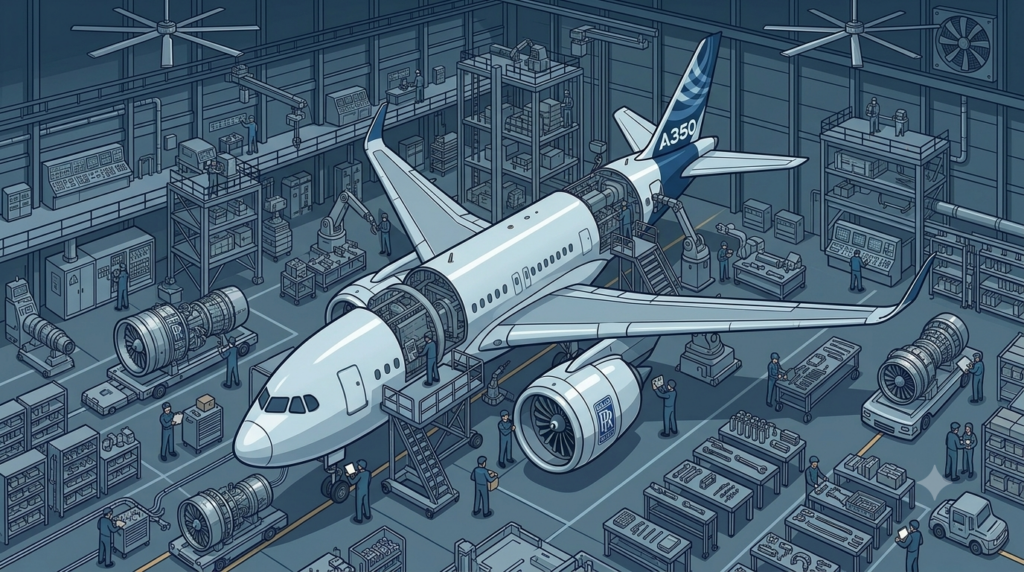
In 1962, Rolls-Royce stopped selling aircraft engines. Not quite: the company kept building them, but it stopped billing them as objects. Instead, it offered airlines the option to pay by the flying hour, a contract it named Power by the Hour. The customer no longer bought a piece of metal, it bought availability and reliability. The reversal is quiet and total. As long as Rolls-Royce sold engines, it made money on every breakdown, since a breakdown is repaired and invoiced. The day it started selling flying hours, a breakdown cost it money, and it suddenly had every reason in the world to maintain and keep improving the engine it had placed under the wing. Same object, same shed, but a reversed interest.

That story is more than sixty years old, and yet it describes exactly what happens to you today when you pay a subscription. We long believed that a subscription was a matter of payment cadence. It is a matter of the object of the contract, and that object has changed in nature.
From the owned object to access to the latest
Thirty years ago, owning was the symbol. You bought a record, and it was yours, fixed, exactly as it left the factory. You bought an encyclopedia on CD, a boxed piece of software every three years, a road atlas you replaced when the roads had changed too much. Owning a unique, perishable object was the sign of the freedom and purchasing power a consumer sought. Today, what we want is no longer to own the record, it is to access the most recent catalogue. It is no longer the atlas, it is the map that corrects itself while we drive. It is no longer the software box, it is the service that updates without our thinking about it. Even at the climbing gym, we no longer pay for access to the walls, we expect the routes to be reset on a regular basis. Ownership matters less than access to the most up-to-date product.
This shift was seen coming from far off. As early as 2000, the essayist Jeremy Rifkin announced in The Age of Access that we would increasingly pay for the use of things, in the form of subscriptions, memberships and leases, rather than for the things themselves, and that ownership would become almost a burden. Twelve years later, the researchers Fleura Bardhi and Giana Eckhardt gave the phenomenon a scholarly name in the Journal of Consumer Research, access-based consumption. What Rifkin had guessed, a generation made ordinary.
Two factories, two logics
For an executive, what matters is not the consumer’s change of taste, it is the change of factory it imposes. The old factory turns out objects one by one. A car, a phone, a computer, each built, sold, delivered, then abandoned to its ageing. The model was long bound up with planned obsolescence: since the object, once sold, no longer earns anything, the maker has no interest in improving what you own, and sometimes an interest in its going out of fashion, so as to sell you another.
The new factory does not do that. It does not turn out a thousand units, it transforms a single one, living, shared by all customers at once. It corrects it, augments it, strips out what no longer serves, and above all it tests its ideas directly on its users. This is not a figure of speech: in the large digital companies, continuous experimentation has become the norm. The authors of Trustworthy Online Controlled Experiments, practitioners from Google, LinkedIn and Microsoft, report that these companies each run more than twenty thousand controlled experiments a year, on platforms built so that the cost of one more test falls almost to zero. The factory no longer makes a finished product, it runs a product that is never finished.
This is where the impact factory takes on its full meaning. The subscription is the standing order the customer places with that factory. It holds only as long as the factory produces. The day it stops, the order falls.
The real contract: a flow, not a stock
What the customer now buys is not a stock, a thing owned at a given instant, but a flow, a continuously renewed stream of value. This idea goes by two names depending on the door you come in through. On the software and services side, Tien Tzuo, founder of Zuora, coined in 2007 the phrase subscription economy, and he sums up the customer’s new expectation in a formula that could be yours: we want constant improvement, not planned obsolescence. On the industry side, the researchers Vandermerwe and Rada had named the same movement back in 1988, servitization, the moment a manufacturer sells the integration of a product and a service rather than the product alone. Rolls-Royce, again, is its emblem, even if the idea was born at Bristol Siddeley, which the engine maker would absorb a few years later.
The common thread of the two is the realignment of the producer’s interest with the customer’s. When I sell you an object, I gain by selling you another. When I sell you access that has to be renewed, I gain only if you keep drawing value from it. My interest stops being your repurchase, it becomes your satisfaction over time. It is the same tilt as Rolls-Royce in 1962, carried over to almost everything we consume.
Still, the producer had to be forced into it. As long as supply was scarce, the firm lived in a seller’s market, where a good product sold itself and the customer took what they were given. When supply finally outran demand, the market became a buyer’s market, and the customer gained the power to leave. Peter Drucker had set it down as early as 1954: the purpose of a business is to create a customer, not to move an object. Rolls-Royce did not have a moral revelation, it read a balance of power.
The good is now just a vehicle
It remains to understand how an owned object can carry a flow, when it was bought once and for all. The answer holds in one word: the good becomes a platform. It stops being an end and becomes a base on which a bundle of services is sold and delivered over time. The smartphone made this shift first, to the point where making a call became one app among hundreds. What the old world sold as a finished, closed product is now an open base, onto which things are added, removed, billed.
The idea is not new, it is in fact a classic every executive knows. In 1960, in Marketing Myopia, Theodore Levitt explained that the railroads had declined not because transport was shrinking, it was growing, but because they thought themselves in the railroad business when they were in the transportation business. His line has stuck: people do not want a drill, they want a hole. The good is only a means, the service rendered is the end.
In 2004, the researchers Stephen Vargo and Robert Lusch made this the foundation of what they called service-dominant logic: at bottom, every exchange is an exchange of service, and the good is merely a distribution mechanism for that service. Modern product management has even made it its framing tool, the job to be done popularised by Clayton Christensen: a customer does not buy a product, they hire it to make progress, and the task is to name that progress, that is the service expected, before drawing the object that will deliver it. Modern product management lives entirely inside this inversion, since it judges a product by its impact, that is by the service it renders, before judging it by what it is. That is the very definition of an impact factory, service-oriented by construction.
Tesla, the point of convergence
The Tesla is where the platform and the flow meet in a single object, and that is why it is the most telling example. It is not a car that happens to have software options, it is a service platform on which getting from A to B is only one of the services, alongside self-driving, connectivity or entertainment. The industry has even coined a name for this, the software-defined vehicle, and the firm Deloitte warns that the days of the carmaker as a mere hardware manufacturer are numbered. You buy the car, it is yours, an owned and perishable object as in the old world. But you subscribe to its evolution. Premium connectivity costs about ten dollars a month. Supervised self-driving leases for around ninety-nine dollars a month, and since February 2026 Tesla has even removed the one-time purchase of that feature: it now exists only as a subscription. Between two payments, the car parked in your driveway receives over-the-air updates that add functions to an object you thought was frozen on the day you bought it.
The regular reader of these pages will smile: it is the same Fremont plant we recently described as having learned, then unlearned, the art of organising work. Here it is selling the product and its own improvement in a single gesture. The object and the flow in one contract.
Where the promise is paid for
We have to be honest about what this model costs, otherwise it turns into a slogan. Two things resist.
The first is that making a product evolve without complicating it is anything but automatic, it is in fact the whole difficulty. We think we add value by adding features, and mostly we add complexity. The reason is almost arithmetic: the number of interactions between features grows as the square of their number, so doubling the functions quadruples the cases that must coexist. The computer scientist Larry Tesler captured it in the 1980s with his law of conservation of complexity: a product carries an irreducible complexity that can only be moved, from the user to the designer or the reverse, never removed. The trade even has a word for the disease, feature bloat, the moment a product becomes so rich that no one can use it. The right formulation, then, is not to add features while keeping things simple, it is to add capability while holding, or even lowering, complexity. Which means removing as much as adding. It is a discipline, not a happy consequence of shipping often.
The second is that a counter-current exists, and it is rising. Japan has coined a word for subscriber fatigue, sabusuku-tsukare. Analysing data at the scale of ten million people, the daily Nikkei described users sorting their subscriptions with a new severity, cancelling the moment a month goes by without their using one. On the vendor side, the company 37signals launched in 2023 a line of software called ONCE, whose principle is to pay once and own forever, in open rebellion against the perpetual subscription. There is even a Japanese notion for the trap this counter-current targets, the illusory LTV: those customers who stay not because they draw value but because cancelling is a hassle. Retention obtained through friction is not an asset, it is a debt that comes due the day cancelling becomes easy.
Two products, two sets of stakes
Hence a nuance that the nature of your product should settle, rather than fashion. Take a product whose value does not evolve much, a simple utility that does one stable thing well. Forcing a subscription on it means exposing yourself head-on to fatigue, because the customer does not see what they are paying for each month. For that product, stability is the value, and a one-time sale or some hybrid is sometimes more honest than a forced subscription.
Take, conversely, a product where each evolution opens a real competitive advantage, which is the case for products built on artificial intelligence wherever it genuinely adds value. Here, not evolving means dying, because a competitor’s improvement compounds on itself, data after data. Tesla claims exactly this reading for its self-driving, which it describes as a continuously improving AI service rather than a finished feature, and whose price, the company warns, will rise as capability grows. For that product, the subscription is not a billing convenience, it is the natural form of a value built without end.
The mistake would be to treat the two the same way, slapping a subscription onto everything out of imitation. The model must fit the nature of the product, not the other way round.
The diagnosis to run on Monday morning
An executive who wants to know where they stand, and whether to enter this model, can ask five simple and formidable questions. First: does each new version give the customer a reason to renew this month, or only a reason not to bother cancelling? Second: does my retention rest on the value I deliver, or on the friction I impose? Third: does my product’s value compound with iteration, as with AI and data, or does it plateau once the need is met? Fourth: am I still steering my product as a good to be delivered once, or as a platform whose services I must orchestrate over time? Fifth, the most brutal: if I removed the subscription tomorrow, would my customers rebuy the latest version, or keep the old one forever?
The answers sketch the real nature of the product, and therefore the model it deserves. Above all they separate continuous value from inertia rent, which look alike on a dashboard and have nothing in common over time.
Rolls-Royce had understood it in 1962: selling the flying hour rather than the engine means promising something every day, and therefore having to deliver it every day. The difference, in 2026, is that the customer now audits that promise every month, finger on the cancel button. The factory that stops producing no longer loses a sale, it loses the standing order. And an impact factory is judged precisely on that: not on what it delivered once, but on what it still produces.
Sources
- Power by the Hour: Can Paying Only for Performance Redefine How Products Are Sold and Serviced?, Knowledge at Wharton
- Sandra Vandermerwe and Juan Rada, “Servitization of Business: Adding Value by Adding Services”, European Management Journal, 1988
- Tien Tzuo and Gabe Weisert, Subscribed, Portfolio, 2018; term “subscription economy” coined in 2007
- Theodore Levitt, “Marketing Myopia”, Harvard Business Review, 1960
- Peter F. Drucker, The Practice of Management, 1954 (“the purpose of a business is to create a customer”)
- Clayton M. Christensen, The Innovator’s Solution, 2003, and Competing Against Luck, 2016 (jobs-to-be-done theory)
- Stephen L. Vargo and Robert F. Lusch, “Evolving to a New Dominant Logic for Marketing”, Journal of Marketing, 2004
- Jeremy Rifkin, The Age of Access, Tarcher/Putnam, 2000
- Fleura Bardhi and Giana M. Eckhardt, “Access-Based Consumption: The Case of Car Sharing”, Journal of Consumer Research, 2012
- Larry Tesler, law of conservation of complexity (a product’s complexity is irreducible, it can only be moved), 1980s
- Ron Kohavi, Diane Tang and Ya Xu, Trustworthy Online Controlled Experiments, Cambridge University Press, 2020
- 37signals Introduces ONCE, 37signals, 2023
- Subscription fatigue and the sorting of services (data analysis), Nikkei, 2022
- Connectivity and Full Self-Driving (Supervised) Subscriptions, official Tesla pages
- The software-defined vehicle revolution, Deloitte