Companies have spent tens of billions of dollars putting artificial intelligence to work, and most have reaped nothing. A 2025 MIT study did the maths: across enterprise generative-AI projects, 95 percent produce no measurable return. Five percent do, pull away from everyone else, and turn every use into an advantage that compounds over time. Between the two, a gap that widens rather than closes, because in a race where the fastest learner leads, falling behind does not get easier to fix, it gets worse.

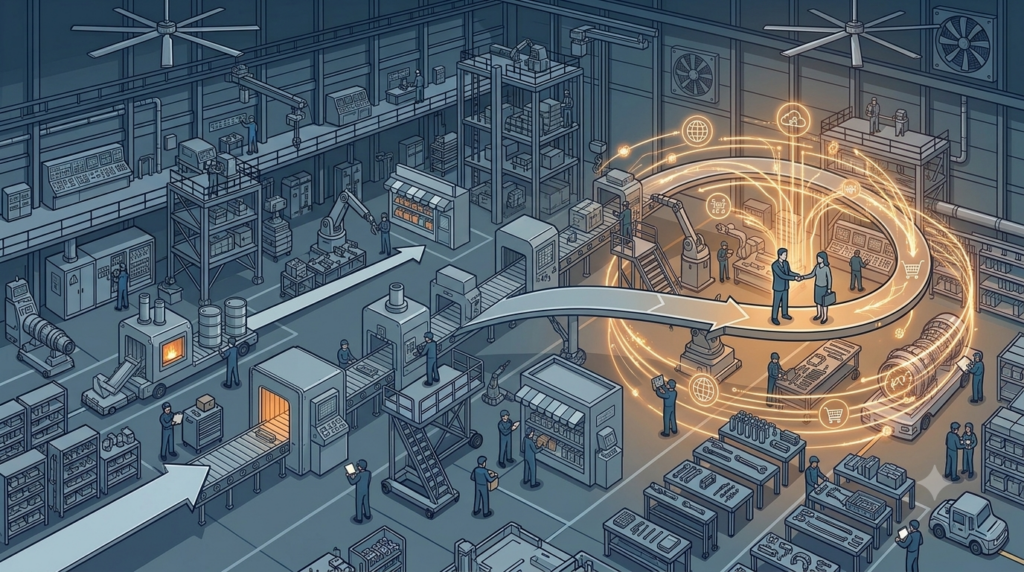
We usually blame the technology, the models too weak, the data too messy, the skills too scarce. That is the wrong trial. The same study is categorical: the cause of failure is not technical, it is organizational. You will not fail because of artificial intelligence, you will fail because your company stayed a line when it needed to become a loop. This dossier explains that sentence, and what truly separates the 5 percent from the 95 percent. It begins with a map almost every executive carries in their head, and almost no one has updated.
the cause of failure is not technical, it is organizational
The map you are still following
In 1985, in Competitive Advantage, Michael Porter drew a figure that would become the thinking tool of a whole generation of executives: the value chain. A company is seen as a sequence of activities that add value one after another, from inbound logistics through to marketing and sales, with after-sales service right at the end, as the last primary activity. Value is added as you walk down the line, and the margin is collected at the exit. It is clean, it is linear, and it stayed forty years in the minds of leadership teams.

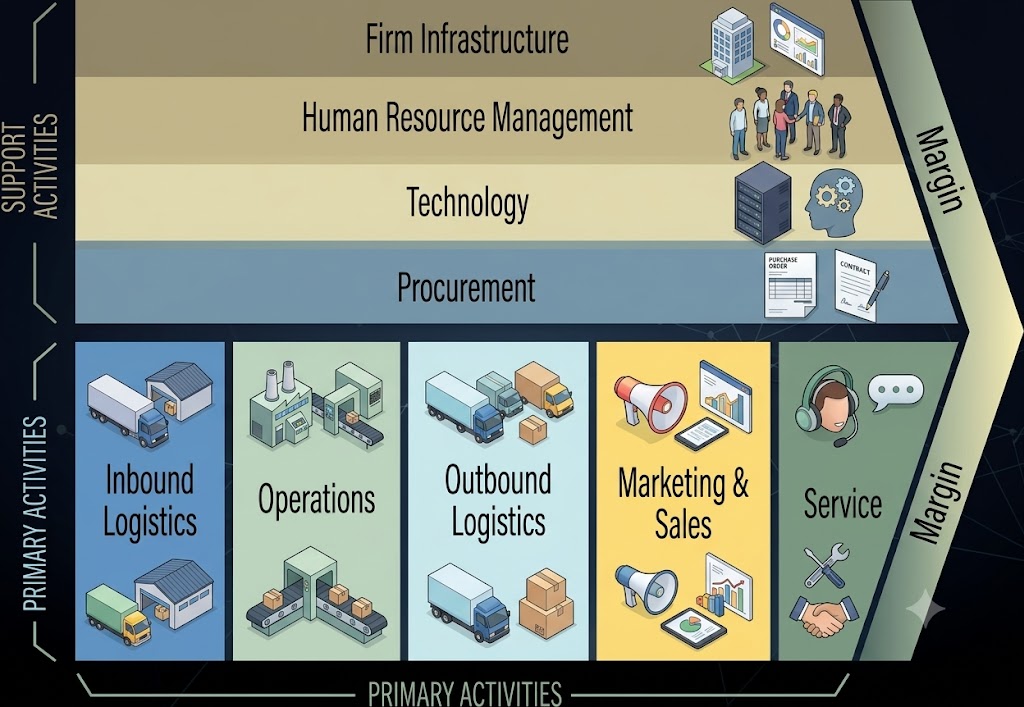
In 2014, in the Harvard Business Review, the same Porter wrote, with James Heppelmann, that this line no longer holds. Products that have become smart and connected, he argued, disrupt value chains and force companies to rethink almost everything, from design to service. The master revises his own map. And at the end he asks the question Levitt was already asking in 1960: at bottom, what business am I in? This is the first sign of the failure to come: when the author of a model corrects his own map, and so many companies keep following it, unchanged.
Take Porter’s line in its original logic. You buy components, you transform them, you distribute them, you sell them, and service comes only afterward, as a repair or a warranty, a comet’s tail attached to the delivered object. The sale is the terminus. That is where value freezes, where the margin is counted, where the relationship, often, ends. The whole model points toward that exit.
The product we discuss in this review reverses that direction of travel. When the good becomes a platform that receives updates, when the customer pays a subscription that must be re-earned every month, as we showed in the piece on subscription, the sale stops being the terminus and becomes the starting point. You no longer deliver a finished product at the end of a line, you open a relationship that then feeds on usage, on data, on tests run on users. The chain closes back on itself. The line becomes a loop (impact factory loop all explained here).
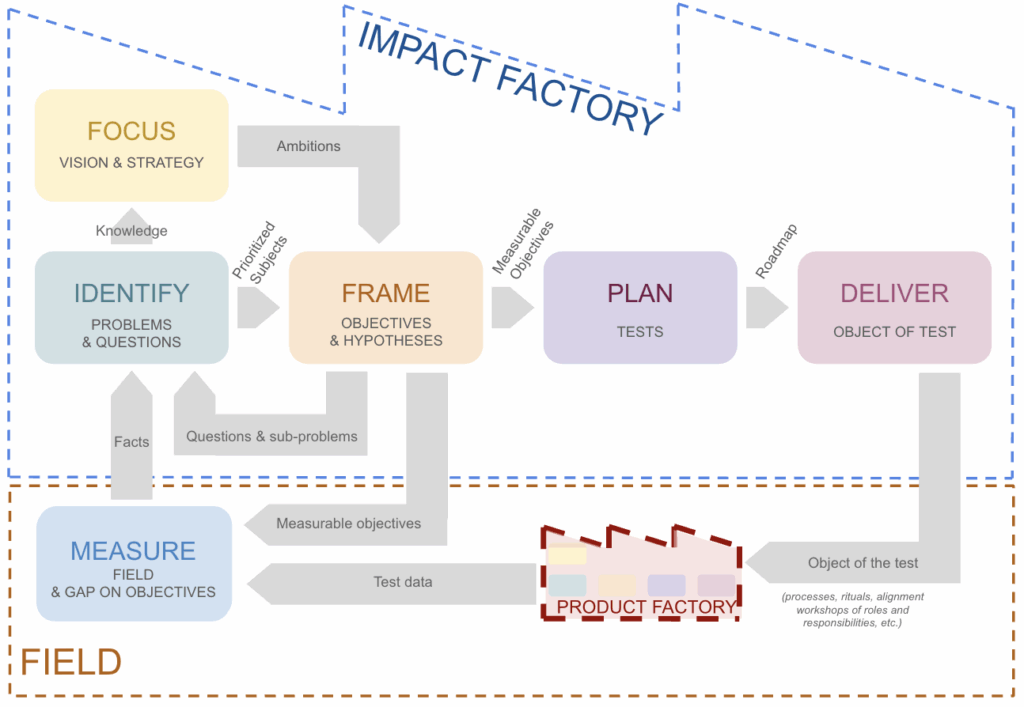
This is not a convenient metaphor, it is what Porter and Heppelmann describe in black and white in their 2015 companion article. Connected products, they write, require an entirely new technology infrastructure, a product cloud, software running on remote servers that keeps making the object evolve after purchase. And above all, the ability to stay connected to the product and track its use shifts the center of the customer relationship, from the one-time sale toward a continuous relationship. Translated into the vocabulary of this review: the sale is no longer the end of the chain, it is the start of the standing order placed on the factory.
From the product that works to the product that serves
This loop would be a mere engineer’s curiosity if it did not answer a deeper change, the change in what we expect from a product. Those who fail stop at the first definition of a good product, the one that works. For a long time, a good product was a conforming product: it did what the spec sheet promised, it did not break down, it passed the tests. Professor David Garvin, in the Sloan Management Review of 1984, called this quality seen from the manufacturing side, conformance to specifications, an internal measure taken inside the factory before the customer even uses it. Alongside it he placed another definition, quality seen from the use side: a product is good if it delivers the service expected by the person who uses it and satisfies them in their real life. Joseph Juran had summed up this second view in a line that has stuck, quality is fitness for use.
What these three articles describe is the shift from the first to the second (artice 1, article 2, and this article). We no longer judge a product first by what it is, an object that works, but by what it produces in its user, an impact. And that impact, unlike conformance, is not established once and for all as the product leaves the factory: it is measured over time, through use, which is exactly what forces the line to close into a loop so that we can go and find it. Performance questioned the object; impact questions the life of the person who uses it. That is, precisely, what the name impact factory means.
When the map starts to shake
To believe the map has not moved is already to stand with the 95 percent. Porter was not the first to feel the line wobble. As early as 1993, in the Harvard Business Review, Richard Normann and Rafael Ramírez published a text with a title like a manifesto, “From Value Chain to Value Constellation”. Their thesis: in a fast-moving environment, strategy is no longer about positioning a fixed set of activities along the old industrial model, but about reconfiguring the roles and relationships of a constellation of actors. Their example is famous, IKEA, which does not merely add value but reinvents it by handing the customer part of the work, transport and assembly, turning the buyer into a co-producer. The customer enters the factory. The line becomes a network.
Twenty years later, another crack, more radical still. In 2016, again in the HBR, Marshall Van Alstyne, Geoffrey Parker and Sangeet Choudary set two worlds head to head, the pipeline and the platform. The pipeline, they say, is exactly the value chain: it succeeds by optimizing activities it owns and controls. The platform draws its value from an asset it does not own, the community of its members, and its work is no longer to control resources but to orchestrate them. Uber has no cars, Airbnb no rooms, and yet they capture value by animating the interactions between third parties. Their line is a knife into Porter: in the age of platforms, scale trumps differentiation. There, you no longer extend the chain, you set it beside another model.
And beneath these two cracks runs the same underground water, the one we already met with Vargo and Lusch’s service-dominant logic: value is not contained in the good and handed to the customer, it is co-created in use. Yet a value chain assumes exactly the opposite, value made inside the firm and transferred at the exit. Three frameworks, one conclusion: value has overflowed the pipe.
The trades change trade
Here is what the 5 percent rebuilt, and the 95 percent left intact. A shifting strategic model would be a matter for theorists if it did not come back down into the daily work of teams. And that is where the shift shows best: every major trade in the company has seen not its tools change, but the question it answers.
Product management used to answer the question “did we ship what was planned?”. It now answers “did it change anything for the user?”. Mik Kersten named this shift in Project to Product in 2018: a project is judged by milestones and stops when the tasks are done, a product is not finished until the day it leaves the market. Between the two, everything changes, the budget, the teams, the definition of success. And Teresa Torres, in Continuous Discovery Habits, turned needs discovery into a continuous practice, at least weekly touchpoints with customers, run by the team building the product. The product manager no longer delivers a plan, they hold a conversation that never stops.
Sales used to ask “will you sign?”. It now asks “are you succeeding?”. The change was so deep it gave birth to a whole trade. The term customer success was coined by Salesforce in the early 2000s, in response to the churn of the first software sold by subscription: when the licence gave way to the subscription, revenue moved from a one-time transaction to a commitment that must be re-earned endlessly. The consequence is measurable, and brutal for anyone still thinking in terms of a single sale. According to Forrester, about 75% of a vendor’s revenue comes on average from renewals and expansions, not from new customers. And acquiring one euro of new revenue costs on the order of twice what it costs to expand it within an existing customer. Hence a telling shift on the org chart, customer success moving under revenue leadership rather than under support: the customer’s success has become the engine of the top line. You can see it in a telling detail: yesterday’s salesperson signed the contract and moved on to the next account, whereas the one who succeeds them opens a usage dashboard every morning, spots the curve dipping on an account, and picks up the phone not to sell but to prevent a departure. The order book has given way to the dashboard.
Marketing used to ask “how do we get them?”. It increasingly asks “how do we make them worth keeping, so they pay again next month?”. The acquisition funnel has not vanished, but it has yielded the lead role to retention. This is the direct extension of the buyer’s market: when supply outruns demand and the customer can leave in one click, the ruling metric is no longer the number of leads captured, it is the share of revenue you keep and grow among existing customers. The marketing scoreboard has moved from before the sale to after it.
R&D, finally, used to ask “when is it done?”. It has learned to answer “it is never done”. Development has moved from a cycle that closes to continuous delivery, where you deploy constantly and where usage data feeds back into design. The laboratory has left its closed room to settle onto the living product, as we described with the tens of thousands of experiments run each year, in production, on the users themselves. The prototype is no longer a stage before the market, it is permanently on the market.
The boundary dissolves
Step back to see what these four shifts have in common, because it is the deepest point of the dossier. In Porter’s chain there is a clean boundary: on one side the firm, which creates value, on the other the customer, who receives it. The line runs from one to the other, and crossing the boundary is the sale.
That boundary is dissolving. When you test your ideas on users, when you interview customers every week, when you learn from usage to decide what to build, the customer is no longer at the end of the chain, they are inside it, co-producing the value they consume. This is exactly what Normann and Ramírez called mobilizing the customer in the creation of value, and what Vargo and Lusch set as a foundation: value arises in use, therefore with the one who uses. The value chain described a world where you knew where the company ended and the customer began. That world is closing. Producer and consumer now work in the same loop, and it is that loop, precisely, that an impact factory organizes.
You then understand why Porter did not throw away his chain but extended it. It remains true as a description of activities and costs. It becomes misleading the moment you read it as a one-way direction of flow, from inputs to the sale. The right move is not to tear it up, it is to bend it until its two ends meet.
When the loop learns on its own
Everything so far was thought through without artificial intelligence. It does not change the direction, it accelerates it, and it punishes those who ignored it. Where the impact factory ran a loop turned by humans, AI turns the loop itself. Marco Iansiti and Karim Lakhani, of Harvard, named it the AI factory, a decision core that ingests data, trains algorithms, and where each interaction improves performance. The bar of impact rises accordingly: since prediction becomes cheap, as the economists Ajay Agrawal, Joshua Gans and Avi Goldfarb show, the customer no longer expects a product that serves them, they expect a product that anticipates them. And each use is no longer mere feedback, it is data that trains the product for everyone. The customer no longer turns inside the loop, they train it.
the AI factory, a decision core that ingests data, trains algorithms, and where each interaction improves performance
But we must not believe AI is free. What becomes almost free is a unit of output, a line of code, a draft, never the system, which is heavy in capital, compute and energy. The electricity demand of data centres, of which AI is the main driver, is set to double by 2030, according to the International Energy Agency. It exposes nearly 40 percent of jobs and risks worsening inequality, warns the International Monetary Fund. And it rarely pays: the 95 percent of failures cited at the outset are explained not by the models, but by companies grafting AI onto an organization that was never built for it.
This is where the three articles close, and where it becomes clear who can truly welcome AI. An impact factory tracks its value flow, measures it, and keeps making it evolve: it therefore already holds everything AI needs to accelerate, an instrumented loop, clean usage data, and the habit of learning from what it observes. There, AI plugs into a machine that was already running, and makes it run faster. In the company that stayed a line, that celebrates the sale and relegates service to the caboose, that never measures what it produces in the user, AI has nothing to plug into: it automates the disorder instead of resolving it, as Tesla over-automated Fremont before learning to organize the work. AI does not build the impact factory, it presupposes it. It is an accelerator, and an accelerator only serves those who already know where they are going. The others join the 95 percent. Because the one thing AI does not automate is impact itself.
AI does not build the impact factory, it presupposes it. It is an accelerator, and an accelerator only serves those who already know where they are going.
The diagnostic for Monday morning
To know which side of the divide you are on, the 5 percent or the 95 percent, ask yourself four simple and uncomfortable questions. First: does my value chain end at the sale, or begin there? In other words, do my efforts and budgets concentrate on the moment of signature, or on what happens afterward?
Second: who, in my company, is responsible for the customer’s success once they have paid, and does that person hold real power, or are they after-sales support in disguise? Third: do the teams building the product talk to customers every week, or once a quarter when the damage is done? Fourth, the most disturbing: if I look at where the money I make comes from, does it come mostly from new customers I tear away at great cost, or from long-standing ones who stay because they succeed with me? To these four, the era adds one: am I expecting AI to repair an organization I have not yet rebuilt?
The answers say in a word which side of the divide you are on. And they do not lie, because they bear on budgets, roles and powers, not on intentions.
The map, the order and the factory
This dossier closes a trilogy. We first argued that the organization is not an org chart but the production tool, the factory itself. We then showed that the customer no longer pays for an object but for a standing order placed on that factory, and that the owned good becomes a platform for services. It remained to look at the map executives use to think about themselves, the value chain, and to find that it has changed shape under the pressure of the first two moves.
Porter redrew his map because the product had changed nature. Service is no longer the last activity, it is the whole loop; the sale is no longer the exit, it is the entrance; and the customer is no longer at the end of the pipe, they work inside it. An impact factory is nothing other than this, an organization that understood its value chain formed a loop and set about turning with it. It, and it alone, is the one that artificial intelligence will make run faster. The others, still following a line, will spend fortunes automating a disorder, and watch their competitors build a lead that compounds. You will not fail because AI is too weak. You will fail if your value chain stayed a line. The cure cannot be bought, it has to be built, and it has a name: close the line into a loop.
Sources
- Michael E. Porter, Competitive Advantage, Free Press, 1985 (the value chain)
- Michael E. Porter and James E. Heppelmann, “How Smart, Connected Products Are Transforming Competition”, Harvard Business Review, November 2014
- Michael E. Porter and James E. Heppelmann, “How Smart, Connected Products Are Transforming Companies”, Harvard Business Review, October 2015 (product cloud, one-time sale to continuous relationship)
- Richard Normann and Rafael Ramírez, “From Value Chain to Value Constellation: Designing Interactive Strategy”, Harvard Business Review, 1993
- Marshall W. Van Alstyne, Geoffrey G. Parker and Sangeet Paul Choudary, “Pipelines, Platforms, and the New Rules of Strategy”, Harvard Business Review, April 2016
- Stephen L. Vargo and Robert F. Lusch, “Evolving to a New Dominant Logic for Marketing”, Journal of Marketing, 2004 (value co-created in use)
- David A. Garvin, “What Does Product Quality Really Mean?”, Sloan Management Review, 1984 (manufacturing-based vs user-based quality)
- Joseph M. Juran, “quality is fitness for use”
- Mik Kersten, Project to Product, IT Revolution, 2018 (from project to product, Flow Framework)
- Teresa Torres, Continuous Discovery Habits, 2021 (weekly customer touchpoints, outcomes over outputs)
- Theodore Levitt, “Marketing Myopia”, Harvard Business Review, 1960 (“what business am I in?”)
- Customer success: term coined by Salesforce in the early 2000s in response to churn in the first subscription software; share of revenue from renewals and expansions (about 75%) reported by Forrester; acquisition-vs-expansion cost ratio reported by Benchmarkit via the SaaS trade press
- Marco Iansiti and Karim R. Lakhani, Competing in the Age of AI, Harvard Business Review Press, 2020 (the “AI factory”)
- Ajay Agrawal, Joshua Gans and Avi Goldfarb, Prediction Machines, Harvard Business Review Press, 2018 (AI as a drop in the cost of prediction)
- Mik Kersten, Output to Outcome, IT Revolution, 2025 (impact becomes the constraint in the age of AI)
- International Energy Agency, Energy and AI, 2025 (data-centre electricity demand)
- International Monetary Fund, “Gen-AI: Artificial Intelligence and the Future of Work”, 2024 (40% of jobs exposed)
- MIT Project NANDA, “The GenAI Divide: State of AI in Business 2025” (95% of projects with no measurable return)