
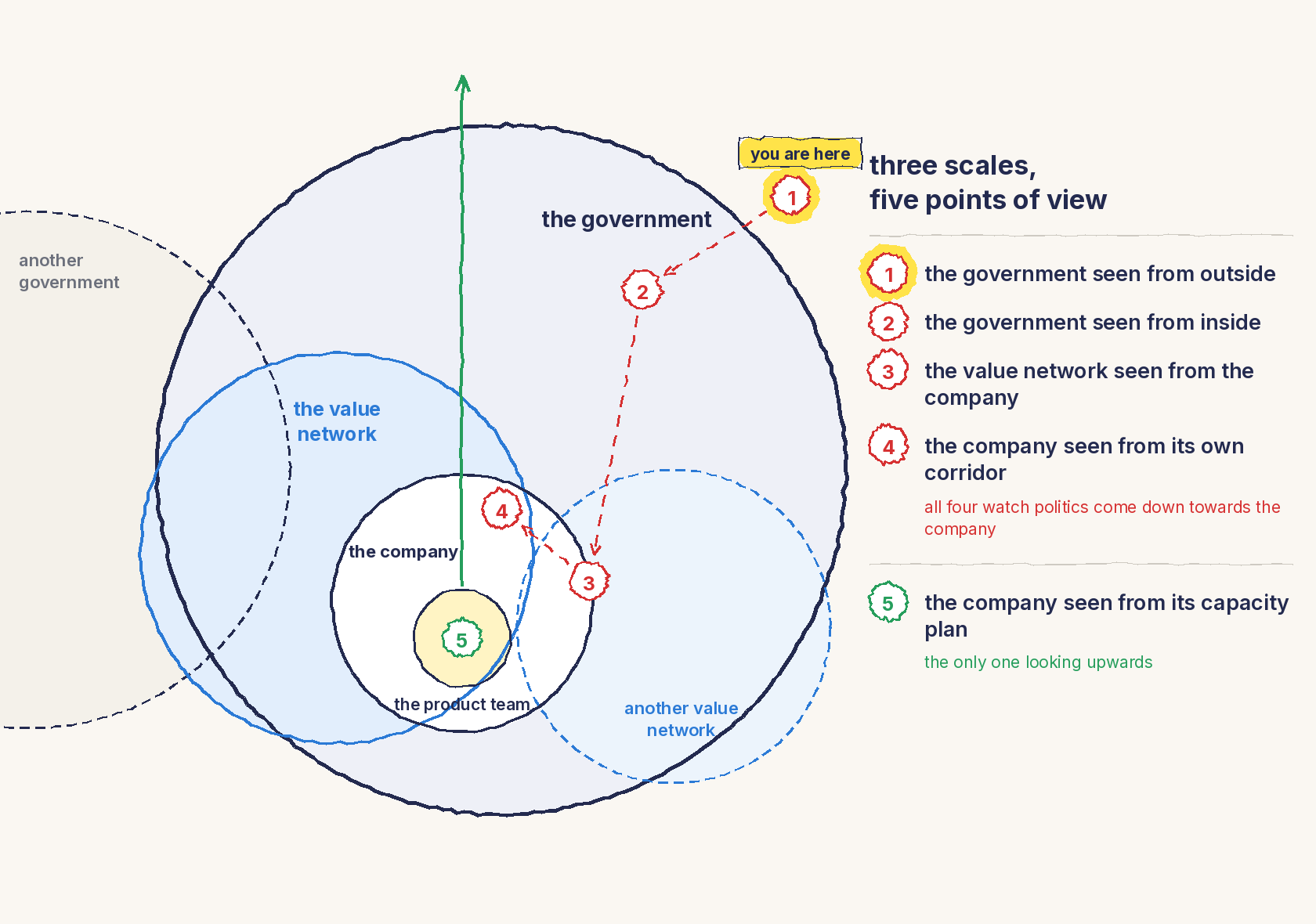
Third episode of a seven-episode series on the weight of politics in the success of a product. The first two picked up the trace of the state, then put it to the test. What is left are today’s champions, the ones that should owe nothing to anyone.
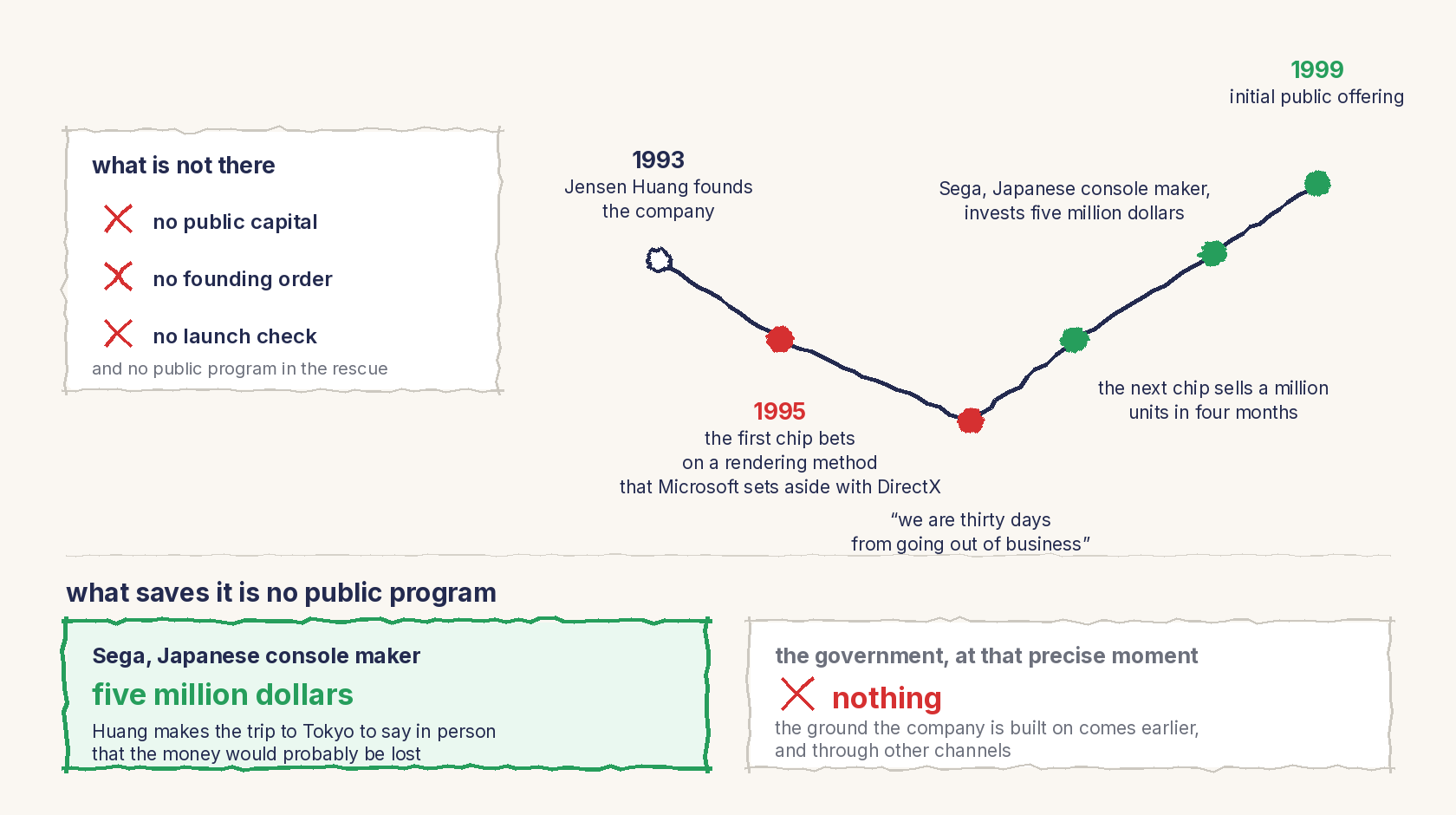
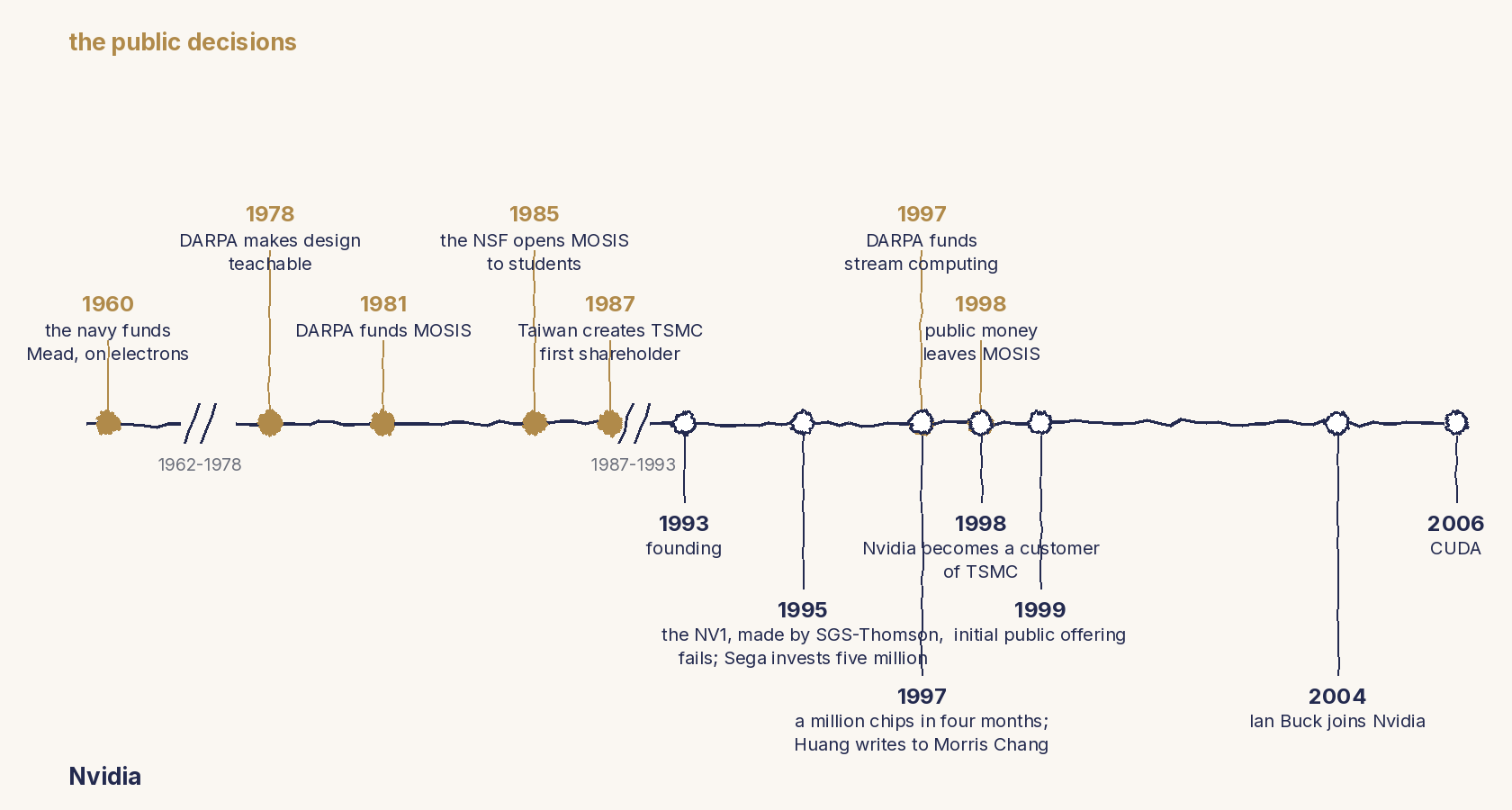
Today’s champions, the ones that built empires in twenty years, owe nothing to anyone. Are we sure about that? Take the case most favorable to the claim, Nvidia. No public capital, no founding order, no launch check. Jensen Huang founded the company in 1993, and it came close to dying before its fifth birthday. Its first chip, released in 1995, bet on a rendering method that Microsoft set aside by imposing its own with DirectX. The company came so near to closing that it kept an unofficial motto out of it: we are thirty days from going out of business. What saved it was no public program. It was Sega, a Japanese console maker, which invested five million dollars after Huang had made the trip to Tokyo to tell them in person that the money would probably be lost. The next chip sold a million units in four months, and Nvidia went public in 1999.
Software, not the graphics card
What makes Nvidia irreplaceable today is not the graphics card of 1999, it is the software that lets you use it to compute something other than images. And that software was not born at Nvidia. In the early 2000s, at Stanford, a doctoral student named Ian Buck wired thirty-two GeForce cards together, Nvidia’s own, first to push Quake and Doom beyond what his machine could manage, then to answer a question that had nothing to do with games: can chips designed to paint pixels compute something else?
Buck built Brook there, a programming language that treats the graphics card as a general-purpose calculator, capable of any computation and no longer only of drawing images. His Stanford laboratory lived on private money, from IBM, Sony, ATI and Nvidia, and on federal money, from DARPA and the Department of Energy. Nvidia hired Buck in 2004. With John Nickolls, at Nvidia, he turned Brook into CUDA, the software that lets these cards be programmed to compute something other than images, and that would make them irreplaceable twenty years later.
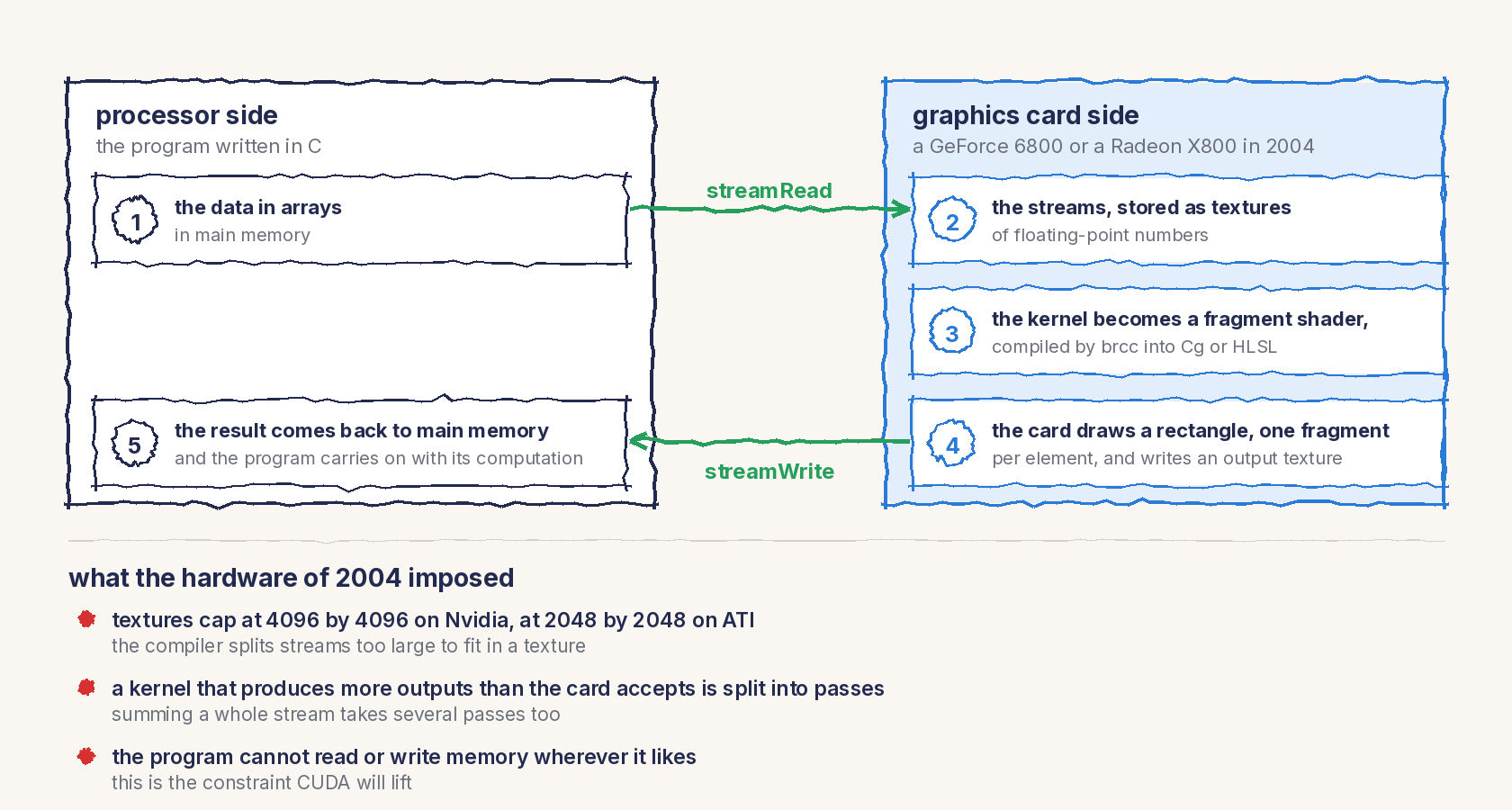
For readers who like the machinery: Brook treats the card’s memory as a data warehouse rather than as an image. Streams are stored there as textures of floating-point numbers, the kernel is compiled into a fragment shader, the small program the card normally runs to compute the color of a pixel, and the computation is triggered by drawing a rectangle: one fragment per element of the stream. Only two instructions move the data, streamRead to push it onto the card and streamWrite to bring the result back into main memory, where the program takes over again. The hardware imposed its limits: a texture caps at 4096 by 4096 points on Nvidia and at 2048 by 2048 on ATI, a kernel that produces too many outputs is split into several passes, and the program cannot read or write memory wherever it likes. That last constraint is the one CUDA would lift, by giving the programmer a vast set of execution threads and free access to memory. Brook itself was not specific to Nvidia: the 2004 paper measures its performance on a GeForce 6800 still in preview and on an ATI Radeon X800.
The chain projected to the National Science Board
Bill Dally went to tell this story to the National Science Board on 23 July 2025. Nvidia’s chief scientist projected a timeline whose title announces the cooperation between government, university and industry in Nvidia’s history, starting from a parallel machine funded by DARPA in 1983, passing through stream computing in 1997 and through Brook, and arriving at CUDA in 2006. The chain he draws is not a row of boxes: public funding leads to university research, which produces two things at once, trained people and technology, and those two branches meet on two outcomes, large companies and the country’s technological leadership. His last slide sums it up in one line: federally funded university research plants the seeds of industrial success and of that leadership.
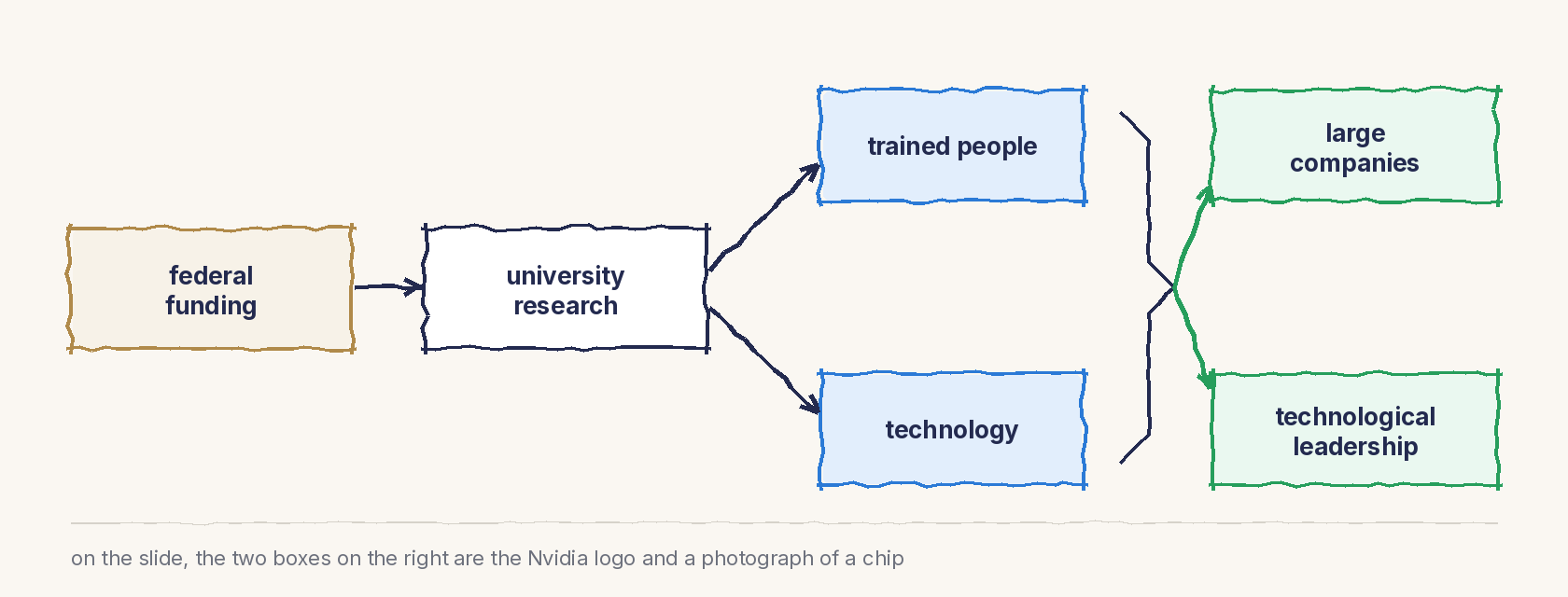
That chain reaches Nvidia in 2004, five years after the initial public offering. So the government straightened nothing out: it supplied material to a company that was already doing well.
The company therefore owes nothing to anyone, except the ground it is built on, and that is where it gets interesting, because the ground is quickly forgotten. Nvidia owns no plant. It designs chips and has them manufactured elsewhere, and that trade did not exist before governments built it.
Carver Mead, and the refusal of American industry
Carver Mead teaches at the California Institute of Technology. He works on the passage of electrons through very thin barriers, the basic physics of components, and it is that work the American navy funds. One day in 1960, Arnold Shostak, of the Office of Naval Research, walked into his office, asked him what he was doing, and offered him a grant. Four pages of proposal later, he received 30,000 dollars, enough to equip a laboratory, hire a technician and pay a doctoral student.
He teaches as well. In the early 1970s he opened circuit design courses at Caltech, and watched students complete projects with nothing more than the basics of the trade. In the middle of the decade, with Lynn Conway, at Xerox’s research center in Palo Alto, he looked for simplified methods. Conway invented drawing rules that carry over from one generation of chips to the next, and the result separated two trades that had until then been one: the designer no longer needs to know the manufacturing process, he only has to follow a few rules. That left the question of who would etch those drawings. So, in the middle of the 1970s, Mead called for plants that would agree to manufacture other people’s designs instead of keeping everything under their own roof, which he called silicon foundries.
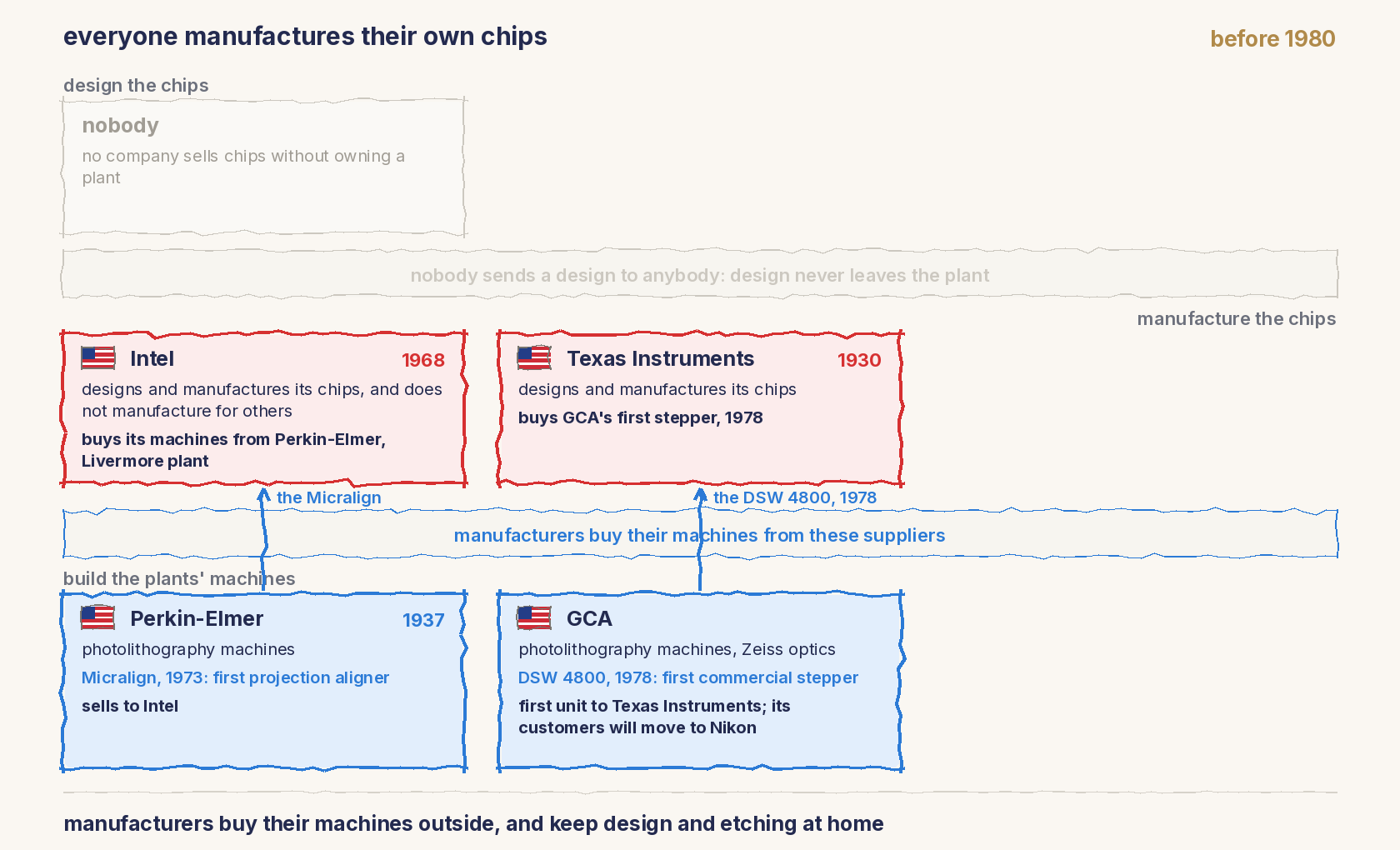
American industry would have none of it. The trade magazine that gave him its award in 1981 describes the rejection by most of a skeptical sector. Mead recounts that Andy Grove, then head of Intel, even accused him of undermining Intel’s position in the industry.
What Mead was asking for, the industry already practised one notch further up the chain. No plant has ever built its own machines: it buys them from specialists, and the supplier changes with the era. Perkin-Elmer, founded in 1937, launched the Micralign in 1973, the first projection aligner, which went into Intel’s Livermore plant among others. GCA sold the first commercial stepper in 1978, the DSW 4800, with Zeiss optics, the first unit going to Texas Instruments. Nikon, founded in 1917, released the NSR-1010G in 1980, bought first by NEC and Toshiba, then by IBM, Intel, Texas Instruments and AMD. ASML was born in 1984 from a joint venture between Philips and ASM International and launched its first system the same year, the PAS 2000 stepper, then in 1991 the PAS 5500 platform that brought it its first large customers, in 2001 the TWINSCAN, and delivered its first extreme ultraviolet prototype in 2010. Applied Materials, founded in 1967, introduced the Precision 5000 in 1987, a multi-chamber vapor deposition machine that entered the Smithsonian in 1993. Buying part of one’s production outside was therefore nothing new: manufacturers already did it for their machines. Mead proposed going one notch further and buying the etching as well, and it is that notch that was refused. It holds in the other direction too: since the machines can be bought, a newcomer can open a plant without inventing its own tools.
MOSIS, silicon brokerage funded by DARPA
Industry having refused, the money came from elsewhere. From 1978, DARPA, the research agency of the American Department of Defense, funded the university work that made circuit design a teachable discipline. The process that goes with it, multi-project prototyping, consists of etching the projects of several teams onto the same silicon wafer, each paying only a share of the cost. It was developed by Lynn Conway at Xerox’s research center, for Mead’s courses, and the laboratory first played the broker itself: in the spring of 1980, 250 designers from fifteen universities and laboratories submitted 171 projects there, manufactured by Hewlett-Packard. Xerox’s laboratory was not meant to run that counter for the whole country. Conway therefore pushed Robert Kahn, then head of DARPA’s computing office, to take the service over and scale it up. The agency transferred the silicon broker role to one of its usual contractors, the information sciences institute attached to the University of Southern California. The laboratory’s know-how went with it, and in 1981 the service took the name MOSIS. Support existed, then, but it came from a corporate laboratory and then from public agencies, not from the chip makers.
The service works like a counter. The designer sends his drawing over the network, MOSIS checks it, stacks it with others on the same dies and translates it into the etchers’ format, has the masks made and the wafer etched at contracted manufacturers, has it diced and packaged, and sends back chips ready to be plugged in. The designer never speaks to the foundry. He waits eight to ten weeks and pays 5 to 10 percent of the price of a whole wafer, which came to 258 dollars for a two-micron chip in 1988.
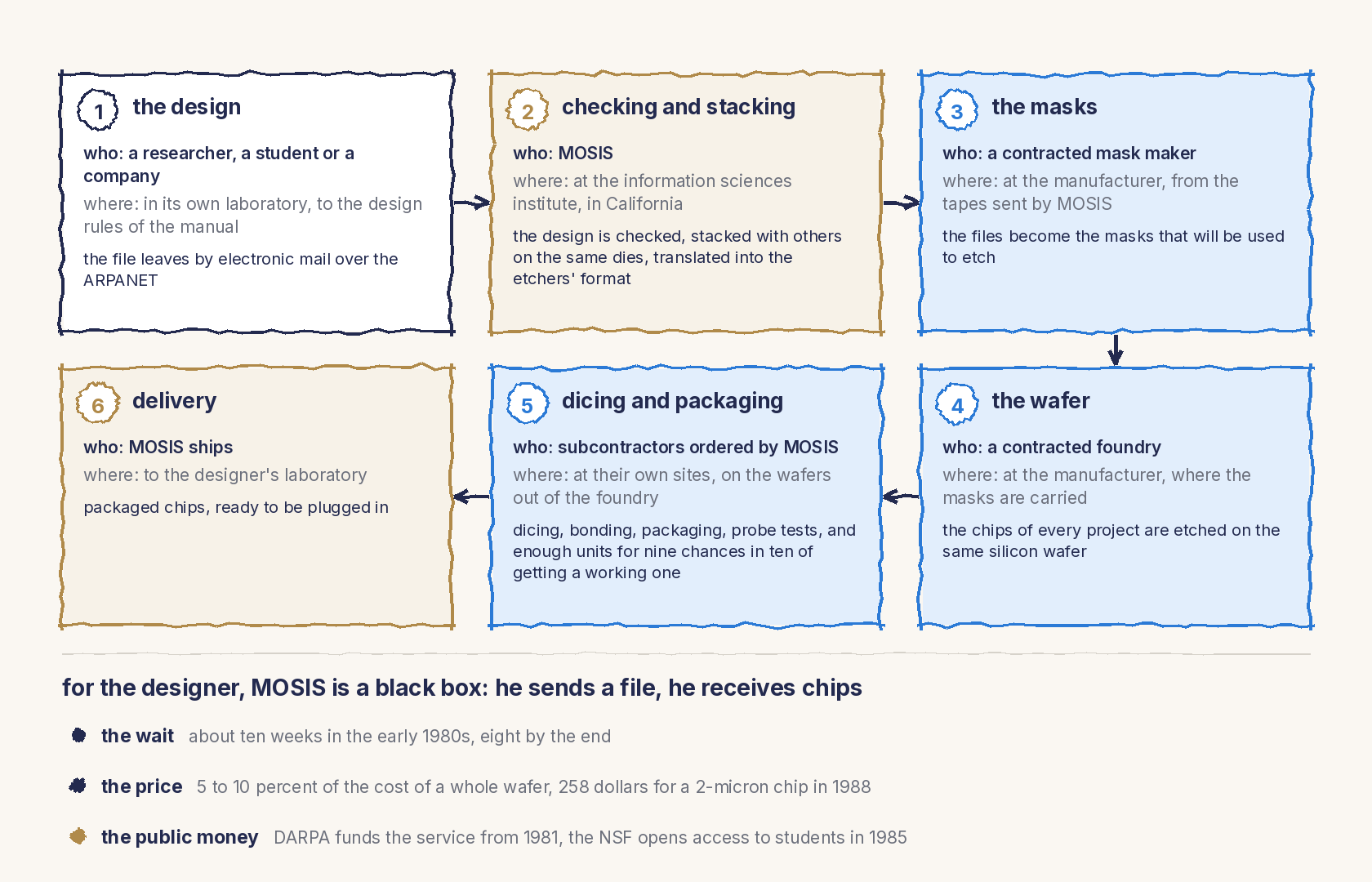
Jennifer Kuan and Joel West traced what followed in Research Policy: MOSIS laid down the standard interface between design and manufacturing that companies without plants, known as fabless, would use for forty years. From 1985, the National Science Foundation opened access to students at any accredited American institution, and more than fifty thousand of them went through the design courses attached to the service between 1990 and 2000, before going to work in those companies or founding them. By 1994, commercial customers accounted for the majority of the designs manufactured. Public money then withdrew, and in 1998 MOSIS no longer received a dollar from the government.
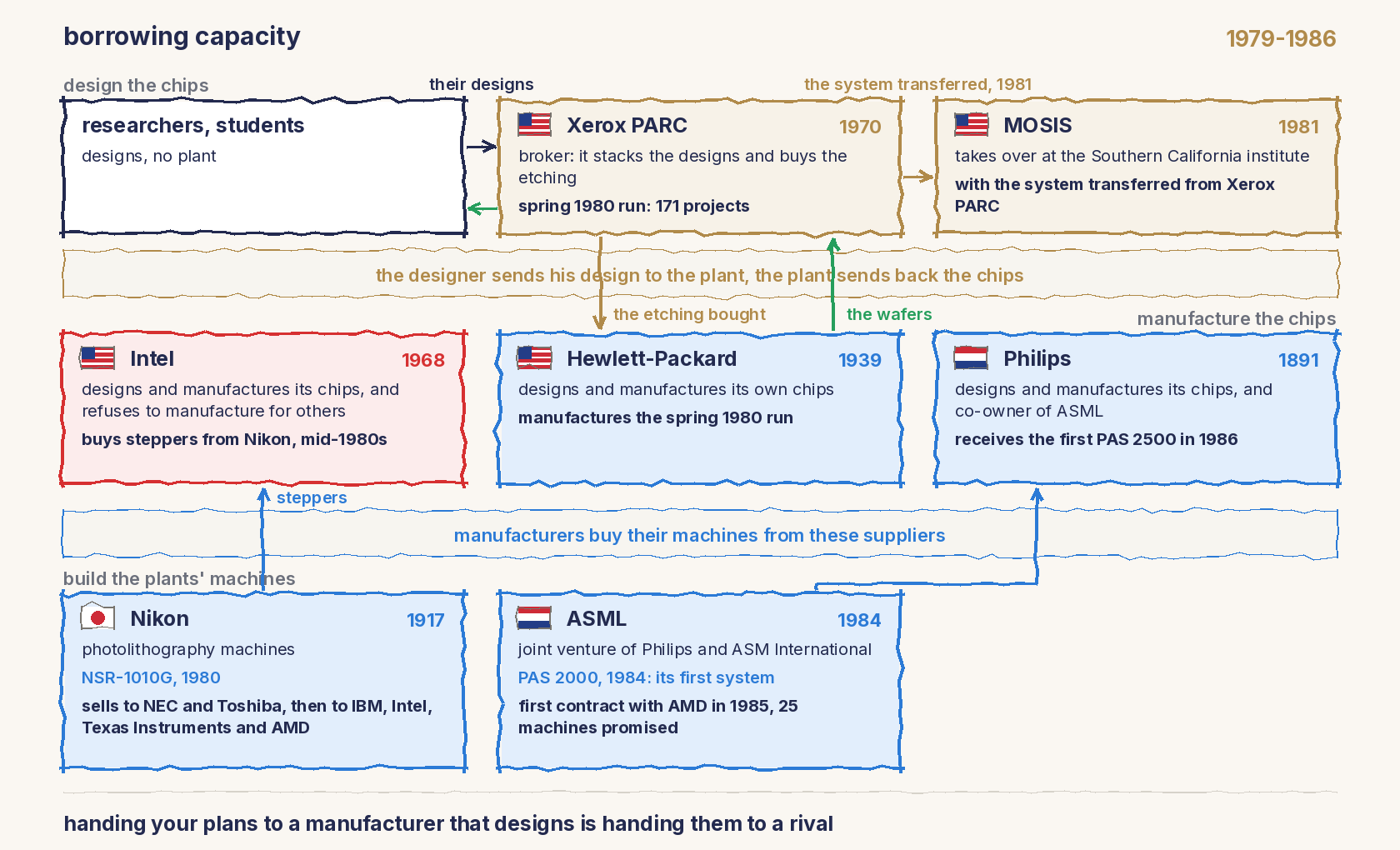
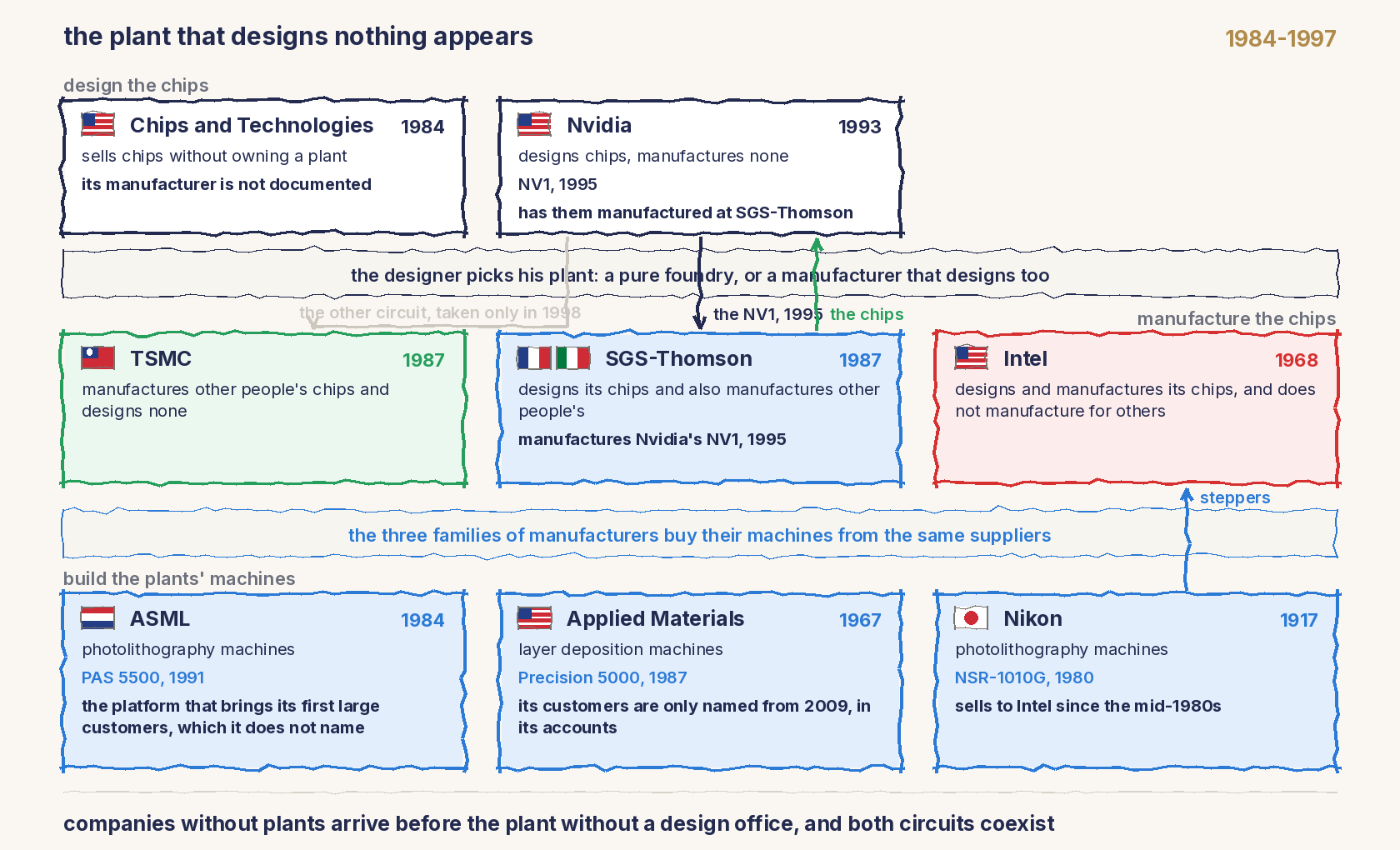
But MOSIS was never anything more than an intermediary: it bought etching time from existing plants, it built none. That left the question of who would build plants that designed nothing. A government took that bet. Mead went to set out his vision of an industry cut in two at Taiwan’s Industrial Technology Research Institute, at a meeting organized by one of his students. TSMC was founded a few years later, in 1987, as a joint venture between the Taiwanese government, its first shareholder, and Philips. Taiwan had the money and the will, not the know-how. Philips had been making integrated circuits for decades, and that is what it brought, along with around 58 million dollars. The technology cooperation agreement signed at the end of 1986 is precise: the group transfers its manufacturing processes, and it commits to a result, compatibility, meaning that a chip coming out of its plants must be able to come out of TSMC’s with the same design rules, the same electrical characteristics, and a comparable yield and cost. It trains Taiwanese engineers and technicians in its own plants, posts a resident expert in Hsinchu, and advises down to the layout of the workshops. Finally it opens its patent portfolio: licenses on its own titles, an undertaking not to sue, and efforts to extend to TSMC the cross-licenses it had signed with third parties, which shields the young plant from infringement suits. In exchange, TSMC pays it a percentage of its sales. Morris Chang, the engineer Taiwan went to find to build this industry, had first knocked at Intel and at Texas Instruments, which refused. At TSMC he installs what is called a foundry: a plant that manufactures the chips designed by others and designs none of its own. A manufacturer that also designs its own chips is a rival to whoever hands it their plans. This one designs nothing, so you can hand it yours without fear, and it is no longer necessary to own a plant in order to sell a circuit.
Companies without plants had not waited for the foundry, as it happens. Chips and Technologies, founded in Milpitas in December 1984, was already selling chips without owning one.
TSMC, the licenses, and the configuration that has held since
Nvidia, for its part, starts on the old circuit. From 1995 to 1997, its chips are manufactured by the European company SGS-Thomson, which is anything but a simple subcontractor: it also assembles and tests the products, and it holds a worldwide license to sell the RIVA 128 under its own name and to take the technology into its own products. Nvidia collects royalties on those sales, 6 to 7 percent of its revenue, and writes in black and white in its stock market prospectus that nothing prevents this partner from releasing a competing product, better equipped and cheaper. That is exactly the situation Mead described: the manufacturer is also a rival.
Two reasons push the change. First quality: in December 1997, the yields obtained at SGS-Thomson collapse, meaning that too many chips come out unusable. Then feature size: the next chip has to move to 0.25 micron, and Nvidia’s strategy is to use the most advanced process available at a commercial foundry.
That leaves getting the door opened. Nvidia is then a company of about sixty people, nearly out of money, so a tiny customer, and TSMC’s Californian office does not answer its approaches. Jensen Huang writes to Morris Chang, by post. Chang calls him, and the two companies sign in 1998. The first Nvidia chip out of TSMC’s plants is the RIVA TNT, the same year, and since then the company has never left the foundry’s five largest customers.
That move does not take Nvidia out of the public orbit, it shifts it. SGS-Thomson was born in 1987 from the merger, decided by Paris and Rome, of two state-owned companies, the Italian SGS Microelettronica and the French Thomson Semiconducteurs; its December 1994 flotation covered only a minority stake, and the two governments remained its main shareholders. TSMC’s first shareholder is the Taiwanese state and its second is Philips, which would keep its stake into the 2000s. The American designer therefore leaves a plant born of a European public decision for a plant born of an Asian public decision.
The change has a price all the same, and it comes from a peculiarity of the trade. A chip puts to work hundreds of processes and devices patented by others, so that manufacturing it exposes you to lawsuits. Established manufacturers protect themselves with cross-licenses: each authorizes the others to use its patents, in exchange for the same. SGS-Thomson, born of two already old companies, held a complete set. Those licenses made it possible, in certain cases, to manufacture its chips without infringing third-party patents. The manufacturer acted as a lightning rod.
A young foundry does not have that set of licenses, and it is exactly what TSMC had gone to look for at Philips in 1986: the extension to itself of the group’s cross-licenses, and the help of its lawyers against infringement suits aimed at its foundry business. But those licenses protect the foundry, not those who entrust it with their designs. In leaving SGS-Thomson, Nvidia therefore steps out from under the umbrella and warns its future shareholders, in black and white, that the risk of being sued for infringement is rising. The year 1998 proves it right: Silicon Graphics, S3 and 3Dfx sue it in turn. The move to the foundry did not only change plants, it moved a legal risk from the manufacturer to the designer.
The configuration is then in place, and one last floor holds it up: the machines, left above with Perkin-Elmer, Nikon and ASML. Those suppliers are attached to no family of manufacturers, and that is what allows the three to coexist. ASML’s first three customers are Intel, which designs and manufactures for itself alone, TSMC, which manufactures only for others, and Samsung: in 2012 the three together bought 23 percent of its capital, 15 percent of it for Intel alone.
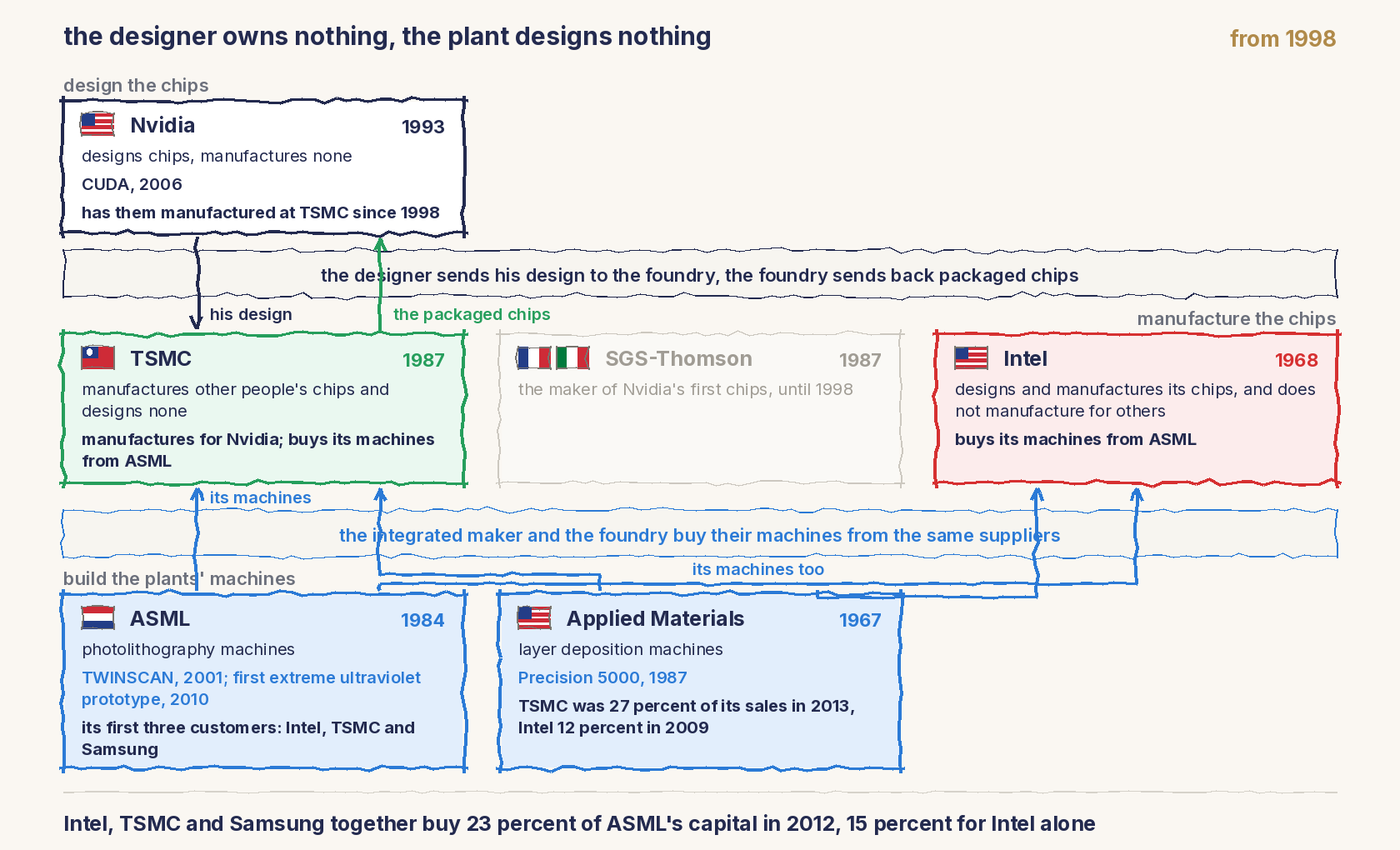
Nvidia is founded six years after TSMC, twelve years after MOSIS. Neither the design method nor the plant would be there without two public decisions. Behind this particular leader there are two governments.
2025, when the export license becomes the risk
In its financial year ended in January 2025, Nvidia sells around 17 billion dollars’ worth in China, 13 percent of its revenue. Then two governments take hold of that market, each in turn.
Washington starts. On 9 April 2025, the American administration requires a license to export the chip Nvidia had designed specifically for China: four and a half billion dollars lost in the day. In August 2025 it gives the licenses back, but against 15 percent of the revenue made in China, paid to the American government. On 8 December it authorizes a more powerful chip, against 25 percent this time.
Beijing answers. On 14 January 2026, Chinese customs block at the border the processors Washington has just authorized, while the Chinese authorities discourage their own companies from buying them. It takes until mid-March for China to allow the sale, and only to selected customers.
The grid applied to Nvidia
Back to our scoring grid. When you look at all of this, asking whether a given company was helped leads nowhere, because the answer is almost always yes as soon as you look at enough channels. For each channel I asked myself the question: if the government did not act through this channel, what would it change for the company? If it does not act at all, the question does not arise and I score zero. If it does act, but the company feels no difference compared with the government doing nothing, I give one point. If it acts and there is a correlation between the company’s results and the government’s action, jackpot: two points. So that makes six channels, twelve points at most.
Let us do the exercise in front of you, on Nvidia, since it is the hardest case. Public capital: zero, no public money has ever entered its capital. Public demand: one, the government buys cards from it, never enough to keep it alive. Targeted public money: one, it benefits from the general research tax schemes, which its competitors enjoy as well. Passport standard: zero, no mandatory specification conditions its sales. Barrier standard: two, export controls now decide who is allowed to buy what from it, and not really to its advantage. Upstream: two, its software building block comes from publicly funded research, and it is its own chief scientist who set that out before the National Science Board.
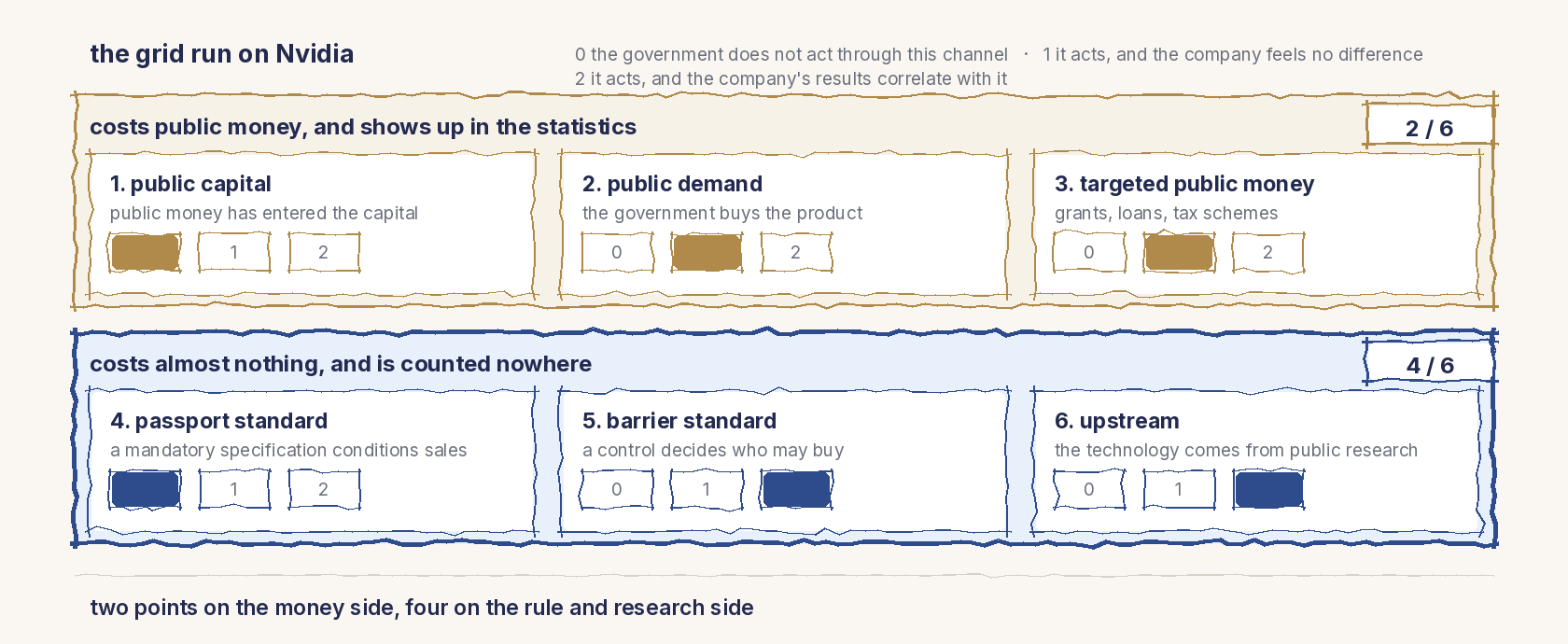
Six out of twelve. The total on its own is not worth much, for lack of other companies scored by the same rule. The distribution does speak: the three channels that cost public money total two points, the three that cost almost none total four. For the most self-built company in the world.
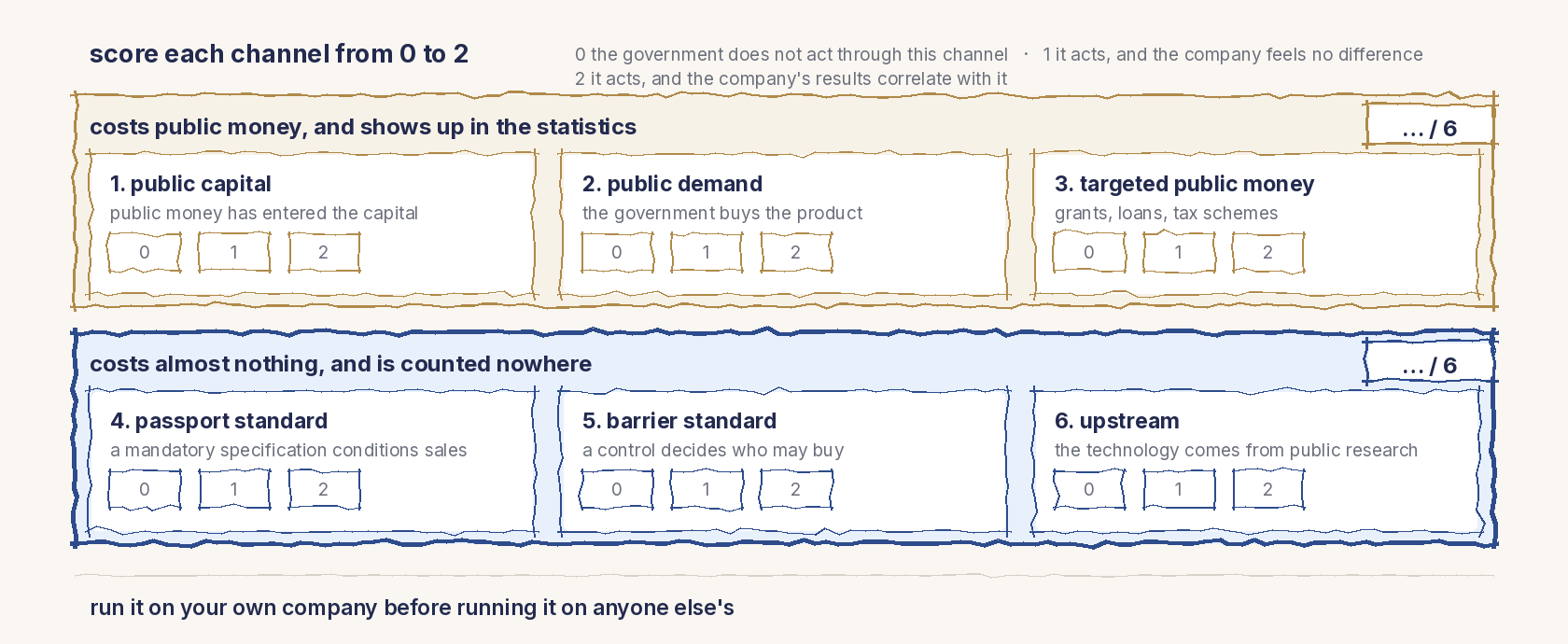
Do the exercise on your own company before doing it on other people’s, it is more instructive. And look for the one that scores zero. I have not found it.
What has changed since 2018
One last word on what has changed recently, because it moves your risk. Until 2018, what triggered a public decision was the trade balance, employment, sometimes the environment. Since then, it is rivalry between powers. Japan released the equivalent of more than two billion dollars in 2020 to help its companies bring back production installed in China. The Chinese five-year plan traded its growth target for a goal of technological self-sufficiency. The French government took a stake in a satellite operator and took back a high-performance computing division.
In practice, the commercial survival of a product line can now depend on the relationship between two capitals, on a horizon of a few weeks. That parameter did not exist in the product plans of ten years ago.
What this article does not say
Do not misread the argument: this article does not say politics does everything, and it would be dishonest to leave that impression.
Inside the envelope, execution still decides everything. The four-meter rule applied to every manufacturer present in India: some drew two product categories out of it, others shortened boots and convinced nobody. The 900 megahertz band was open to every European equipment maker: two of them took the lead of the world market, the others did not. Textile quotas did not designate Bangladesh, they only designated capped countries, and somebody there had to go and find training in Korea.
The envelope deals the cards. It does not play the hand. The hand is played on a table whose dimensions were set by somebody else, and ignoring that is expensive. You can find the value, deliver it, execute perfectly, and lose because a frequency band went elsewhere, because an approval list excluded you, or because a quota written in another decade moved production to another country.
So here is the question to add to the agenda of your next product committee, right after the one about the customer: which public decision opens or closes my market, on what horizon, and who holds the pen?
That last question opens the next episode.
The six channels in this article form the first line of a sheet that has four. It fits on one page.
What this article rests on
Nvidia
- summary of the export controls
- Jensen Huang recounts in Tokyo, in July 2026, the Sega investment that saved Nvidia in 1995
- Jennifer Kuan and Joel West, Interfaces, modularity and ecosystem emergence: how DARPA modularized the semiconductor ecosystem, Research Policy 52 (2023) 104789, open access under CC BY
- Britannica Money, founding of TSMC in 1987 and the Taiwanese government’s majority stake
- TSMC, company profile, pure-play foundry model since 1987
- Founding of TSMC in 1987 and the role of the Taiwanese development fund
- Ling-Ming Huang, history of semiconductors in Taiwan in the 1970s and 1980s, Taiwan Insight
- Nvidia, first quarter results for fiscal 2026, 28 May 2025
- Bureau of Industry and Security, Department of Commerce
- Stanford University, sponsors page of the Brook project, listing IBM, Sony, ATI, Nvidia, DARPA and the Department of Energy
- “The Origins of GPU Computing”, Communications of the ACM, on the move from Brook to CUDA by Ian Buck and John Nickolls
- Good Science Project, “MOSIS: The 1980s DARPA Silicon Broker”, 27 January 2024, citing the 1981 talk by Danny Cohen and George Lewicki, for the production chain, the turnaround times, the prices and the target success rate
- EE Power, 2026, on electronic submission of designs and the return of packaged chips, and on sharing the cost of a wafer
- EE Journal, “Lynn Conway, 1938-2024”, on the multi-project prototyping program designed by Lynn Conway and turned into MOSIS, funded by DARPA in 1981
- IEEE Computer Society, “Famous Graphics Chips: Nvidia’s RIVA 128”, on the partnership with SGS-Thomson struck in May 1995 to manufacture Nvidia’s first chip
- Morris Chang, Acquired interview, on Jensen Huang’s letter in 1997, the San Jose office that did not answer, and the call that followed
- Summary of the second volume of Morris Chang’s autobiography, for Nvidia’s place among TSMC’s five largest customers since 1998
- Nvidia, initial public offering prospectus filed with the Securities and Exchange Commission on 20 November 1998, for the move from ST to TSMC, ST’s worldwide license on the RIVA 128, the royalties, the December 1997 yields, the move to 0.25 micron and the loss of patent cover
- Company history of STMicroelectronics, for the merger decided in 1987 by the French and Italian governments, the 1994 flotation and the two states remaining the main shareholders
- Wikipedia, “ASML”, for the 1984 joint venture between Philips and ASM International
- Wikipedia, “Chips and Technologies”, for a company without a plant founded in Milpitas in December 1984
- Wikipedia, “Intel”, for the founding on 18 July 1968
- Wikipedia, “Hewlett-Packard”, for the founding in 1939
- Wikipedia, “PARC”, for the founding of Xerox’s laboratory in 1970
- Wikipedia, “ASML”, for the first contract signed with AMD in 1985 and the first PAS 2500 delivered to Philips in 1986
- Wikipedia, “Philips”, for the founding on 15 May 1891 in Eindhoven
- Technology cooperation agreement between Philips and TSMC, concluded on 31 December 1986, filed with the Securities and Exchange Commission, for the process transfer, the compatibility requirement, the training of the teams, the resident expert, the patent licenses and the cross-licenses extended to TSMC
- Oral history interview with Carver Mead, California Institute of Technology archives, 1996, for the work on electron transport, the visit from Arnold Shostak of the Office of Naval Research and the 30,000 dollar grant
- University of Washington, “Silicon Chips in the Northwest”, on the separation between design and manufacturing: the designer no longer needs to know the process, he only has to follow a few rules
- National Inventors Hall of Fame, entry for Lynn Conway, on the transposable design rules and on the plant used as a silicon foundry, manufacturing designs that come from elsewhere
- Biography of Carver Mead published by the California Institute of Technology, which credits him with the silicon foundry concept and the model of the company without a plant
- Wikipedia, “Applied Materials”, for the founding in 1967 in California, the Precision 5000 of 1987 which entered the Smithsonian in 1993, and its place as the world’s second equipment supplier behind ASML
- Applied Materials, fiscal 2015 annual report on Form 10-K filed with the SEC, for TSMC’s share of its sales: 27 percent in 2013, 21 percent in 2014, 15 percent in 2015
- Applied Materials, fiscal 2010 annual report on Form 10-K filed with the SEC, for Intel’s share of its sales: 12 percent in 2009
- Wikipedia, “Micralign”, for the first projection aligner launched by Perkin-Elmer in 1973
- Chip History Center, on the Micralign entering Intel’s Livermore plant
- The Chip Letter, “The Founding of ASML”, for GCA’s DSW 4800 in 1978, its Zeiss optics and its first unit sold to Texas Instruments
- Asianometry, “How Japan Won the Lithography Industry”, for Nikon’s NSR-1010G in 1980 and its first customers, NEC and Toshiba
- Atsuhiko Kato, chronology of the stages of lithography, for the customers Nikon took over from GCA: IBM, AT&T, Intel, RCA, Texas Instruments and AMD
- ASML, company history page, for the 1984 joint venture, the PAS 2000, the PAS 5500, the TWINSCAN of 2001 and the first extreme ultraviolet prototype delivered in 2010
- Ian Buck, Tim Foley, Daniel Horn, Jeremy Sugerman, Kayvon Fatahalian, Mike Houston and Pat Hanrahan, “Brook for GPUs: Stream Computing on Graphics Hardware”, SIGGRAPH 2004, for the streams stored as textures, the two transfers, the size limits and the test hardware
- Ian Buck interview, Tom’s Hardware, 2009, on Brook’s memory access constraint and on what CUDA lifted
- Wikipedia, “CUDA”, relaying a Business Insider profile for the thirty-two GeForce cards assembled at Stanford; the exact model is not documented
- Bill Dally, slides presented to the National Science Board on 23 July 2025, “Government, University, & Industry Cooperation: The NVIDIA Story”