



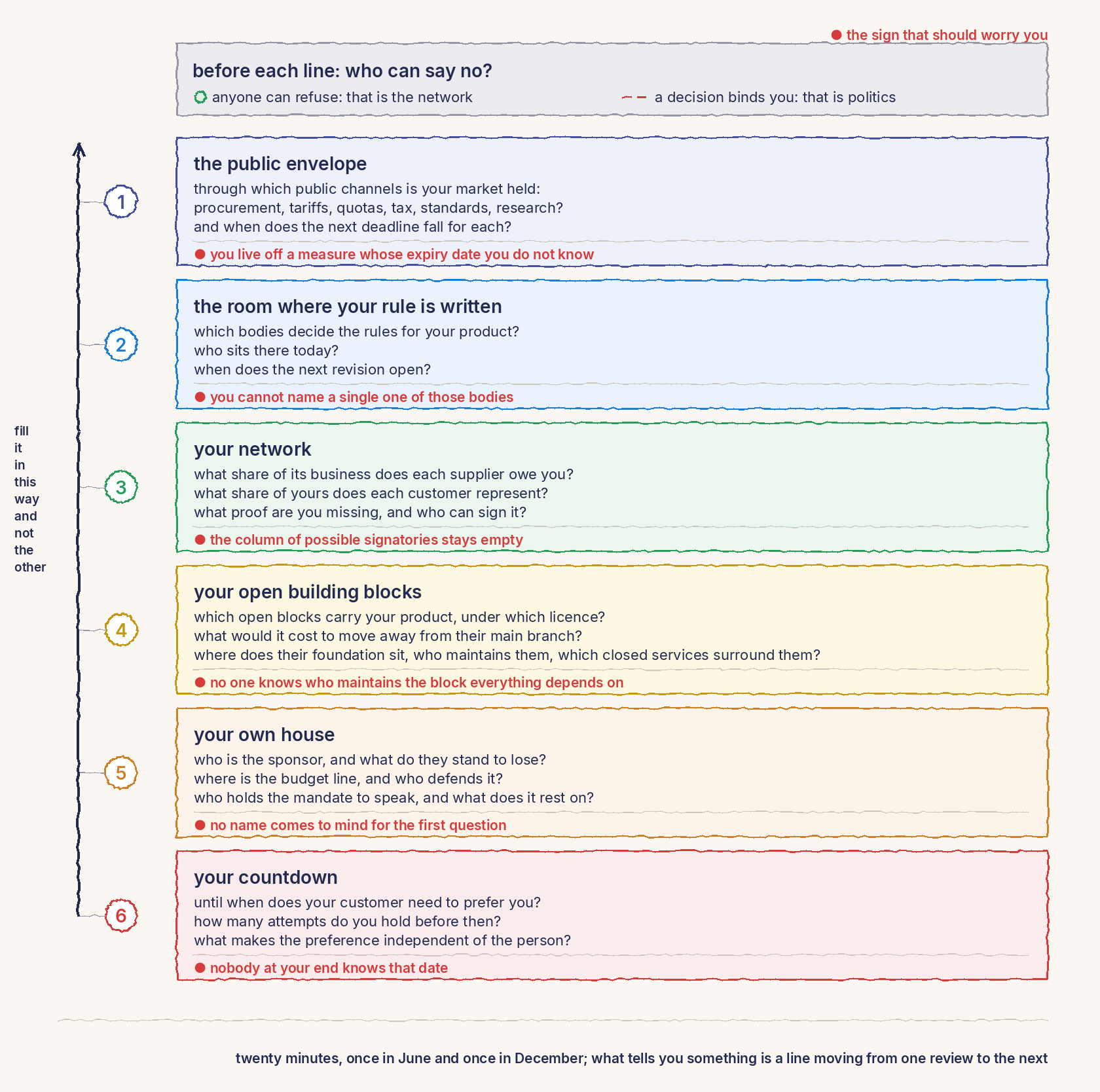
Ten episodes, three scales, and one page at the end. This sheet brings together their instruments, to be filled in with your own data. No line requires outside research: everything sits in your accounts, your calendar and your org chart.
Before each line, one question: who can say no?
For each dependency you write down, first ask who can say no. If anyone can refuse, the line belongs to the network: you work it through discovery, bridges, trust and vouching. If a decision can bind you without your consent, it belongs to politics: you work it through coalitions, public consultation and evidence filed in time.
The warning sign: you are negotiating one partner at a time what a rule will soon impose on everyone.
Fill it in from the inside out
That is the reverse of the order in which the series reads, and it is deliberate. Nobody obtains a public decision because they are right. They obtain it because somebody, inside an organization, first won from their peers the right to go and ask.
So start with the last band, then work upwards. If the bottom two stay empty, the other four are reading exercises.
Six, your countdown
Until when does your customer need to prefer you? How many attempts do you hold before then? What makes that preference independent of the person who prefers you?
The warning sign: nobody at your end knows the expiry date. Your product plan has no horizon, it has a habit.
Five, your own house
Who is the sponsor, and what do they stand to lose? Where is the budget line, and who defends it? Who holds the mandate to speak, and how far does it go? What does the transparency register say about you, and about your competitors? What does the file rest on if the sponsor leaves?
The warning sign: no name comes to mind for the first question. The outside file does not exist yet, whatever your roadmap says.
Four, your open building blocks
Which open building blocks carry your product, and under which license: open source in the strict sense, or open weights with conditions? What would it cost to move away from their main branch? Where does their foundation sit, who maintains them, and which closed services surround them? Where does the data come from, if the block is an AI model?
The warning sign: no one knows who maintains the block everything depends on. Your product rests on a commons whose governance you do not know.
Three, your network
What share of its business does each critical supplier owe you? What share of yours does each important customer represent? What proof are you missing, and who else can sign it?
The warning sign: the column of possible signatories stays empty. You do not have a proof problem, you have a network problem.
Two, the room where your rule is written
Which technical bodies, working groups or trade associations decide the rules that apply to your product? Who sits there today? When does the next revision open?
The warning sign: you cannot name a single one of those bodies. Your competitors are already sitting in them.
One, the public envelope
Through which public channels are your product and your market held: procurement, tariffs, quotas, tax, standards, research funding? Since when? And above all: when does the next deadline fall for each of them?
The warning sign: you live off a measure whose expiry date you do not know. It is the only line on this sheet that can cost you a market in a single decision.
The cadence
Twenty minutes, twice a year, in front of your product review. Once in June, once in December. What fills in quickly reads back quickly.
A sheet filled in once is worth nothing. What tells you something is how a line moves between two readings.
A word about the numbers
Several scales in this series carry thresholds that come from no study. They are markers I propose, and the method appendix says which ones are anchored on a fact from the file and which are conventions. If you judge a threshold badly placed, move it and keep the question.




 CC BY-SA 4.0
