Seventh episode of a ten-episode series on the weight of politics in the success of a product. The first six followed public decisions all the way inside the company. This one crosses the three scales at once: whether it comes from a government, an investor or the floor above, support has a size and an end date, and a team’s performance is measured by what it does with that support before it runs out.

27 April 2024, Galileo leaves from Florida
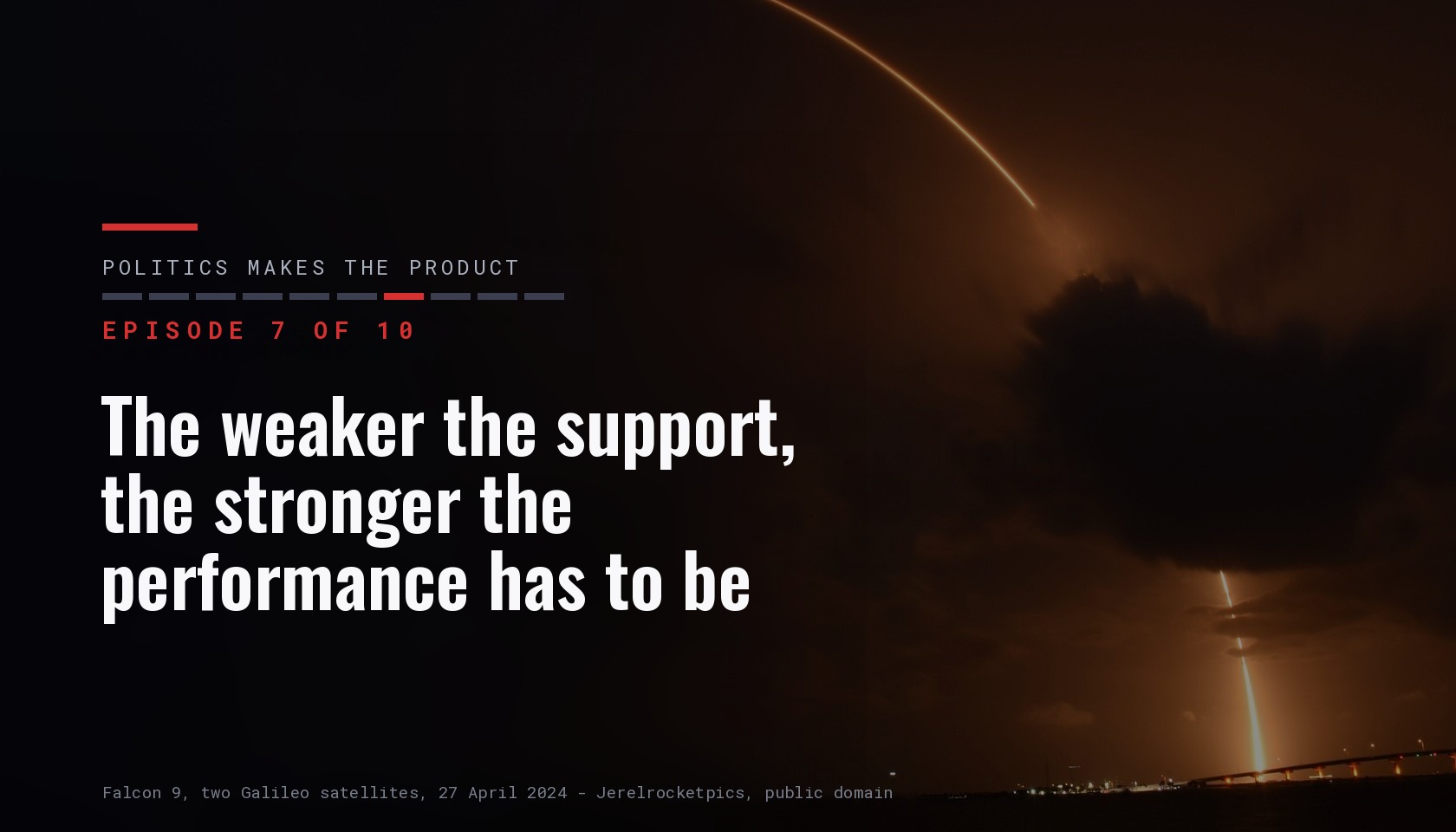
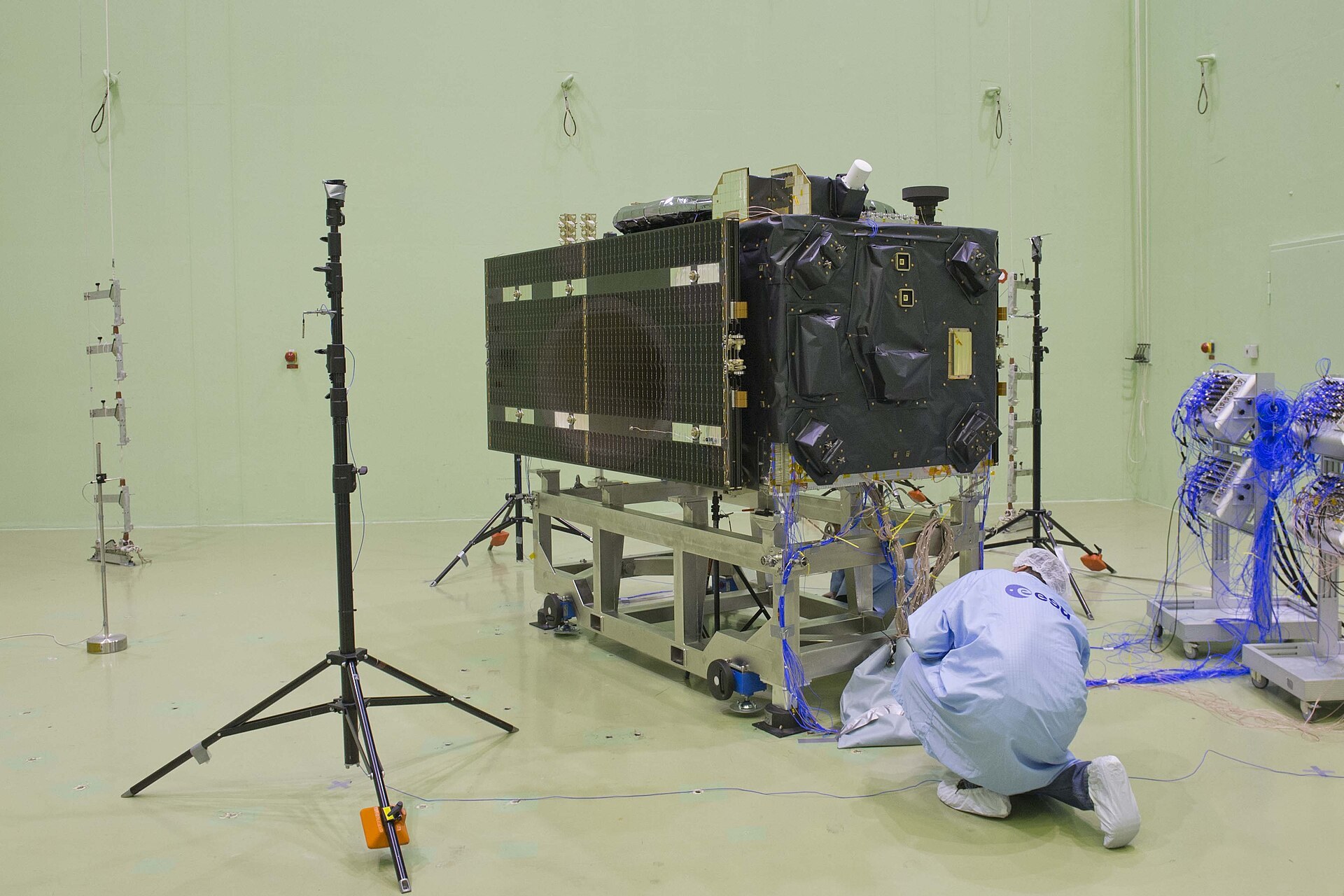
At 8:34 pm Eastern time, a SpaceX Falcon 9 lifts off from Launch Complex 39A at the Kennedy Space Center. Under its fairing, the shell that protects the payload at the top of the rocket, ride two European satellites, FM25 and FM27. They belong to Galileo, the European Union’s positioning system, the equivalent of the American GPS.

Until that evening, every Galileo satellite had left on Russian Soyuz rockets or on Ariane 5. Europeans have had no access to Soyuz since the invasion of Ukraine, in February 2022. Ariane 5 made its last flight in July 2023. Ariane 6, which was due to succeed it in 2020, has still not flown.
The first stage, the lower part of the rocket that ignites at liftoff, will not come back to land. This is its twentieth flight, and the mass of the two satellites, bound for medium Earth orbit more than 23,000 kilometers up, leaves it without the fuel it would need to return. The European Commission signed on 19 March: €180 million for two launches, about 36 percent above the list price of a dedicated Falcon 9.
The next day, the European Commissioner for the Internal Market, Thierry Breton, writes on X that until Ariane 6 is ready, these launches are crucial to Galileo’s resilience and to the continuity of its civil and military uses.
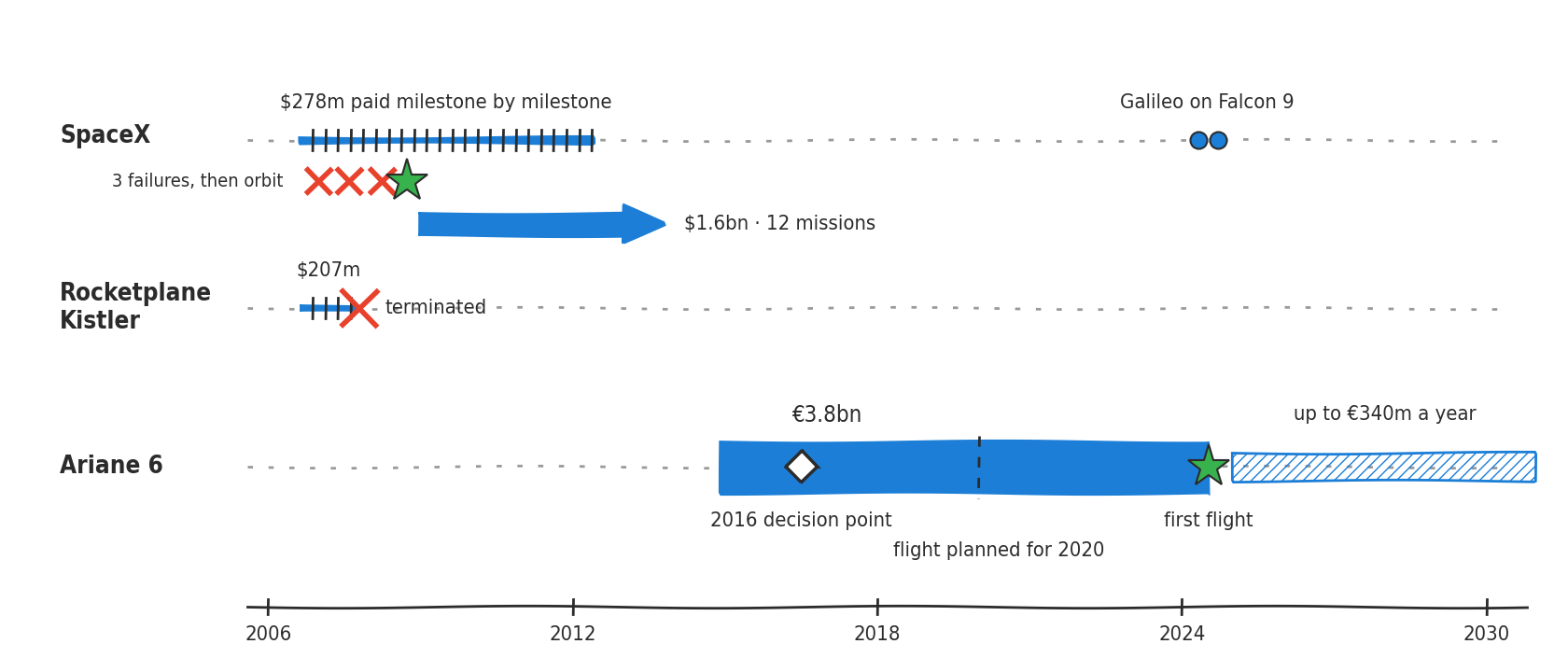
Ten years earlier, European ministers had set aside €3.8 billion to develop Ariane 6 and its little brother, Vega C. SpaceX, for its part, had received from NASA in 2006 an agreement worth $278 million, doled out a little at a time. On that 27 April, Europe’s best-supported launcher was missing, and the most strategic European satellites were leaving on the rocket those $278 million had helped bring into being.
Why does the best-supported launcher arrive late? And how does the size of the support change what a company is allowed to get wrong?

August 2006, $278 million paid in stages
On 18 August 2006, NASA signs the first two agreements of its Commercial Orbital Transportation Services (COTS) program, through which it wants to hand the resupply of the International Space Station to private companies. SpaceX gets $278 million, Rocketplane Kistler $207 million.
These agreements fund a development without buying the vehicle. The money does not arrive in one lump: it is paid in installments, each on completion of a milestone, that is, a step defined in advance and verifiable, such as a successful engine test or an approved design review. Some milestones are financial. The company has to prove that it is raising its own share of the funding, and NASA placed these milestones early in the schedule so that it could leave the agreement before spending too much.
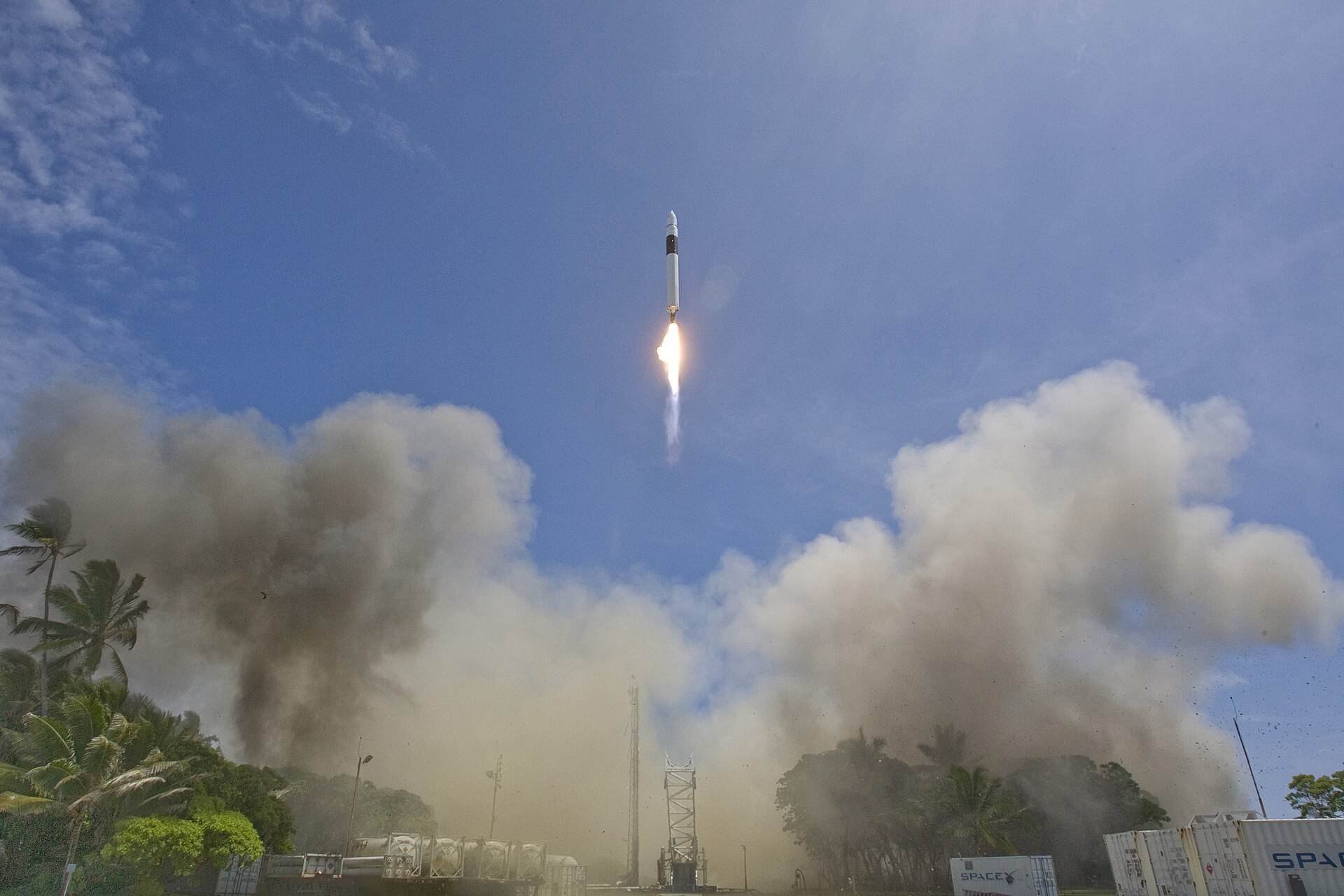
SpaceX then has a small launcher, Falcon 1, which fails on its first three attempts to reach orbit. Hans Koenigsmann, who led guidance at SpaceX, remembers a heartbreaking first failure: a lot of people had worked for a long time, on a rocket that had not gotten very far.
On 28 September 2008, from Kwajalein Atoll in the Marshall Islands, the fourth Falcon 1 reaches orbit.
Gwynne Shotwell, who went on to become president of SpaceX, later described what kept her busy during those years: finding investors and persuading customers to buy launches before the rockets had proved anything, keeping the company alive and continuing to make payroll.
In December 2008, three months after orbit, NASA orders twelve station resupply missions from SpaceX for $1.6 billion. In March 2009, the company clears the agreement’s three financial milestones.
These milestones were known before the first dollar. They were negotiated with each company in verification sessions that sometimes lasted several days, and they could differ from one winner to the next. They fell roughly every three months, each with its defined objective and a price fixed in advance, and any cost overrun was borne by the company. Each company knew what it had to demonstrate and by when, and its investors could rely on the same schedule.
NASA published these schedules as an annex to its report on the program. The block below goes through them milestone by milestone: the one SpaceX signed in 2006, the one for Orbital Sciences, which in 2008 took over the $170 million left by Rocketplane Kistler, and the story of Rocketplane Kistler itself. Each milestone is something to prove, with its amount, its planned date and its actual date; for each company, the block also shows what it had to fund on its own between two payments. It opens collapsed: click a company to expand it.
This interactive block needs JavaScript. In short: NASA paid SpaceX $278M over 22 milestones from August 2006, then $118M over 18 milestones added in October 2010; the last demonstration flight, planned for September 2009, took place in May 2012. Orbital Sciences received $170M, then $118M; its program cost $530.4M, of which it bore $242.4M itself. Rocketplane Kistler, selected for $207M, received $32.1M before its agreement was terminated in October 2007. Sources: NASA SP-2014-617, appendices pp. 112 and 113; Orbital annual reports filed with the SEC.
Design reviews and financing rounds land almost on the planned date. Demonstration milestones slip by up to three years, at both companies, and the money waits for the proof: each of them is worth only $5 million at SpaceX, $2.5 million at Orbital.
The 2006 support was small, conditional and time-bound. It served to produce the proof that triggered the next round of support, nearly six times larger.
The other winner
Rocketplane Kistler, selected on the same day as SpaceX, plays by the same rules. Its financial milestone requires it to raise $500 million of private capital before May 2007.

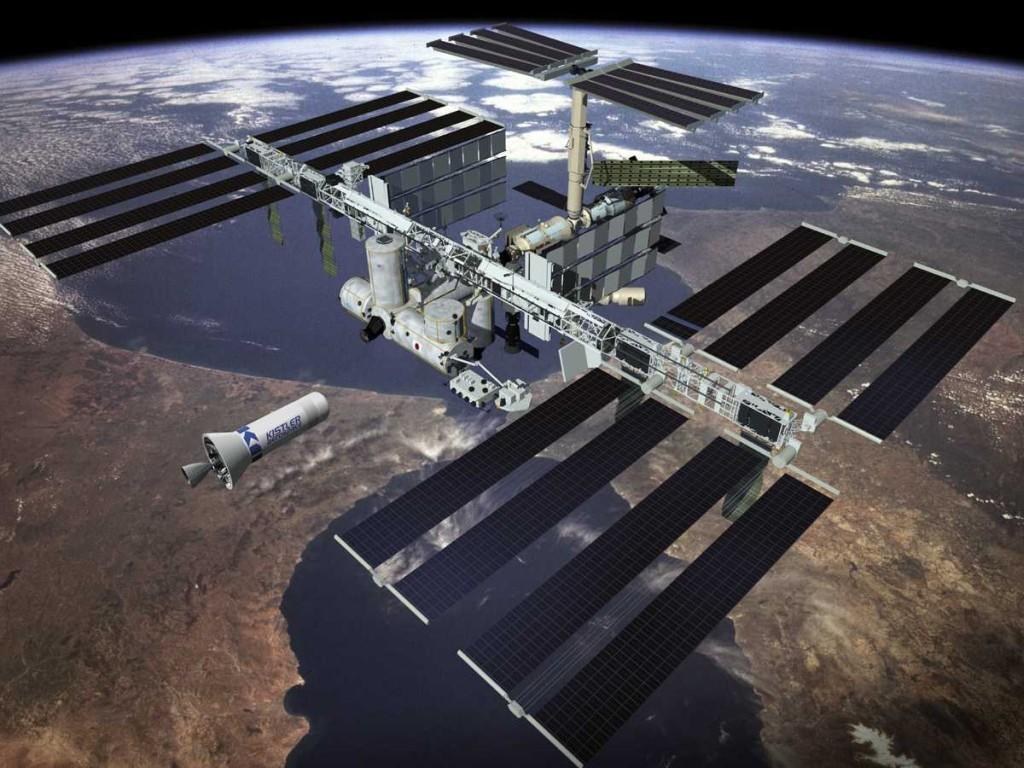
NASA helps it. Its officials go over the investor presentations and accompany the company to its investor day in July 2007, in New York. A Canadian pension fund promises more than $200 million. Rocketplane Kistler reaches $300 million, and gets no further.
On 7 September 2007, Scott Horowitz, who runs NASA's exploration programs, sends the notice of termination. He sums up his rule: three strikes and you're out; the company has not met its milestones, the agency has tried, and it is moving on. The agreement ends on 18 October. Four days later, NASA issues a new call to award the remaining $170 million. Rocketplane Kistler had received $32 million.
On 19 February 2008, Orbital Sciences signs in its place. A program official explained the choice: having been burned by a financial risk, NASA picked a company that already had the money in the bank.
Rocketplane Kistler argued that investors refused to commit because NASA did not guarantee the purchase contract that would come afterwards. The argument describes the chain as it works. Each backer waits for the proof that will let it bring in the next one, and when one link is missing, the others pull out fast. Nine months separated the May 2007 deadline from Orbital's signature.
Rocketplane Kistler was not held back by the technology. NASA judged it technically competent, and a program official explained that its heaviest risk had always been on the business side. Each milestone tests a risk of one precise kind, the feasibility of an engine or the viability of a financing plan, and the one that stops a company is not necessarily the one it works on most. Proof obtained on one front also lightens the load on the others. SpaceX cleared its three financial milestones in March 2009, after the orbit in September and the order in December; Rocketplane Kistler was looking for investors with no order to show them.
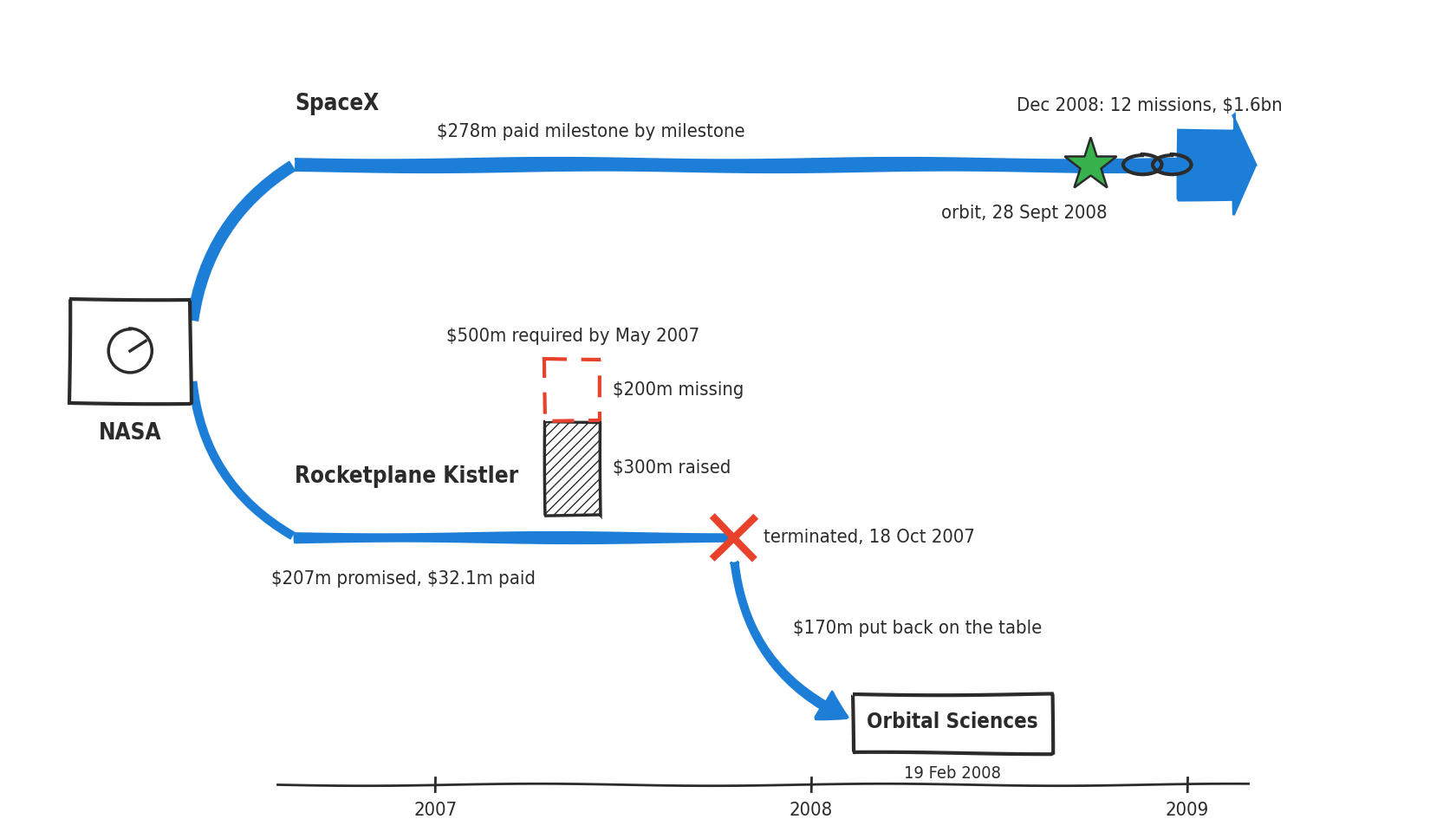
December 2014, €3.8 billion committed up front
Eight years after NASA's agreements, Europe launches its new heavy launcher, Ariane 6, with support of another kind. It is not paid out proof after proof: the budget is voted in one block, for the whole development.

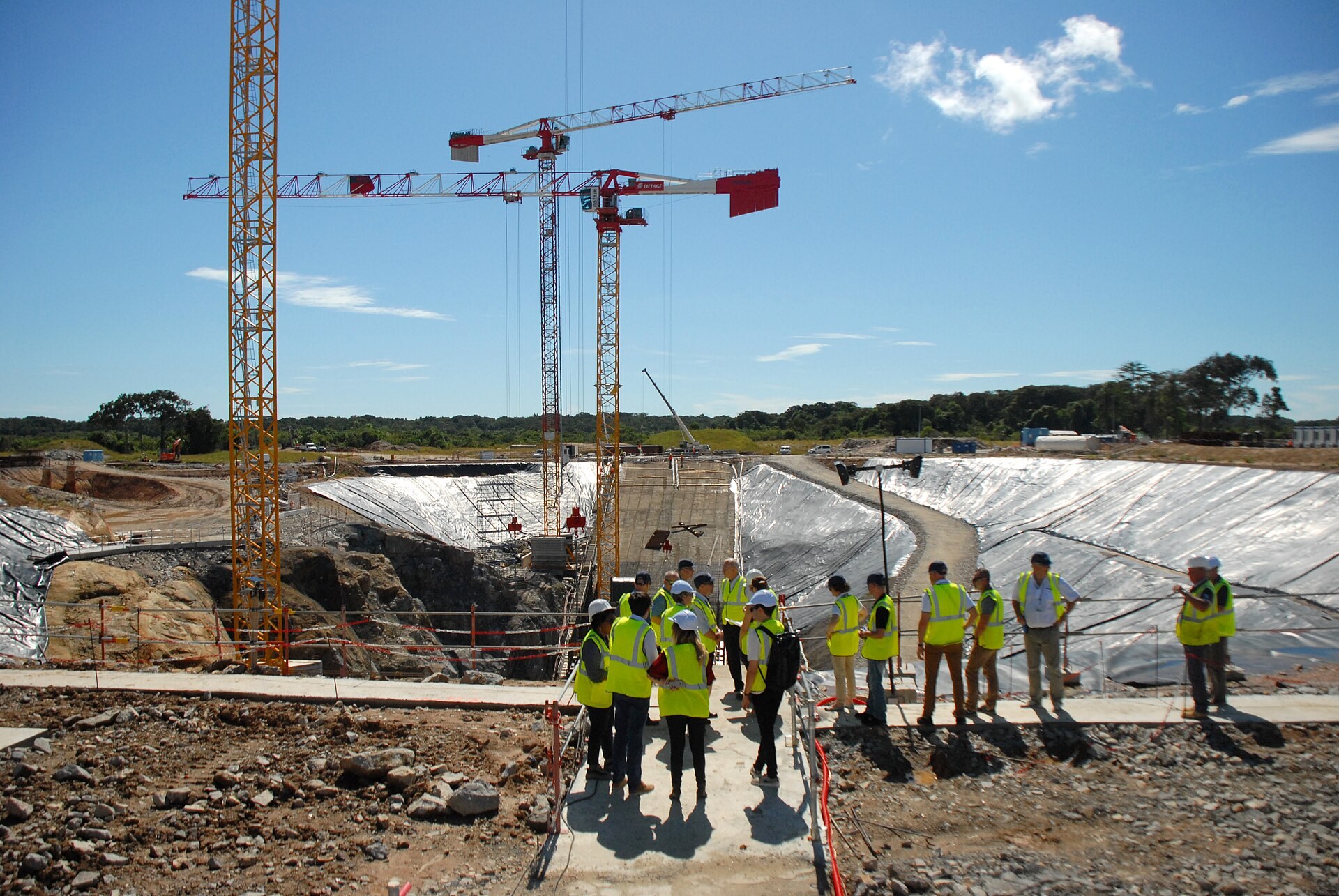
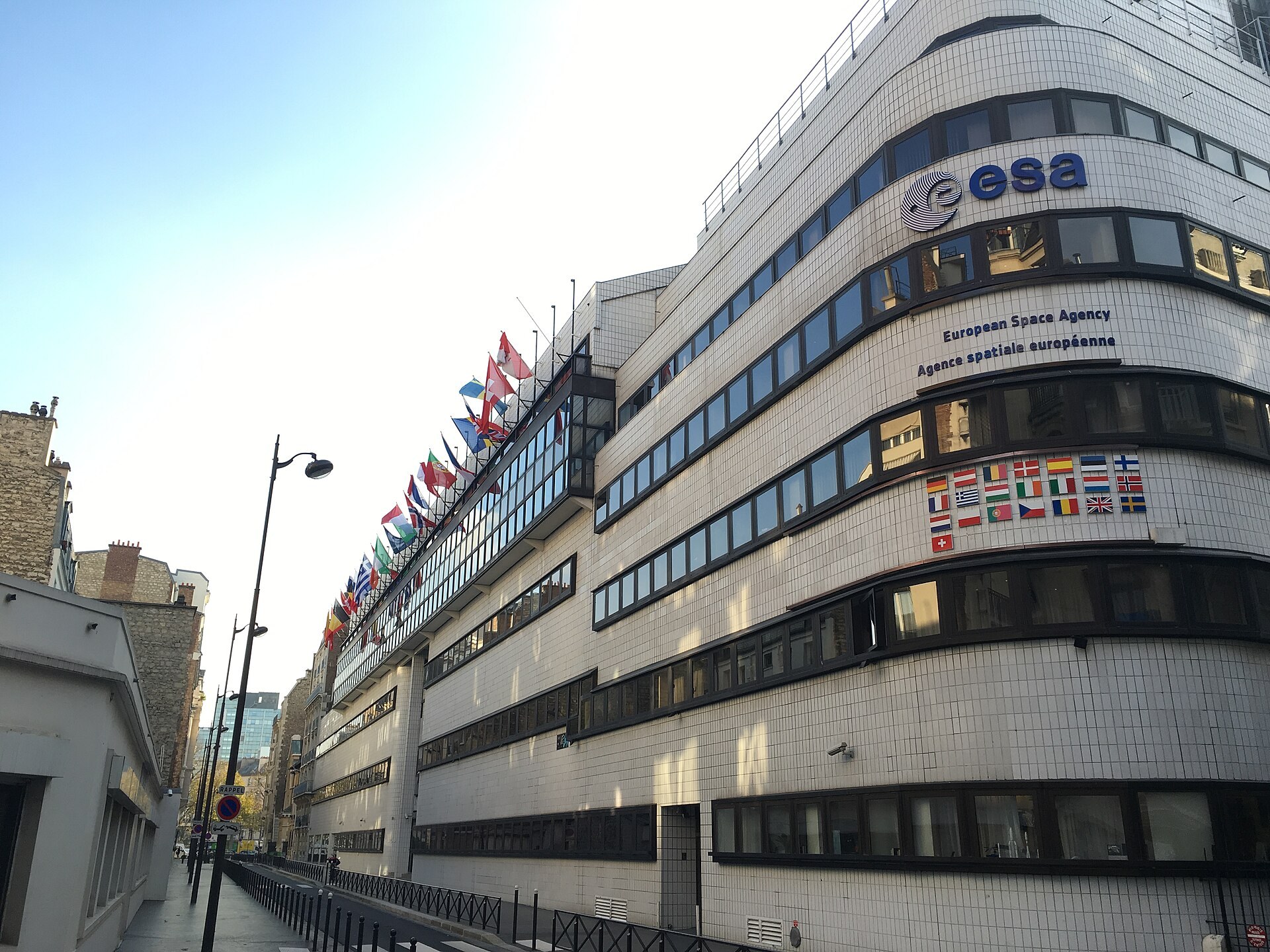
In June 2014, Airbus and Safran present their Ariane 6 design alongside President François Hollande, on the lawn of the Élysée Palace. In December, in Luxembourg, the ministers of the member states of the European Space Agency (ESA) adopt it, and the agency drops eighteen months of preliminary studies. They set aside €3.8 billion to complete the development of Ariane 6 and of Vega C, its little brother. The first flight is planned for 2020, and a single decision point is written into the schedule: in 2016, the member states will confirm that the program goes on.
The decision also changes who does what. Industry becomes the design authority: it is industry, no longer the agency, that settles the technical choices. ESA then signs €2.4 billion with Airbus Safran Launchers for the launcher, €600 million with CNES, the French space agency, for the launch pad, and €395 million for Vega C. Only a first tranche of about €680 million is firm; the remaining €1.7 billion is committed only in November 2016, after the review and the vote to continue. After that, no further checkpoint is scheduled until the first flight.
Then come the delays. In August 2023, ESA's director general, Josef Aschbacher, announces that the first flight is slipping to mid-2024, nearly four years after the planned date. According to Reuters, development costs by then exceed €4 billion.
In the meantime, Europe has lost its other rockets. Vega C has been grounded since a failure in December 2022. Ariane 5 retires in July 2023, after twenty-seven years of service, and Europe finds itself without a heavy launcher. Aschbacher speaks publicly of an acute launcher crisis.
The support, for its part, stays in place. Four years of delay cost Ariane 6 neither its budget nor its backers; NASA had needed only five months to withdraw its own support from Rocketplane Kistler. In November 2023, at the space summit in Seville, France, Germany and Italy commit to requesting up to €340 million a year for the operation of Ariane 6, that is, its flights once development is over, and €21 million for that of Vega C. The agreement reserves at least four institutional missions a year for Ariane 6, ordered by European agencies and governments, and three for Vega C.
This renewal comes before any demonstration, since Ariane 6 has not yet flown. It does, however, come with tougher conditions. Industry commits to cutting its costs by 11 percent. The funds will only be voted at the next meeting of ministers, in 2025. And the same agreement opens a competition to new European launchers.
In June 2024, Toni Tolker-Nielsen, ESA's director of space transportation, spells out the arithmetic. The business plan counts on nine flights a year, four institutional and five commercial, and the need for aid lies between €290 million and €340 million a year. When a journalist asks him whether this is the price of European sovereignty, he says it is, and calls Ariane 6 a sovereign launcher.
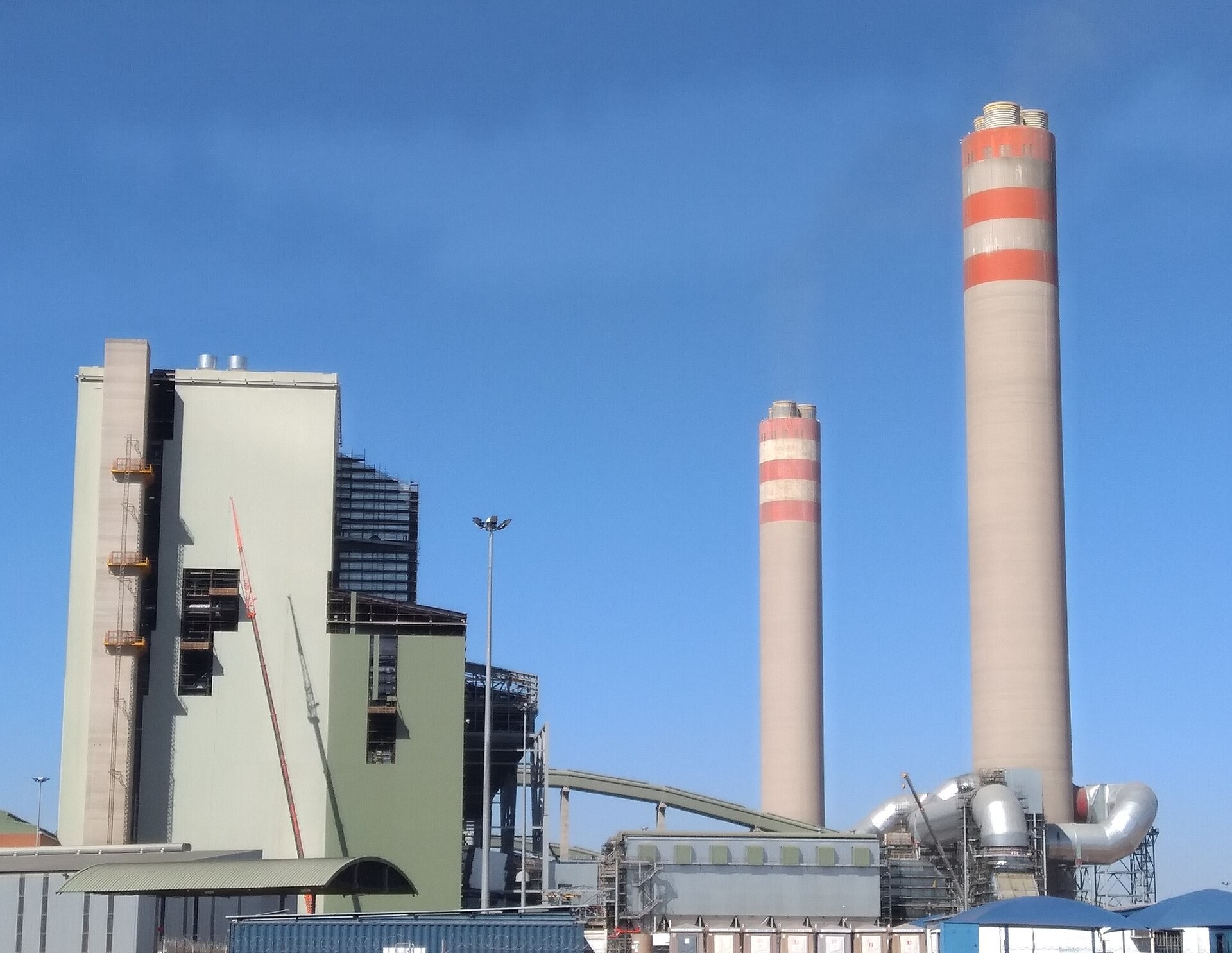
On 9 July 2024, Ariane 6 finally lifts off from Kourou.
The block below lays out this program with the same tools as the NASA one: the stages and their successive planned dates, the events, the money and the flight cadence. It opens collapsed: click a phase to expand it.
This interactive block needs JavaScript. In short: in December 2014, the ESA member states commit €3.8bn to Ariane 6 and Vega C; industry promises €400M. The first flight, announced for 2020, is postponed four times and takes place on 9 July 2024. In Seville, in November 2023, three states promise up to €340M a year for operations; Ariane 6 flies four times in 2025, against six flights announced. Sources: ESA, ArianeGroup, Arianespace, SpaceNews, European Spaceflight.
What room for error measures
Room for error is the number of failures, or the length of delay, that an organization can absorb before the people backing it walk away.

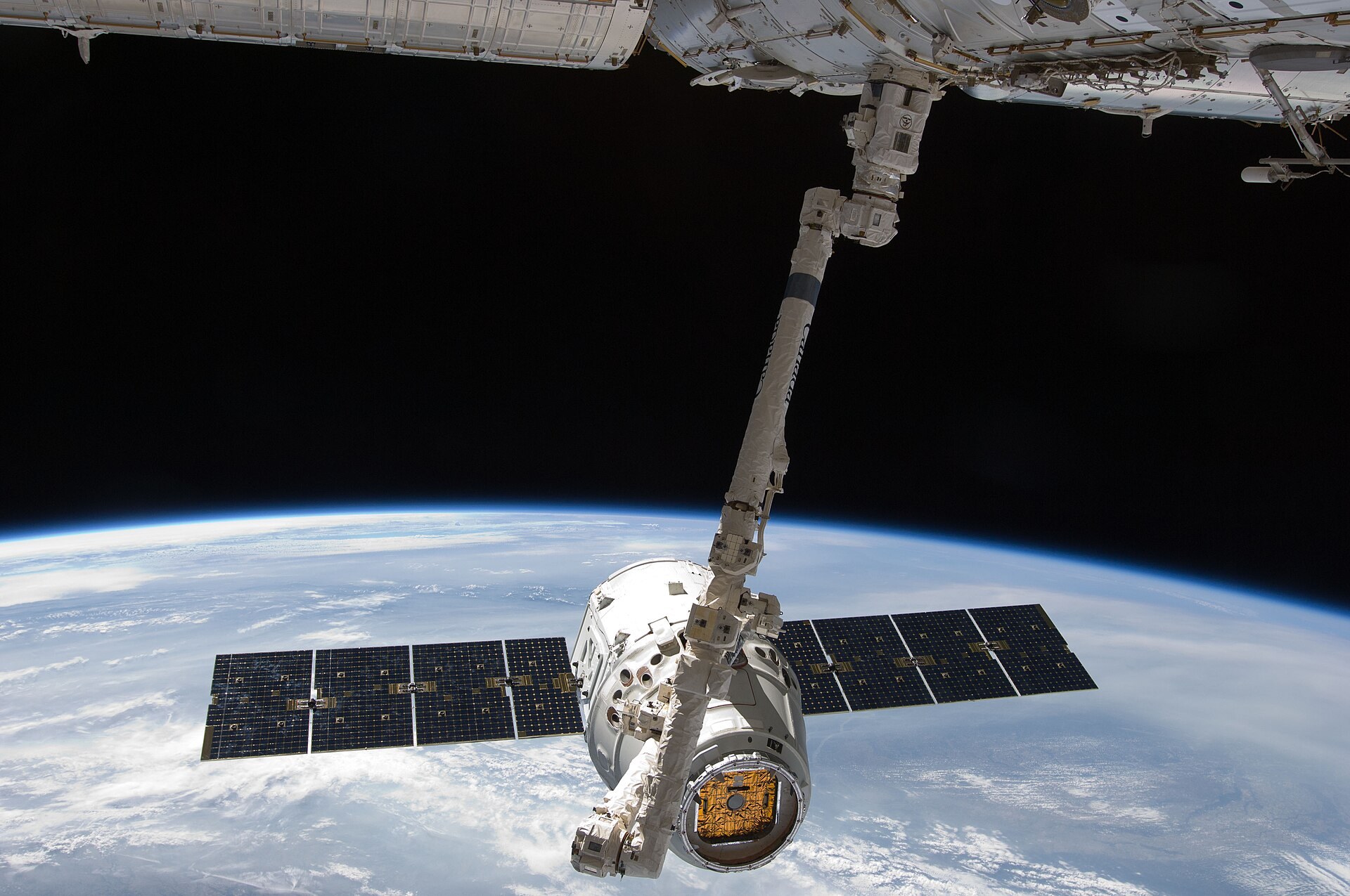
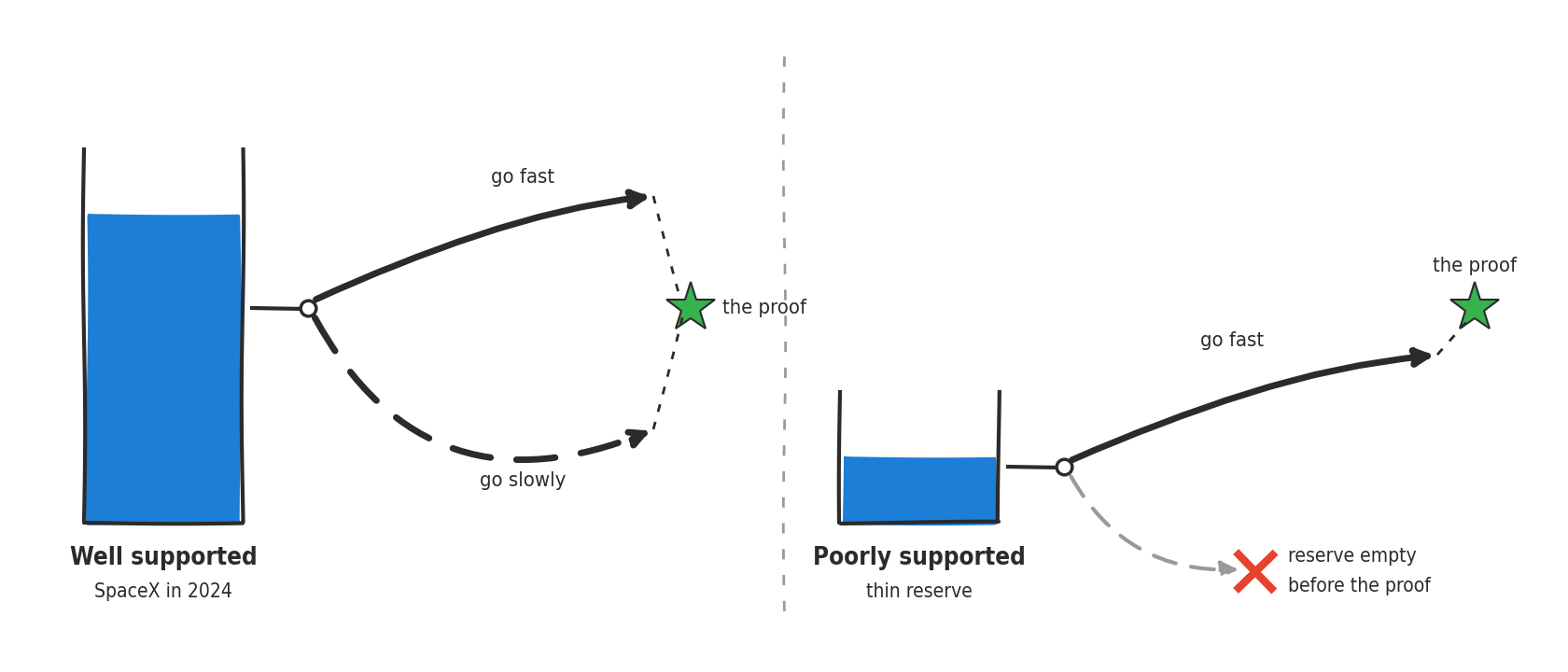
It depends on two things: the reserve the organization holds beyond what the plan requires, and the patience of whoever is paying. Rocketplane Kistler lost its support five months after missing its financial milestone. SpaceX launched three times without reaching orbit, and its president describes a company struggling to make payroll. Ariane 6 absorbed four years of delay, and its support was renewed before it had even flown.
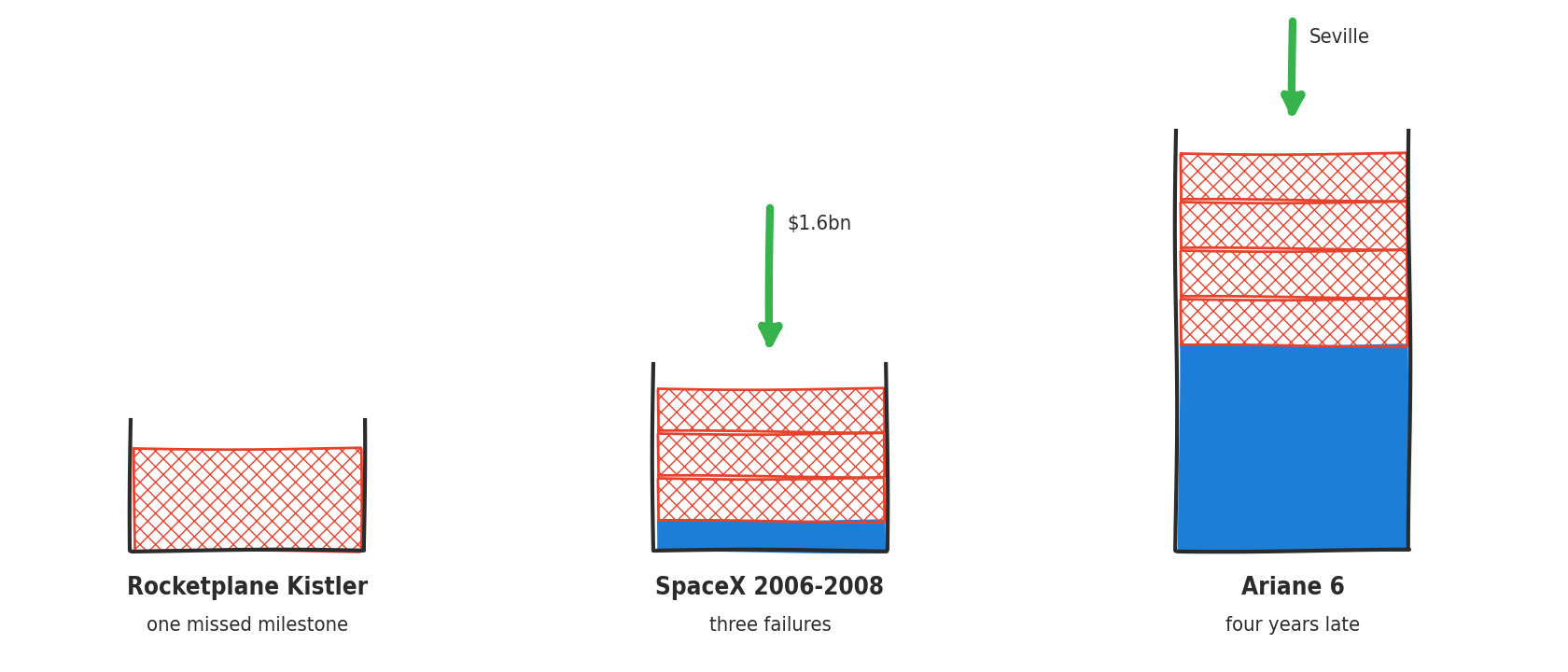
The gap has nothing to do with the engineers' merit. It comes from what each failure takes out of the reserve. When the reserve is thin, a failed test eats up a large share of it, and the organization has no choice but to learn more per dollar spent: cheaper tests, faster decisions, less work that does not serve the next proof. When the reserve is deep, a failure is absorbed, and nothing forces the organization to change its pace.
How the money is paid out weighs as much as the amount. NASA paid after each milestone, roughly one a quarter, at the agreed price. For Ariane 6, the only planned decision point was the one in 2016. The ground test that simulated a complete flight, a long-duration firing, was scheduled for the end of November 2023, nine years after the decision of December 2014.
This is the logic of the V-model: you specify the whole system, build the whole system, then verify the whole system at the end, and the first complete learning loop arrives when development is over. Support paid on proof forces you to cut the work into clear, measurable intermediate objectives. Support committed up front lets you do without them. It does not make you do without them: SpaceX now has a considerable reserve, and Starship keeps advancing through successive tests.
Bruno Le Maire, then France's economy minister, presented the Seville agreement by asserting that this support was comparable to the support SpaceX enjoys. The two amounts do not measure the same thing. NASA funded milestones, then bought missions at a fixed price; Europe funded a development, and now guarantees its operation. But at the moment when each had to prove itself, one had $278 million paid on proof, the other a budget of €3.8 billion for Ariane 6 and Vega C, committed up front.
Room for error has changed sides
In 2024, SpaceX launches 134 Falcon rockets, 38 more than the year before. Eighty-nine of them carry Starlink satellites, the satellite internet network run by SpaceX itself.
The company has become its own biggest customer. Two thirds of its cadence rests on demand it creates for itself, an internal preference that depends on no minister.
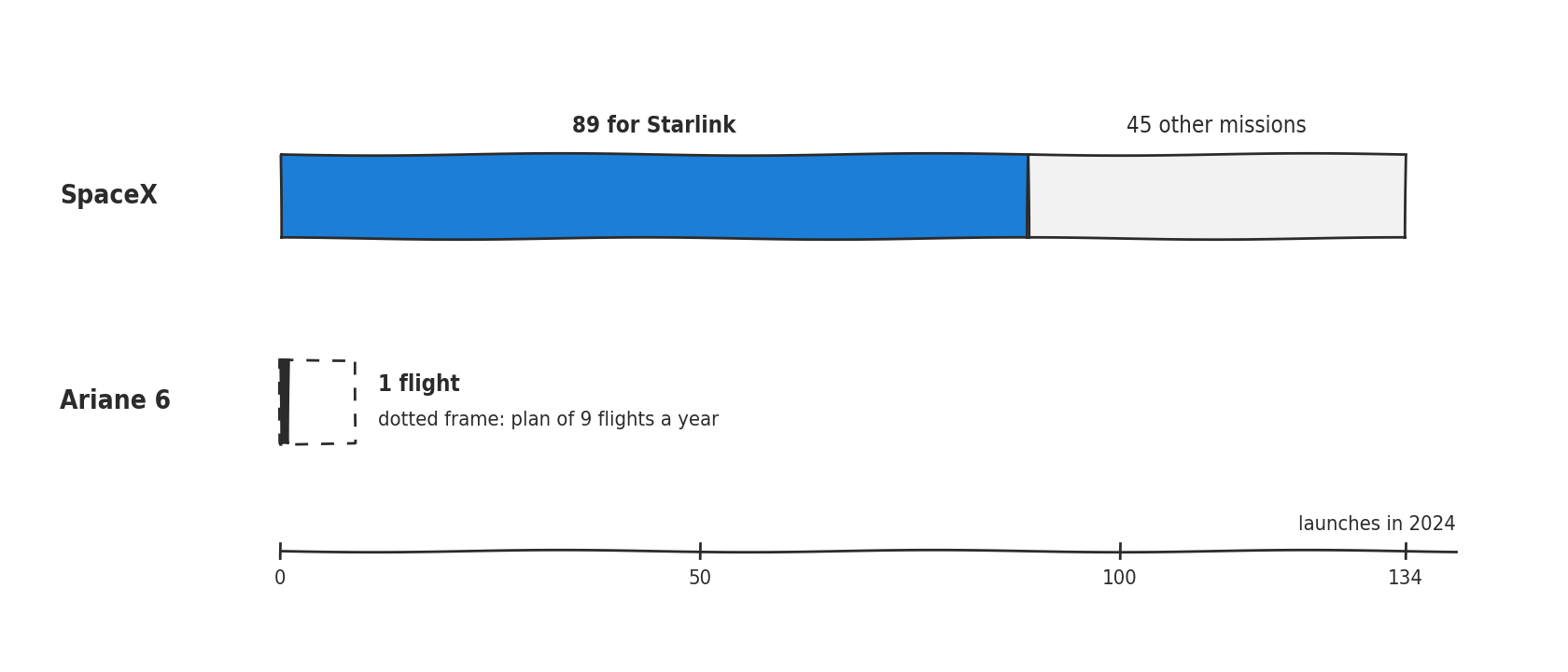
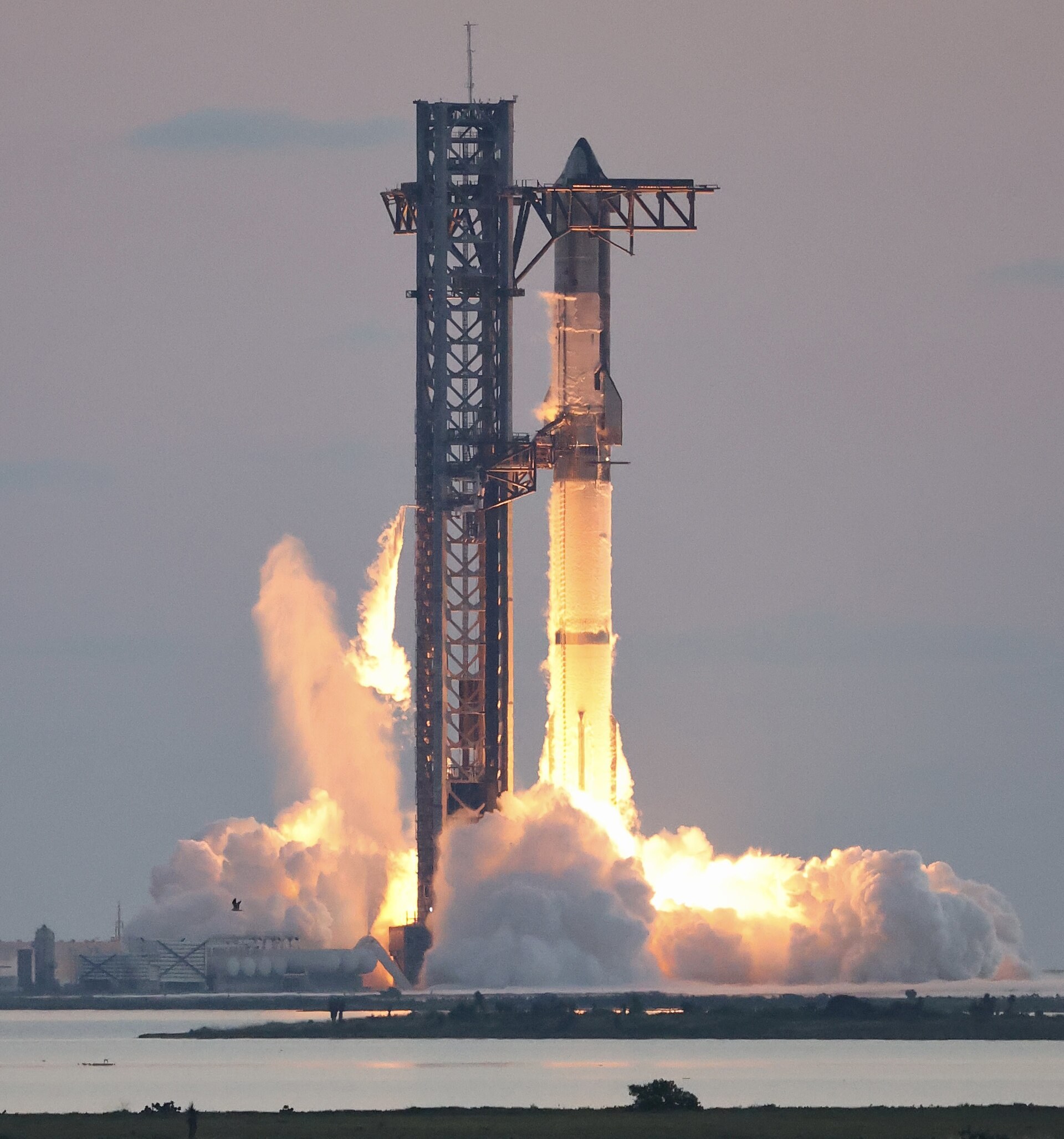
That reserve buys the company room for error it did not have at Kwajalein. In 2025, Starship, its giant rocket still in development, flies five times. The first three flights go wrong: on 16 January and again on 6 March, the upper stage breaks up a few minutes after liftoff; on 27 May, both stages are lost. On 18 June, another vehicle explodes on the ground while being prepared for an engine test. The program carries on.

Meanwhile, Europe has to cut its costs by 11 percent and stick to the plan announced in June 2024: six flights in 2025, eight in 2026, ten in 2027, then nine a year. Ariane 6 flies once in 2024, four times in 2025, and four times between February and August 2026, three of them for Amazon, which is deploying a constellation, that is, a set of satellites working together. On 17 December 2025, two Galileo satellites leave Kourou on Ariane 6, the first of the constellation to fly on the new European launcher.
The positions have been reversed. In 2008, after three failures, SpaceX was struggling to make payroll; in 2025, it loses three Starships in five months and carries on with the program. In 2014, Ariane 6 could absorb four years of delay without losing its funding; since Seville, its support depends on a promised flight rate, and in 2025 it flew four of the six flights announced.
The rule does not depend on geography. In digital technology, it is American companies that hold the deepest reserves. Meta has piled up more than $80 billion in operating losses since the end of 2020 in Reality Labs, its virtual and augmented reality division, which was still losing $4 billion in the first quarter of 2026 on $402 million of sales; the division still exists. In March 2025, OpenAI raises $40 billion in a single funding round. Six months later, Mistral AI, seen as OpenAI's main European rival, raises €1.7 billion, around twenty times less. With such a gap in reserves, a failure does not carry the same weight: the American giant can try, give up and start again; the European challenger has to choose its bets and prove itself faster.
In China and South Africa, the aid falls and the bar rises
SpaceX and Ariane 6 followed this rule without having chosen it. Two public policies applied it on purpose: they announced in advance that aid would fall and that requirements would rise.
In China, the state subsidizes the purchase of electric cars. In 2015, the Ministry of Finance warns that these subsidies will fall every year. In 2016, a scandal reveals that manufacturers have inflated their sales to collect more subsidies; several are penalized. On 29 December 2016, the government rewrites the rule: the subsidy per vehicle will fall by 20 percent every two years, and it will only be paid for cars that meet technical thresholds, first range, then the amount of energy stored per kilogram of battery. In 2020, the minimum range required rises from 250 to 300 kilometers, and the exit timetable is set: minus 10 percent, minus 20 percent, minus 30 percent, then the end of the purchase subsidy on 31 December 2022, after thirteen years and more than 200 billion yuan in subsidies and tax exemptions. The exemption from purchase tax, for its part, is extended.

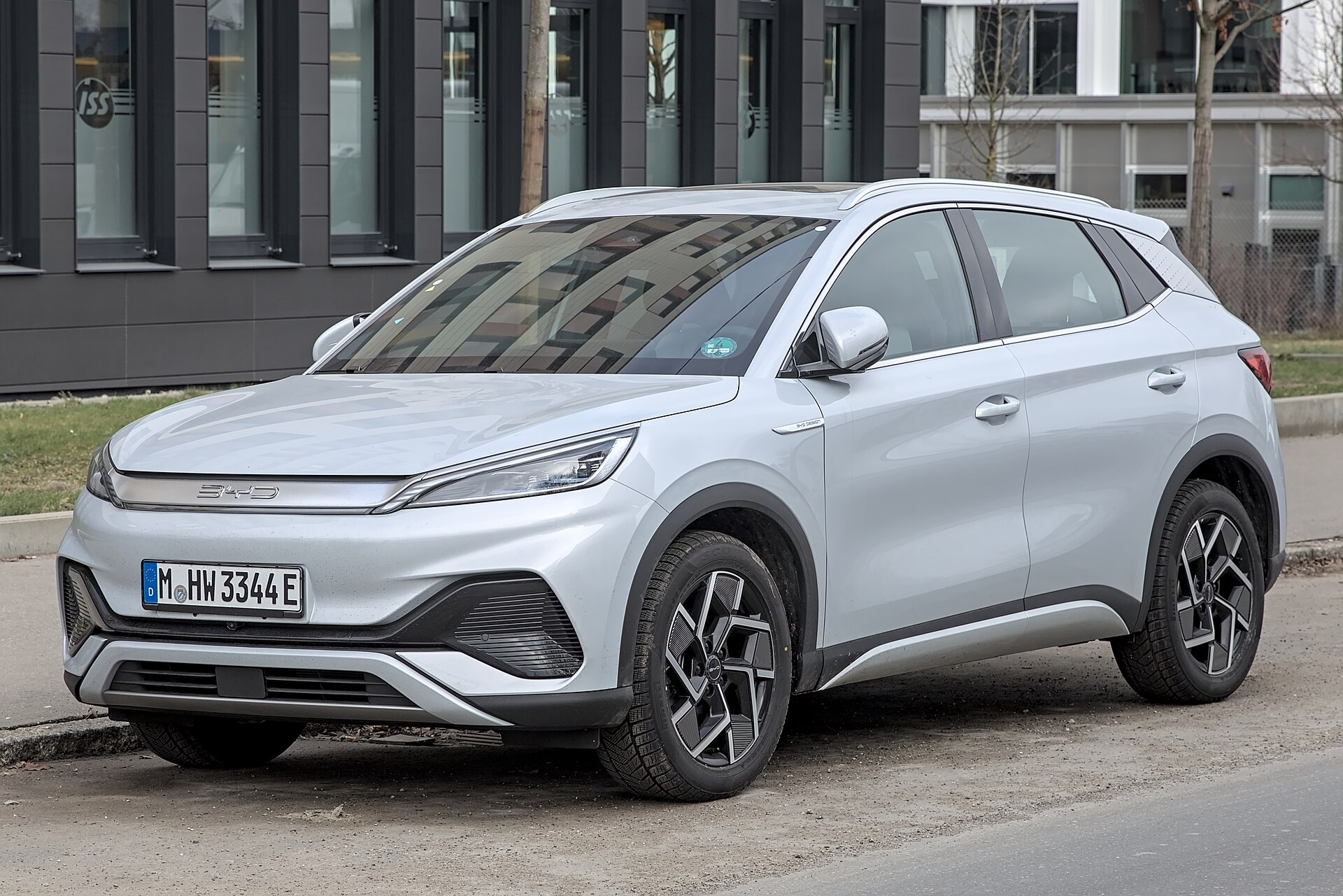
Every year, then, a Chinese manufacturer received less for a car that had to do better. In 2025, the consultancy Jato Dynamics counts 93 Chinese manufacturers out of 169 with less than 0.1 percent of the market. Among those holding on, BYD and Leapmotor have widened their cost advantage by integrating their supply chain.
The tool below sets these data side by side: the national subsidy year by year, the range thresholds, the sales, margins and average cost per vehicle of the manufacturers that publish them, the rule changes and the exits from the market. It opens collapsed; it lets you pick a period, manufacturers and an indicator, then compare before and after each rule change.
This interactive tool needs JavaScript. In short: China’s national subsidy for buying an electric car reaches 55,000 yuan in 2016, falls to 25,000 yuan in 2019, then to 12,600 yuan in 2022, its last year; the minimum range required rises from 80 km in 2015 to 300 km in 2020. Sources: ICCT, electrive, KrASIA, carmakers’ filings with the SEC.
In South Africa, the renewable electricity procurement program launched in 2011 works through successive tenders: the state buys, for years on end, the electricity of the cheapest producers. The guaranteed price per kilowatt-hour is therefore the support, and it falls from one round to the next; a producer that cannot keep up loses the next tender. Over the rounds, the average price of solar power fell by 75 percent and that of wind power by 54 percent.
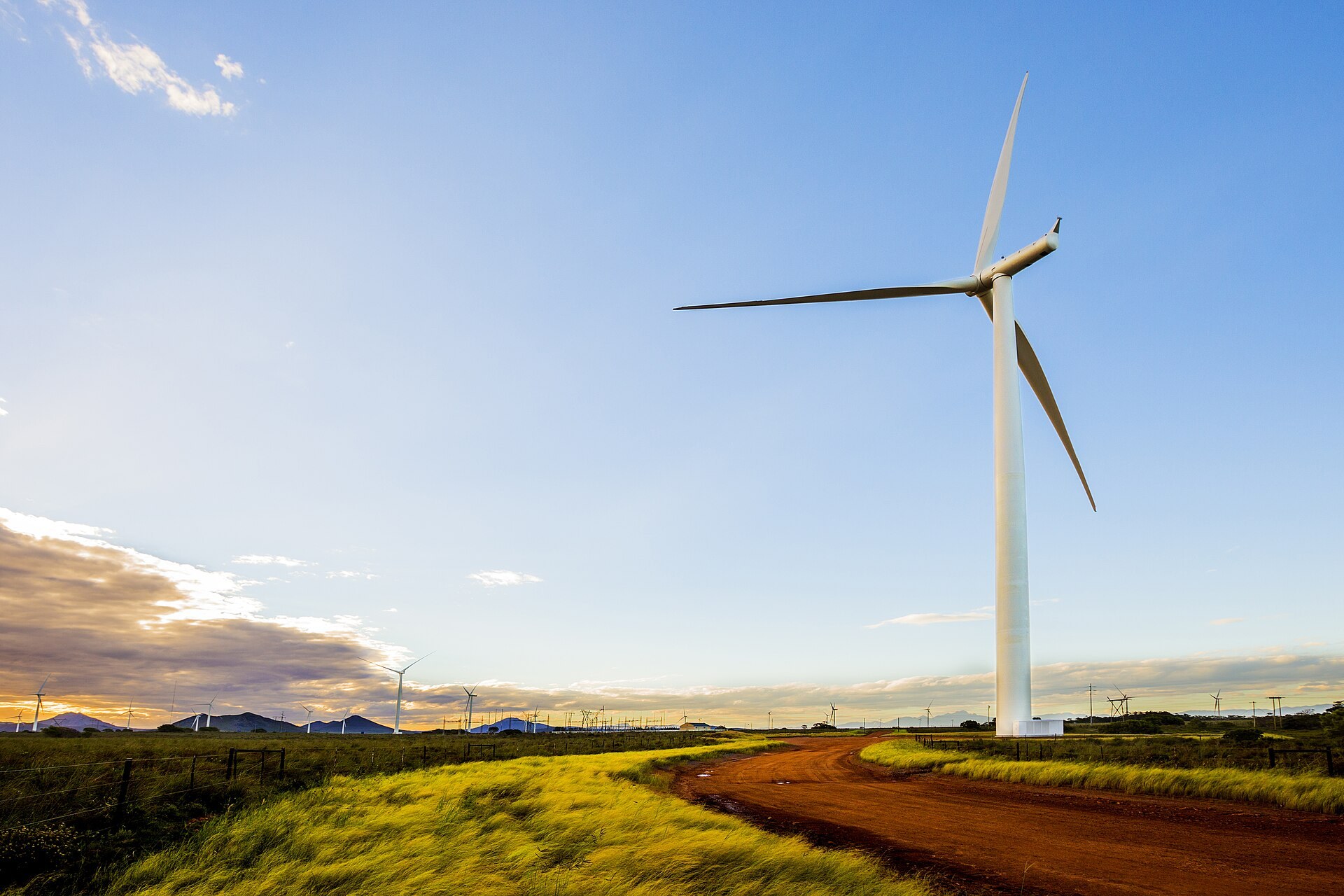
The two cases also show the limits of the rule. Part of the South African fall comes from the world price of solar panels and wind turbines, which collapsed over the same period: performance is not only made at home. The second case shows that public support can stop even once the proof has been delivered. In South Africa, the state-owned power utility Eskom is the only buyer of this electricity: it signs the contracts, and the state guarantees its debt. In 2015, the tenders name new winners, chosen for their price. In 2016, Eskom announces that it will sign no more contracts with these producers. It cites a production surplus, caused by falling demand, and the price of the contracts, which it considers too high: it does not want to pay more than 62 South African cents per kilowatt-hour. The Treasury fears for its balance sheet and for the country's credit rating. Critics also suspect the utility of keeping its purchases for coal and nuclear power.
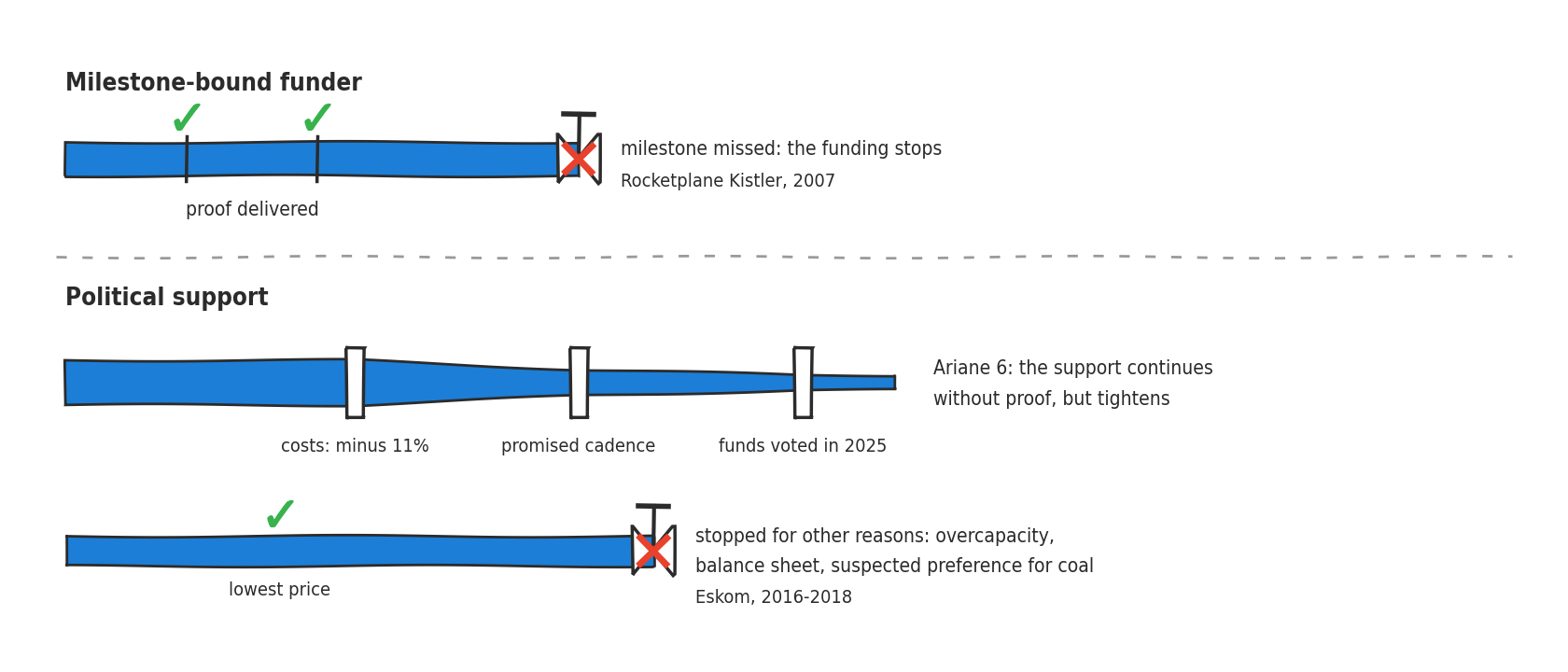
In February 2017, President Jacob Zuma announces that he will make Eskom sign; nothing gets signed. It takes a change of president. On 4 April 2018, the new energy minister, Jeff Radebe, has the 27 pending contracts signed, 2.3 gigawatts and 56 billion rand of investment, despite a court challenge by the metalworkers' union NUMSA and an association seeking to block them. The producers had delivered the proof asked of them, the lowest price; their support was suspended for nearly two years for reasons of overcapacity, public finances and energy policy choices.
Inside a group: Loon, at Alphabet
The rule also holds inside a company. In a group, a project's support comes from the floor above: a budget voted again every year, a charter that sets its scope, a sponsor who defends it, as the previous episode showed. The story of Loon, at Alphabet, Google's parent company, shows this support at each of its stages, and the proof it demands at each one.
In 2011, a team at X, Google's lab for very long-term projects, starts work on balloons that would relay a mobile network from the stratosphere over regions with no cell towers. The project is unveiled to the public in June 2013; Shy Robotics covered it at the time in “Google X, le projet Loon et l'Internet pour tous ?” [Google X, Project Loon and internet for everyone?, in French]. At that stage it lives on the group's budget, and the group has never published how much it spent on it; the proof expected is technical. That proof is delivered: the balloons navigate precisely, relay one another as a network and last more than a year in the stratosphere.

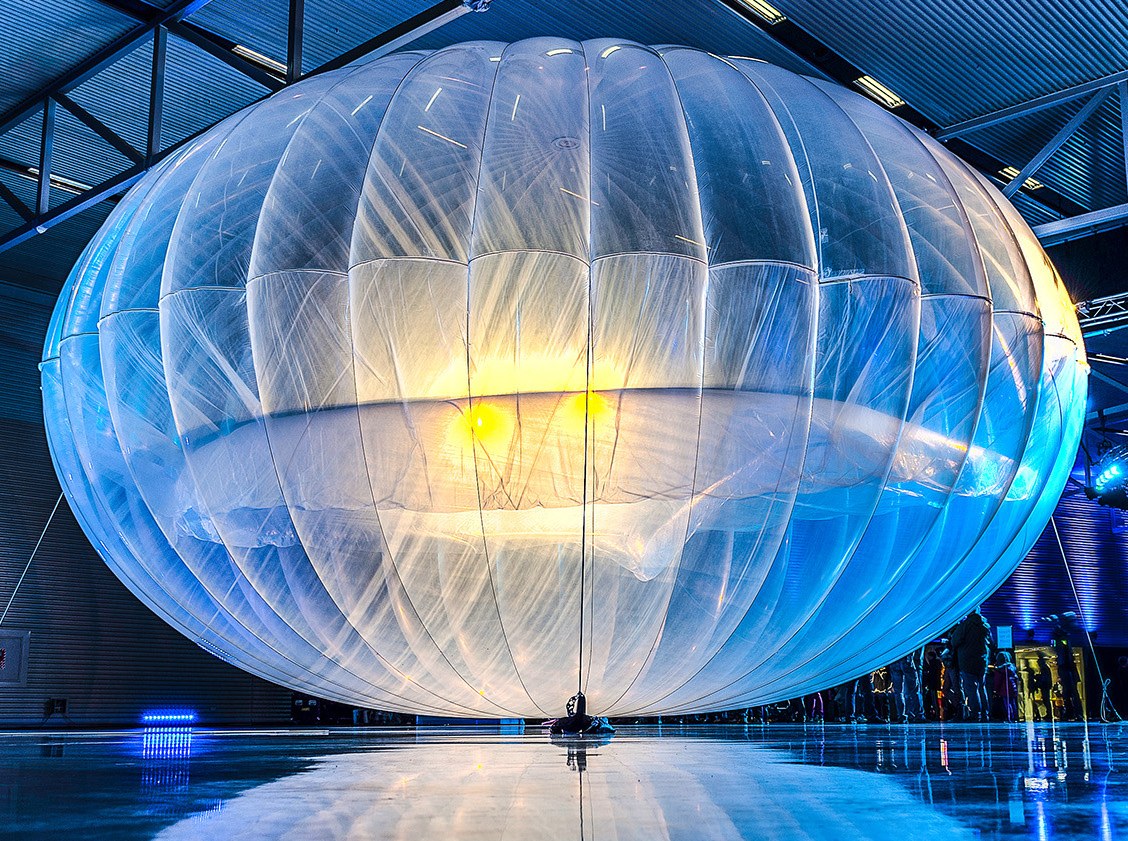
In July 2018, Loon becomes a separate company within Alphabet, under a strategy that asks these projects to pay their own way little by little. The proof required changes in nature: Loon now has to show that customers will pay. In April 2019, it finds outside money to take over, $125 million from HAPSMobile, a SoftBank subsidiary. In 2020, with the operator Telkom Kenya, it opens its first commercial service, over some 80,000 square kilometers of central and western Kenya.
By the end of 2020, SoftBank's money has been spent, and Loon turns back to Alphabet to stay solvent. In January 2021, Astro Teller, who runs X and chairs Loon's board, recommends that the group stop funding it. Loon's chief executive, Alastair Westgarth, gives the reason: the company has not found a way to bring its costs down far enough to build a sustainable business.
Loon had delivered the technical proof; it lacked the proof the next floor up was asking for, as Rocketplane Kistler did in 2007. For a product team, two questions follow: how much time is left before the next budget round, and what proof will that round demand? It is often no longer the proof that won the previous budget.
Two objections
The first: plentiful capital also buys efficiency. SpaceX proves it in 2024, with the deepest reserve in the industry and the highest cadence. Ample support condemns nobody to slowness. It only removes the constraint that forces you to move fast. A well-supported organization can choose speed; a poorly supported one has no choice.
The second: political support does not wear out the way an investor's does. Ariane 6 was renewed without proof, which a funder bound by milestones, such as NASA in 2006, would not have done, and Eskom froze contracts that had proved their performance. The objection is fair. A state also provides support for the sake of sovereignty, jobs or the balance between its regions, and those reasons have deadlines of their own. But even then, the wear shows: it takes the form of tougher conditions rather than a withdrawal.

What this article does not say
It does not say that Ariane 6 has failed. The launcher flew nine times between July 2024 and August 2026, and the Seville arrangement runs until 2030.

It does not say that SpaceX owes its success to frugality alone. Its president has since stated that without NASA's support, the company would not be what it has become.
Nor does it say that small support is better than large support. Rocketplane Kistler had received an agreement worth three quarters of SpaceX's, and it disappeared.
Your own countdown
Three questions to ask at your next product review.
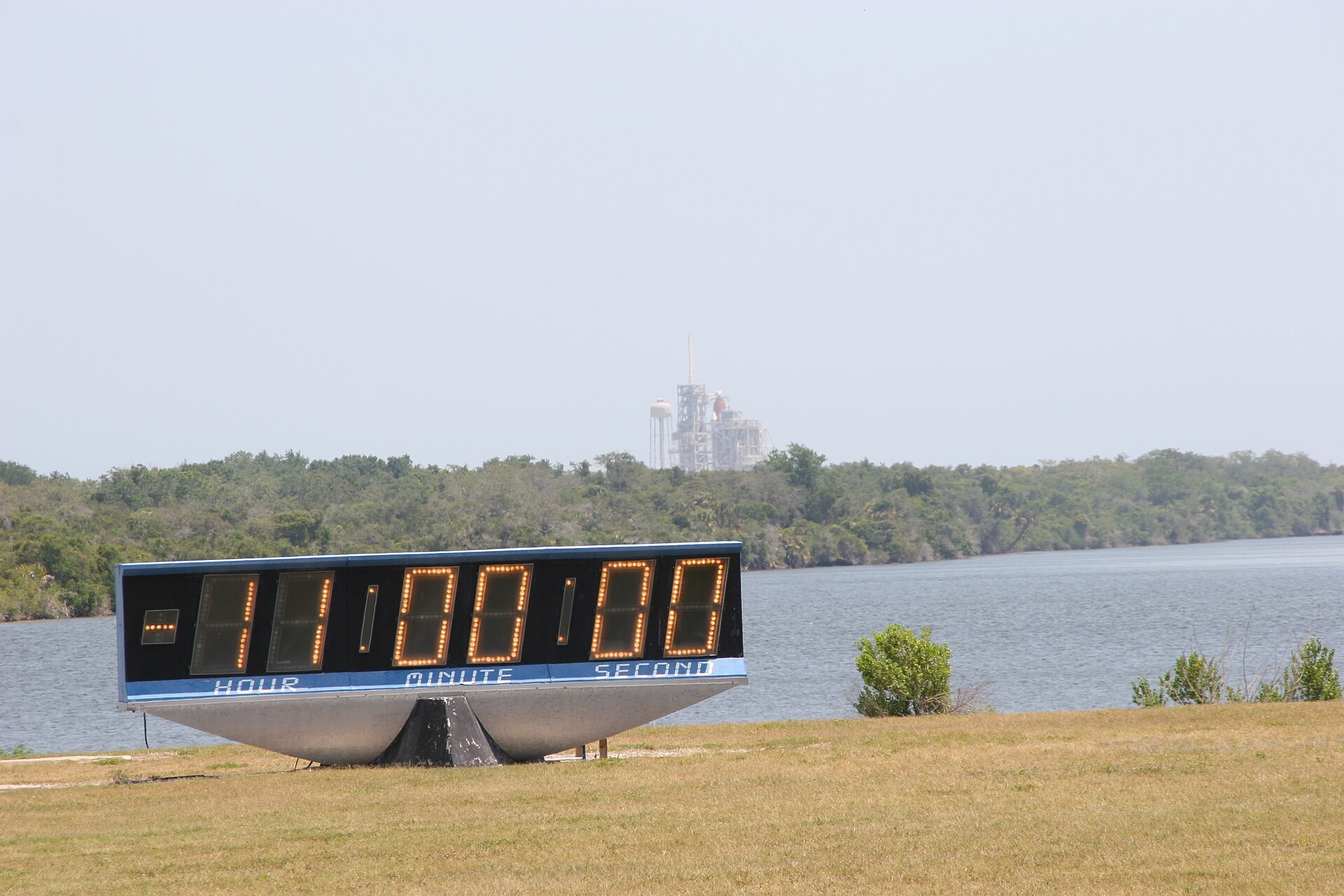
Who supports you, and until when? An annual budget, a funding round, a framework contract (the contract that sets the terms of future orders), a subsidiary's charter, a sponsor's mandate: each one has an end date. Write it down.
What proof will the next round of support demand, and who will judge it? NASA had written it into its milestones. Sort yours by type of risk (need, desirability, feasibility, viability) and put first the one that can stop you, even if it is not technical; the grid of test types used in an impact factory (in French) helps to name them. If nobody at your company can state that proof, you are working for the current reserve, not for the next one.
How many failures can you absorb between now and then? Count your releases to production over the last twelve months and multiply by the time left before the deadline. If the result fits on the fingers of one hand, your margin for error is SpaceX's in 2007, and your organization has to work accordingly.
Your countdown
Model: attempts left = production releases over the last twelve months × months left ÷ 12, rounded down. It assumes your pace stays what it was over the past year; it says nothing about what each attempt proves.
An example, without the calculator: a team that shipped 6 times in twelve months, and whose support runs out in 8 months, has 4 attempts left, as many as the Falcon 1 launches SpaceX had to reach orbit.
27 August 2026
At 5:11 pm Kourou time, an Ariane 6 lifts off with a European weather satellite. It is the launcher's first mission to geostationary orbit, 36,000 kilometers up, where a satellite stays above the same point on Earth.

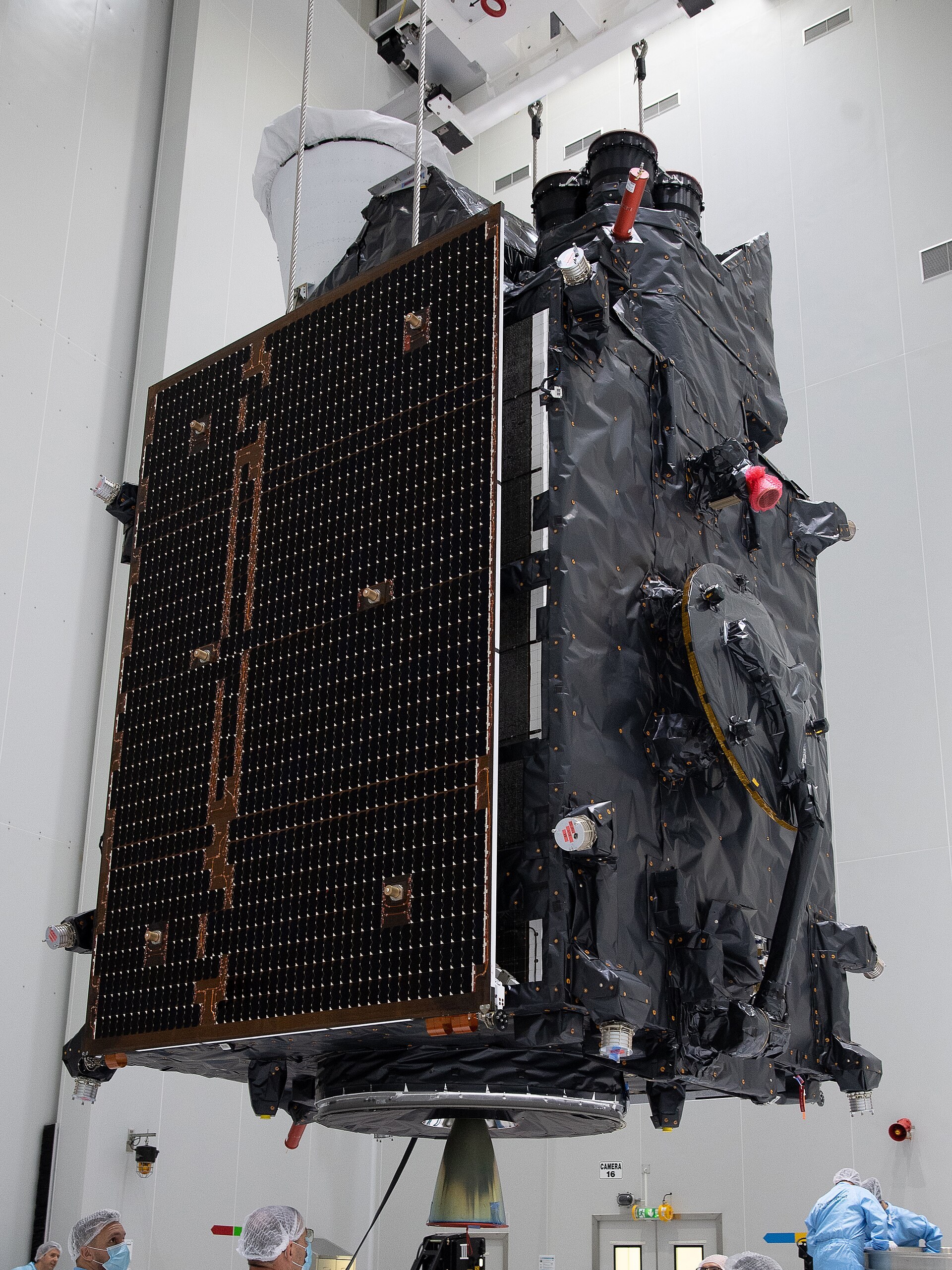
The same day, ESA announces the first contracts of the European Launcher Challenge created in Seville: €197.8 million for Germany's Isar Aerospace, €186.9 million for Rocket Factory Augsburg, €158.9 million for Spain's PLD Space. The money is conditional. Each company must reach orbit before the end of 2027 for the agency to start buying launches from it. Another finalist, Scotland's Orbex, has signed nothing: it went into administration in February, after its fundraising failed.
Lucia Linares, head of launch strategy at ESA, sums up the contract: the agency has set the challenge, and it is up to the candidates to prove they can deliver. In January 2024, Josef Aschbacher was already saying that Europe had learned it could reproduce the American system that produced SpaceX and Falcon 9.
Three European companies now stand where SpaceX stood in August 2006: support of a few hundred million, paid on proof, with a date.
These programs have neither cost nor returned the same thing. The comparison below sets side by side the public and private money invested in each, the missions obtained, the number of missions needed to absorb the cost of development, and the cost of each mission after that; it opens collapsed.
This interactive comparison needs JavaScript. In short, according to NASA, SpaceX and NASA put $850M into developing Falcon 9 and Dragon, spread over 20 cargo missions; Orbital, NASA and Virginia put in $1,015M, spread over 11 missions. Ariane 6 cost more than €4bn of public money plus €400M promised by industry, for 9 flights by the end of August 2026. Sources: NASA, NASA Office of Inspector General, ESA, trade press.
You do not choose the size of the support you are given. You choose what you do with it before it runs out.
Network and politics have crossed paths throughout these seven episodes, sometimes under the same name. The next episode pulls them apart: what a network carries, and what only a political decision can impose.