

Fifth episode of a nine-episode series on the weight of politics in the success of a product. The first four showed that a public rule opens or closes a market, and that it is written in rooms where the companies it governs have a seat. What remains is how you get in.

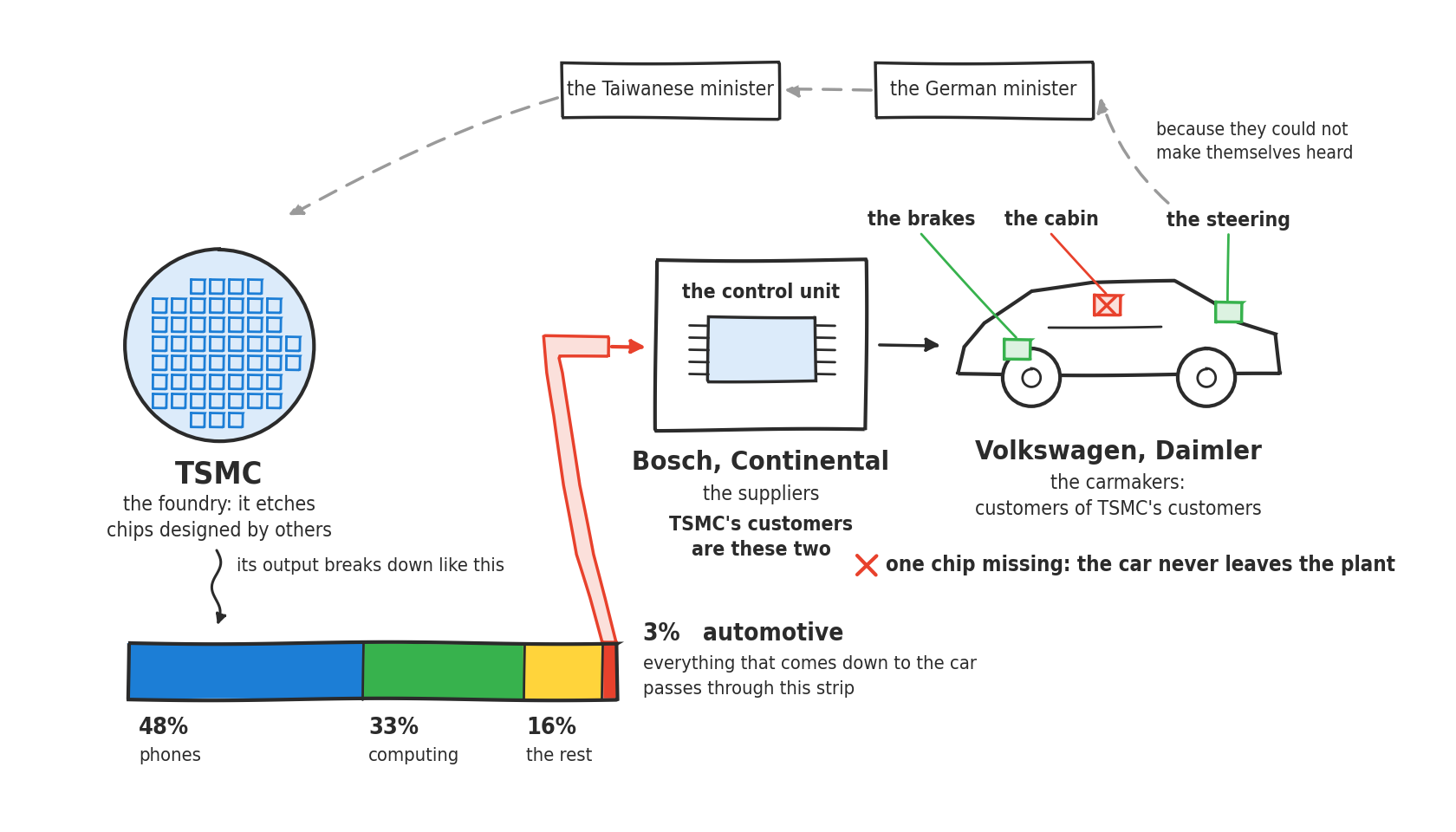
In January 2021, car assembly lines stop one after another. Volkswagen, Ford, Toyota, Nissan, Subaru and others cut or suspend production. They are short of semiconductors, the electronic components etched onto silicon wafers that now control a car’s steering, brakes and cabin.
The manufacturer that etches them is TSMC, Taiwan Semiconductor Manufacturing Company. It is the world’s largest foundry, that is, a plant that manufactures chips designed by others. The carmakers want it to put their orders first.
The German economy minister, Peter Altmaier, writes to his Taiwanese counterpart, Wang Mei-hua, asking her to push TSMC to produce more for German carmakers. The Taiwanese ministry will wait for the letter before deciding whether to contact the company again. It has already received requests through diplomatic channels from the United States and the European Union at the end of the previous year, then from Germany and Japan.
In 2020, automotive accounted for 3 percent of TSMC’s sales. Mobile phones accounted for 48 percent, and high-performance computing for 33 percent.
The balance of power fits in those three figures. Carmakers with combined revenues in the hundreds of billions of euros, employing millions of people, and accounting for less than a thirtieth of the order book of the company they depend on. A Taiwanese official sums up how little room there is to maneuver: these are dealings between private companies.
And the request itself was badly framed. An industry professional interviewed by the American Chamber of Commerce in Taipei puts it plainly: nobody knows exactly which semiconductors each carmaker needs. TSMC’s customers are not Volkswagen and Daimler but their suppliers, Bosch and Continental.
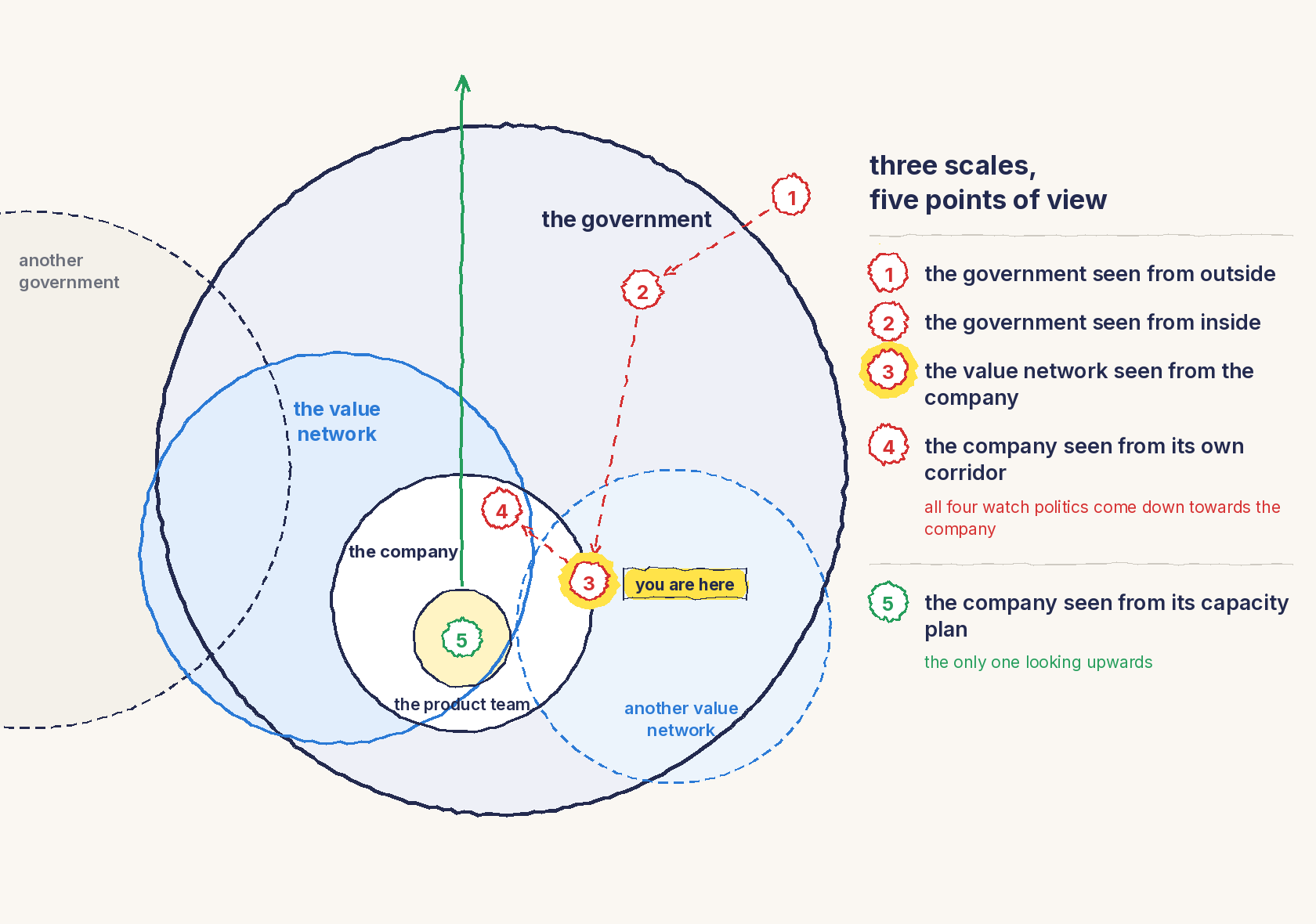
The carmakers wanted something from a company they were not even customers of. They had no way of getting it themselves. Their requests were addressed to organizations that owed them nothing. Suppliers, like customers, funders, laboratories and trade federations, are links in the value network.
None of these links grants anything out of goodwill. They do it when there is something in it for them. And unfortunately, that calculation depends on how much weight you carry with them. Could there have been a way to carry more? To make the requests count for more?
The physics of the network, described in 1979
In March 1979, a young associate professor at Harvard Business School publishes his first article in the Harvard Business Review. His name is Michael Porter, the piece is titled “How Competitive Forces Shape Strategy,” and it runs to nine pages.


His thesis: competition is not played out only between direct rivals. Five forces determine who captures the value of an industry: rivalry among established competitors, the threat of new entrants, the threat of substitute products, the bargaining power of customers, and the bargaining power of suppliers.

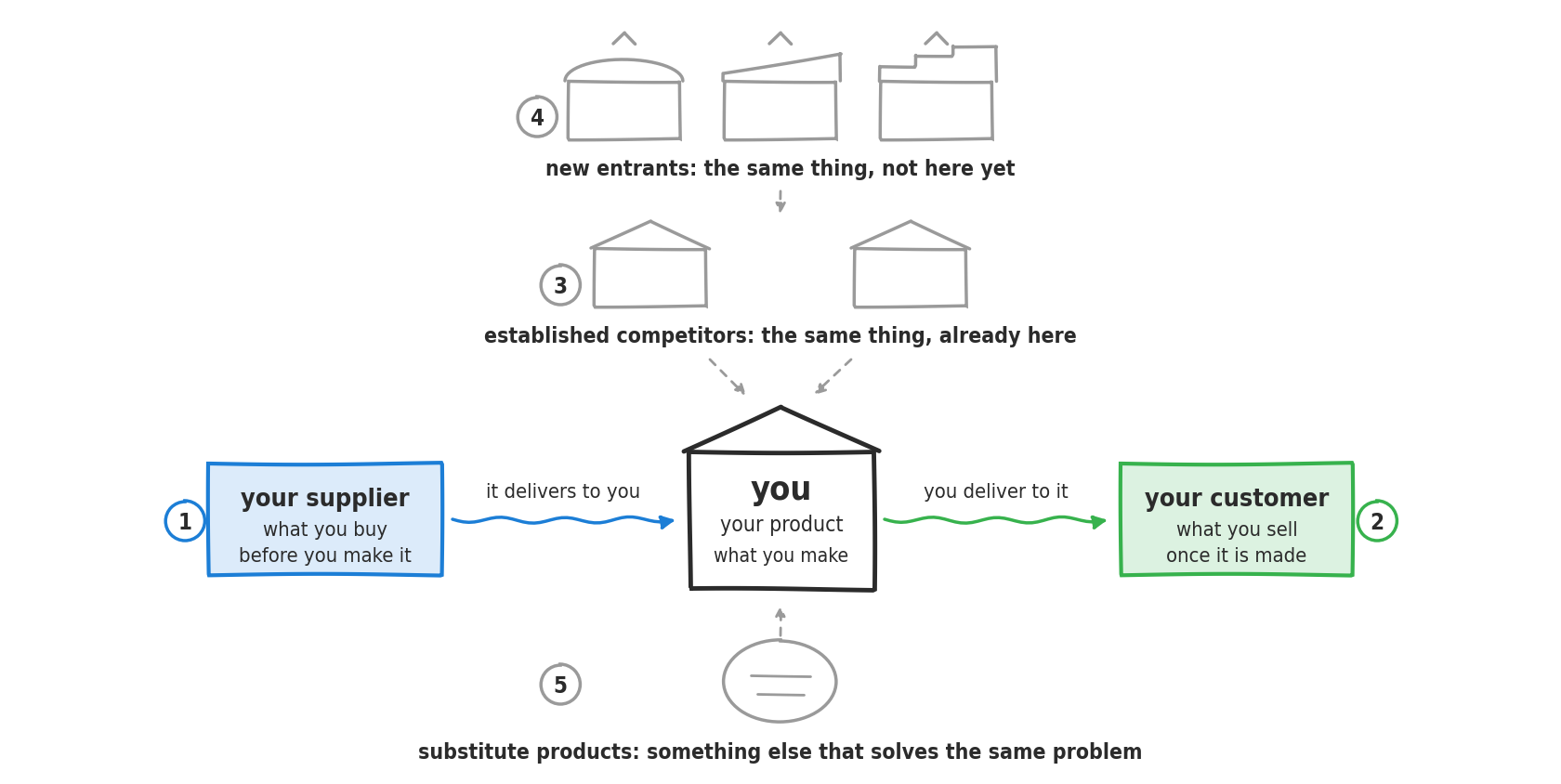
Between that first version and the one Porter published in the same journal in 2008, two criticisms grew. The first came from game theory. In 1996, Adam Brandenburger, of Harvard Business School, and Barry Nalebuff, of Yale, gave the value network its name. They placed four players around a company: its customers, its suppliers, its competitors, and a fourth they call the complementor. The complementor sells a product that makes yours more useful, as the software publisher does for the computer maker. Their book reminds us that a customer or a supplier is also a partner with whom you create value before you share it out. Two of the cases that follow show it: in one, a customer funds its supplier; in another, a customer sends its engineers to get its supplier running again.
The second said the state was missing. In 1995, the Stanford economist David Baron wrote that a strategy must cover both the market and the nonmarket, that is, everything that passes through governments, regulators, the media and public opinion, and strategy textbooks got into the habit of adding the state as a sixth force. Porter refused in 2008: in his view, government intervention is neither good nor bad in itself for an industry’s profitability, and it matters through what it changes in the five forces. A regulation that requires a license raises the cost of entry, and so acts on the threat of new entrants. The state is not one more force; it is the hand that moves the others. The five forces therefore remain five.
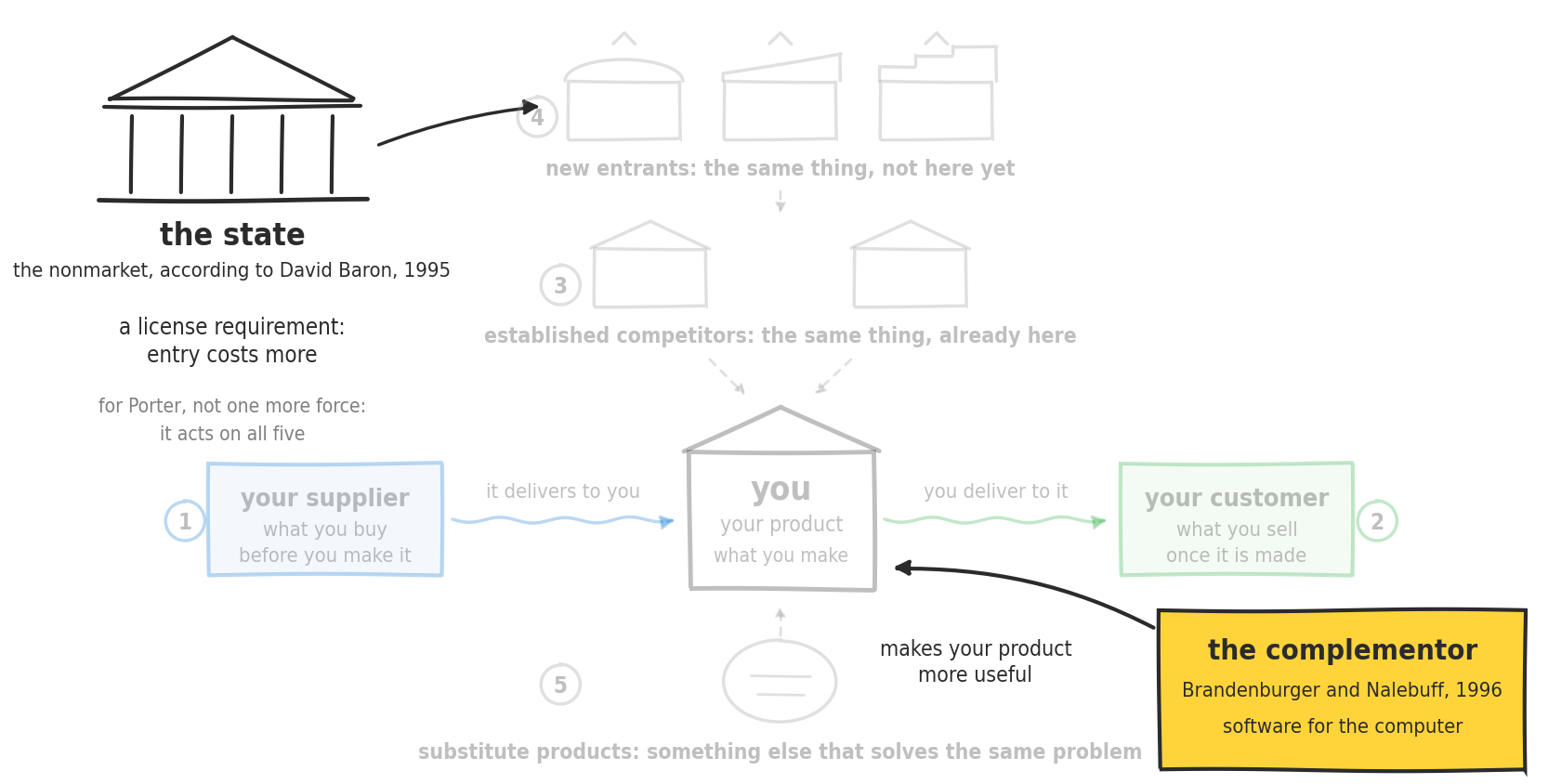
Three of these forces are often confused, yet two questions tell them apart: does it sell the same thing as you, and is it already here? An established competitor sells the same thing, today. A new entrant will sell the same thing, but has not arrived yet. A substitute solves the same problem with something other than your product.
For a rail operator: another operator on the same line, an operator that has just been granted its license, and the video call that makes the journey unnecessary.
Two of these five forces concern us here, the ones that play out along the chain: the power of the supplier and the power of the customer. They obey a rule that comes as a surprise the first time you apply it. Bargaining power hardly depends on absolute size. It depends on the share each party represents for the other.
Hence a test you can run on a single sheet of paper, for each of your ten main suppliers and each of your ten main customers: what share of revenue do you owe each other?
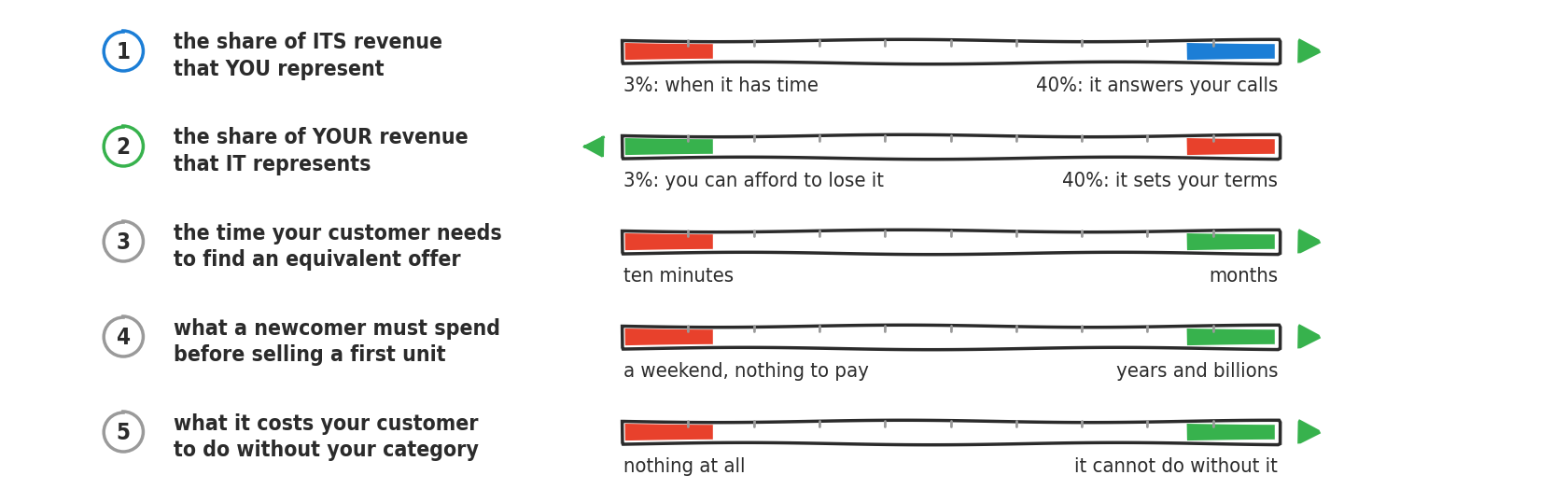
A supplier to whom you bring 40 percent of its business answers your calls. A supplier to whom you bring 3 percent will answer you when it has time. The carmakers discovered this figure in January 2021, at the same moment their own customers discovered the delivery times.
The other three forces can be measured too. The questions that follow are one way of putting numbers on them.
For established competitors: how long does it take your customer to find an offer equivalent to yours? For new entrants: how much money, and how many months, does someone starting from scratch need before selling a first unit? For substitute products: what does it cost your customer to do without your category altogether?
These three questions run in the same direction: the lower the answer, the stronger the force, and the less leverage you have. The first two scales, those of the chain, do not read that way. Weighing heavily in a supplier’s revenue makes you strong; a customer weighing heavily in yours makes you dependent. The favorable side therefore changes from one scale to the next, and that is the first trap of the exercise.

Three companies show what this calculation changes, in the Netherlands, in Japan and in Texas: a customer that pays to secure its only supplier, customers forced to rescue theirs, and a supplier that depends on a single customer.
Veldhoven buys a quarter of its supplier
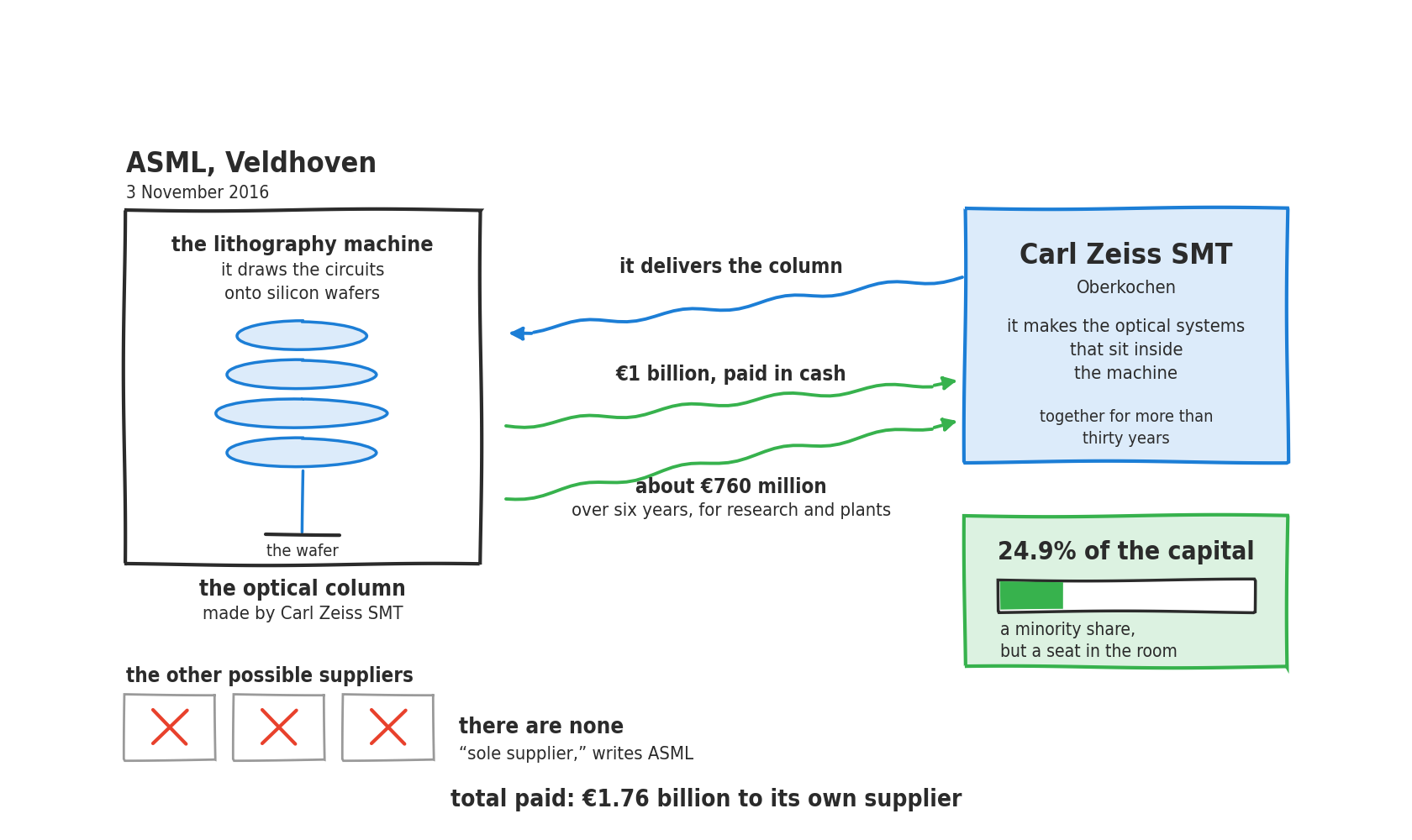
On 3 November 2016, in Veldhoven in the Netherlands, the equipment maker ASML announces that it is buying 24.9 percent of Carl Zeiss SMT, the subsidiary of the German optics group Zeiss based in Oberkochen. The price is €1 billion, paid in cash. The two companies state in their joint press release that no further exchange of shares is planned or agreed.
ASML makes the lithography machines that draw circuits onto silicon wafers. Carl Zeiss SMT makes the optical systems inside those machines. The two companies have worked together for more than thirty years, and their press release says so in its opening lines.


The stated aim is to fund the next generation, known as high numerical aperture, an optical system that captures light over a wider angle and can print finer patterns. At the same time, ASML commits to funding its supplier’s research and industrial investment to the tune of about €760 million over six years.
A customer that pays €1.76 billion to a supplier is not being generous. The sum is the accounting translation of a sentence ASML itself wrote later, in a report filed with the US securities regulator: Carl Zeiss SMT is its sole supplier of the optical columns its machines cannot do without.
Sole supplier. Not main, not preferred. Sole.
In the vocabulary of 1979, ASML is a company that dominates its market and is structurally dependent upstream. A single supplier able to deliver, no substitute possible within any useful time frame, and a technology whose development costs more than that supplier can carry alone.
ASML’s answer is neither to negotiate harder nor to look for a second source. It is to pay so that its supplier can keep up, and to take a minority stake so as to sit where the trade-offs are made.
What ASML is buying is not a quarter of a company. It is the certainty that the industrial proof of the next generation will exist, and that ASML will have it first.

Could ASML have calculated that quarter? No published formula says whether to take a stake in a partner, or how large a stake to take. Research offers three conditions and one limit.
Across more than 10,000 customer-supplier relationships, Edward Fee, Charles Hadlock and Shawn Thomas find two reasons that lead a customer to take a stake in its supplier: a contract that cannot foresee everything, and a supplier that struggles to raise finance. Jeffrey Allen and Gordon Phillips supply the third: a stake creates the most value for the company held when it comes with an alliance or a joint venture, especially in research-intensive industries. ASML ticks all three boxes. An optical system still to be invented cannot be described in a contract, Zeiss could not bear its cost alone, and the billion comes with €760 million for its research and its plants.
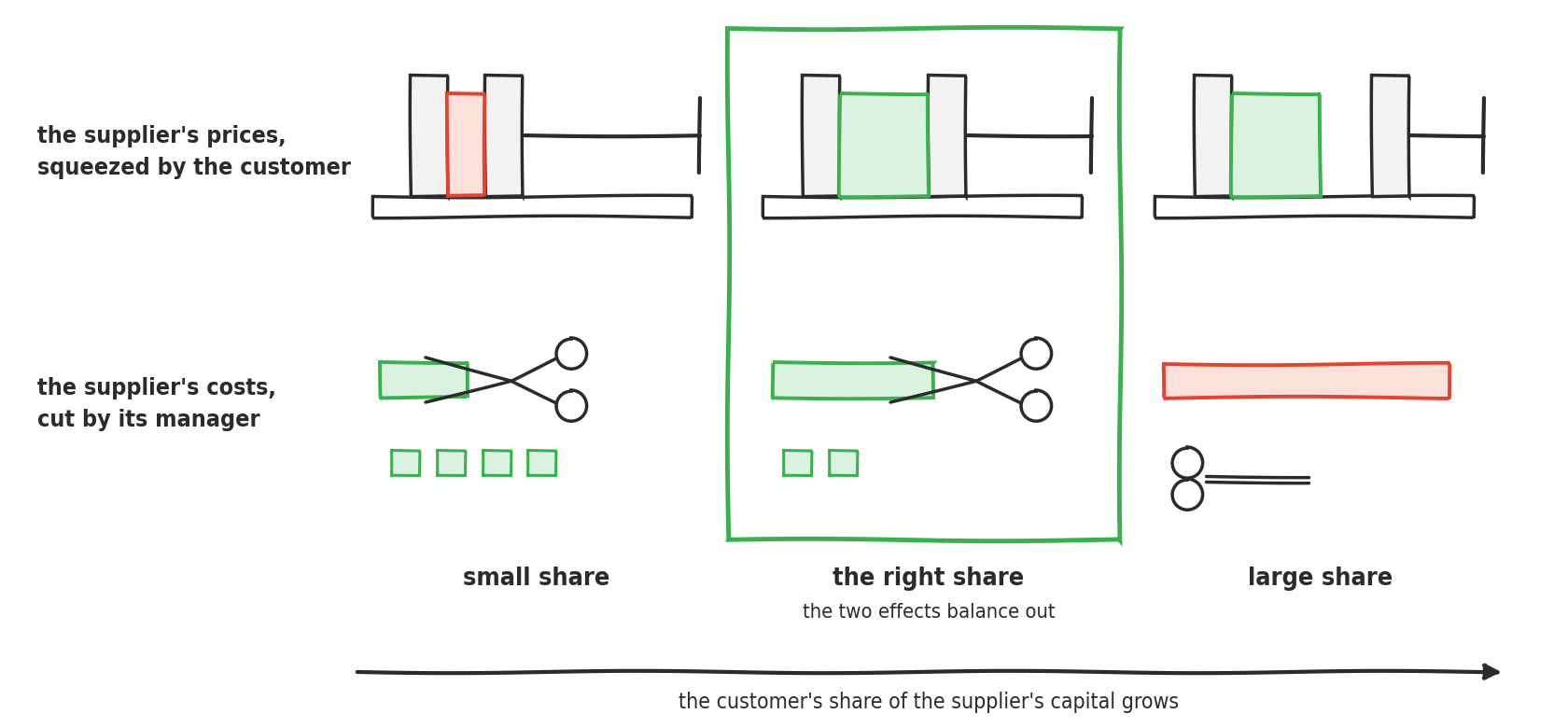
The limit was described by the economist Michael Riordan in 1991. The more of its supplier a customer owns, the less interest it has in squeezing it on prices, since it pays part of the supplier’s costs. But the less interest the supplier’s manager has in cutting those costs, since the manager no longer keeps all the profit. The right share is the one where the two effects balance out. Fee, Hadlock and Thomas find this in the data: in many relationships, the useful size of a stake levels off.

The only reference figure comes from accounting. The international standard IAS 28 presumes that from 20 percent of the voting power, the investor has significant influence, that is, the power to take part in the company’s major decisions without controlling it. With 24.9 percent, ASML crossed that threshold. It is not an optimum, it is a door. For a supplier that would like to take a stake in its customer, only Allen and Phillips’s findings apply: they cover any company that takes a block of shares in a business partner.
That leaves the arithmetic. By paying €1 billion for 24.9 percent, ASML was in effect valuing Carl Zeiss SMT at about €4 billion. If you value your partner at less than your price implies, the relationship has to earn you the difference. The calculator below does that sum. It is a tool proposed here, not a published formula.
A tool proposed here, not a published formula. It does arithmetic on your figures and assumes that every share carries the same right to profits. The mechanism of the two effects is the one Michael Riordan described in 1991; the 20% threshold comes from the IAS 28 accounting standard. The calculation does not tell you where the right stake lies: that depends on how much each effect weighs in your relationship. The last box summarizes, without turning them into figures for your case, the findings of Jeffrey Allen and Gordon Phillips (402 stakes of at least 5% taken by American companies between 1980 and 1991, Journal of Finance, 2000), of C. Edward Fee, Charles Hadlock and Shawn Thomas (Journal of Finance, 2006), of I.-M. Haw and co-authors (American customer-supplier pairs from 1982 to 2017, Journal of Operations Management, 2023, based on the published abstract) and of Matthias Hunold and Shiva Shekhar (theoretical model, Review of Industrial Organization, 2022).
Kashiwazaki, or two hundred engineers sent to a supplier
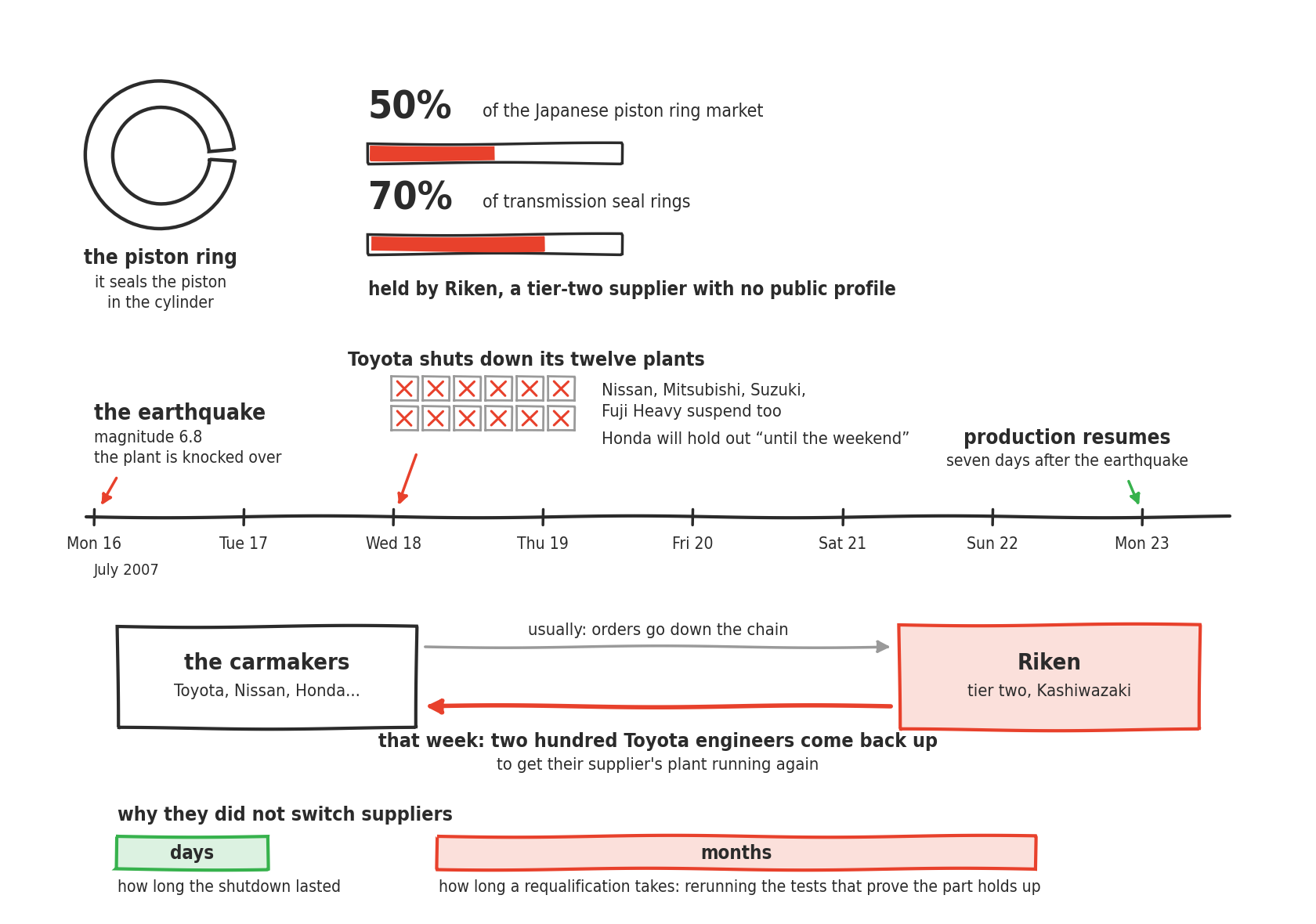
On Monday 16 July 2007, a magnitude 6.8 earthquake strikes Niigata Prefecture, on the west coast of Japan. Nine people die. The city of Kashiwazaki lies close to the epicenter.


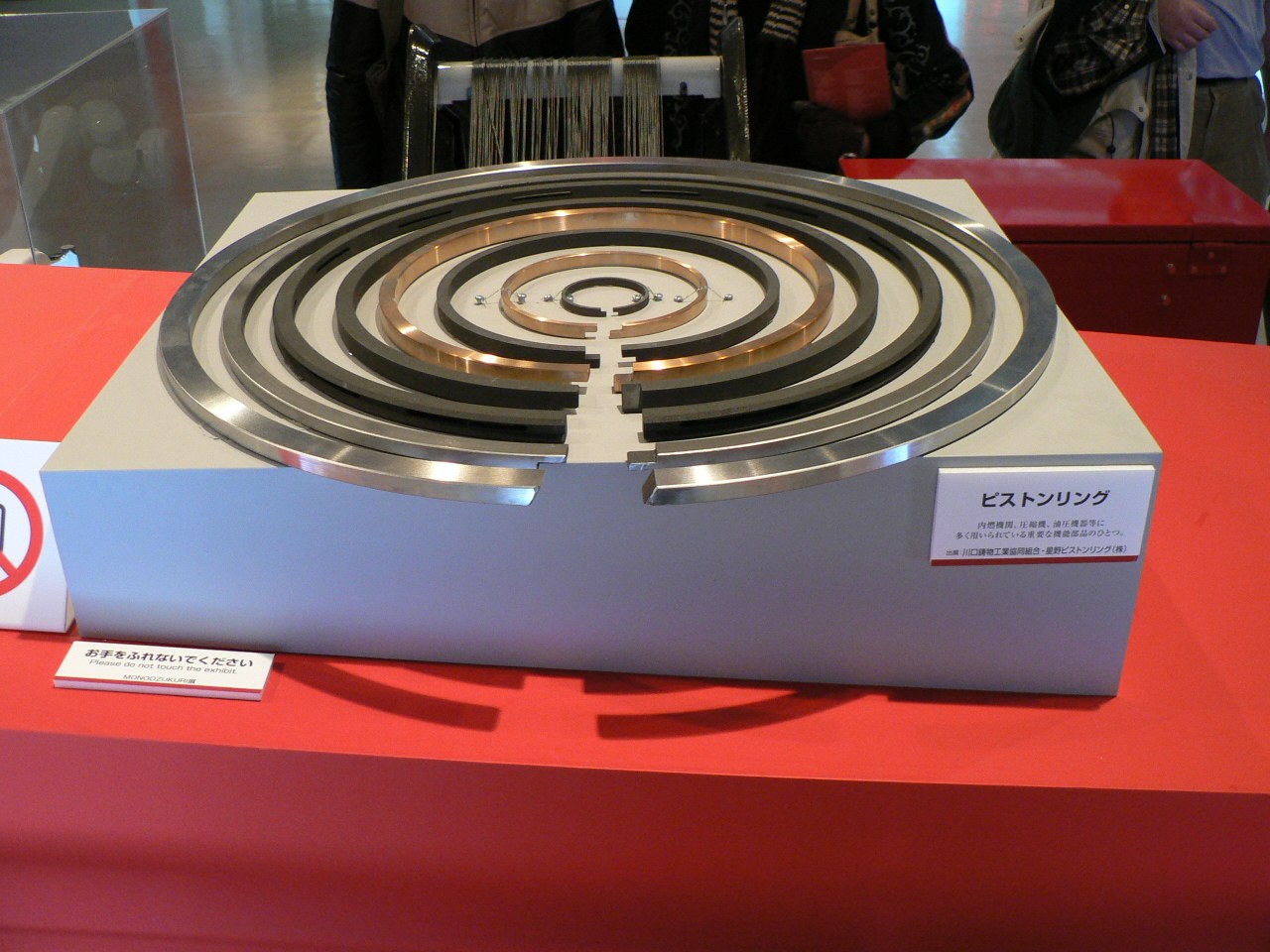
This city is home to the main plant of Riken, a maker of piston rings, the metal rings that seal the gap between the piston and the cylinder of an engine. Without them, an engine cannot be assembled.
The earthquake knocks over the molds, the power tools and the precision measuring instruments. Riken announces that it must inspect, replace, then run a trial before reopening.
On the Wednesday, Toyota announces that its twelve Japanese plants are shutting down. Nissan, Mitsubishi, Suzuki and Fuji Heavy Industries, the maker of Subaru cars, suspend all or part of their production. Honda’s president, Takeo Fukui, tells the public broadcaster NHK that his company will hold out until the weekend, but no longer.
Here is why. Riken says it holds half the Japanese market for piston rings, and about 70 percent of the market for transmission seal rings.
A company trading at 616 yen a share had just brought a country’s car industry to a standstill.
The carmakers looked for alternatives. Nippon Piston Ring and NOK were approached. Teikoku Piston Ring received requests from several carmakers. A Honda executive summed up the obstacle: it might be possible to source the parts elsewhere, but it would take time to test them for compatibility and quality.
That is what locks buyers in, and it applies in every industry where a part has to be approved. Changing supplier does not mean placing an order elsewhere. You have to requalify, that is, rerun the series of tests that proves the part holds up in the engine. That takes months. The shutdown, for its part, lasted days.
So the carmakers did the only thing left to them, and this is where the balance of power turns around. They sent their own engineers to get their supplier’s plant running again. The automotive trade press reported that Toyota had dispatched two hundred.
Riken states in its corporate history that the plants in the Kashiwazaki area stopped work and resumed it on 23 July. Seven days after the earthquake.
Look at what has just happened. In January 2021, carmakers with no bargaining power had to borrow a minister’s. In July 2007, a tier-two supplier with no public profile obtained in one week what no business continuity plan would have paid for: its customers’ skilled labor, free of charge, on its own site.
The same mechanism produces both results. Size does not decide; the share each party represents for the other does.
Austin, or a supplier that depends on a single customer
In Veldhoven and in Kashiwazaki, the customer depended on its supplier, and had to pay or send its engineers. What happens when it is the supplier that depends on its customer?
Cirrus Logic designs integrated circuits for audio and signal processing. Its main site is in Austin, Texas. Like every company listed in the United States, it files an annual report each year with the Securities and Exchange Commission (SEC), the US financial markets regulator. The report contains a mandatory section on risk factors.


There, year after year, it states the share accounted for by a single end customer, Apple, which buys through several contract manufacturers.
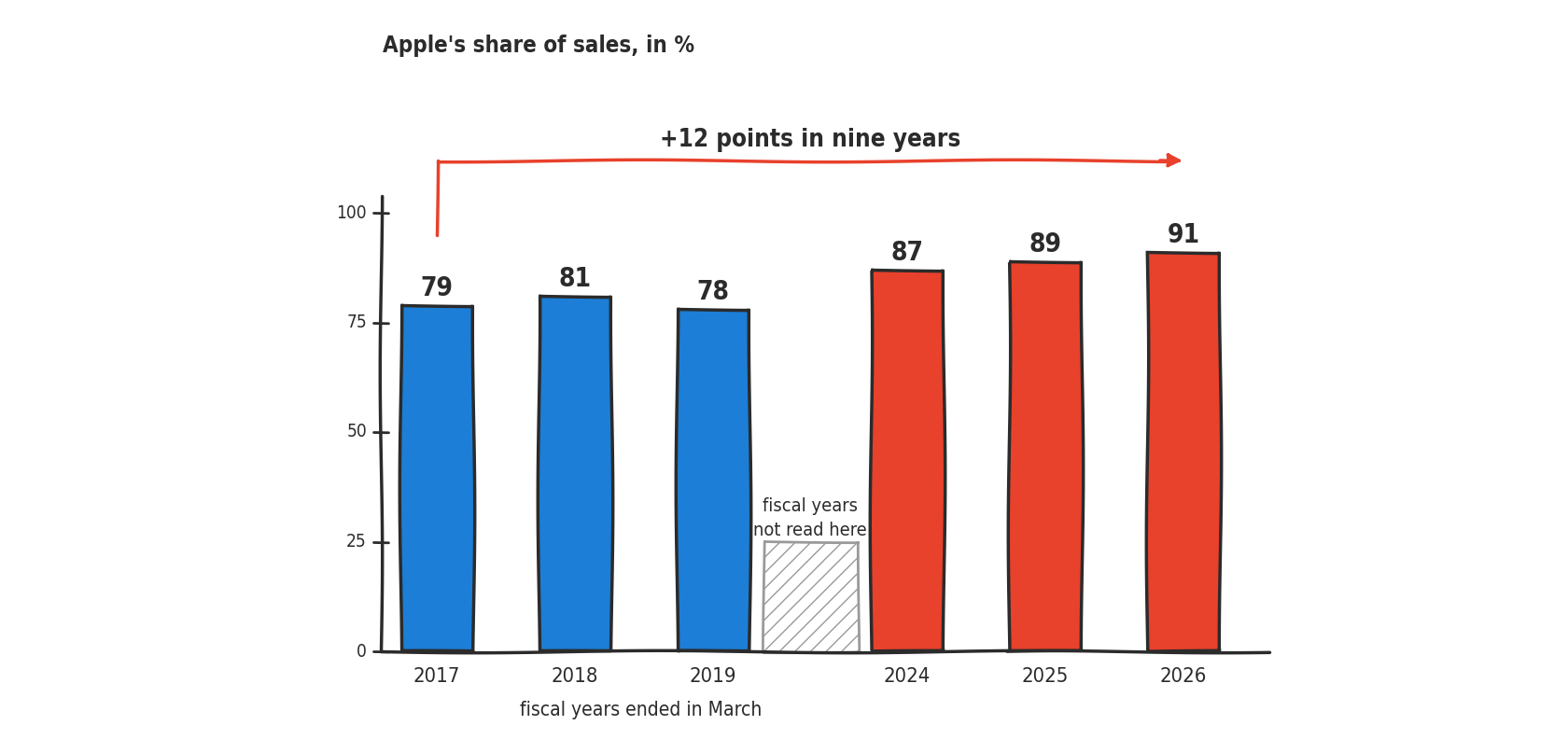
For the fiscal years ended in March 2017, 2018 and 2019: about 79, 81 and 78 percent of total sales. For the fiscal years ended in March 2024, 2025 and 2026: about 87, 89 and 91 percent.
The dependence has not shrunk in nine years. It has deepened by twelve points.
On scale 2, the more a customer weighs in your revenue, the more it sets your terms: at 40 percent, the bar is already in the red. Cirrus Logic stands at 91 percent.
In the same document, the company then lists what makes this situation dangerous. Most of its customers can stop incorporating its products at short notice and with little or no penalty. Its contracts generally set no minimum purchase quantity. And the products it develops are often specific to one customer’s architecture, to the point that they cannot be sold to anyone else.
Finally, it writes the sentence that completes the demonstration. Its reliance on a small number of key customers may make it easier for them to demand favorable commercial terms or to put pressure on prices.
ASML paid €1 billion to secure its supplier; Toyota sent two hundred engineers to its own. The customer of a supplier that depends on it has no need to do anything of the kind: that dependence already lets it dictate its terms, as Cirrus Logic itself writes. The balance of power follows dependence, in both directions.
You can look up this figure for your own partners too. A company listed in the United States must disclose the revenue it earns from any customer that accounts for 10 percent or more of its sales, and the SEC has asked listed companies to name that customer when losing it would have had a material adverse effect. Before asking a US-listed supplier to sign for you, read its annual report: you will know how much you weigh for it.

The proof you cannot pay for alone
Guichon Valves has made custom industrial valves since 1921. The company employs eighty people, had revenue of €10.5 million in 2018, exports more than 85 percent of its output and has belonged to the Valco group since 2015.
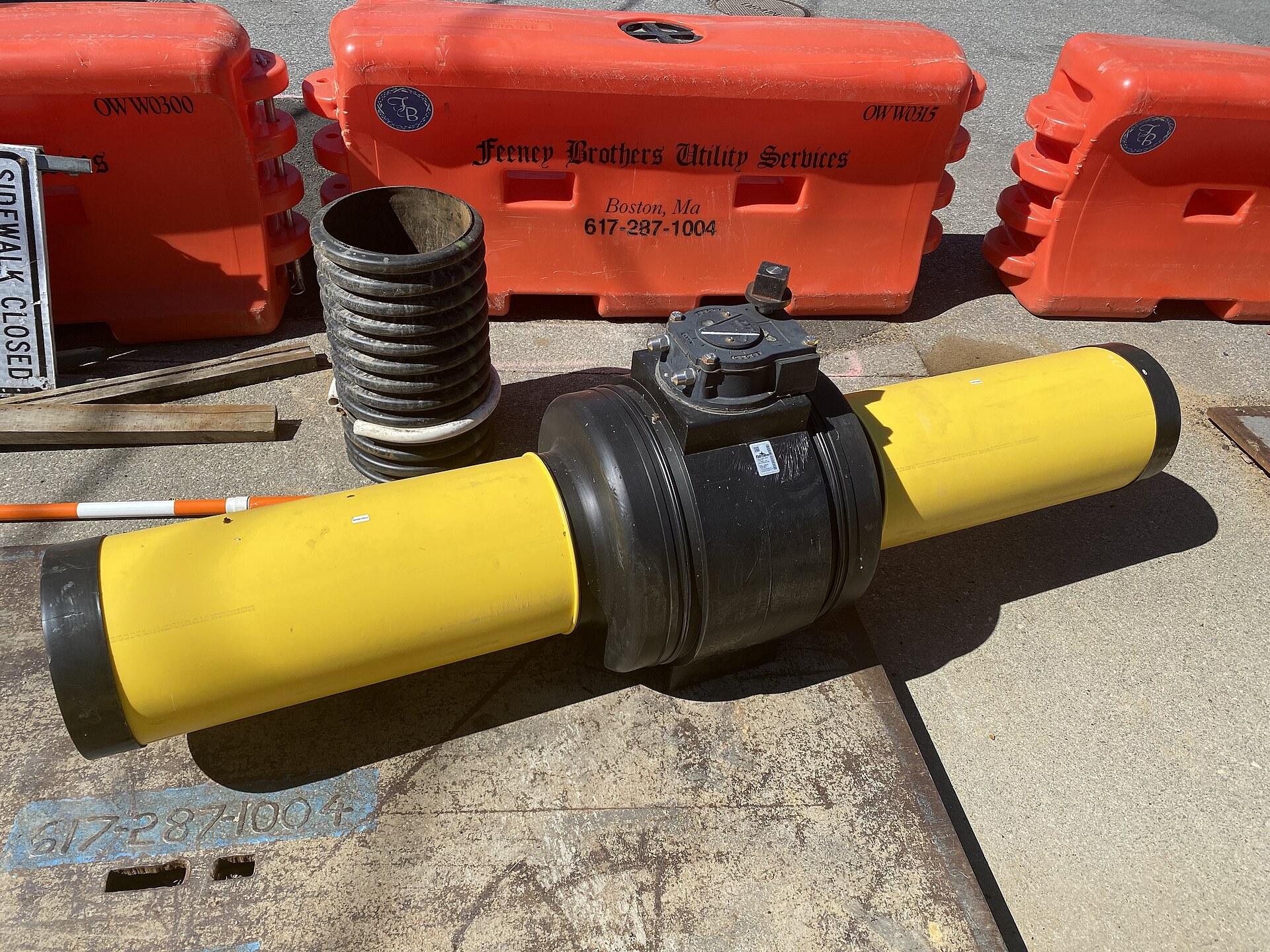
An international oil company orders a valve adapted to one of its processes. The design poses no difficulty. The sealing does. In petrochemicals, valves are considered the main source of fugitive emissions of volatile organic compounds, the gases that escape through the seal around the stem that operates the valve. The customer requires tests at 20 bar, at −45°C, at room temperature and at +200°C, run one after another on the same test bench without dismantling the valve. Guichon’s project manager acknowledges that the company often designs this type of valve, but rarely has to qualify it for fugitive emissions.
Guichon entrusts its prototypes to Cetim, the technical center for the mechanical industries, which designs a bench able to heat and cool the valve without moving it. The helium leak measurements are taken under the eye of an inspector from the oil company and follow its acceptance criteria.
Cetim had built this expertise in sealing tests long before the order, partly with money from the whole trade. Industrial technical centers were created by a 1948 law to carry out studies, tests and standardization work on behalf of an entire industry, and part of their funding comes from a tax paid by the companies in the sector. In 1992, Cetim’s industrial valves committee began work with the oil company Elf that led, in 2006, to the international standard ISO 15848, the reference method for qualifying valves for fugitive emissions. Manufacturers and customer prepared the rule together, and small and medium-sized valve makers have it at their disposal without having borne its cost alone.
Not every small or medium-sized enterprise (SME) has an industry center on its doorstep. Across the regions, the regional centers for innovation and technology transfer, the CRITTs, offer this kind of service on a local scale. In Charleville-Mézières and Nogent, CRITT MDTS, which specializes in materials, coatings and surface treatments, has operated since 1984 as a nonprofit association. It serves SMEs that cannot afford an in-house research and development center, with a laboratory that analyzes and tests raw materials and finished products, for sectors as different as biomedical, aerospace, automotive and rail. I visited it for Shy Robotics (my tech blog).

The valve standard did not settle everything. The major oil companies keep their own specifications, and in 2010 Cetim noted that valve makers and users were calling for a single standard. Guichon, in fact, was qualified to its customer’s requirements. Pooled proof supplies the expertise and the method; the customer sets the criterion.
Customer immersion is not for what you think
There is one more ally that product teams talk about a great deal, and rarely for the right reason.
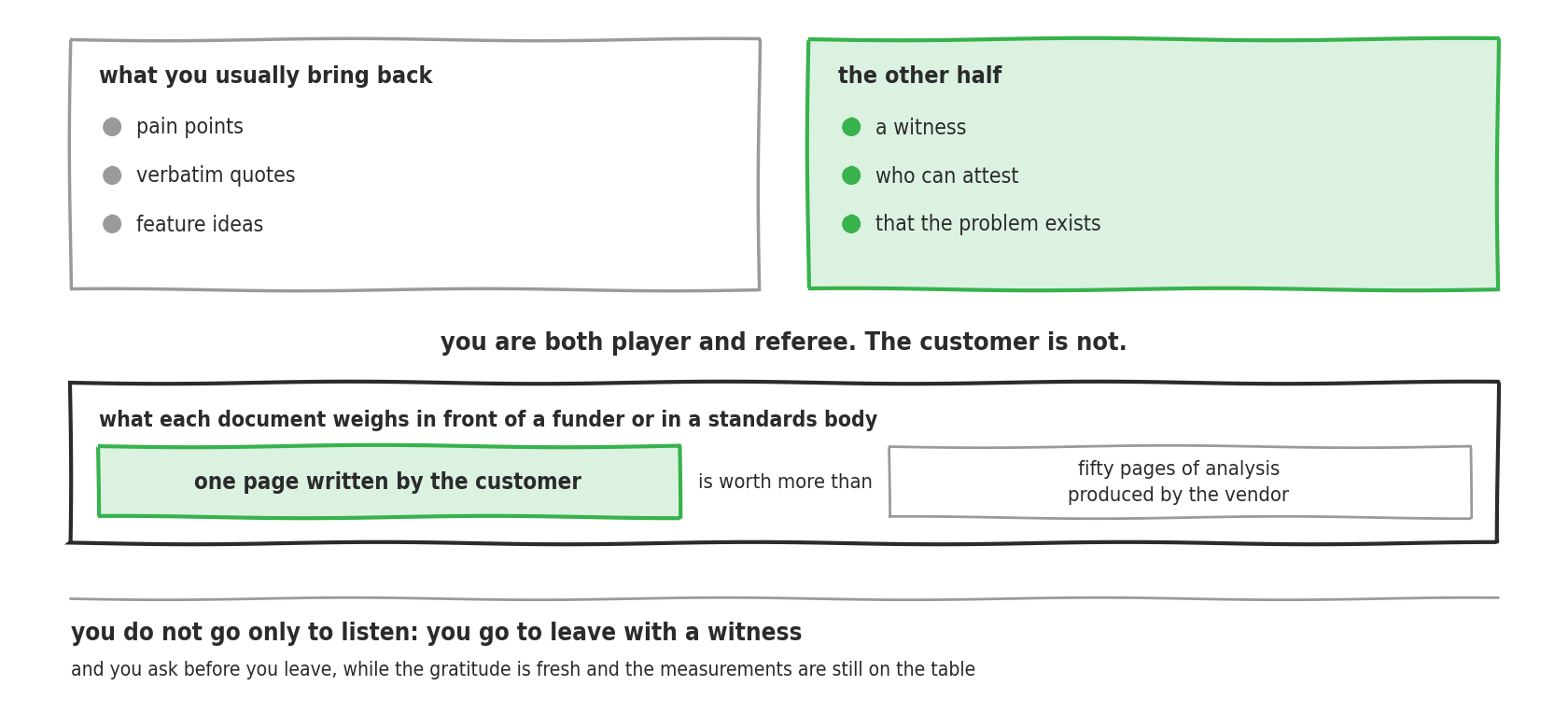
Spending three days with a user is called immersion, and it belongs to the work of uncovering the need, what the trade calls discovery. You come back with pain points, verbatim quotes and feature ideas.

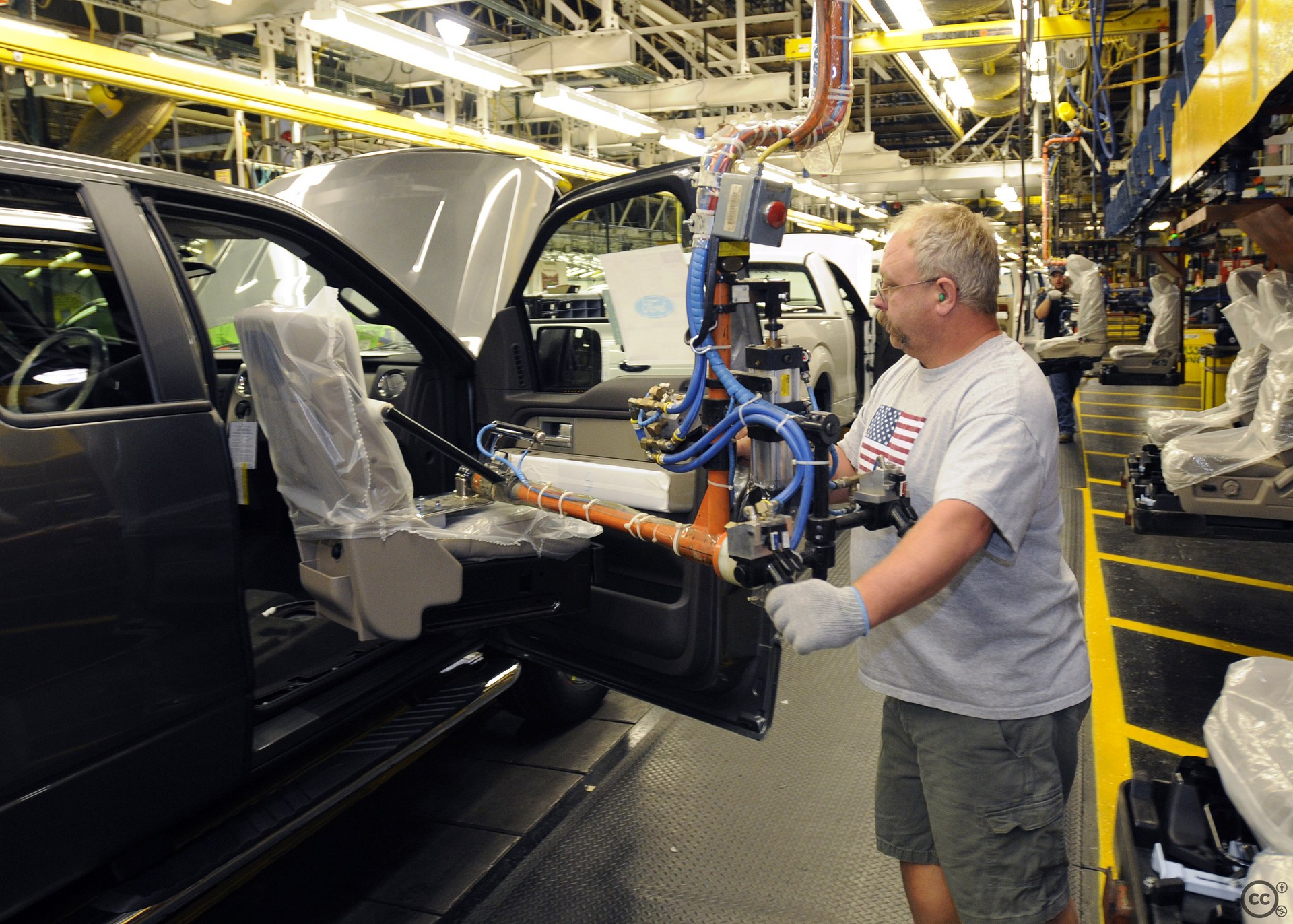
That is useful, and it is half of what you should get out of the visit.
The other half: the company where you have just spent three days is the only one in the world that can attest that the problem exists. Not you. You are an interested party. It is not.
A customer that agrees to write one page describing what it measured on its own premises is worth more, in a standards body or in front of a funder, than fifty pages of analysis produced by the vendor of the solution. It is the mechanism of the previous episodes, applied at your scale.
Which changes the way these visits are run. You do not go only to listen. You go in order to leave with a witness, and you ask before you leave, while the gratitude is fresh and the measurements are still on the table.
The objection: all of this is simply called having good partners
You could read these stories as good purchasing management. A customer that looks after its sole supplier, carmakers that rescue theirs, a supplier that depends on its customer, an SME that has its valve tested. Where is the politics?

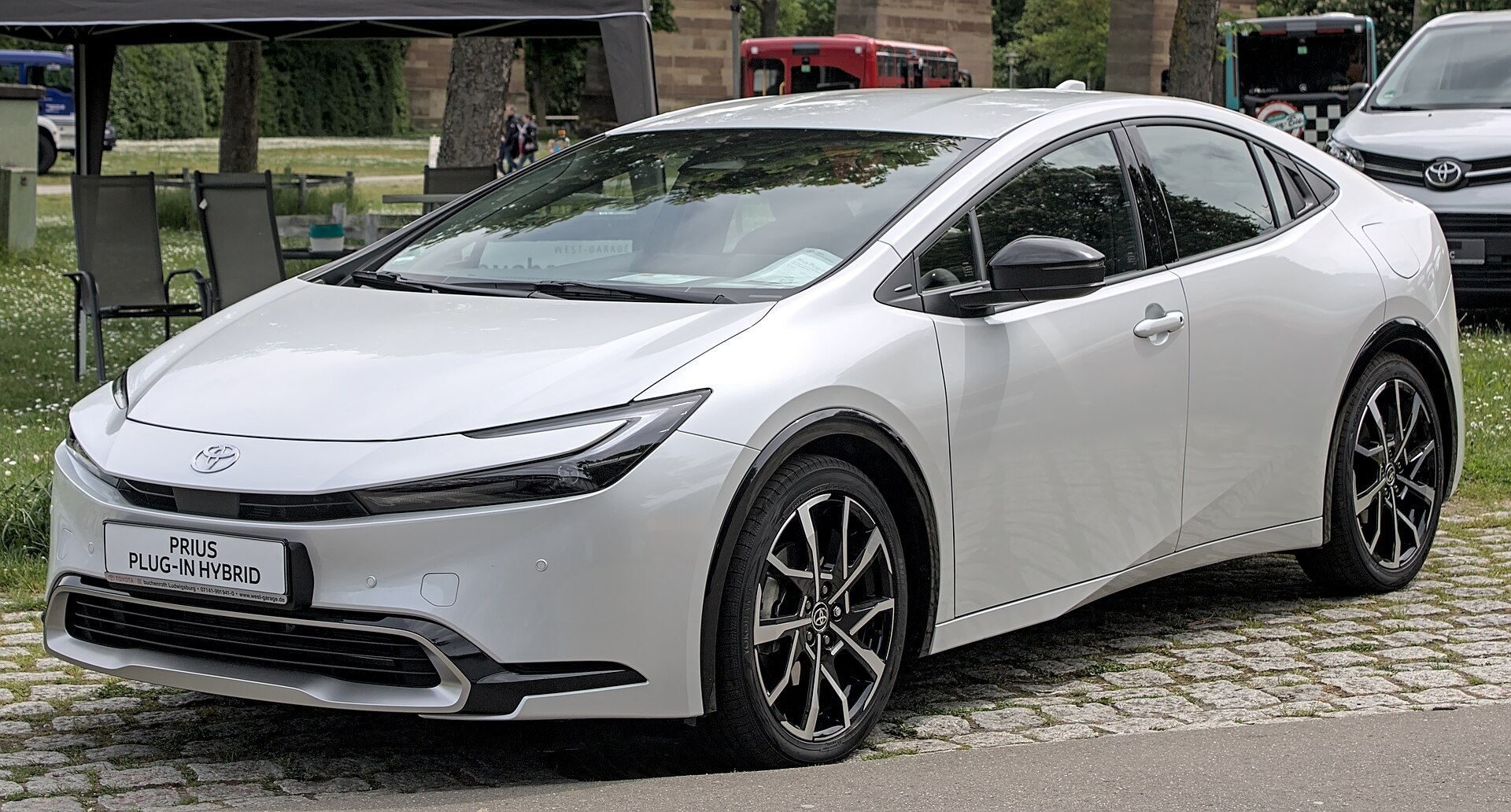
It appears when you have nothing to offer the party you depend on. ASML had €1 billion to put on the table, Toyota two hundred engineers: they acted on their own. The German carmakers accounted for only 3 percent of TSMC’s sales and had nothing to offer: they went through their economy minister, who wrote to the Taiwanese minister. Guichon could not ask its customer to take its word for it: it went through a laboratory that its trade partly funds. When you lack weight, you borrow it from a third party: a state, a technical center, a CRITT.
That is what links this network to the rooms of the previous episode, the ones where standards are written. You get in with proof that others sign: a measurement from a third-party laboratory, a customer’s attestation. That proof is negotiated with partners, at the price of how much you weigh for them, and the fugitive emissions standard itself came out of a committee where manufacturers and an oil company worked together.
Porter’s framework goes no further. It describes the profitability of an industry and how its value is shared out. It tells you what you can obtain from your partners, not who will be invited into a room or what they will do there.
For you, the practical question has two parts. Before asking for a test, an attestation or support, measure how much you weigh for the party you are asking. If it is too little, look for the third party that will weigh on your behalf: your technical center, your trade federation, your government agency.
In the previous episode, the state signed what industrialists had written. Here, industrialists get a state to write because they have nothing of their own to get signed.
What this article does not say
It does not say that the network replaces the product. Riken was rescued because its piston rings were good and hard to replace, not because its executives lunched with the right people. A network serves to get existing value recognized; it does not manufacture any.

It does not say that the five forces explain everything, nor that the shift argued for above comes at no cost. Porter’s framework describes the structure of an industry at a given moment. It does not predict technological breakthroughs and says nothing about individual trajectories.
Finally, it says nothing about other comparable schemes. France’s competitiveness clusters follow the same logic of pooled proof. They have no place here for want of a quantified source that I was able to open and cite.
What your accounts already know about your power
The third episode proposed one question to add to the agenda. The fourth proposed three, and a four-column grid, about the forums where the rule is written. Here are three that call for no outside investigation: the answers are in your own information systems.
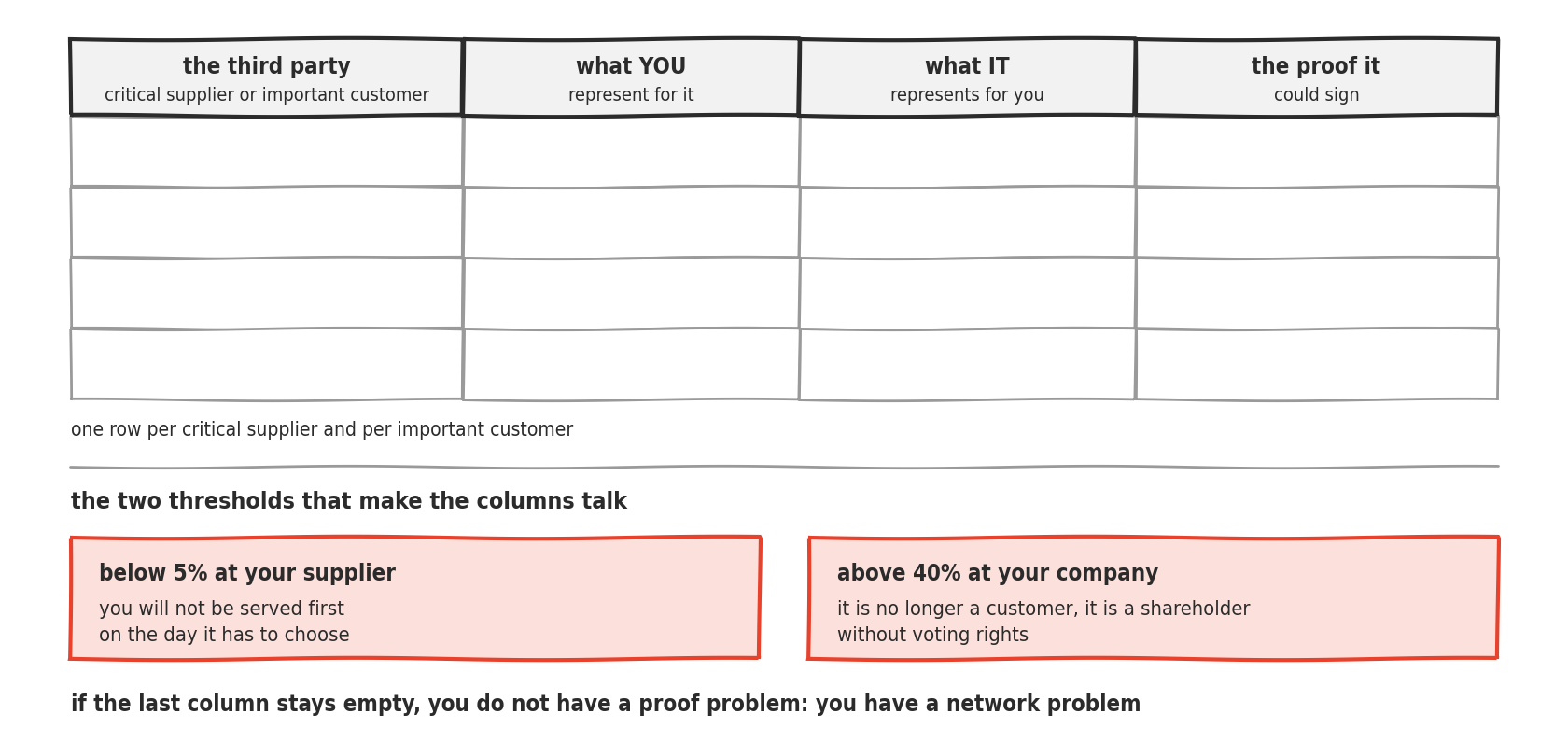
What share of its revenue does each critical supplier owe you? Below 5 percent, you will not be served first on the day it has to choose. You can ask for the figure, and a supplier that refuses to give it has just answered you.
What share of yours does each important customer represent? Above 40 percent, it is no longer a customer, it is a shareholder without voting rights, and it will get your discounts without asking for them.
What proof are you missing, and who other than you can sign it? Write down the missing document, then the name of the organization that would sign it. A test report, a certificate of performance measured at a customer’s site, an industrial property right. If the second column stays empty, you do not have a proof problem, you have a network problem.
The answers fit in a table that I will call a dependency map, for lack of an established name: it is a tool I propose here, not a standard. Three columns. The name of the third party. What you represent for it, as a percentage of its business. What it represents for you. One row per critical supplier and per important customer, and a fourth column left free for the proof that party could sign.
It takes half a day to fill in and one rereading a year. Its value is not that it produces a strategy. Its value is that it makes impossible the sentence the carmakers had to hear themselves say in January 2021: we did not know we counted for so little.
Filling in this table still requires someone at your company whose job it is, with a budget and a mandate to go and collect the missing signatures. Without that line, the grids of the previous episodes will remain notebook exercises. That is the subject of the next episode.
The scales in this article make up the third line of a sheet that gathers the series. It fits on one page.

What this article rests on
The numerical thresholds in this article’s scales are proposed markers, not study results. Their origin is set out in the series’ method appendix.