But in the logic of an impact factory, this separation becomes relative. Discovery and Delivery are not two sealed-off worlds: they share the same learning cycle, made of the same steps: Focus, Identify, Frame, Plan, Deliver, Operate, Measure. The difference does not lie in the method, but in the nature of the test.
-
If the delivery of the test happens in a production environment, with real users, measurable impacts and operating constraints, then it is Delivery.
-
If the delivery of the test stays within an exploratory frame (mockups, prototypes, simulations, studies or experiments without release to production), then we are in Discovery.
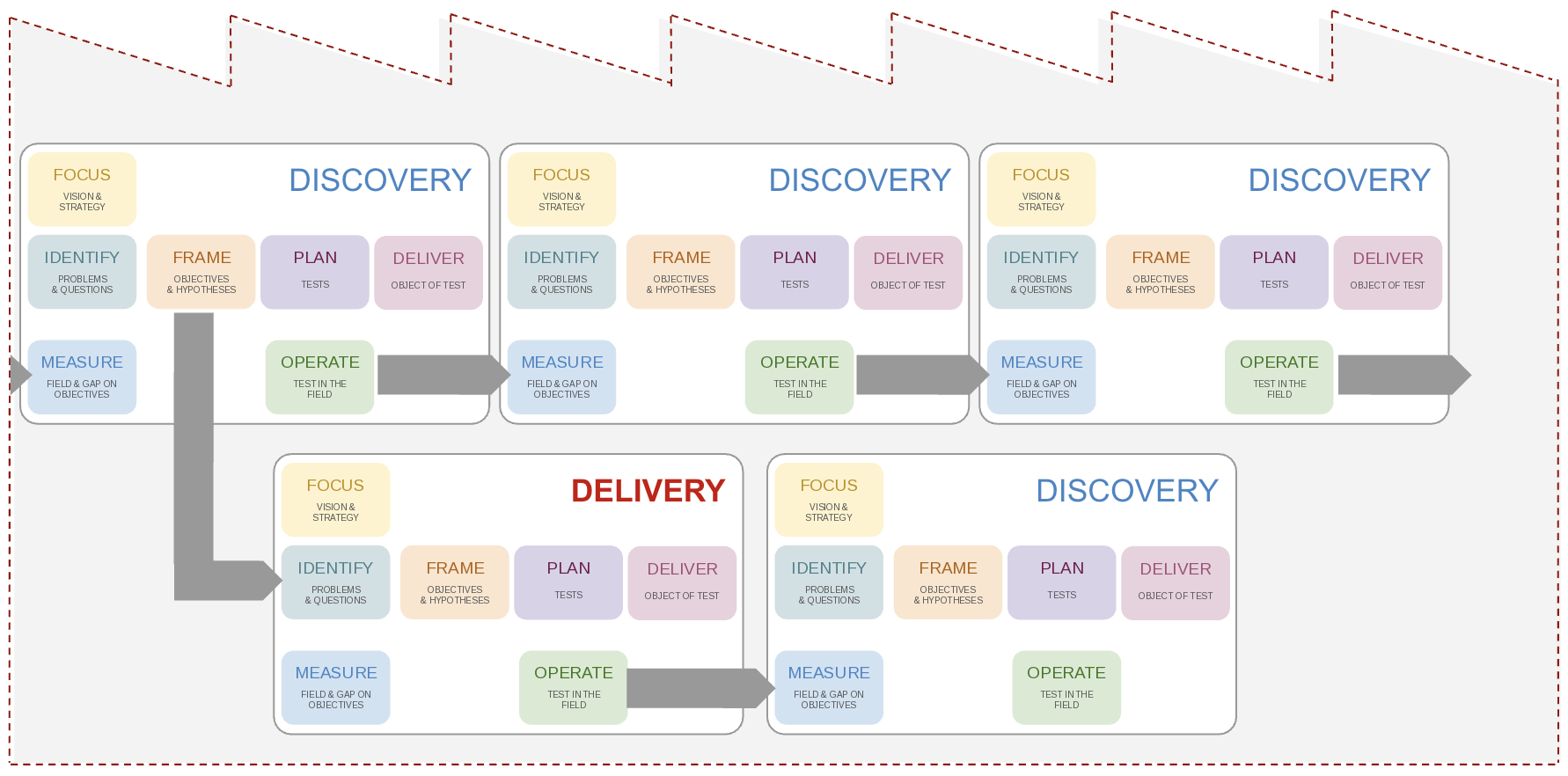
In both cases, the principle is the same: we test to learn. The loop is identical, only the scope of the test changes. This is why, in the impact factory model, the verb “Deliver” is not limited to “Delivery” in the traditional sense. It refers to the delivery of the test material, whether or not it is deployed to production. In other words, our “Deliver” applies just as well to a research mockup as to a live feature: in both cases, the point is to learn, to measure the gap, and to adjust the trajectory to maximize impact.
Delivery, “build”, and “run”
To illustrate the difference between the value created in discovery and the value generated afterwards in delivery, let’s take a concrete example: the team developing CantinaFlow, a piece of software meant to help school cafeterias reduce their food waste.
From the very first weeks, the team runs interviews, observes how the kitchens work and organizes focus groups. These initiatives produce neither features nor contractual commitments, but they create another kind of value: cafeteria managers feel involved and understood, and start picturing themselves using the product. This is the IKEA effect: when users take part in building something, they become attached to the solution. Discovery therefore builds relational capital, a fine-grained understanding of the problem and a community ready to support what comes next.
However, this value remains exploratory. As long as CantinaFlow has delivered nothing, no cafeteria benefits from any guarantee: no service level, no support, no obligation to fix unexpected behavior. It is the move into Delivery that changes the nature of the relationship: when a first increment of the product is delivered, we leave the exploratory field and enter the field of commitment. Delivering a feature, even as a pilot, immediately creates expectations, usage rights, and therefore obligations for the team.
Within this Delivery phase, the impact factory then distinguishes two complementary and inseparable moments:
• Build, where the team designs and delivers a new increment of the product,
• Run, where this increment is used, measured, and adjusted so that it keeps its promises.
In our example, Build corresponds to delivering the module that forecasts the quantities to cook. Run starts as soon as this module is used in real conditions: if the forecasts turn out to be less reliable than expected in some schools, the team has to analyze the problem, fix it, and adjust the models or the experience. Build creates the value; Run makes sure it lasts and does not erode the trust that was created.
Either way, in an impact factory, build and run are also measured against the expected result, using the test logic specific to the impact factory: everything is part of the same continuous improvement cycle. Run activities are no longer seen as simply keeping things in operational condition, but as a valuable source of data to steer the next learnings.
In the same way, Build activities are not one-off production phases, but experiments designed to be measured, evaluated and enriched by what Run reveals. An anomaly in Run becomes a hypothesis to test in Build; an innovation in Build becomes a new field of observation in Run. That said, Build and Run are clearly tied to Delivery.
Delivery is not necessarily technological
At what point does a customer really start to benefit from the value of your product? The answer is often less obvious than it seems. Take a classic example: at the very beginning, your team sent out a simple newsletter with tips, exclusive content and a direct relationship with your audience. Back then, it was not yet the platform with millions of users, endless customizable feeds and REST APIs. Yet this newsletter was already creating value. In some cases, it could even have been charged for: it solved a problem, it retained an audience, it triggered a regular behavior.
From this angle, this newsletter was perhaps not just a discovery artifact. It was potentially a first minimal Delivery, a first commitment to something concrete that you produced on an ongoing basis.
The same logic applies to marketing actions carried out to sustain engagement or generate growth. As soon as a campaign promises a benefit (fast access, a quality of service, a level of support, a highlighted feature), it meets the field. It commits the company toward the market. And this commitment is not purely theoretical: it assumes that, internally, an operational organization is able to actually deliver what is announced, maintain it and support it. In this sense, some marketing actions are already part of Delivery, since they trigger expectations the company must meet over time.
This is where we discover how thin the line between Discovery and Delivery really is. The distinction I propose is the following: Discovery does not commit the company over time. It makes it possible to learn, and then we move on once the test is over. Conversely, Delivery creates commitments, whether explicit (customers, contract, SLA) or implicit (marketing promise, regularity of a service, continuity of content).
This distinction justifies the existence of a step that comes after Delivery: Operations. It is in Operations that we maintain, support, adjust, fix and align what was delivered with the initial promise, whether it is software, a feature, an API… or even a simple newsletter that began, long before the platform, to create tangible value.
Why the confusion between Deliver and Delivery
In the impact factory, the test cycle uses the steps Deliver and Operate, a vocabulary very close to Delivery and Operations. This similarity may seem confusing, but it is deliberate: it is a reminder that, even in a test, as soon as an artifact is delivered (be it a feature, an onboarding funnel, an API or even a simple newsletter), it creates a minimal commitment that must be maintained beyond the duration of the test.
This is precisely why, beyond Delivery, we distinguish an Operations step. What is at stake in Operations is not only tied to the final product, but also to the health of each increment delivered over the course of the tests: maintaining what exists, supporting users, correcting gaps, adjusting the experience, making sure the announced promise, even a temporary one, is actually kept.
In other words, the lasting commitments created by Delivery, even when it is a test, naturally carry over to Operations activities. This structure aligns the organization with the reality of the field, while making it explicit that what is delivered, even on a small scale, must be owned, supported and operated until the end of the experiment.







 CC BY-SA 4.0