
Part one of a three-part series on the weight of politics in the success of a product, at three scales: the government, the company’s network, and internal company politics. We start with the most distant scale, the one made of governments, because it is the one you see least and the one that decides earliest.
The cable of June 1943
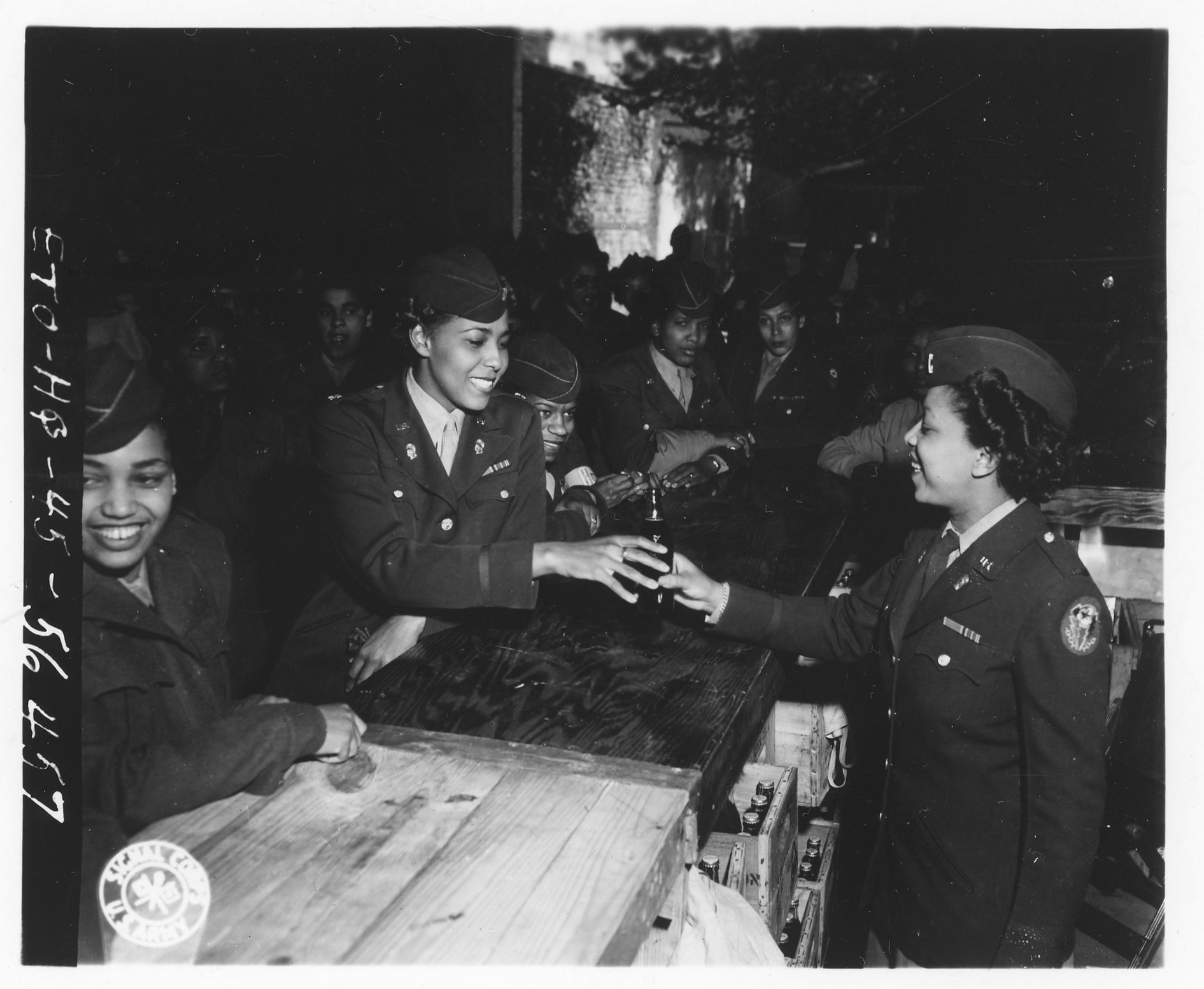
On 29 June 1943, a cable left Allied headquarters in North Africa for Atlanta. A cable, at the time, was an urgent message sent by telegraph. It asked for no ammunition, no fuel, no penicillin. It asked for three million filled bottles of Coca-Cola, the complete equipment for ten bottling plants, and resupply twice a month.
Why would an army at war ask for soda?
Because the army treated the morale of its troops as a logistics parameter, on the same footing as rations. A cold sweet drink, identical to the one you drank at home, beats a speech. Robert Woodruff, then running Coca-Cola, had made a decision two years earlier that was commercial genius: every man in uniform would get his bottle for five cents, wherever he was, whatever it cost the company. The army wanted morale and simple logistics. Coca-Cola wanted two things: an entire generation of consumers won while they were in uniform, and industrial plants in countries where it had none.
The government, though, was managing shortage. Sugar was rationed, and every ton granted to one was taken from another. To let Coca-Cola sell, Washington pulled three levers, none of which involved a dollar of subsidy: an exemption from sugar rationing, granted from 1942 for sales to the army and to retailers serving soldiers; a transport priority, on ships where every cubic meter was fought over; and access to the bases, meaning a captive clientele of several million people.
Six months after the cable, a company engineer opened the first plant in Algiers, and sixty-four more followed, built as close to the fighting as possible, in Europe and in the Pacific. They were run by a hundred and forty-eight civilian employees to whom the army granted the status of technical observer, uniform included. The soldiers called them the Coca-Cola colonels. Military personnel drank more than five billion bottles before the end of the war.
Like every public decision, this one had losers. Pepsi-Cola did not get the same access and had to cut production, while a Coca-Cola executive sat on the committee in charge of sugar rationing. That detail describes the ordinary workings of a war economy, and above all it shows where the game was played: in an allocation committee, not on a shelf.
What could a founder never have done alone?
A private industrialist, however immensely rich, cannot buy rationed sugar. He cannot get a military freighter to load his crates instead of shells. He cannot build a plant in a war zone, nor walk his civilian employees onto a base without military status. Woodruff had the will, the money and the product. Only the government could supply the rest.
The best-selling drink in history therefore owes its global reach not to an advertising campaign, but to a military logistics decision and a line in a sugar regulation.
Why this belongs on a product manager’s desk
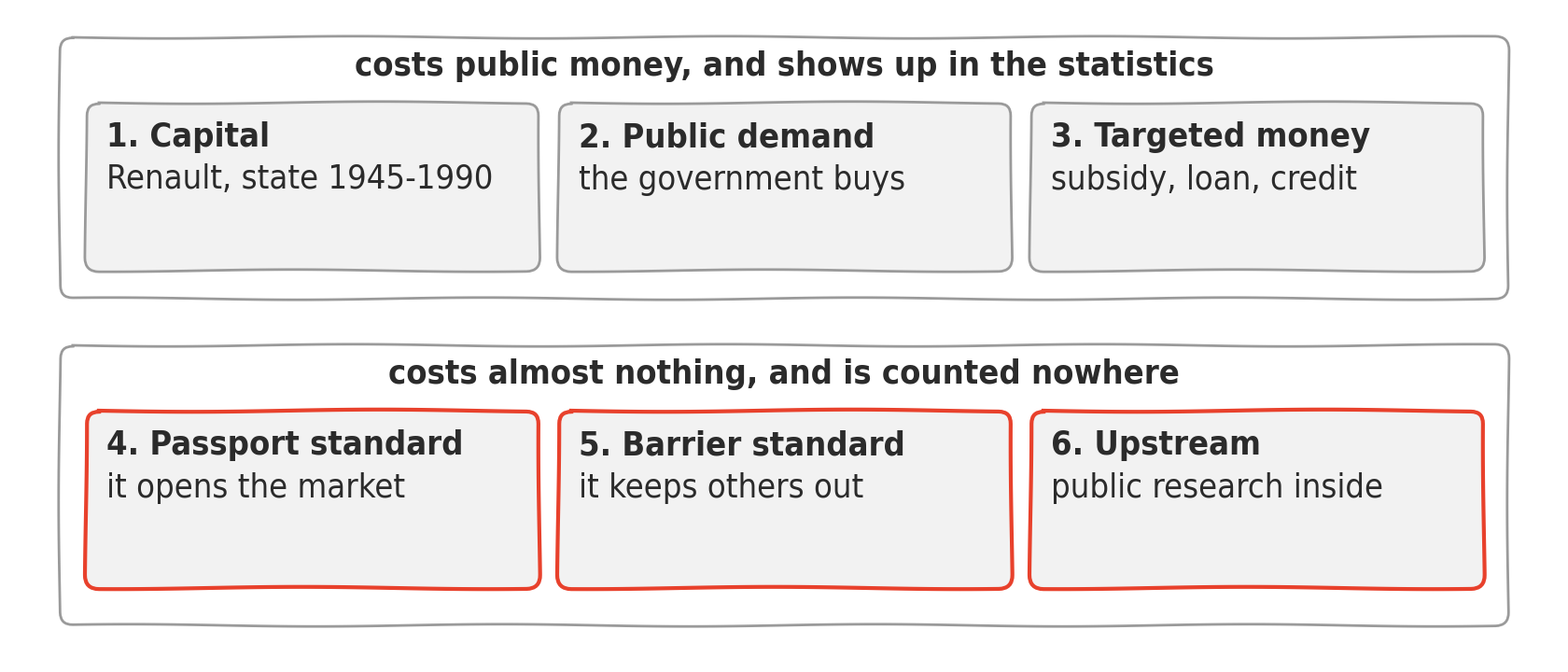
Yes, this is a long way from the discovery work that product management articles usually cover, and that distance is the point: it marks a job the product literature neglects, which is influence. The argument here has three parts. First, no company has reached global leadership without a political envelope around it, and what changes from one country to the next is the channel used, never the existence of the envelope. Second, the rule often beats the check, which distorts how product teams read their own market when they concentrate on tuning their delivery machine. Efficiency does help competitiveness, innovation and therefore differentiation, but the best team with the best product is not automatically the one that wins. Third, that envelope is sometimes withdrawn, and it is better to know in advance what that feels like.
Here is the map of the ground we will cover.
Bananas, or twenty years of negotiation over a one-euro fruit
In the early 1990s, Europe was about to open its single market. Until then, each country handled its bananas its own way. France and the United Kingdom protected production from their former colonies and their territories, in the Caribbean and in West Africa. Germany, which had no banana-growing colony, freely imported the cheapest bananas in the world: those from Latin America, grown at scale and sold by three American groups.
What was each side defending? Caribbean and African growers wanted to survive, with production costs structurally higher than those of the huge Latin American plantations. Paris and London were honoring commitments made to former colonies for which they remained responsible. German distributors wanted their cheap banana. Carl Lindner, chairman and chief executive of the banana multinational Chiquita Brands International, wanted Europe.
Lindner ran Chiquita from Cincinnati. In 1984 he had bought the famous company, formerly United Fruit. Although he grew no bananas in the United States and employed no farm workers there, he had made himself one of the largest funders of American political life, giving enormous sums to both major parties.
In 1993 the European Union settled the matter with a common market organization, meaning a single set of rules for the whole continent. The instrument paid out no money: it set a quota, a volume allowed in at reduced duty, reserved as a priority for producers from Africa, the Caribbean and the Pacific. Everyone else paid more.
The Americans did not like it. Mickey Kantor, the United States Trade Representative, opened a retaliation procedure on 17 October 1994 on behalf of a product that is not exported from the United States. A first. It triggered one of the longest trade disputes in the history of the multilateral system, repeated rulings against Europe, and American customs sanctions that struck back at European products with no connection to bananas.
On 10 November 1998, the American administration proposed 100 percent duties on forty-two categories of European products, applicable on 3 March 1999 if Europe did not give way. Then came a lobbying campaign. Gillette pleaded for its pens, Mattel for its dolls, the furriers for their coats, and two weeks after the hearing all of them were off the list. On 3 March, Washington applied the duties to 520 million dollars of imports without waiting for the arbitration to conclude, which earned it a ruling against it in turn. Arbitration brought the amount down to 191.4 million, a little over a third. On 19 April, Charlene Barshefsky, by then the Trade Representative, published the final list: nine categories only, pecorino cheese, handbags, greeting cards, chandeliers and cashmere sweaters.
Meanwhile Rick Reinert was selling bubble bath, a business that looks a long way from any of this. He had started it in the family garage in Summerville, South Carolina, with his wife, whom he had met during his military service in Germany. His herbal foams, lavender and rosemary, made sixty percent of his sales. They came from a German supplier. His customs bill went from 1,851 dollars to 37,783 over the second half of the year. When he called the Trade Representative’s office, he was told they were surprised he was still importing, and that he should have shown up at the Washington hearing, like Gillette and Mattel.
The whole principle of trade retaliation is to hurt exporters, who will then go and complain to their own government. Reinert exported nothing. He bought.
The Netherlands and Denmark were exempt, because they had not supported the European banana regime. Washington calibrated its sanction member state by member state, inside the Union. Then an agreement signed in Geneva with eleven Latin American countries brought the European duty down from 176 to 114 euros a ton, in exchange for dropping the proceedings.
What could a founder never have done alone?
No grower in Guadeloupe, however good, closes a structural cost gap against a plantation of several thousand hectares through sheer productivity. No American group, however powerful, brings down a European quota by commercial force alone. So both camps did the only effective thing: they mobilized a government. For twenty years, each side’s market share was decided in negotiating rooms far from any shelf, and the bill landed on the desk of a man selling bubble bath.
Sidebar: chicken and pickup trucks
In the early 1960s, American industrial chicken production exploded and flooded Europe. European farmers protested, and several countries taxed imported chicken.
In late 1963, Lyndon Johnson hit back with a 25 percent duty on four European products chosen to hurt: potato starch, dextrin, brandy and light commercial vehicles. The last one is on the list because American manufacturers and their union were worried about German vans arriving on their market.
Washington eventually dropped the first three duties. The fourth is still standing, sixty years later. The most profitable segment of the American car market has lived in shelter: the Ford F-150 has been the best-selling vehicle in the United States for more than fifty years.
The size of American cars, which drives their fuel consumption and therefore part of the country’s energy policy, descends from an argument about frozen chicken.
The T-shirt, or how a quota built a national industry
In the 1970s, European and American textile industries were losing ground to Asian producers. They employed a great many people across entire regions, and that weight converts into political weight. Northern industrialists were asking for time. Their governments wanted to avoid a wave of closures, while the exporting countries of the day, Japan, South Korea, Hong Kong and Taiwan, wanted to keep selling.
From 1974 to 2004, the Multi Fibre Arrangement allowed importing countries to cap textile exports from developing countries. A quota, here, caps the number of garments a given country is allowed to ship to another. Everything turns on one word: the cap applies to countries, not to companies. So at the very moment the rest of world trade was being liberalized, textiles moved under a control that handed out a quota per exporting country rather than a ceiling on total imports. Capped producers then did the only rational thing: they went to produce where quota was still available.
Daewoo, a Korean conglomerate, was looking for such a country. Noorul Quader, a former civil servant who had been the first establishment secretary of Bangladesh’s provisional government during the 1971 war of liberation, left the administration and went looking for an industry to build in a country that had almost none: Bangladesh. Quader signed the joint venture with Daewoo in 1978, and got the Koreans to train his Bangladeshi supervisors in Korea, free of charge.
On 2 October 1978, he ran a half-page advertisement in a Dhaka daily. He was looking for a hundred and thirty people. The advertisement drew a crowd at the university canteen, where students copied the terms out by hand. Women went with them, the first Bangladeshi women sent abroad for training.
They came back with more than sewing skills: with the logistics of shipping, the address book of European buyers, the quality standards those buyers demand, and the tight calendar of selling seasons. A hundred and fifteen of them would later leave the company to found their own. Fifteen stayed. Yung Whee Rhee, an economist at the World Bank, went to interview them on site and wrote the reference account of that start.
Bangladesh, absent from every world clothing ranking at the moment Quader placed his advertisement, ended up among the top eight exporters on the planet, with millions of jobs and a social transformation nobody had planned. And the price of your T-shirt.
What could a founder never have done alone?
Turn the question around, it is more interesting that way: no investor in the world would have chosen Bangladesh in 1978. No reliable electricity, no modern port, no trained workforce, no industrial tradition, a country seven years out of a war. The country’s only competitive advantage that day sat in a line of regulation: it was not under quota. Nothing else. A sentence written in Geneva to protect European spinning mills built a national industry on the other side of the world.
Diesel, or the government as shareholder, tax collector and regulator at once
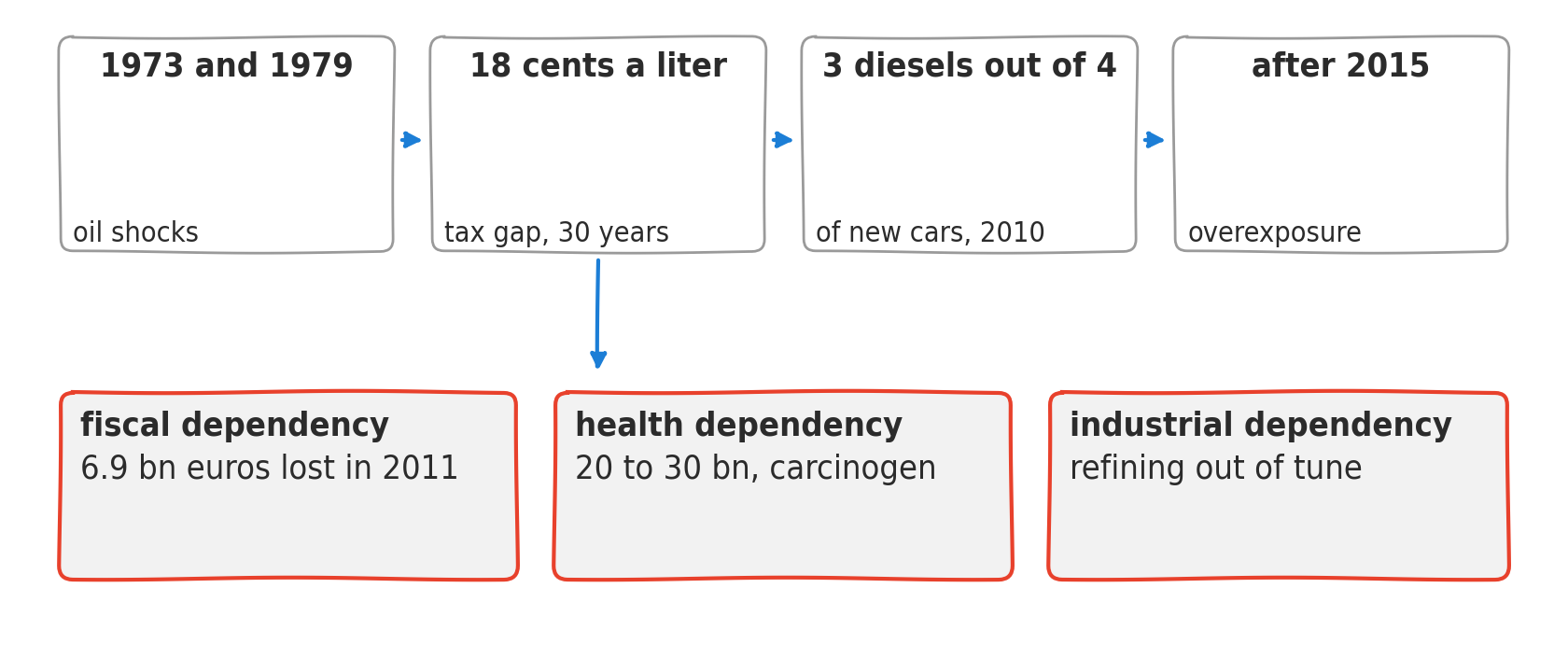
Two oil shocks, in 1973 and again in 1979, left France with an import bill it did not know how to pay. Diesel burns less per kilometer than gasoline. Road hauliers run on diesel, and their fuel bill ends up inside the price of everything that moves around the country.
The hauliers wanted cheap fuel, and they knew how to shut a country down in three days. The government was trying to cut its oil consumption and hold down the cost of transport. Carmakers wanted a market. Renault, above all, belonged entirely to the state from 1945 to 1990, remained a publicly owned company until its 1996 privatization, and still counts the state among its reference shareholders today, a stake kept in order to obtain commitments to manufacture in France. The French government does not arbitrate this market from outside. It plays in it.
The decision and its instrument: no subsidy, no order book. A fuel tax gap, held for decades, of around 18 cents per liter between diesel and gasoline, at a time when the European average was around 12.
On 17 December 2012, the Cour des comptes, France’s national audit office, sent the ministries of the economy and of ecology a formal letter on energy tax expenditure, which it made public the following 1 March. A tax expenditure is revenue the state gives up by taxing one thing less than another. The court’s reproach was that the administration did not even count this gap among its tax expenditures. Delphine Batho, then ecology minister, replied in February. She wrote that the differential “results mainly from the choice made by France” and by other European countries after the two oil shocks, the choice of a tax regime favoring a diesel car fleet. She added that the policy had initially aimed to reduce road transport consumption in order to loosen the country’s energy dependence. A ministry acknowledged in writing, before its own state’s audit judge, that it had manufactured a consumption preference.
Christian de Perthuis received the file straight afterwards. He chaired the committee on environmental taxation, which ruled on 18 April 2013 that the gap could not be justified against the environmental costs of the two fuels.
This produced an advantage cut for road professionals that spilled over onto private buyers, who do the arithmetic at the pump. But it also let French carmakers place a considerable industrial bet: they invested in a technology their domestic market was asking for and that taxation made unbeatable. They became excellent at diesel, and their domestic market soon asked them for little else. By the early 2010s, close to three out of four new registrations were diesels.
Then the bill arrived, and it runs to three pages. Taxing diesel less than gasoline deprived the state of 6.9 billion euros for the single year 2011, eight billion counting the reduced rates granted to fishing and farming, according to the customs administration’s estimate. The court put the health cost at 20 to 30 billion, three to four times the lost revenue. In June 2012, the World Health Organization classified diesel engine exhaust among carcinogens. And the French refining base, calibrated for another era, found itself out of tune: the country imports diesel while exporting its gasoline.
After 2015, taxation converged, regulation tightened, and French carmakers discovered they had specialized in exactly the technology public policy had sold them.
What could a founder never have done alone?
No carmaker can open an 18 cent per liter gap at the pump and hold it for thirty years. That lever moves the behavior of millions of buyers, and it belongs to the government alone. Carmakers did not create diesel demand. They served it, very well, until the day the hand that had created it took it away.
Here the government holds three incompatible roles at once: shareholder in a carmaker, collector of the tax that steers the market, and regulator of public health, who will one day have to rule against the first two.
Two more sidebars
In India, the four-meter rule has had a comparable effect. P. Chidambaram, then finance minister, read out point 137 of his 2006 budget speech: excise duty, the tax paid at the factory gate, would fall from 24 percent to 16 percent, but only for vehicles under 4,000 millimeters, with a capped engine size. He announced that he wanted to make the country a global hub for the small car.
Since then, around three out of four cars sold in India measure under four meters. Manufacturers invented two whole categories to fit inside the constraint: the compact sedan, born of a shortened trunk, then the compact SUV. Models sold worldwide are not offered in India for the sake of a few centimeters.
In Brazil, fuel by decree is another good example. The decree of 14 November 1975 came after the first oil shock. Three levers combined: an obligation to blend ethanol into all gasoline sold, tax incentives to buy alcohol-powered vehicles, and an obligation on service stations to sell it at a guaranteed and much lower price. In 1987, the fall in oil prices and the end of the support broke the industry outright and left drivers wary. The revival came in 2003 with flex-fuel engines, which let the driver arbitrate at the pump.
Today, a foreign manufacturer that wants to sell in Brazil has to design engines compatible with the Brazilian standard. The country is not buying a product. It is imposing its specification.
Fine, but isn’t all this marginal?
Work by the Center for Strategic and International Studies, funded by the US State Department, has costed what eight economies spend on industrial policy, and puts China, in 2019, at a little under 2 percent of its annual wealth. France, South Korea, Japan, Germany, Taiwan, the United States and Brazil all sat between a third and two thirds of a percentage point.
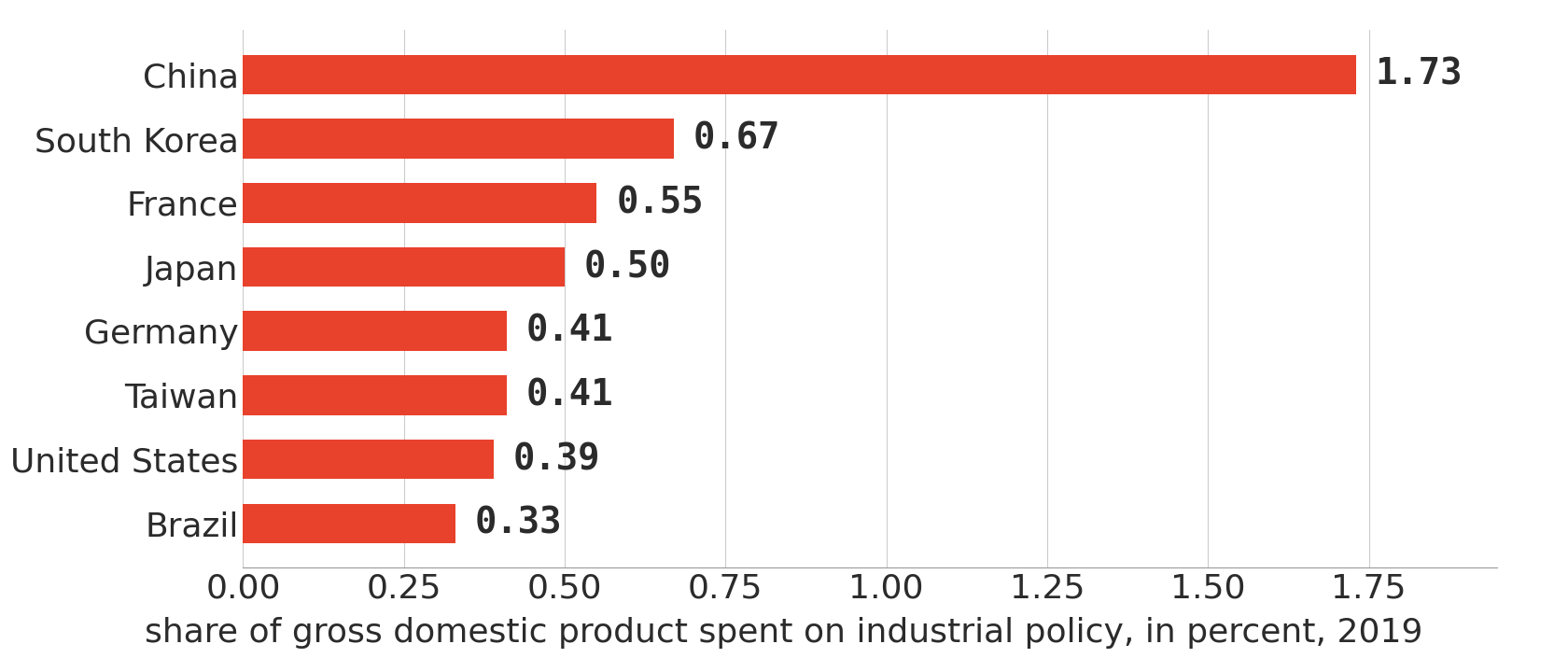
Three readings are possible, and the third is the useful one.
First, none of these economies reaches zero. Including those that most loudly claim the market.
Second, the channel varies, the existence of the intervention does not. Research and taxation for France, Korea and the United States. State funds for China. Public banks for Brazil, Germany and Japan. A country without a plan runs its industrial policy through the tax credit and the public bank. Germany, which refuses to plan, runs it through KfW, its public development bank: what a plan would write into a document, it decides loan file by loan file.
Third, these figures are a floor, and the authors say so themselves. Their method excludes public procurement for lack of comparable data, while noting that it is probably the most important lever they cannot measure, and it also leaves out infrastructure, education and agriculture. In other words, everything we have just seen, quotas, tariff contingents, retaliation duties, fuel tax gaps, sits outside the counter.
That leaves the ideological objection, the one that would make intervention a fad of certain countries. Three figures close it. Ronald Reagan protected steel, cars and motorcycles from import competition, ton by ton and plant by plant. Augusto Pinochet subsidized the Chilean forestry industry and pushed its exports. Margaret Thatcher courted Japanese carmakers and financially supported their British plants. None of the three claimed to be running a strategic state.
So the accurate formulation is not that every government plans champions. Some do so explicitly, others not at all. Ricardo Hausmann and Dani Rodrik put it differently: governments are condemned to choose. Building a port rather than a road, funding one training pipeline rather than another, mechanically advantages some producers. The neutral option does not exist.
Any product manager will recognize the exercise. A finite budget, a queue of requests that is not, and the discovery that prioritizing mostly consists of saying no to people who were right to ask. A government arbitrates between a port and a road the way you arbitrate between two features, knowing that every refusal manufactures an identifiable loser. A government that swears it does no industrial policy then looks like a product manager who swears he has no roadmap: he ships something anyway, and that something was chosen.
One question stays open. If every government mechanically advantages its own producers, and none can abstain, why does world trade not collapse into a general bidding war? Because governments negotiate with each other what they allow themselves against each other. Quotas capped by agreement, retaliation rights authorized rather than seized, disputes arbitrated in Geneva.
Except that these negotiations do not suspend industrial policy. They continue it by other means. The Multi Fibre Arrangement was an agreement, and it existed to restrict. The banana settlement took twenty years, and its bill landed on a bubble bath maker in South Carolina who exported nothing. The 25 percent duty of 1963 was a negotiated retaliation measure, and it still protects the most profitable segment of the American car market. A negotiated order does not remove the advantage, it moves it toward those who know how to negotiate, and the bill falls on those who were not in the room.
The moment to test the argument against itself
Here is the objection that should be forming, and I would rather carry it myself than leave it to you. That a company was helped does not prove the help explains its success. Perhaps it would have succeeded without. Perhaps the help even arrived because it was already succeeding.
The objection reaches further than it looks. Réka Juhász, Nathan Lane and Dani Rodrik put it in 2024 in a literature review, that is, a stock-take of everything research has published on industrial policy. Their reasoning runs through two imaginary worlds, built to be as far apart as possible. In the first, a government captured by private interests showers money on its friends without checking whether it works, and its friends are the incumbent industries, therefore the old ones, therefore the declining ones. In the second, an irreproachable government targets market failures, meaning precisely the activities private investors refuse to fund, therefore the most fragile ones. The corrupt and the virtuous pay into the same place, for opposite reasons.
Send a researcher into each of those worlds. He ranks companies by the public support they received, sets against it what we know how to measure, margin, revenue per employee, headcount growth, and reports the same thing from both sides: the companies at the top of his ranking earn less margin, produce less per employee and hire more slowly than those at the bottom. The worst and the best of governments leave the same statistical trace.
That result does not say public money damages companies. Nor does it say governments only help lame ducks: Coca-Cola, Nokia and TSMC were not lame ducks. It says that one particular comparison proves nothing, the one that ranks the companies of a whole economy by money received and then looks at what they are worth. So nobody can conclude from the mere presence of support that the support worked. Not its supporters, not its opponents, not this article.
That is not the comparison made here. Coca-Cola is not read against all American companies, but against Pepsi, which sold the same product at the same moment and did not get the same sugar. Diesel is not read against the French economy, but against gasoline, taxed eighteen cents more at the same pump. The footprint shows in these cases because there is a term of comparison the rule did not apply to. Whether that term holds is the next question.
Napoleon closed the continent to British goods in 1806 and, without meaning to, delivered the most elegant of these experiments. At that date, the English textile industry was crushing a French competition that still spun cotton by hand. The blockade did not protect all French regions equally, since geography and smuggling cut some off from English products far more than others, and the best protected ones invested in mechanical looms, learned to use them and trained workers. The blockade lifted. They kept the lead for decades. Protection did not create the industry. It bought the time to learn.
Other cases have been studied with the same rigor, from the Korean heavy industry push of 1973, which nobody wanted to finance at the time, to British and Italian regional aid, with incomparable political regimes and different instruments. The effects point the same way. They last decades.
Now the opposite objection. Alberto Mingardi reproaches this kind of demonstration with mistaking a spillover for an intention. His example is the touchscreen. Wayne Westerman, a doctoral student at the University of Delaware, defended a thesis funded in part by a National Science Foundation grant, like two thousand others every year, then founded the company whose technology would end up in phones. Does that make the touchscreen a product of industrial policy?
Mingardi answers no. Public money came first. It did not aim. Writing what DARPA, the US defense department’s advanced research agency, was trying to obtain by funding that work would be committing exactly the fault he charges others with.
His criticism holds, and it does not move the argument of this article: the argument is not about the government’s intention, it is about the company’s dependence. That public money was aimed elsewhere does not make the company any less dependent on it. Words matter here, because they guide actions and consequences.
The point deserves to be driven the other way too: public money is not enough. The French Plan Calcul, launched in 1966 to create a national computing champion, pulled every lever at once, company mergers, a public research institute, state orders and a European alliance, and none of them sufficed. It stopped in 1975, when France pulled out of the European consortium Unidata and merged its national computer company with Honeywell-Bull. The stop came from an industrial policy decision, not from a bankruptcy, which is another way of saying that public inconstancy kills more reliably than the absence of money.
And the same American Department of Energy guaranteed 535 million dollars to Solyndra, which went bankrupt in 2011, and lent 465 million to Tesla in 2010, roughly the same sum, repaid nine years early. Two windows of the same department. Two opposite outcomes. Hence the formulation that beats every debate about whether governments can pick winners: the test is not the picking of winners. It is the ability to let losers go.
Funchal, February 1987, or why the rulebook beats the checkbook
In the mid-1980s, each European country was developing its own mobile telephone system, incompatible with its neighbor’s. A French phone did not work in Germany. National markets stayed too small to bring costs down through volume, and American and Japanese manufacturers were waiting for the chance to sell their own system to a continent that had failed to agree. History does repeat itself in Europe, and you can see why: letting your own losers go is hard.
The telecommunications administrations, then public monopolies, wanted a common system in order to create a continent-sized market. The manufacturers wanted the chosen standard to be the one they had already invested in, which is perfectly rational and perfectly incompatible with the collective interest. The French and German governments wanted to protect their shared industrial champion.
From 16 to 20 February 1987, in Funchal, on the island of Madeira, the European working group in charge of the future standard had to choose between two technical solutions. The French delegation had received its instructions a few days earlier, confirmed by the director general of Telecommunications: it was to defend the wideband solution backed by Alcatel and SEL. Germany defended the same one. Facing them, the Nordic countries were pushing a narrowband solution. The chair of the group, Swedish engineer Thomas Haug, put the question to a vote.
The count was lopsided: thirteen delegations out of fifteen preferred the narrowband solution. France and Germany were the only two defending their manufacturers’ option. Since the European conference of postal and telecommunications administrations decides by unanimity, those two votes were enough to hold the other thirteen in check, and they used them. Discussions ran into the small hours, and starving delegates raided the conference center fridge after midnight, where they found only tins of sardines, all of which disappeared. Haug would later say that this meeting was like no other, because the political element in it was very strong, an area where engineers had no power.
The deadlock was worked around by the head of the French delegation himself, Philippe Dupuis, who let the technical work continue while the political compromise was built elsewhere. That compromise would put European manufacturers on an equal footing. On 7 September 1987, fifteen operators from thirteen countries signed in Copenhagen a commitment to open a commercial service based on the common standard before 1991. Twelve countries signed that day. Spain followed three days later. The same year, a European directive obliged member states to reserve two frequency bands around 900 megahertz for that system, the one the world would come to know as GSM.
Look for the subsidy in this story. There is none. A reserved band, a common specification, a calendar.
What did it produce? On 1 July 1991, on the date set by the European Commission and not by the engineers, only two operators were ready. Finland staged an inauguration in front of the press that day to place the first commercial call in the world on the new standard. Harri Holkeri, who had left office as prime minister two months earlier, dialed from Helsinki the number of Kaarina Suonio, deputy mayor of Tampere, on the network of the operator Radiolinja, built by Telenokia and Siemens. It worked, and the conversation lasted a little over three minutes. The second planned call, to the city manager of Turku, did not go through. The network that would go on to equip the planet was running at one call out of two that morning.
The winners have names, and they are not the ones France and Germany were defending in Funchal. Nokia, whose network arm Telenokia was, would become the world’s largest phone seller, and an entire generation would play Snake under the desk during class. The same generation that would later tell the legend of the 3310, the handset said to survive a fall from a building, a washing machine and a car driving over it. Ericsson, Swedish, would become the leading supplier of network equipment, the part you never see and without which nothing rings. France had its handsets too, and you may well have held one: Sagem sold them by the million, and so did Alcatel, the same Alcatel for which Paris had cast its veto on Madeira. Both have left our pockets, the Alcatel brand gone to a Chinese group, Sagem out of the business. As for the French phone that did not work in Germany, it has vanished so completely that nobody remembers it existed.
What could a founder never have done alone?
No manufacturer can reserve a radio frequency band, because the spectrum belongs to governments. No manufacturer can oblige twelve countries to open a service on the same day. And above all, no manufacturer can change the decision rule of the room. That leaves the question of who won what, and three things need separating. The technology chosen is the one the Nordics were pushing, and their suppliers, Nokia and Ericsson, are the ones who profited. The market belongs to nobody: it was born of a frequency band reserved by directive, a calendar signed in Copenhagen and a specification written in common, three things no manufacturer could produce. As for France and Germany, alone in defending their champions, they had the power to stop everything and they used it: they got everything they asked for on procedure, and nothing of what they wanted on substance. The success of GSM therefore does not come from a government backing its champion. Two did exactly that, with a veto in hand, and they lost. It comes from thirteen others accepting a standard none of them controlled.
Now look at what each side put on the table. The European conference brought together nineteen countries, and fifteen delegations sat in Funchal. None of those national markets was large enough to amortize a telephone system on its own. The result of that arbitration can be measured thirteen years later: in 2000, Europe had 56.9 mobile phones per hundred inhabitants against 37.9 in North America, and by 2007 the standard that came out of that room held 80 percent of the world market. A Nordic manufacturer would have sold on its national market. It sold to the world. The question asked that day was not about national pride. It was about the number of customers behind the door, and it comes up again in every European file since.
Note the operational lesson in passing, because it applies today. In Europe, the law sets general requirements, then standards bodies write the corresponding technical specification, and once that specification is cited in the Official Journal, compliant products enjoy a presumption of conformity, meaning they are treated as meeting the law without further proof. In other words, the document that acts as a market passport is drafted in a technical committee where you either have a seat or you do not. Whoever sits there writes the market, years before the rule applies. This is not a compliance topic, it is a product strategy decision. And for anyone without a seat in that committee, one maneuver remains: publish your implementation, for free, and let the committee find that it is already everywhere.
Two quick illustrations of what a rule costs compared with a check, a subsidy for instance. They matter above all for what they suggest: counting rules tells you nothing about what they do. A rule that costs the budget nothing can be worth more than a subsidy to the company it protects, and more expensive than a tax to the company it excludes. It is the same rule, and the only useful question is which side of it you are on.
First, the connector on your phone. On 4 October 2022, the European Parliament adopted, by 602 votes to 13 with 8 abstentions, the directive requiring a USB-C port on portable electronic devices sold new in the Union from the end of 2024. Apple, which had voiced reservations while the text was being drafted, moved to USB-C with the iPhone 15, ahead of the deadline. The rule changed the physical shape of the most profitable product in consumer electronics.
Now the battery in your future electric car. In 2016, China restricted its purchase subsidies to vehicles fitted with batteries from a whitelist of domestic suppliers. Japanese and Korean manufacturers found themselves excluded from the subsidized market, for as long as it took Chinese producers to learn. That is how Beijing built the world’s leading battery maker.
One last example, closer to home, and here I owe you a personal disclosure. In France, a 2021 circular and then a 2024 article of law require the use of a SecNumCloud-qualified host for certain sensitive public data. A technical qualification closes a market. Without a euro of subsidy being paid. I work as a product manager at a French sovereign cloud operator concerned by that qualification. You are entitled to read this paragraph knowing that, which is why I write it here rather than in a footnote.
One figure remains, and it is disconcerting. Work by the economist Tim Bartik puts the cost of a job created at between 78,000 and 155,000 dollars when you go through customized training and business services, against around 436,000 dollars when you go through tax incentives. Yet of the fifty billion dollars that American states and localities devote to economic development each year, forty-seven go to tax incentives and three to business services and customized training.
A minister cuts a ribbon in front of a factory. Nobody cuts a ribbon in front of a training session. That difference is enough to explain the rest: the money goes fifteen times more heavily to the instrument that costs the most per job created, because it is the only one of the two that photographs well.
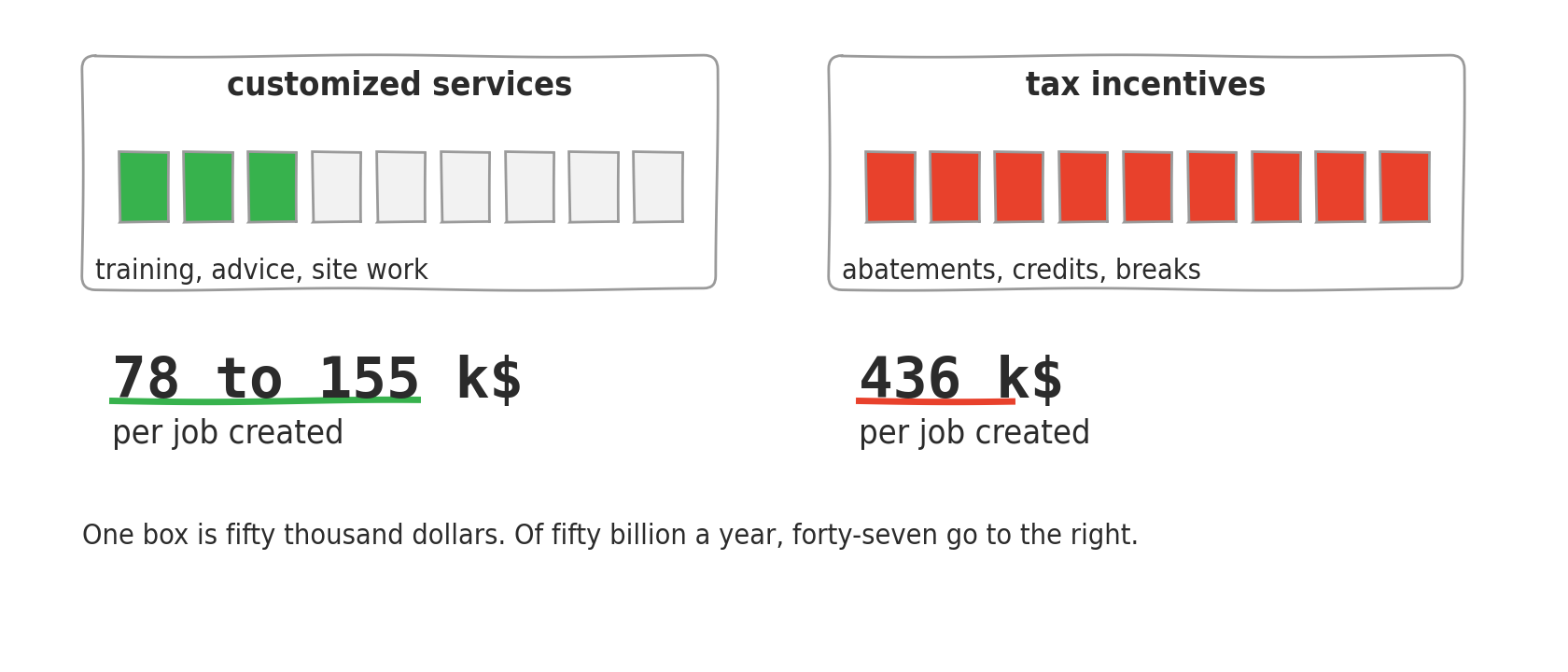
Both figures come from the same author, the same method and the same vintage. Mixing them with another year’s would manufacture a ratio that exists nowhere.
What happens when the government leaves
If a public presence counts, its withdrawal should count too. Three full-scale tests exist, and they do not point the same way. All three are worth reading.
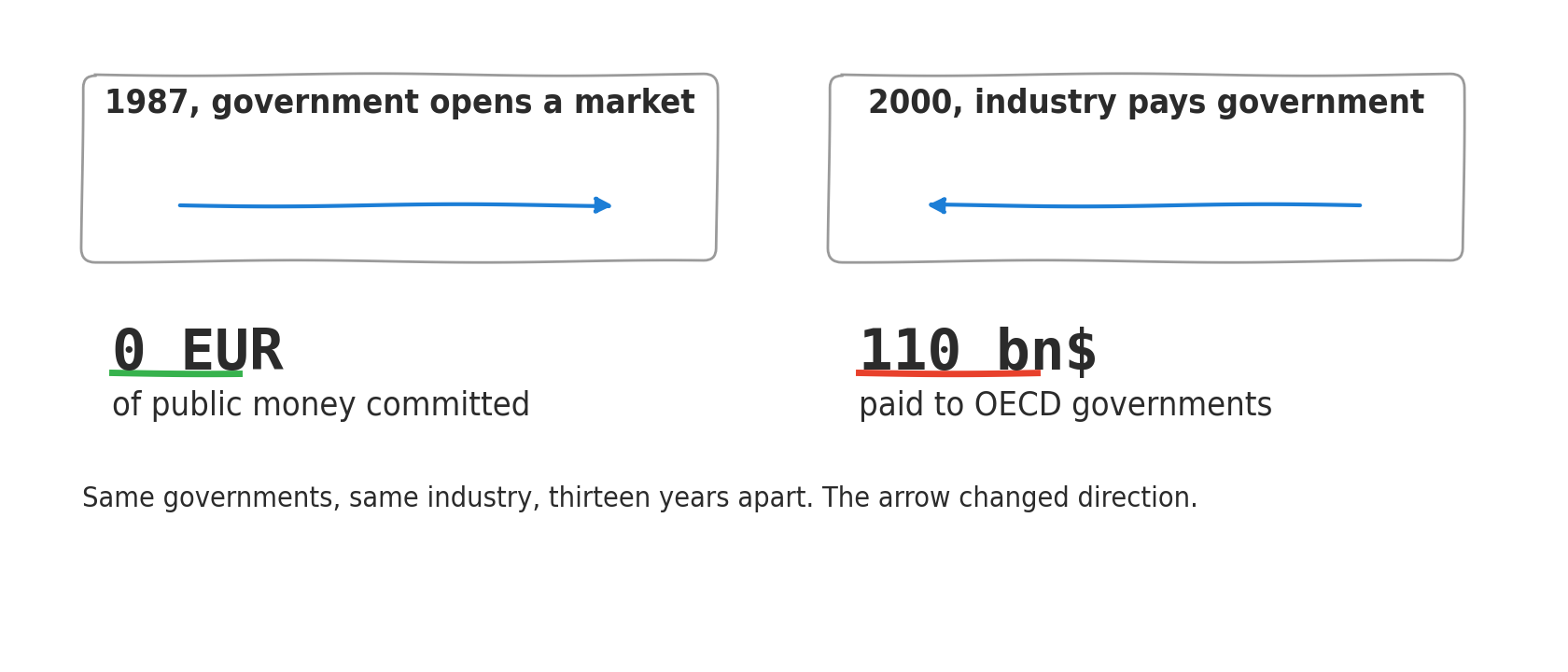
First test, the auctions of the year 2000. Thirteen years after creating the mobile market by reserving a frequency band, the same European governments turned back to the same industry, no longer to open a market for it, but to take money from it. On 18 August 2000, the German auction of third-generation licenses closed at a little over 99 billion marks, around 50 billion euros, and the finance minister publicly welcomed an unexpected windfall for paying down public debt. In the United Kingdom, licenses had gone four months earlier for 22.5 billion pounds. The table of awards published by the OECD allows a total to be struck: added together, the third-generation licenses sold in its member countries brought in on the order of 110 billion dollars, of which 51 for Germany alone and 35 for the United Kingdom.
What followed ran on its own. One German operator handed back a license it had paid 8.4 billion euros for, one French operator would write off 7.1 billion of debt tied to that acquisition, and rollout investment slipped by several years, at exactly the moment the next generation was being decided. That is a heavy weight to place on operators and on their capacity to invest.
Europe dominated the second generation of mobile telephony. It has never dominated a single one since. Same governments, same industry, opposite decision, opposite result.
Second test, German solar. It has to be read twice, because it tells two different stories. Germany created world demand for solar panels through its guaranteed feed-in tariffs, a scheme that promises the electricity producer a fixed price for twenty years, paid by the consumer on the bill. That money bought panels. In 2011, China exported twenty-one billion euros’ worth of them to the European Union. On the European market, the share of Chinese modules went from 63 percent in 2009 to 80 percent in 2011, while their average import price fell from 2,100 to 764 euros per kilowatt. Four times the volume at a third of the price: that is what the German electricity bill financed.
This first reading depends on no contested causality. It describes a transfer. The German consumer paid. The leaders were born elsewhere. Remember this sentence more than the others: behind every leader there is a government, but not always its own.
The second reading is an autopsy, and it is more disputed. Q-Cells, the world’s leading photovoltaic cell maker in 2007, filed for bankruptcy on 3 April 2012. SolarWorld, the last large German manufacturer, followed in May 2017. Analysts point to four possible factors: the reduction of German feed-in tariffs, Chinese competition itself supported by its provinces, German production capacity close to double the demand, and the sovereign debt crisis. The first factor is a decision by the German government to withdraw, which makes the case less simple than it looks. Between the two bankruptcies, SolarWorld went to the public authorities: on 24 July 2012, the company filed a dumping complaint in Brussels. It obtained duties of 47.6 to 67.9 percent in June 2013, then a guaranteed minimum price. It asked public authority to close the market, it got it, and it died anyway. Was the delay of the procedure the reason?
Third test, and it points the other way. The Japanese ministry of industry judged for itself that most of its research projects of the 1980s and 1990s had not produced substantial results. Japanese companies had acquired their own technical capabilities, so the government’s role in their competitiveness had become marginal. Public money did not stop working through a dosing error. It stopped being useful the day the industry no longer needed it. Accordingly, in 2000, the ministry reorganized its projects around social needs rather than technologies chosen in advance, and paired its health program with a regulatory reform of the sector. It changed instrument, not profession: it moved from funding to rules. So the Japanese case does not show that an industry eventually does without government. It shows that one form of support has an expiry date, and that the government changes window rather than leaving.
A government that withdraws therefore does not mechanically kill its companies. It removes an option from them and transfers the risk onto their balance sheet. Sometimes they absorb it. Sometimes they disappear. But nothing is never what happens.
What about the companies that owe nothing to anyone?
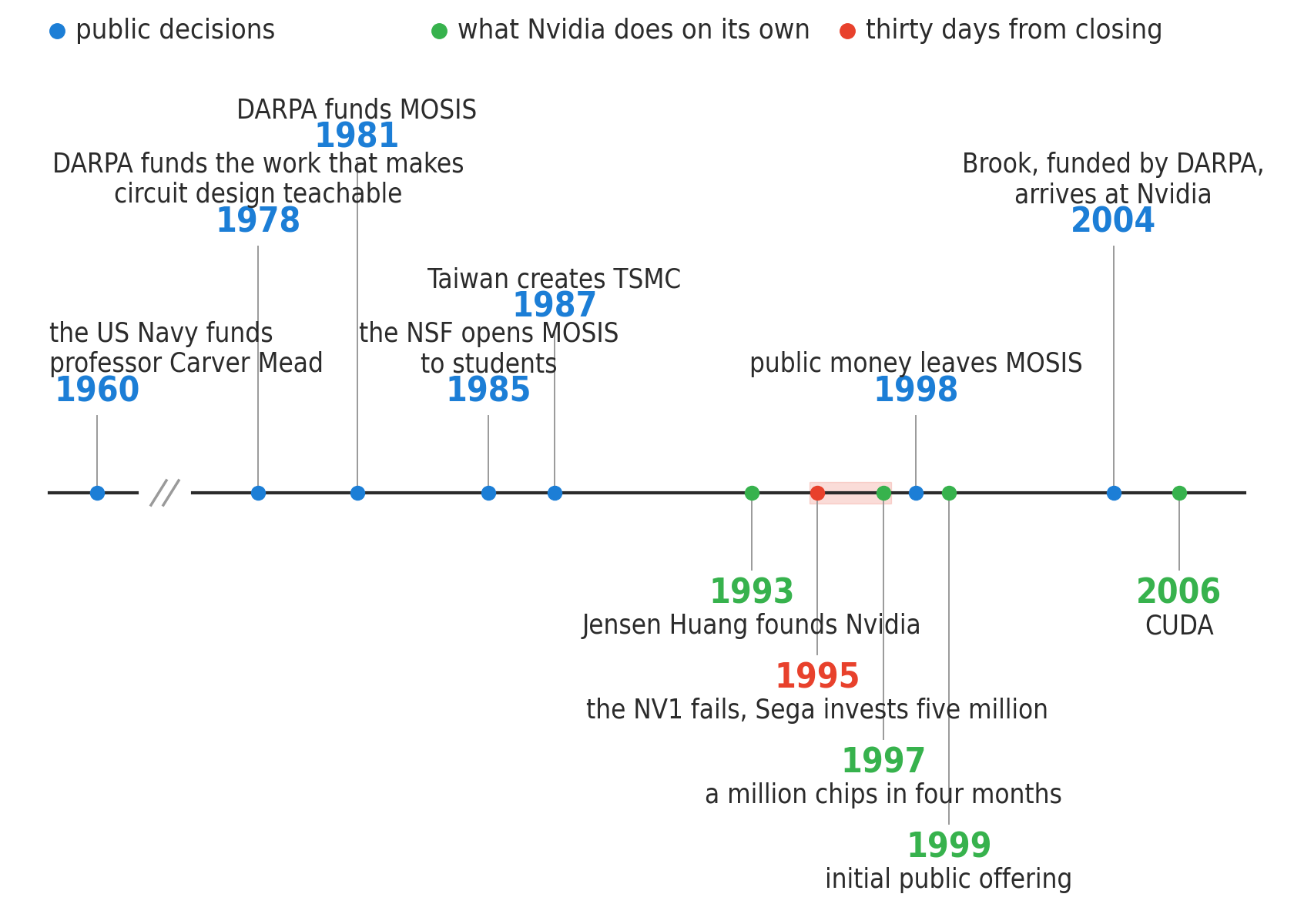
Today’s champions, the ones that built empires in twenty years, should owe nothing to anyone. Take the case most favorable to that view, Nvidia. No public capital, no founding order, no launch check. Jensen Huang founded the company in 1993, and it nearly died before it was five. Its first chip, released in 1995, bet on a rendering method that Microsoft set aside by imposing its own with DirectX. The company came so close to shutting down that it kept an unofficial motto out of it: we are thirty days from going out of business. What saved it was no public program. It was Sega, a Japanese console maker, which invested five million dollars after Huang had made the trip to Tokyo to tell it in person that the money would probably be lost. The next chip sold a million units in four months, and Nvidia went public in 1999.
Ian Buck was preparing his thesis at Stanford in the early 2000s. He wired thirty-two graphics cards together, first to push Quake and Doom beyond what the machine could do, then to answer a question with nothing to do with games: can these chips, designed to paint pixels, compute something else?
Buck developed Brook, a language that treats the graphics card as a general-purpose calculator. His laboratory lists its funders on its own page: IBM, Sony, ATI, Nvidia, DARPA and the Department of Energy. Two of those funders are federal. Mingardi’s objection applies here without discount: nobody at DARPA wanted CUDA. Nvidia hired Buck in 2004. With John Nickolls, he turned Brook into CUDA, the software that would make the company’s cards irreplaceable twenty years later.
Bill Dally went and told this story to the National Science Board on 23 July 2025. Nvidia’s chief scientist projected a timeline whose title announces cooperation between government, university and industry in the company’s history, starting from a parallel machine funded by DARPA in 1983, passing through stream computing in 1997 and through Brook, and arriving at CUDA in 2006. The chain he draws holds in five boxes: public funding, university research, trained people, technology, large companies.
That chain reaches Nvidia in 2004, five years after the initial public offering. The government straightened nothing out: it supplied material to a company that was already doing well.
So the company owes nothing to anyone, except the ground it is built on. Nvidia owns no factory. It designs chips and has them manufactured elsewhere, and that profession did not exist before governments built it. From 1978, DARPA funded the work that turned circuit design into a teachable discipline, then in 1981 a service called MOSIS, which groups the designs of several teams onto a single silicon wafer. Jennifer Kuan and Joel West traced what followed in Research Policy: MOSIS laid down the standardized interface between design and manufacturing that companies without factories, known as fabless companies, would use for forty years. From 1985, the National Science Foundation opened access to students at any accredited American institution, and more than fifty thousand of them went through those courses between 1990 and 2000 before going to work in such companies or founding them. By 1994, commercial customers accounted for the majority of designs manufactured. Public money then withdrew, and in 1998 MOSIS received not one federal dollar.
The factory itself was paid for by another taxpayer, and the idea came to that one from the first. Carver Mead, the professor the US Navy had been funding since 1960, had been calling since the mid-1970s for factories that would agree to manufacture other people’s designs. American industry did not want them. The trade magazine that gave him its award in 1981 describes the rejection by most of a skeptical sector. Mead recounts that Andy Grove, then head of Intel, even accused him of undermining Intel’s position in the industry.
The refusal was not just a matter of pride. There were almost no companies without factories, therefore no customers for a factory that would only manufacture, and no private industrialist was going to build for customers who did not yet exist. A government took that bet. Mead went to present his vision of an industry cut in two at the Industrial Technology Research Institute in Taiwan, at a meeting arranged by one of his students. TSMC was founded a few years later, in 1987, as a joint venture between the Taiwanese government, its largest shareholder, and Philips, the Dutch electronics group. Taiwan had the money and the will, not the know-how: Philips brought capital, but above all its production technology and the licenses that go with it. Morris Chang, the engineer Taiwan went out to recruit to build this industry, had first knocked at Intel and Texas Instruments, who turned him down. At TSMC he set up what is called a foundry: a factory that manufactures chips designed by others and designs none itself. A manufacturer that also designs its own chips is a rival to anyone handing over their plans. This one designs nothing, so you can hand over yours without fear, and owning a factory is no longer necessary in order to sell a circuit. Nvidia became a customer in 1995.
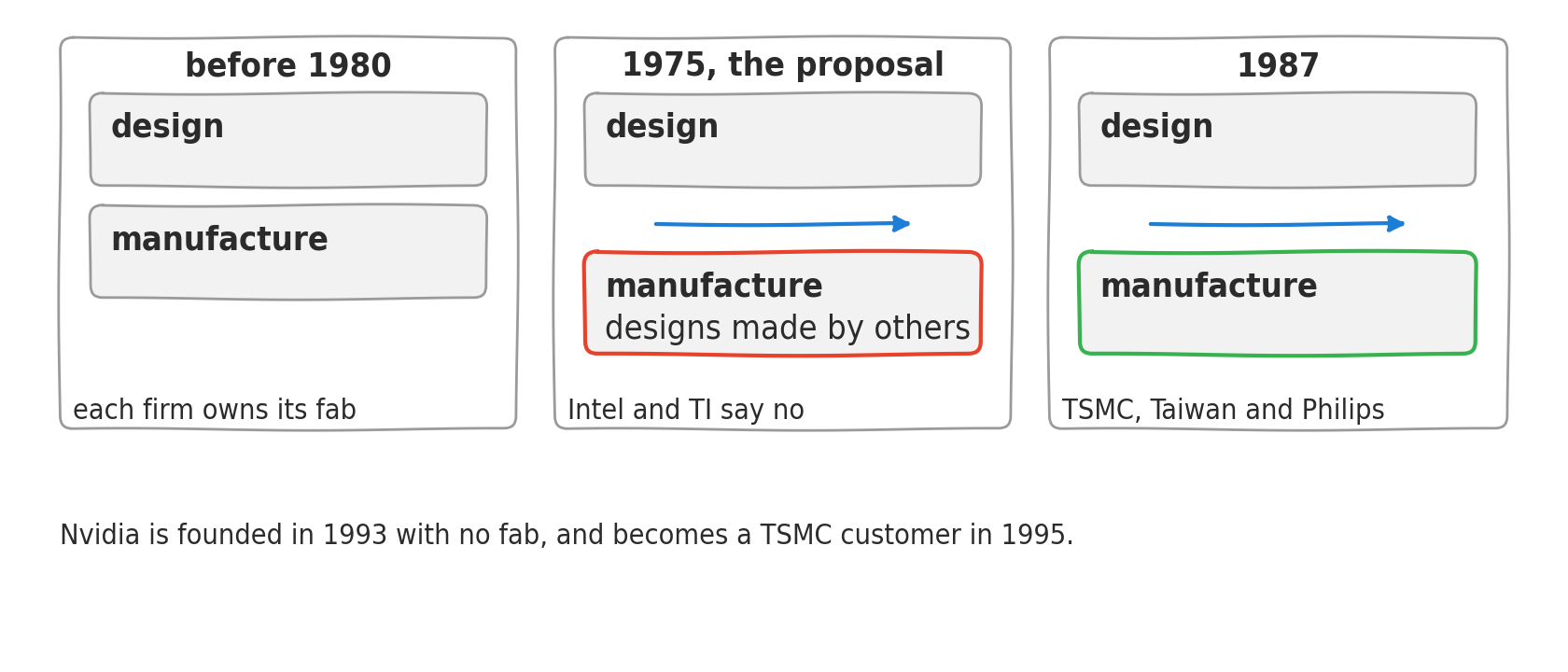
Nvidia was founded six years after TSMC, twelve years after MOSIS. Neither the design method nor the factory would be there without two public decisions. Behind that leader there are at least two governments, and one of them is not its own.
In its fiscal year ended January 2025, Nvidia sold around 17 billion dollars’ worth in China, 13 percent of its revenue. Then two governments took hold of that market, each in turn.
Washington started. On 9 April 2025, the American administration required a license to export the chip Nvidia had designed specifically for China: four and a half billion dollars lost in a day. In August 2025 it gave the licenses back, in exchange for 15 percent of revenue made in China, paid to the American government. On 8 December it authorized a more powerful chip, at 25 percent this time.
Beijing hit back. On 14 January 2026, Chinese customs blocked at the border the processors Washington had just authorized, while the Chinese leadership discouraged its own companies from buying them. It took until mid-March for China to allow the sale, and only to selected customers.
Once you have watched all this, asking whether a given company was helped leads nowhere, because the answer is almost always yes as soon as you look at enough channels. Two questions teach you something: through which channels was the company helped, and how much.
For each channel I asked myself: if the government did not act through this channel, what would change for the company? If it does not act at all, the question does not arise and I score zero. If it does act, but the company feels no difference compared with the government doing nothing, I give one point. If it acts and there is a correlation between the company’s results and the government’s action, jackpot: two points. That makes six channels and twelve points at most.
Let us run it in front of you, on Nvidia, since it is the hardest case. Public capital: zero, no public money has ever entered its capital. Public demand: one, the government buys cards from it, never enough to decide its fate. Targeted public money: one, it benefits from general research tax schemes, which its competitors also enjoy. Passport standard: zero, no mandatory specification conditions its sales. Barrier standard: two, export controls now decide who is allowed to buy what from it, and it can do nothing about that. Upstream: two, its software brick comes from publicly funded research, and it is its own chief scientist who laid that out before the National Science Board.
Six out of twelve. The total alone is not worth much, in the absence of other companies scored by the same rule. The split does speak: the three channels that cost public money total two points, the three that cost almost none total four. For the most self-built company in the world.
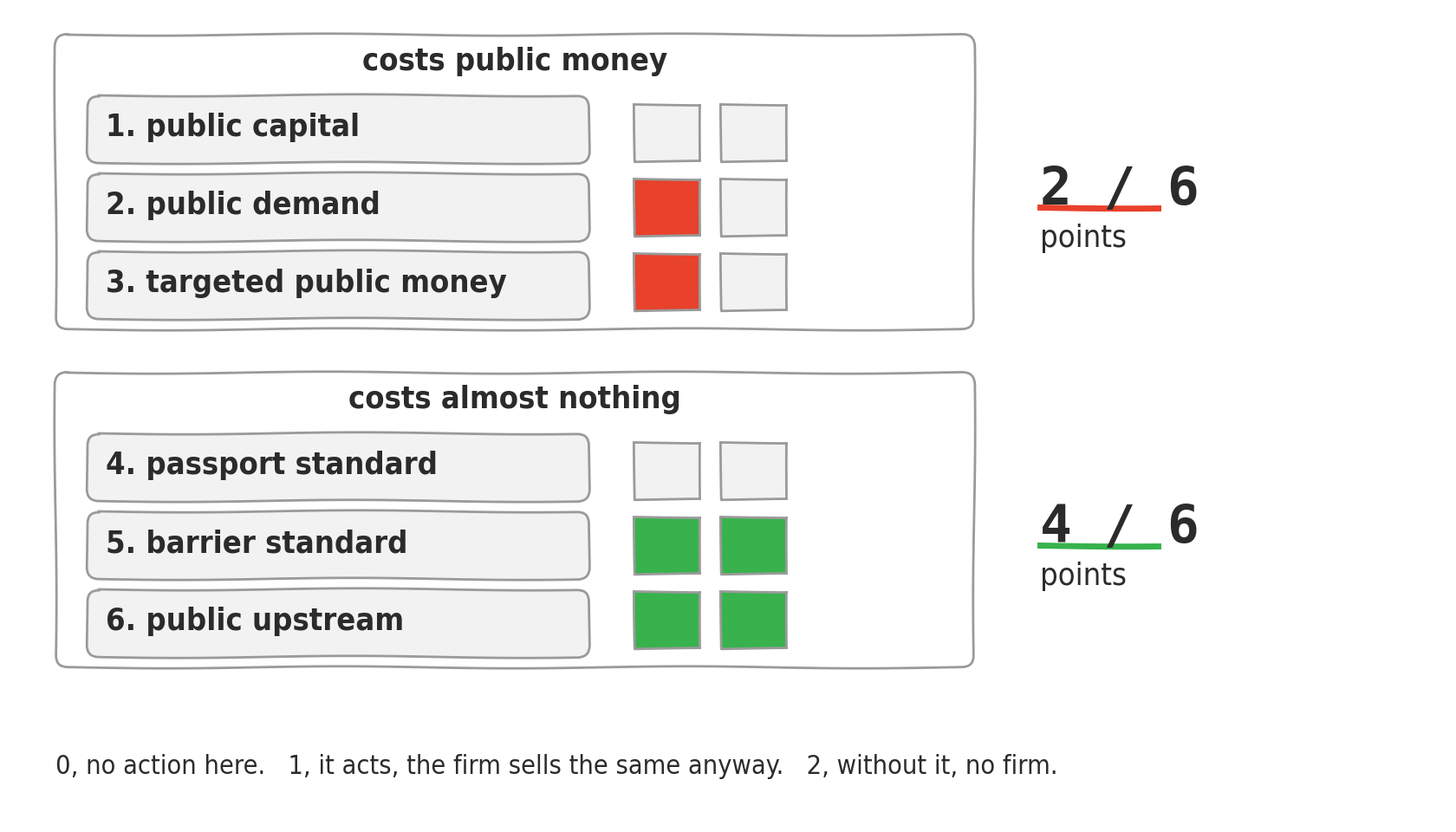
Run the exercise on your own company before running it on others, it teaches more. And go looking for the one that scores zero. I have not found it.
A word, finally, on what has changed recently, because it moves your risk. Until 2018, what triggered a public decision was the trade balance, employment, sometimes the environment. Since then, it has been rivalry between powers. Japan released the equivalent of more than two billion dollars in 2020 to help its companies bring production back from China. The Chinese five-year plan traded its growth target for a technological self-sufficiency objective. The French government took a stake in a satellite operator and took over a high-performance computing division.
In practice, the commercial survival of a product line can now depend on the relationship between two capitals, on a horizon of a few weeks. That parameter was not in the product plans of ten years ago.
What this article does not say
Do not misread the argument: this article does not say politics does everything, and it would be dishonest to leave that impression.
Inside the envelope, execution still decides everything. The four-meter rule applied to every manufacturer present in India: some drew two product categories out of it, others shortened boots and convinced nobody. The 900 megahertz band was open to every European equipment maker: two of them took the lead of the world market, the others did not. Textile quotas did not designate Bangladesh, they only designated capped countries, and somebody there had to go and find training in Korea.
The envelope deals the cards. It does not play the hand. The hand is played on a table whose dimensions were set by somebody else, and ignoring that is expensive. You can find the value, deliver it, execute perfectly, and lose because a frequency band went elsewhere, because an approval list excluded you, or because a quota written in another decade moved production to another country.
So here is the question to add to the agenda of your next product committee, right after the one about the customer: which public decision opens or closes my market, on what horizon, and who holds the pen?
That last question opens the next part. Because in Funchal, in February 1987, the French delegation was not defending an idea born in a ministry. It was defending a position whispered by an industrialist, who had known how to convince two governments before the meeting even began.
The person who signs the decision is almost never the one who wrote it.
What this article rests on
The cable of June 1943
- The Coca-Cola Company, “The Chronicle of Coca-Cola: A Symbol of Friendship”, for the cable dated 29 June 1943, the clause forbidding it to displace other cargo, the three million bottles, the ten plants, the engineer sent to Algiers and the sixty-four plants
- United Service Organizations, interview with the company archivist, who attributes the cable to General George Marshall rather than to Eisenhower
- “Quench Warfare”, HistoryNet, on the 1942 letter campaign, the sugar rationing exemption for sales to the army, and the company executive appointed to the rationing committee
The banana dispute
- European Commission, case file on dispute WT/DS27
- WTO, press release Press/591, Lamy welcomes the agreement ending the long banana dispute, December 2009
- Donald Barlett and James Steele, “How to Become a Top Banana”, Time, 7 February 2000, on Lindner, Kantor, Barshefsky, the lists of 10 November 1998 and 19 April 1999, and the case of Rick Reinert
Chicken and pickup trucks
The T-shirt and Bangladesh
- Yung Whee Rhee, “The catalyst model of development: lessons from Bangladesh’s success with garment exports”, World Development 18(2), 1990, pp. 333-346, the reference for the 130 trained in Pusan and the 115 departures
- Desh Garments, founder’s page, on the joint venture with Daewoo and the number of leavers, a figure that diverges from other sources
- The Daily Star, “Desh Garments, a pioneer’s gift to his country”, on the advertisement of 2 October 1978 and the career of Mr Noorul Quader
French diesel
- Céline Antonin, Avantage fiscal sur le gazole : une fin programmée, OFCE, 2017
- French Senate, report l13-600, which reproduces Delphine Batho’s February 2013 reply to the Cour des comptes and the 6.9 billion euro estimate for 2011
- Actu-Environnement, 1 March 2013, on the formal letter sent on 17 December 2012 to the ministries of the economy and of ecology and made public on 1 March
- French National Assembly, written question 27181 from Lucette Lousteau, answer published in the Journal officiel on 2 July 2013, on the committee chaired by Christian de Perthuis
Renault
South Korea in 1973
What eight economies spend
The cost of a job created
- Upjohn Institute, research summary, June 2026
- Timothy J. Bartik, Making Sense of Incentives: Taming Business Incentives to Promote Prosperity, Upjohn Press, 2019, whose chapter 2 table breaks down the fifty billion a year
Funchal and GSM
- Léonard Laborie, “Concurrence et changement technique. De la norme au marché, la trajectoire unique de la téléphonie mobile en Europe depuis les années 1980”, Histoire, économie & société, 2008/1, pp. 91-101
- Ericsson
- From 2G to 3G, The Evolution of International Cellular Standards
- GSMA, twentieth anniversary press release
- Nokia, post by Pekka Lundmark, thirty years on
The third-generation auctions
- Patrick Lenain and Sam Paltridge, “After the Telecommunications Bubble”, OECD, working paper 361, ECO/WKP(2003)15, table IV.1 page 17
- European Central Bank, Monthly Bulletin, September 2000, box on the implications of the UMTS auctions
- heise, 2025
German solar
Japan
Nvidia
- summary of the export controls
- Jensen Huang recounts in Tokyo, in July 2026, the Sega investment that saved Nvidia in 1995
- Jennifer Kuan and Joel West, Interfaces, modularity and ecosystem emergence: how DARPA modularized the semiconductor ecosystem, Research Policy 52 (2023) 104789, open access under CC BY
- Britannica Money, founding of TSMC in 1987 and the Taiwanese government’s majority stake
- TSMC, company profile, pure-play foundry model since 1987
- Founding of TSMC in 1987 and the role of the Taiwanese development fund
- Ling-Ming Huang, history of semiconductors in Taiwan in the 1970s and 1980s, Taiwan Insight
- Nvidia, first quarter results for fiscal 2026, 28 May 2025
- Bureau of Industry and Security, Department of Commerce
- Stanford University, sponsors page of the Brook project, listing IBM, Sony, ATI, Nvidia, DARPA and the Department of Energy
- “The Origins of GPU Computing”, Communications of the ACM, on the move from Brook to CUDA by Ian Buck and John Nickolls
- Bill Dally, slides presented to the National Science Board on 23 July 2025, “Government, University, & Industry Cooperation: The NVIDIA Story”
India and the four-meter line
China’s battery whitelist
Qualified cloud in France
The work the method rests on
- Juhász, Lane, Rodrik, The New Economics of Industrial Policy, Annual Review of Economics 16:213-242, 2024
- Alberto Mingardi, “A Critique of Mazzucato’s Entrepreneurial State”, Cato Journal 35(3), Fall 2015, pp. 603-625
- Réka Juhász, Nathan Lane and Dani Rodrik, “The New Economics of Industrial Policy”, NBER, working paper 31538, note 2, on Reagan, Pinochet and Thatcher
The USB-C connector
Solyndra and Tesla
Plan Calcul and Unidata
Brazilian fuel
Note on the one translated quotation: Delphine Batho’s reply is quoted in translation. The French original reads « résulte principalement du choix opéré par la France », in the Senate report l13-600 listed above.