“Did you know that every click, every search, every purchase you make is already being tracked, analyzed, and exploited without your full knowledge?” The activist asking the question has just grabbed the microphone in the middle of a neurotechnology conference in San Francisco, and his voice carries to the back of the room. Up on the stage, the speaker takes a step back, while in the middle of the audience an engineer and a neuroscientist who have never met look up at the same moment. The activist doesn’t give anyone time to answer. “Now imagine that it’s not just your clicks, but your thoughts themselves that are being monitored!”
Murmurs rise from the rows. At the back of the hall, hurried footsteps start down the stairs: security. The activist doesn’t even turn his head. “We’ve seen the abuses with the internet, how our behavioral data has become a currency. How can you assure us that the same thing won’t happen with technologies that claim to read our minds directly?”

The guards are on him when he shouts over their shoulders, “Think about the implications before it’s too late!” They walk him out. Behind him, the room stays silent.
The engineer’s name is Sophie. A robotics specialist, she’s passionate about brain-machine interfaces, which link the brain directly to a device. The neuroscientist, Julien, designs algorithms that decode thought. Their eyes meet, and Julien stifles a laugh as he leans toward her. “Another armchair intellectual who doesn’t really understand technology… He talks as if we could read thoughts as easily as emails. We’re far, very far from that.”
Sophie barely smiles. “Great premise for a sci-fi novel. The technical reality is much more complex, and much less threatening.”
They spend the rest of the day side by side. Between talks, they pick up their technical sparring, scribbling in the margins of the program. “Your sensors will never keep up,” Julien says. “Neither will your algorithms,” Sophie shoots back.
Little by little, a sketch takes shape in the margin: a headset capable of reading thoughts. Not one of those devices still confined to laboratories or reduced to triggering simple gestures, like turning on a lamp or telling a household robot to start preparing dinner. Theirs will go much further.
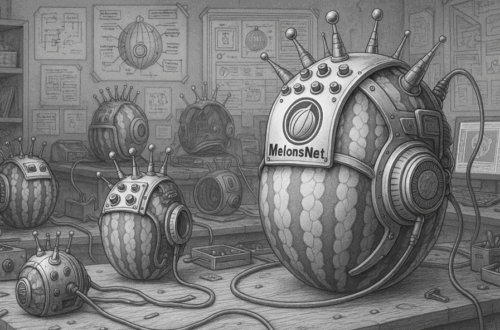
For this headset, they walk away from everything: their prestigious positions in world-renowned research laboratories, and the job security that came with them. They call the venture MelonsNet. In French, avoir le melon, “to have the melon,” means to be full of yourself, to have a big head; the expression makes them laugh. They also like the image hidden inside it: a network of brains connected to one another through thought.
The headset will mirror their two professions. It will combine the integration of complex neurological signals with the most advanced open-source technologies in artificial intelligence. Open-source code is published freely, like the software building blocks thousands of developers share online. It will be able to interpret thoughts and translate them, into speech or text, in the language and register suited to any interlocutor, human or machine, in any country, in any professional context.
As for money, they’re counting on their savings, on government assistance, unemployment benefits first and foremost, and on an inheritance Julien received. That’s enough to last a little over two years with two employees and two interns paid minimum wage. “Tight, but perfectly doable,” Julien says. “We’ve seen worse in the lab.”
“We can’t afford a mistake,” Sophie says. Julien immediately thinks of an electronics and computer science student, brilliant and a little eccentric, whom he met at a robotics competition a few years earlier. They call him, and Éric says yes before they’ve finished the sentence.
He knows his circuits cold, and he knows people: his network of college friends will later become valuable allies in integrating the headset’s electronics and mechanics. One evening, after a long day’s work, Éric tells them he soldered his first circuits at the age of eight. All three of them crack up.
A year later, they find their second employee by chance, in a Latin Quarter café in Paris that’s been turned into a hackathon arena, a programming marathon in which teams code against the clock. The smell of cold pizza mingles with the bitter scent of coffee brewing nonstop, and a giant countdown timer ticks away under the dim glow of the LED lights.
In a corner, hunched over his keyboard, sits a developer the open-source community knows well for his breakthroughs in neural decoding: Marc. Participants file past his table to ask for advice. He answers each of them with a quick, eager smile, never turning anyone away and never once glancing at the countdown.
Sophie and Julien wait their turn. The moment they mention the headset, Marc tells them everything: sleepless nights, labyrinthine algorithms, a gut feel for AI… He talks so fast he forgets his cup, which goes cold. A few coffees later, he joins MelonsNet. With Éric, he immediately forms a duo in which each reads through the other’s code, nodding along, and the two of them talk of nothing but taking mind reading further.
Another year, and the team is buried under the work of training the neural networks, programs that learn from thousands of examples, adjusting themselves as they go, in this case recordings of brain signals.
Those networks also have to be tuned to the project’s own data, what specialists call fine-tuning. For extra hands, the budget only allows two interns, for a six-month assignment. They pick Fatima and Gunter, final-year master’s students in computer science and electronics at Stanford.
Sophie met them at a conference in San Francisco, where the two students peppered her with pointed questions about MelonsNet. A few weeks later, they join the team.
Convinced that the only barrier to success is the technological revolution, they focus on developing whatever seems most technically demanding to them. Around the coffee machine, all anyone talks about is “latency,” “neural interface,” and “prediction algorithm,” and the nights at the office get longer.
One night, Marc sets his mug down next to Éric’s keyboard. “Has anyone actually asked us for this headset?”
Julien doesn’t look up from his screen. “Once it works, everyone will.” Éric laughs. Marc picks his mug back up.
The strategy pays off: over the months, Julien and Sophie’s office turns into a cutting-edge lab where prototypes pile up, each one a break from the technologies already on the market. The walls, bare at first, fill with circuit diagrams and neural data graphs, a record of their progress in the complex integration of hardware and software.
As the workdays stretch on, Julien and Sophie regularly accept media invitations. One of those invitations lands them on the set of a famous talk show followed by millions of people on social media.
A shrill jingle, blinding spotlights. The heat of the set presses on their chests, and Sophie squints into the glare. Applause breaks out in bursts, and the host turns to Julien and asks, “So, Julien, can your machine really read all our thoughts? Admit it, it’s a little scary, isn’t it?”
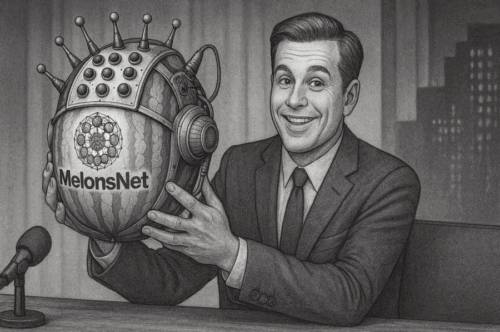
The host flashes an impish grin as the spotlights close in. Julien doesn’t blink as he answers, “Imagine that our devices work like a highly secure safe. They only open if you enter the right combination, and only for specific, authorized thoughts. No random reading, no intrusion. Every access is consented to and strictly controlled.”
On the radio, it’s Sophie’s turn. A listener calls in and asks, her voice trembling, “Aren’t you afraid of creating an era where our thoughts no longer belong to us?”
Sophie lowers her voice. “I understand your fears, but our goal is to help, not to invade. We place a high priority on our system’s security, confidentiality, and regulatory compliance.”
TV studios, social media, radio: every anxious question becomes, for them, a platform where they state their intentions and dispel misunderstandings about their revolutionary work. After two years in business, trade shows become the highlights of their calendar: Vivatech, Paris’s big startup gathering, and CES, the giant consumer electronics show in Las Vegas.
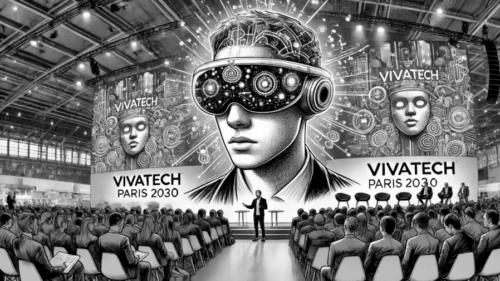
At Vivatech, Julien faces a crowd holding up their phones. “And now, ladies and gentlemen, let’s see how our device can interpret the thoughts of our volunteer!” Beside him, a young woman picked at random from the audience, nervous but smiling, puts the headset on.
The first few seconds go without a hitch. Then a thought she meant for no one booms from the speakers of the big conference hall. “I really hope my husband hasn’t left his keys at the office again, it would be the third time this week.” A second of silence, then the room bursts out laughing. The young woman turns scarlet.
Sophie grabs the microphone and puts a hand on the volunteer’s shoulder. “As you can see, our technology is still in the learning phase. A new version of the software fixing this bug is currently in testing! It’ll soon be a thing of the past.” The laughter swells, and the room applauds. At the edge of the stage, Julien gives Sophie a discreet thumbs-up. “At least we know what’s left to tame,” he murmurs.
A little over two years have passed since they started out, and new interns, Cassandre and Paul, have replaced Fatima and Gunter. In the media, MelonsNet has established itself as the pioneer of mind-reading technology. At the last CES in Las Vegas, though, a rival startup draws the crowds by unveiling a device strikingly similar to theirs. Sophie replays the video of the demo three times in a row.
Asked about the rival, Julien strikes a pose for the cameras and says, “Challenges are what shape us. MelonsNet doesn’t just follow trends, it creates them!”
Meanwhile, away from the microphones, Julien and Sophie talk at length about where to take the product. They reach a clear conclusion: if they want to take the next step and stay ahead, they need a dedicated product owner. Someone capable of structuring the product, owning the roadmap, and bridging the gap between vision and execution.
A roadmap is the plan that says what to build and in what order: what ships this quarter, what waits for the next.
“Money’s too tight for another salary,” Sophie says, the cash-flow spreadsheet in front of her. A few days later, without telling Sophie, Julien puts his house up for sale. To cut expenses, he plans to move his family into a rented apartment. When Sophie asks how he intends to suddenly inject money into the company, he brings up a different inheritance, from a distant great-uncle, an old family story he’d never told anyone.
She doesn’t press. Together, they agree on a new equity split that reflects the effort he’s made. With the money from the house, they can finally hire their first product owner.
They go looking for one at a tech meetup in Paris, an informal evening where people come to pitch a project and meet others in the field. Sophie grips her notes a little too tightly, Julien talks a little too fast, but they present their ideas all the way through, and that’s where they meet Laura. Within a minute, she’s leaning over their sketches, asking three questions about the headset before she’s even given her name.
An experienced product owner, Laura has the profile of what people call the modern product manager. She started at a top business school, where she sharpened her eye for economics and marketing, then, out of methodical curiosity, added a year of web development. “So I could talk to engineers as an equal,” she says. That foray into code gave her real technical footing.
Straddling both worlds, she brings the key skills of the job: strategic vision, listening to users, data analysis, ruthless prioritization, and the art of storytelling to bring stakeholders on board.
Add to that mastery of Agile methods, which move a team forward in short cycles: you ship a version, watch what people do with it, and adjust.
“So what’s your trademark, in practice?” Sophie asks.
“Turning nebulous ideas into concrete products that feed both the market and the technical roadmap,” Laura answers.
Until closing time, she tells them about her previous projects and how she motivated teams to reach ambitious goals. By the end of the evening, as the staff starts stacking chairs, they shake hands: Laura is joining MelonsNet.
The months go by, and on the whiteboard the dates change while the tasks don’t. Julien brushes off every criticism, every competing startup that raises money or gains visibility, with a “Good! A competitor just proves we’re right.”
The team is the same, almost frozen, while other companies pull ahead, and Laura has been with them for several months now. “She was supposed to give us a second wind,” Julien says. “Do you think she’s on board? I still see her standing on the dock.” Sophie shrugs. “Less committed than we’d hoped.”
The journalists have stopped calling. Despite Julien’s new contribution, they have only a little over nine months of cash left. The office, once bustling, is now littered with abandoned plans and unfinished prototypes, and on the walls, where new circuit diagrams used to go up every week, the Post-its have yellowed.
One evening, the two of them are alone there, and neither raises their voice. Julien stares at a Post-it whose ink has faded, unable to remember what it said. Sophie opens the cash-flow spreadsheet on her screen.
“With numbers like these, we’ll have to be smart,” Sophie says, tapping the screen with the end of her pen.
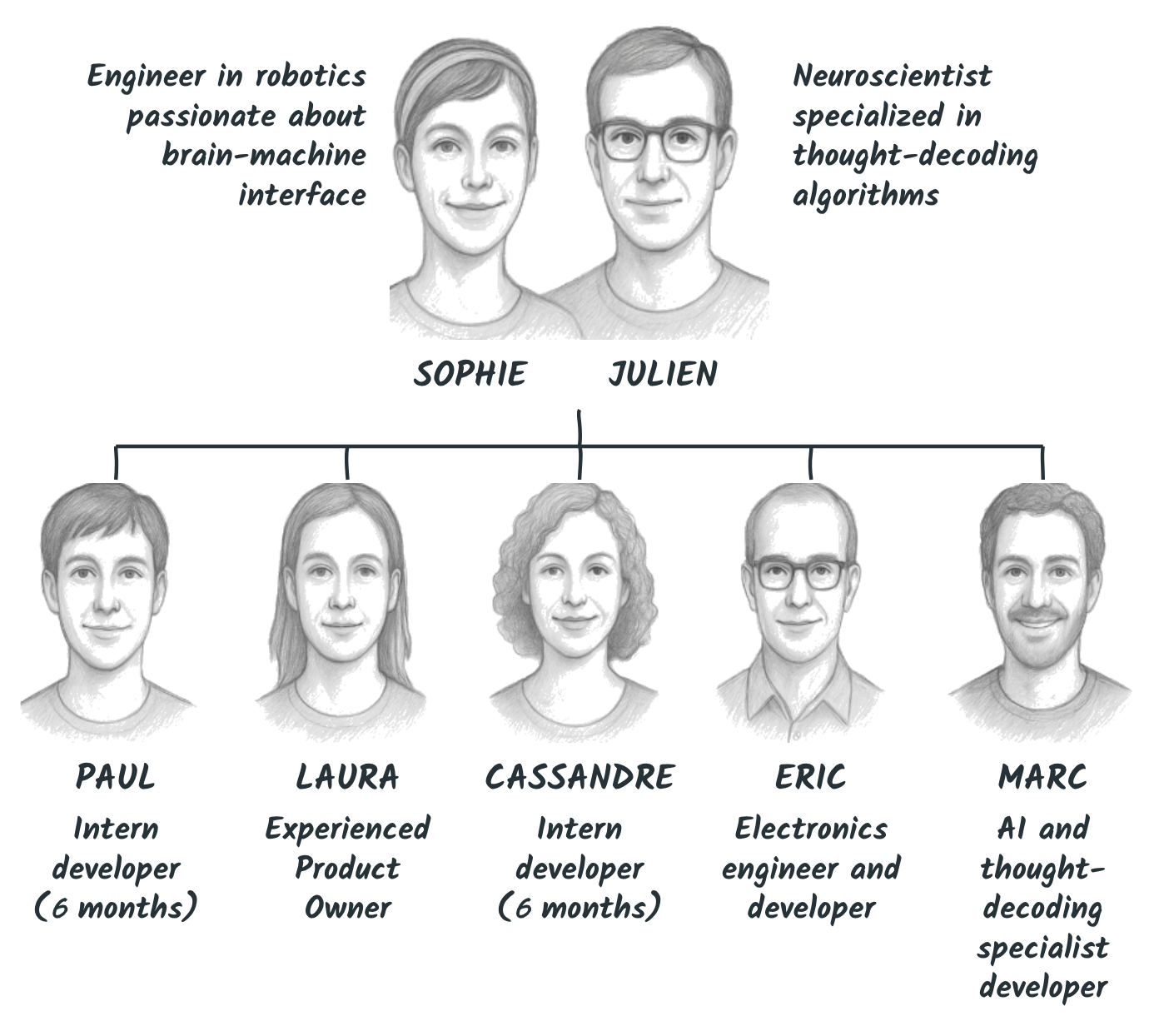
“We already are,” Julien answers, pointing at the org chart pinned to the wall. “Nobody’s cut costs like we have. Two of our four developers are still interns, and we’re using every last open-source algorithm out there.”
“Yes, and that’s what buys us working prototypes and an image of success,” Sophie says, pointing at the cash line. “In public, a facade of confidence and progress. In private, we’re fighting to keep the company afloat.”
“Every presentation, every demo we pull off, brings us closer to a viable solution,” Julien adds, his voice an octave too high. “You’ll see.”
“Stop, Julien. We have to face facts: what we’re doing isn’t working. We’re going around in circles.” She swivels the screen toward him and runs her finger down the rows. “Zero revenue, still.”
“Customers will come once the headset’s ready,” Julien tries.
“They won’t. Look.” Sophie’s finger moves down a row. “The potential users we reach out to are afraid of the technology’s harmful effects. Development is extremely slow because there are too few of us.” Her finger stops on the last cell. “And nine months of cash.”
Julien rubs the back of his neck. “I know, I know. We thought our technical expertise would be enough. And that a product owner would save us. But something’s missing. A part of the engine, and I don’t even know what it looks like.”
Sophie gets up and paces the office, stepping over the cables snaking across the floor. Julien follows her with his eyes. “I think… I think we played rock stars on TV, trying to win over backers. We thought promotion alone would bring in investors and customers. It looks a lot more complicated than that.”
Sophie stops. “The numbers say the same thing. We got swept up in our own story, the one we wanted the world to hear. And we were so absorbed by our technological vision that we lost sight of what matters.” She spreads her arms toward the empty room. “We kept to ourselves. No network. Nobody to lean on. Trade shows are full of products nobody asked for. We just added one more.”
Julien doesn’t answer, so she goes on, faster. “Maybe we just need a salesperson. Someone who can sell our product better than we can! It’s time to get out of this bubble.”
Julien looks up. “We ran… I don’t even know what we were chasing anymore. We need to change our approach. And fast!”
Sophie thinks of her little boy, who’s been staying with her sister lately; he’ll soon be falling asleep there. She promised him this separation was only temporary, that she’d soon be able to give him all the time he deserves. She glances at his photo on her phone, then crosses her arms.
“I refuse to give up now. Not after all these sacrifices, all these nights without him. And besides, who’d want us if we fail? There’s no box on an HR form for three years at a startup. What company, what job? The competition?”
Julien nods slowly, then squares his shoulders. “You’re right. We need some air.” He points toward the door. “Let’s get out of our bubble and go talk to people in the ecosystem. I saw the poster for tonight’s NUMA event in the lobby.”
“NUMA? It’s eight o’clock, we don’t know anyone there, and I don’t even have a business card on me.”
“Exactly. It’s the Paris startup hangout. Let’s go: a fresh perspective might help us adjust our strategy.”
Julien pulls out his phone to text his wife: I’ll be home late; sorry to miss the bedtime story again. Sophie calls her son to wish him good night before he falls asleep.
Jackets in hand, they turn off the lights over the prototypes and run down the stairs. In the lobby, the NUMA poster is waiting for them.
Stories from entrepreneurs and product managers
Sophie and Julien discover that their headset has yet to find anyone it serves. Founders describe here what it cost them to hold on to a solution before pinning down the need.
🎥 Watch the videos
Lara Gervaise (in French), founder of Virtuosis AI, shares her experience with a divisive feature.
Massimo Banzi (in English), the creator of Arduino, looks back on how an open-hardware project grew into an iconic product.
Sylvie Fleury (in French), CEO of Hunteed, illustrates how a poorly designed product can still find its place by meeting a genuine market need.
Sébastien Gilabert (in French), CEO of Missia, shares a ‘silly mistake’ born out of the classic overload faced by entrepreneurs.
Aurélien Onimus (in French), CEO of Tanjiblocks, reminds us how ego can become a founder’s worst enemy.
Paul Benoit (in French), founder of Qarnot Computing, explores the paradox of patents: filing early enough to secure development, while still in the process of discovering the market’s real need.






 CC BY-SA 4.0