
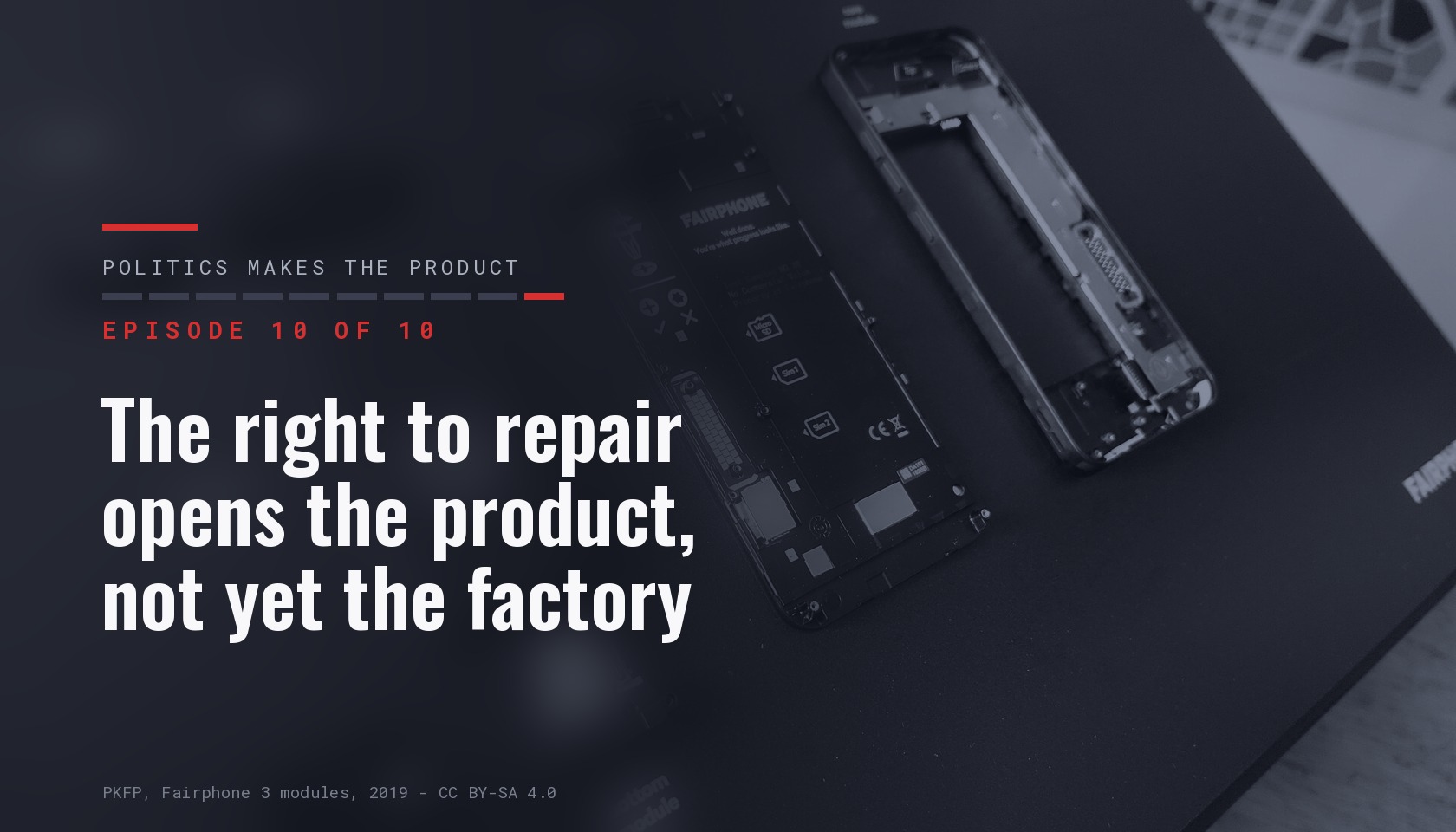
Tenth episode of a ten-episode series on the weight of politics in the success of a product. Since June 2025, any phone placed on the European market must be able to be opened, and its spare parts must stay available for seven years. The EU wanted less waste. Repair does not bring the factory back: in Shenzhen, the factories came before the repairers. But opening a product shows, part by part, what a continent can make.
In May 2014 Andrew Huang steps out of a taxi at the Futian border checkpoint between Hong Kong and Shenzhen, and his Samsung Galaxy Note II slips from his hand. The screen shatters on the sidewalk.
Huang, whom everyone calls bunnie, knows the insides of phones better than the people who sell them. He holds a PhD in electrical engineering from MIT and wrote a book on how he cracked the Xbox console. That day in Futian he is crossing into China on his way to nearby Dongguan, where he is to plan with his suppliers the production of Novena, a device he designed himself. His publisher calls him a hacker and a maker, one of those tinkerers who build their own objects and publish the plans.
He heads to the Huaqiangbei market. It is the electronic heart of Shenzhen. At a stall, a saleswoman tests the phone, then the stall’s team heats the screen with a hair dryer, softens the glue with contact cleaner and slides a very long thumbnail under the panel, where a workshop would use a spudger. They scrape off the old adhesive and lay a new film. Then comes a screen sold as new but presumably refurbished, bunnie notes. Twenty minutes. Parts and labor: $25. There is no better place in the world to break your phone’s screen, he writes.
Eleven years later, the European Union writes that gesture into law: since 20 June 2025, a phone placed on its market must open with commercially available tools, and its parts must stay available for seven years. The law copied the gesture. It did not copy what made it possible in twenty minutes and for a few dollars: a whole market where phones are taken apart and rebuilt on the stalls.
The stakes go beyond the environment. Can a European law that forces phones and other products open give Europe back the know-how to make them?
The short answer is no. Opening is not enough to make: in Shenzhen, repair came after the factory, and the European phone designed to be taken apart is assembled in China. The long answer lies in what you see when you finally open the products.
To own an object is to be able to open it
Makers laid down the idea before the law did: products you cannot open do not really belong to their owners.
Eight years before the Futian mishap, the idea of opening products to repair them was already circulating among makers. In November 2006, the American magazine Make: puts online a page first printed on page 156 of its fourth issue: the Maker’s Bill of Rights, signed by Mister Jalopy. Its title fits on one line, “If you can’t open it, you don’t own it”. The magazine calls for “accessible, extensive, and repairable hardware”, and slips a printed copy in with its “warranty voider” Leatherman tools, a pocket reminder to carry when shopping, so that readers can buy with their eyes open.
I used to host the Show Me the Maker talks, which gave the stage to makers nobody had heard of, and I wrote at the time that makers see freedom in the ability to make, repair and understand how things work, the freedom to fend for oneself (translated from French).
For a maker, repair is the first step toward mastery. You open, you understand, you replace, and one day, after taking apart what others assembled, you make things yourself. Repairability describes what an object lets you do: open it, take out a part, fit another, know how to go about it.
Brussels took up a related idea, for other reasons: open objects so they can be repaired. How far did it go?
Brussels wrote openness into law
Brussels went halfway. To repair a phone or a tablet, the owner now has access to the big parts, the professional to the small ones and to the documentation, and the manufacturer’s software keeps a lock.
First, European regulation 2023/1670 of 16 June 2023 has applied to phones and tablets since 20 June 2025. A regulation applies as is across the whole Union. This one requires manufacturers to keep spare parts for seven years after a model leaves the market, delivered within five working days for the first five years, then within ten. Parts must be replaceable by hand, with the supplied tool or with commercially available tools.
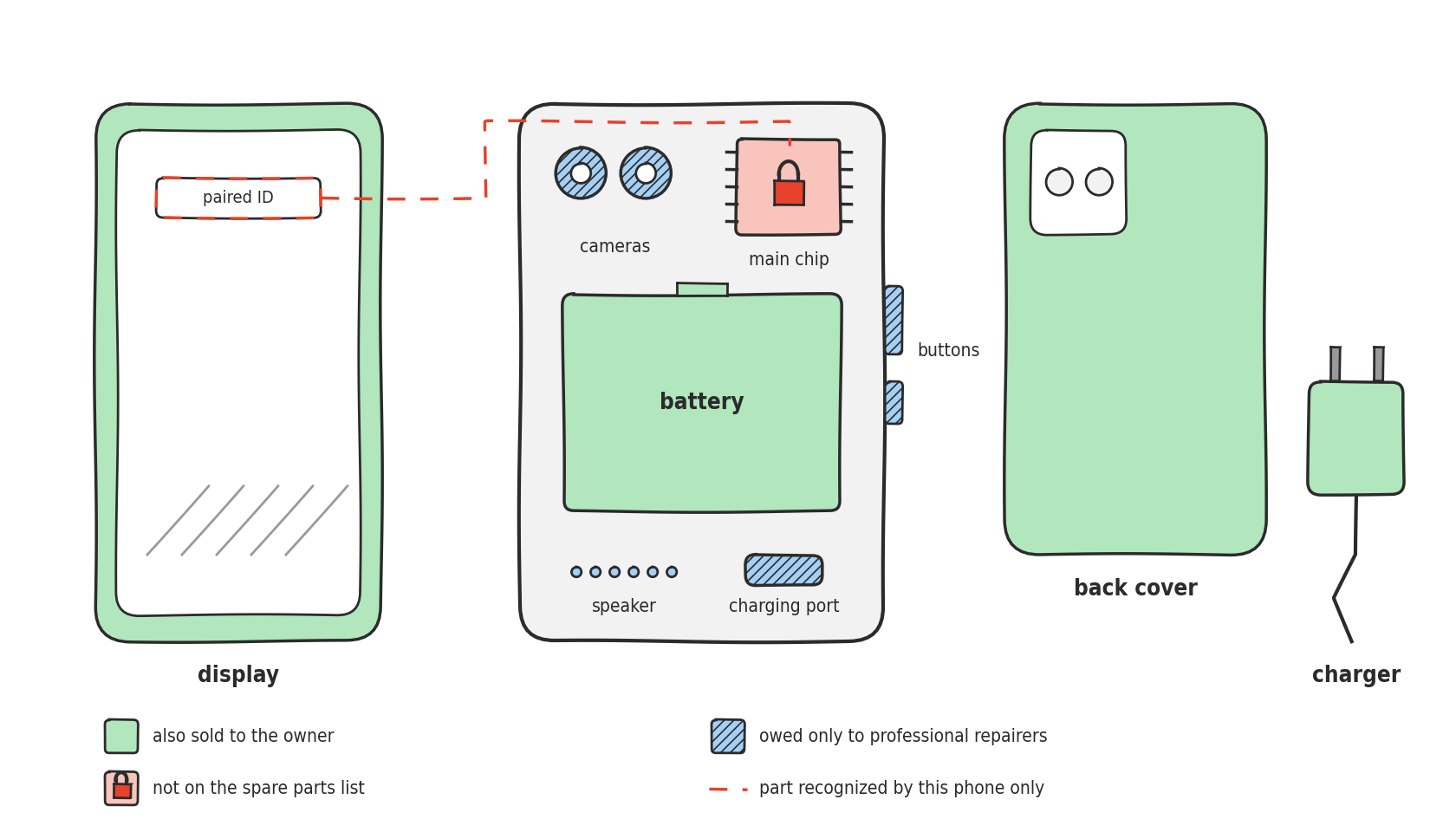
The regulation draws a border inside the device itself. The manufacturer must sell the owner the battery, the display, the back cover and the charger, except for the battery of a waterproof, very durable phone, which it may reserve for professionals. It only has to supply cameras, connectors, buttons, microphones and speakers to professional repairers. The same goes for repair information: it owes it to them for seven years and may charge a reasonable and proportionate fee.
The regulation also sets a battery that must keep 80 percent of its capacity after 800 charge cycles, which comes to a little over two years of charging the phone once a day, every day. It requires free operating system updates for five years after the model leaves the market, for manufacturers that publish them. A repairability grade from A to E now sits on the label next to the energy class.
One lock remains. Some manufacturers tie each part to a single phone. The display, the battery or the camera carries a serial number, and the phone accepts only the one it knows. Fit a genuine part taken from an identical phone and the number does not match: the phone can lose its fingerprint reader or its battery health information and show error messages over and over, until the manufacturer’s software registers the new number and the phone accepts the part. This link between a part and a single phone is called parts pairing: the part and the device form a pair, and only the manufacturer can make a new one. The Commission names the display and the cameras among the parts concerned, and the regulation tolerates pairing, provided the manufacturer gives repairers non-discriminatory access to the software that performs it.
Directive 2024/1799 on the right to repair goes further than the regulation. A directive must first be transposed, that is, copied into each country’s law. Parliament voted for it on 23 April 2024, by 584 votes to 3 with 14 abstentions. The text requires the manufacturer itself to repair, at a reasonable price, products on a list that runs from washing machines to TVs, vacuum cleaners to servers, phones to tablets.
Its article 5 deals with parts. The manufacturer may not impede an independent repairer’s use of original, second-hand, compatible or 3D-printed parts, “issued from 3D-printing” in the text, as long as they comply with the law. The exceptions remain broad: a legitimate and objective reason, intellectual property, and each product’s own rules, such as the tolerance of pairing for phones.
These rules on parts only apply once the directive is transposed. Member states had to do so by 31 July 2026. France missed the deadline. HOP, a French group campaigning against planned obsolescence, then noted that only four countries had transposed it: Slovakia, Lithuania, Croatia and Finland. Four out of twenty-seven.
Finally, on 18 February 2027, a third rule comes in: portable batteries must be removable and replaceable by the users themselves, with commercially available tools, without solvents or heat, with exceptions for a few devices. For the battery, the Huaqiangbei hair dryer will have no place.
Before that, France had led the way with its 2020 anti-waste law. Its repairability index has been displayed since 1 January 2021 on five product families, including smartphones and laptops; a durability index replaced it in 2025 for TVs and washing machines. Since December 2022, its repair bonus has funded more than one and a half million repairs at more than 6,500 certified repairers.
Written law is not yet applied law. Out of 2,334 database listings for smartphones put on sale over one year, only about 18 percent point to a page with parts prices or repair instructions, iFixit, the American repair guide site, counted in September 2026. The Right to Repair Europe coalition regrets a product list that is too narrow and a reasonable price that is never quantified, which each manufacturer reads its own way.
Europe cited the environment, the only motive it puts numbers on
The directive justifies repairing products by waste and climate. Jobs appear only in the press releases, without numbers, and industrial autonomy not at all.
Its recitals, the paragraphs that justify a law before its articles, say so: repair produces less waste and fewer greenhouse gas emissions, because a repaired device avoids making and selling a new one, with the resources and energy that requires. Consumers gain too. They avoid a purchase.
The Commission put a figure on the benefit over fifteen years: 18.5 million tonnes of greenhouse gases avoided, 176.5 billion euros saved by consumers, 4.8 billion euros of growth and investment. Per year, the emissions saving comes to about 1.2 million tonnes, while products thrown away too early emit, according to the same Commission, 261 million tonnes every year, discarded goods that could often have been repaired. The gain is less than one hundredth. On jobs, the Commission merely announces a net increase, “mainly in the repair sector”. It says neither how many nor where.
At the final vote, the Council spoke of “Europe-based” jobs, and the Commission of job creation in repair and maintenance, still without numbers. Skills appear only once in the directive, as an option left to member states: funding training in repair skills, lending premises to neighborhood workshops.
Strategic autonomy, the ability not to depend on a foreign supplier, is absent from the directive. The batteries regulation, which does mention it, justifies removable batteries by recycling. Among these texts, only one links repair to the continent’s supply: the critical raw materials regulation, adopted in April 2024, whose article 26 asks member states to promote the repair of products from which those materials can be recovered. For a manufacturer, it is the only sovereignty argument these texts give to repair.
The digital industry wanted the right to repair directive to stay tied to ecodesign rules, the ones that set, product by product, how a device is designed. Its European association, DigitalEurope, asked for it in the name of safe repairs and legal consistency. The final text kept that link: the list only grows as new ecodesign rules arrive, which the Commission adds one by one, through a delegated act that amends Annex II of the directive, within a year of each new rule.
The environment is therefore the written motive, and the only one the Commission quantifies. It has already changed how phones sold in Europe are designed: parts that come out with commercially available tools, a battery you can remove, pairing software the manufacturer must make available to repairers. Politics has begun to make the product. Nothing in it, however, is designed to bring the factory back.
In Shenzhen, the repairers came after the factory
Yet the makers’ intuition would have us get there anyway: you repair, so you learn, so one day you make. Shenzhen seems to confirm it. The market where bunnie had his screen replaced belongs to one of the world’s electronics hubs.
But Shenzhen did not start with repair. Years earlier, in August 1980, the city became a special economic zone, an area where the Chinese state drew investors and factories, on the Hong Kong border, long before repairers settled into its markets. Politics came before the workshops.
In February 2009, five years before the Futian mishap, bunnie describes the city’s big phone market: every six meters, a stall overflows with soldering irons and power supplies, and people take phones apart or put them together. The shanzhai sell unbranded phones there, often cheap copies of the big brands. Many of these manufacturers used to work for large American or Asian companies and left out of frustration with their employers’ inefficiency, bunnie notes. They came out of industry, not out of the repair shop.

In 2013, bunnie gives a name to what circulates among these manufacturers: gongkai, Chinese for “open” in the sense of made public, a word he deliberately sets apart from Western, license-based open source. Complete design packages pass from hand to hand: case, board and software. Not always according to the letter of the law. Very small teams of engineers can thus take over a whole phone and work only on the part they care about.
Then repair settles into this setting. The 2014 stall benefits from a market that supplies refurbished screens and adhesive films. In 2024, two writers for e-flux journal, Yifan Wang and Changwen Chen, describe a Huaqiangbei where second-hand devices and their unauthorized repairers have taken the place of shanzhai phones and their hackers.
In Europe, that setting is missing. Fairphone, in Amsterdam, sells a phone designed to be taken apart: the Fairphone 5 has ten replaceable modules and scores 10 out of 10 on iFixit, and the company sold 103,053 phones in 2024, all models included. Yet its supply chain report puts final assembly in Huizhou, in Guangdong, the province of Shenzhen, at a manufacturer in the Zhongkai high-tech zone. As for the repairable Framework laptop, which Taiwan’s CommonWealth Magazine calls the darling of the right-to-repair movement, it is manufactured and assembled in Taiwan by Compal, a Taiwanese giant among contract manufacturers.
European repair remains small. In 2022, the repair of computers and personal and household goods employed 340,000 people in 198,000 EU companies, 1.7 people per company, and it produced 0.1 percent of business value added (the wealth those companies create), or 26,700 euros per person. A few years earlier, between 2016 and 2019, the number of companies repairing for consumers had fallen from about 186,000 to 178,000, according to the European Environment Agency’s topic center.
These companies are also short-staffed: the same topic center reports a shrinking number of repair experts for lack of vocational training. In France, a 2026 study by the environment agency ADEME finds a growing shortage of skilled workers, due to an aging workforce and a lack of recognition for trades that nonetheless demand technical know-how, diagnosis, digital skills and customer relations.
Yet one objection holds: repair trains people who understand objects. In Switzerland, two researchers describe smartphone repair shops that produce their own knowledge, by taking phones apart, annotating and sharing what they find, much like a laboratory. In Oslo, most of the independent repairers interviewed have a background in IT or engineering, and one specialist shop salvages broken e-scooter batteries to repair e-bike batteries, or even to power a small electric car. That knowledge is real. What it lacks are parts and plans: most of these repairers buy their parts abroad, with China apparently the main supplier of refurbished parts.
Opening a phone means reading the map of its dependencies
But if repair does not build the factory, it does something else, which neither the Commission nor the statisticians measure, because it is neither a job nor a tonne of waste avoided. It opens the phone’s cover. And what do you see inside?
In 2021, the Japanese daily Nikkei opened up an iPhone 13 Pro Max to identify each component’s supplier and estimate its price. The display comes from South Korea’s Samsung. Estimated cost: $105. The memory comes from Japan’s Kioxia. The battery is attributed to China’s Sunwoda. Apple designs the main chip, and America’s Qualcomm supplies the modem that connects the phone to the network.
Europe is there. It hides in more discreet components: Germany’s TRUMPF has delivered more than a billion small lasers to Apple for the iPhone’s proximity sensor, and STMicroelectronics supplies Apple with chips made in its plants in France and Italy.
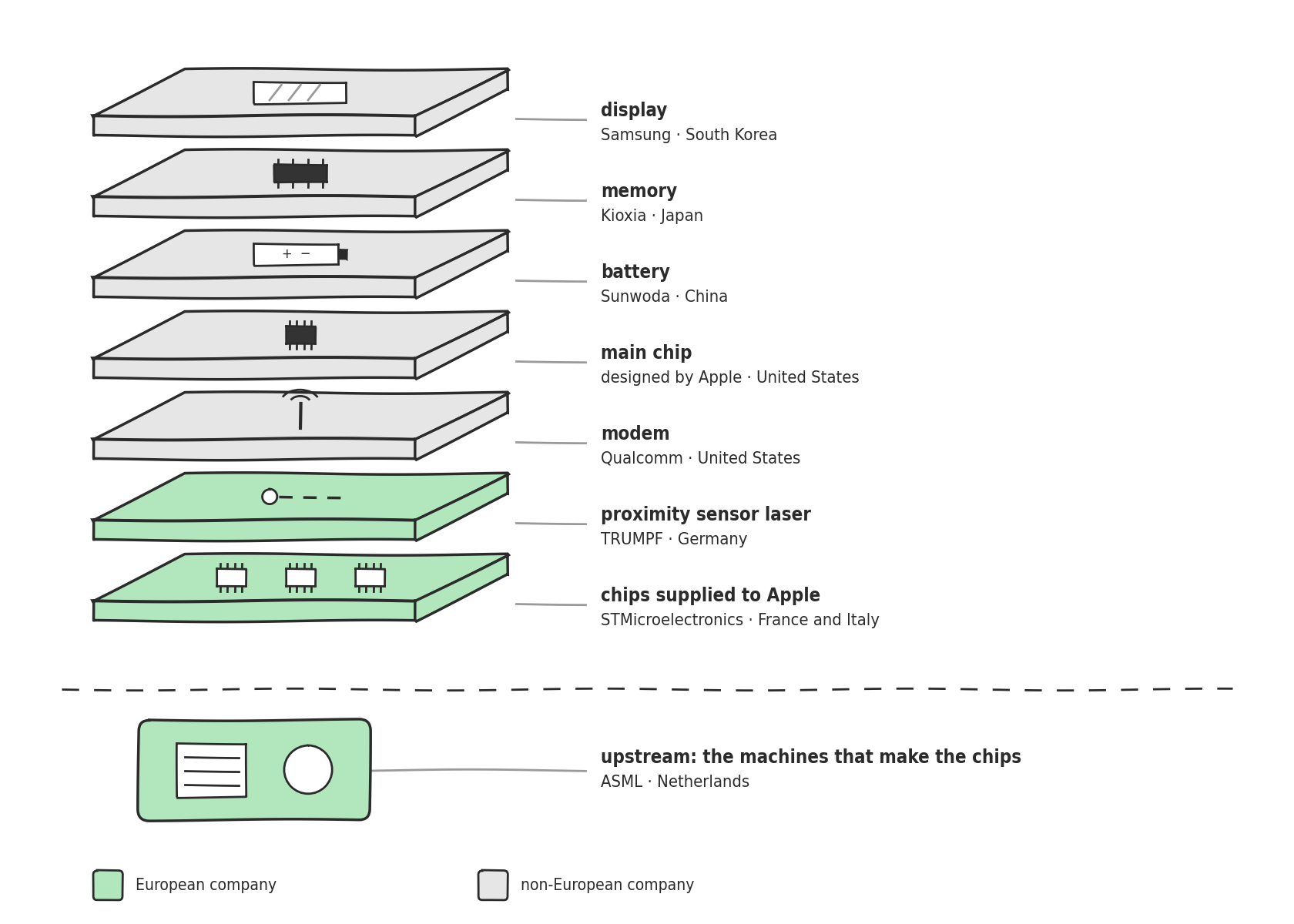
This teardown only shows components. To know who holds each stage, you read the value chain in layers: you follow the object from raw material to finished product and, for each layer, note who holds it. The European Court of Auditors did so for chips in 2025. It split the industry into design, equipment, manufacturing, assembly and test. The Court places Europe, with the Dutch company ASML, among the major machine suppliers, alongside the United States and Japan. For design it names the United States and Taiwan; for manufacturing, Taiwan, South Korea and China; for assembly and test, Southeast Asia and China.
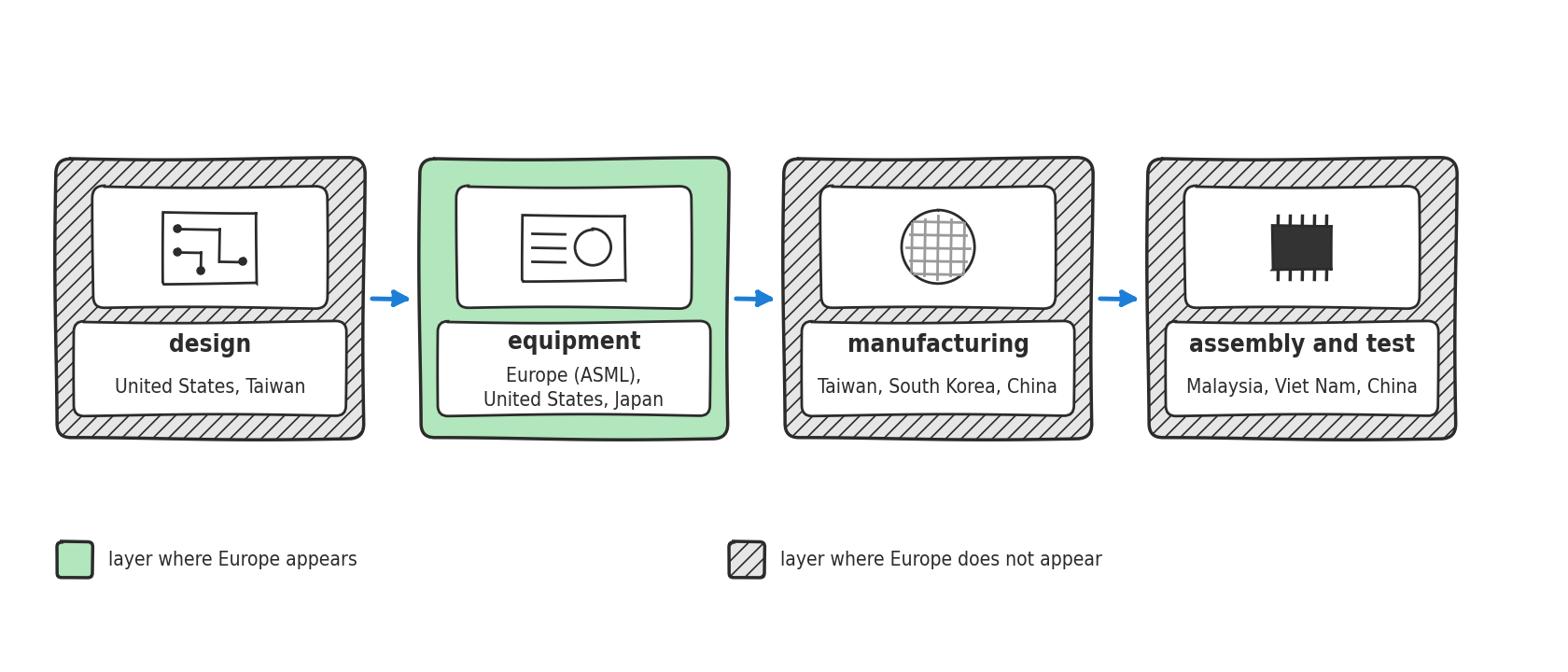
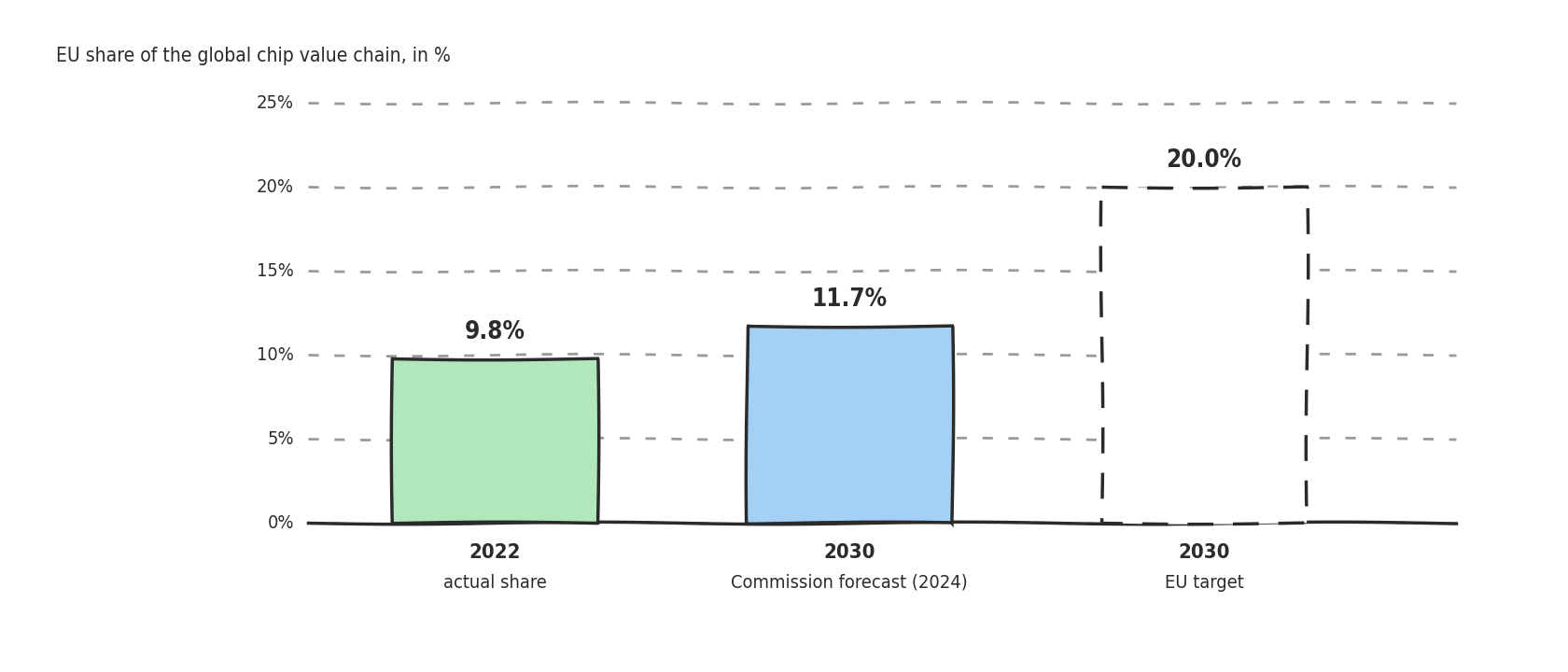
The Court draws a conclusion about the European Chips Act, in force since September 2023. The Union aimed for 20 percent of the world chip market by 2030; it held 9.8 percent in 2022 and, according to a Commission forecast published in July 2024 and quoted by the Court, would reach only 11.7 percent. In other words, of every ten euros of the global industry’s revenue in 2030, European companies would earn barely more than one. A regulation does not etch a chip.
Four years earlier, in 2021, the Commission had screened more than 5,000 products imported by EU companies: it found 137 on which the Union depends heavily, and China supplies about 52 percent of them by value.
A teardown gives a map of the same kind, at the scale of one object, but limited to components. A repairer does not read the name of Samsung or South Korea there: they read a reference etched on a chip, which they then look up to find the maker. But any team that takes apart its own product, piece by piece, sees what Europe cannot make (display, battery, memory) and what it can (sensors and lasers). The machines that etch the chips only show up when you trace the chain upstream.
Repair is the first rung of a ladder
Mastering a product is like climbing a ladder, and each rung requires opening something more. European law opens the first rung and half-opens the second, as long as pairing is tolerated.
First rung, repair: you need the identical part and the tool. Second, substitute: you need the right to fit a part from elsewhere, and that is where pairing locks. Third, modify: you need the code and the design files. Fourth, make: you need the plans, the tooling, the skills and the factory.
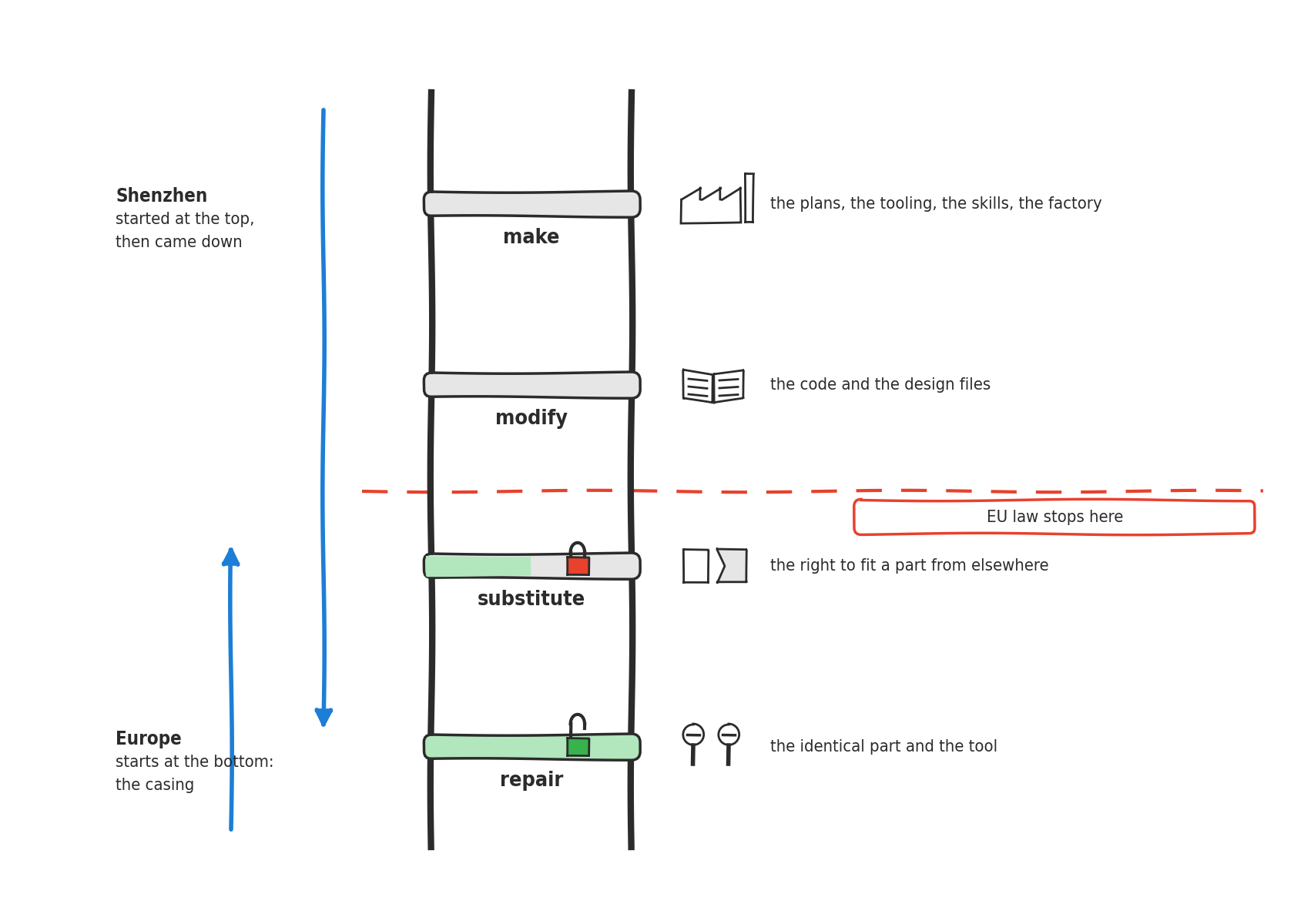
How do you climb to the third rung? By opening something other than the casing: the plans.
In 2005, at the Interaction Design Institute Ivrea, in Italy, Massimo Banzi, David Cuartielles, Tom Igoe, Gianluca Martino and David Mellis are looking for a simple way to prototype with electronics. They take the code of Wiring (the master’s project of Hernando Barragán at the same institute) and derive electronic boards you program from an ordinary computer: Arduino. They publish its schematics and code for free under public licenses, and so open the third rung from the start. This is open hardware: anyone can read the design, copy it and modify it.
Sixteen years later, in December 2021, Arduino announces it has sold ten million Uno boards, the model launched in 2010 as the heir of the project born five years earlier in a design school in Ivrea.
A year before Arduino, in February 2004, Adrian Bowyer had launched the RepRap project at the University of Bath: a 3D printer published under a free license, designed to make a large share of its own parts. Its plans circulate, and hobbyists build it at home.
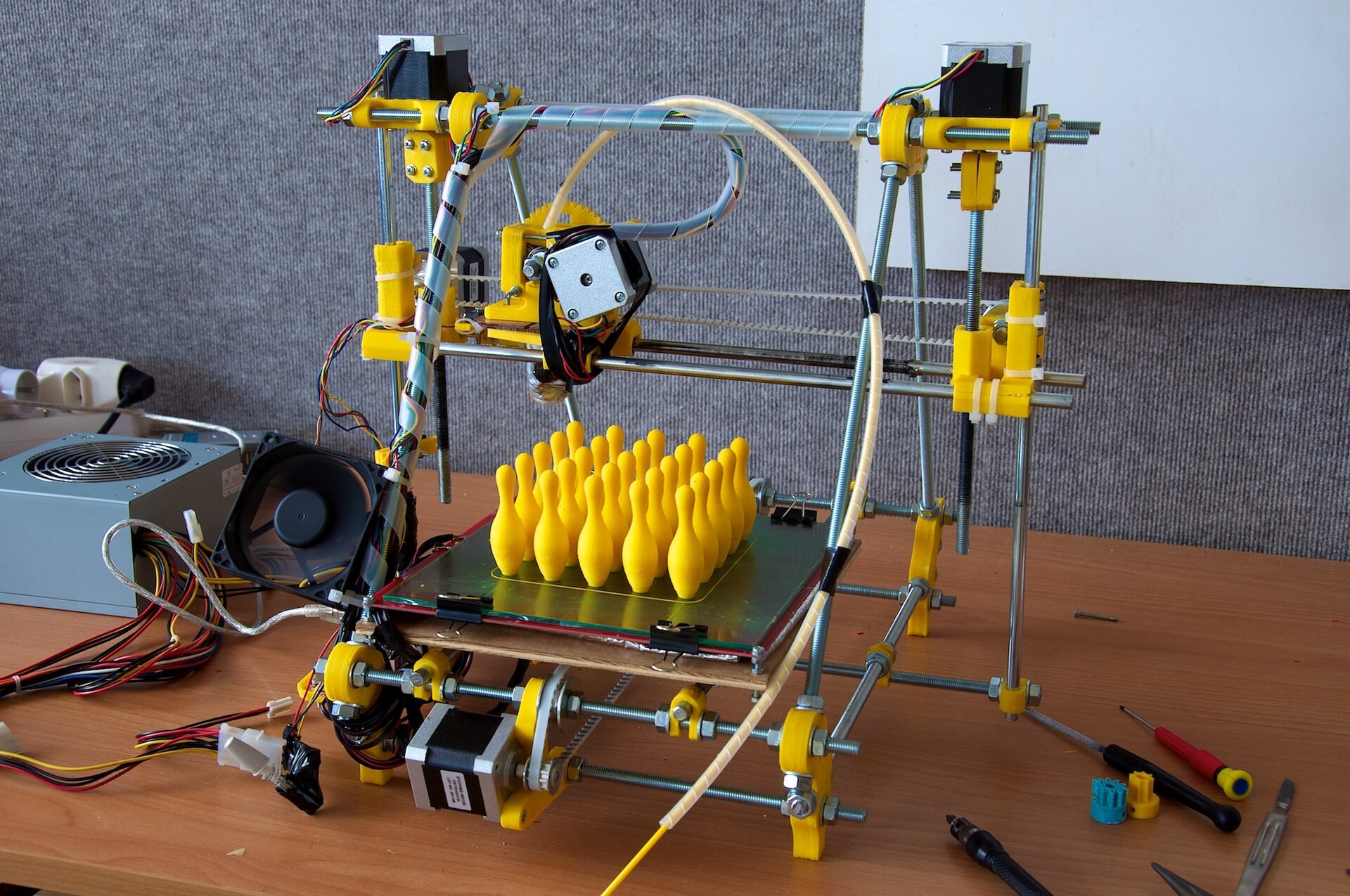
Seven years later Erik de Bruijn, Martijn Elserman and Siert Wijnia found Ultimaker, in 2011. “RepRap was the spark that ignited it all”, Wijnia would say. In 2022, Ultimaker merges with America’s MakerBot, keeping the Ultimaker name: open plans led from a university project, in 2004, to a European printer maker that now sells under a single name with its former American rival.
Open plans to catch up with those who dominate: Yann Lechelle turned that idea into a strategy, and gave it a name. Lechelle applies it to standards, software, data and hardware. The former head of the cloud provider Scaleway and co-founder of Probabl, the company behind the open-source library scikit-learn, he published a book called Ouvertarisme, roughly openness-ism, in November 2025. In an op-ed published in March 2026 on the blog of the Caisse des Dépôts, a French public financial institution, he writes that for those who do not dominate a market, openness can become a method of catching up (translated from French).
Lechelle defines sovereignty through verbs. He writes that it requires the ability to choose, audit, modify and secure the complete technical architecture (translated from French). Modify is the third rung, the one European law does not open. Lechelle is talking about digital technology. His logic still applies to the phone you repair: you only catch up with what you can open.
So Shenzhen started at the top of the ladder, with factories brought in by state policy and complete plans in circulation, then climbed down to repair. Europe starts at the bottom, by opening the casing, within the law. That path only makes sense if it keeps going, rung after rung, up to the plans of what Europe buys today without knowing how to make it again.
What this changes for your product
If you sell electronics on the EU market, whether you design them yourself or have them made elsewhere, this ladder already concerns you.
Three dates matter: 20 June 2025 for phones and tablets. 31 July 2026 for the duty to repair products on the list, in countries that have transposed the directive. 18 February 2027 for batteries that users must be able to remove.
Repairing phones and other products can also become a revenue line, provided you sell the parts instead of keeping them for your own after-sales service. Since 2023, Fairphone has been selling more of them: 2.1 million euros of spare parts in 2024, against 1.8 million the year before, just under 4 percent of its revenue: a modest line, but a growing one.
Before the next version of your product, put it through a quick exam.
- Who can open it, and with what tool? If no one can and it is a phone or a tablet, it is already non-compliant.
- Who repairs it today, and with which parts? A repairer who buys parts in China is already telling you where your dependencies are.
- For each component, who makes it, and where? Draw the stack, from raw material to software. The boxes you cannot fill in are your dependencies.
- Who can stop you from climbing a rung? A patent, a chip supplier, pairing software: name them.
- Which rung can you open? On the first, sell parts and tools; on the second, accept compatible parts; on the third, publish the design files and the plans of a module.
But keep the limits of this exam in mind. Pairing is still tolerated, so is intellectual property, and the product list stays limited to those covered by an ecodesign rule: laptops are not on it yet.
For the third of these questions, the tool below has you draw your product’s stack, layer by layer: it shows who, outside your company, can cut one off, and what to do beforehand.
What this episode does not say
This episode does not put a number on the jobs the right to repair will create for products on the list: the Commission has not estimated them. It does not say repair is pointless. It does not summarize Yann Lechelle’s book, and it does not compare transposition laws country by country.
The stall next door
Back to Huaqiangbei, in 2014. bunnie’s stall needed no European law. Another policy, thirty-four years earlier, had opened its city to factories, and twenty minutes were enough for it to hand back a whole phone.
Europe now has the law. Not the factories. It has opened the cover of its phones, and inside it reads the map of what it cannot make. Makers used to say: to own is to be able to open. A continent is learning the rest. To master is to know how to make again what you find inside.
What this article is based on
To own an object is to be able to open it
- Andrew « bunnie » Huang, I Broke My Phone’s Screen, and It Was Awesome, bunnie:studios
- No Starch Press, The Hardware Hacker (author’s page)
- Commission Regulation (EU) 2023/1670 of 16 June 2023 (ecodesign of smartphones and tablets)
- Andrew « bunnie » Huang, Mobile Phone Mega-Market in Shenzhen
- Yifan Wang and Changwen Chen, The Unauthorized Repair of the World, e-flux journal no. 146
- Fairphone, Supply Chain Engagement: from Risk to Impact
- Phillip Torrone, Owner’s Manifesto, Make:
- The Maker’s Bill of Rights by Mister Jalopy, Best of Make: Volume 2, O’Reilly
- David Leblanc, Le Maker, ce citoyen 2.0, manuscript (in French)
Brussels wrote openness into law
- Commission Delegated Regulation (EU) 2023/1669 (energy label for smartphones and tablets), OJ L 214
- Lauren Greenlee, How Parts Pairing Kills Independent Repair, iFixit
- Manuel Haeussermann, Ecodesign for Smartphones: Two Steps Forward, One Step Back, iFixit
- European Commission, Questions and answers on the right to repair directive
- Directive (EU) 2024/1799 of 13 June 2024 (common rules promoting the repair of goods)
- European Parliament, Right to repair: Making repair easier and more appealing to consumers
- HOP, Right to repair: France is lagging behind (in French)
- European Commission, guidelines on the removability and replaceability of portable batteries
- Regulation (EU) 2023/1542 concerning batteries
- French Ministry for the Ecological Transition, Repairability index (in French)
- French government, Check the durability index before you buy (in French)
- ADEME, Repair bonus (in French)
- Thomas Opsomer, One Year Into EU Ecodesign Rules, 80% of Smartphones Lack Repair Info, iFixit
- Right to Repair Europe, Analysis of the adopted Directive on Common Rules Promoting the Repair of Goods
Europe cited the environment, the only motive it puts numbers on
- European Commission, Questions and answers QANDA/23/1795
- European Commission, Right to repair: Commission introduces new consumer rights for easy and attractive repairs
- Council of the EU, Circular economy: Council gives final approval to right-to-repair directive
- Regulation (EU) 2024/1252 on critical raw materials (consolidated text)
- DIGITALEUROPE, ‘Right to Repair’ Directive: don’t unravel the Commission proposal
In Shenzhen, the repairers came after the factory
- Government of Hong Kong, Greater Bay Area, Shenzhen
- Andrew « bunnie » Huang, Tech Trend: Shanzhai
- Luisa Mengoni, From Shenzhen: Shanzhai and the Maker movement, V&A
- Andrew « bunnie » Huang, The $12 Gongkai Phone
- Andrew « bunnie » Huang, From Gongkai to Open Source
- Fairphone B.V., Annual Report 2024
- Fairphone, Fairphone’s Impact 2024
- Ching Fang Wu, Why is Framework, Darling of the Right-to-repair Movement, Inextricably Tied to Taiwan?, CommonWealth Magazine
- Eurostat, Businesses in the computer and personal and household goods repair sector
- ETC CE Report 2022/6, An overview of Europe’s repair sector (European Environment Agency topic centre)
- GREF Bretagne, Repair trades: skills and training needs (ADEME study, January 2026, in French)
- ADEME, Study on the training of repairers: current situation and projections, January 2026 (in French)
- Nicolas Nova and Anaïs Bloch, « My Store is a Laboratory »: Knowledge Produced by Smartphone Repairers, Engaging Science, Technology, and Society
- Maja van der Velden, Eléonore Maitre-Ekern and Deborah Katland Wanja, The Role of Independent Repair in a Circular and Regenerative Economy, Circular Economy and Sustainability
Opening a phone means reading the map of its dependencies
- Nikkei Asia, Teardown of iPhone 13
- Apple Newsroom, Apple investments with European suppliers top €20 billion in 2022
- European Court of Auditors, special report 12/2025, The EU’s strategy for microchips
- European Court of Auditors, press release on special report 12/2025
- European Commission, Digital sovereignty: European Chips Act enters into force
- European Commission, Strategic dependencies and capacities, SWD(2021) 352
Repair is the first rung of a ladder
- David Kushner, The Making of Arduino, IEEE Spectrum
- Hernando Barragán, The Untold History of Arduino
- Control Design, 10M Arduino Uno boards sold worldwide
- RepRap, About
- UltiMaker, Reminiscing about RepRap 10 years on
- Tilburg University, They led the way: Ultimaker
- Stratasys, Stratasys Completes Merger of MakerBot with Ultimaker
- BoD, Ouvertarisme. Le Numérique des Lumières, Yann Lechelle (in French)
- Yann Lechelle, Rethinking digital sovereignty in the age of artificial intelligence, Caisse des Dépôts (in French)
- Caisse des Dépôts, author page for Yann Lechelle (in French)












 CC BY-SA 4.0