The camera is already rolling when Lisa Duval sits down; Laura stays behind the lens, out of frame, her interview guide open to the first of its three pages. At the top of the page, in pencil, she wrote three words before her guest arrived and underlined them twice: “Don’t lead her.”
“Hello, my name is Lisa Duval.” She looks straight into the lens and puts a file on the table so thick that its elastic band has given way on one side. “I run human resources at Cheek&Circle, a small company that makes organic underwear through a short supply chain.”
The file stays closed. “Thirty employees in our Montauban workshop, a cooperative of cotton growers in Gascony, independent seamstresses spread over a radius of a hundred kilometers. Our promise? From field to briefs, under 450 kilometers traveled, zero pesticides, and a fair wage for every hand that sews.”
She turns a little toward the window and its light. “I love telling my friends about it. They find out that a pair of panties can have a shorter passport than a weekend at the beach.” Her smile widens when she talks about the Career Day filmed the week before. In the footage shot that day, she takes Zoé and Marius, both six, over to the plant-dye vats, lets them try out a miniature serger, then watches them fall silent in front of the pink that comes out of beets. “Ever since, they compare every piece of clothing to ‘our zero-kilometer panties.’”
Behind the camera, Laura lets the story run; her pencil taps the three words at the top of the page. She follows her interview guide page by page.
From off camera, clearly audible, she has just asked the first of the five questions meant to anchor Lisa’s legitimacy. Lisa’s team created an express program to train seamstresses changing careers, the retention rate is above 95 percent, and every employee lives less than twenty minutes from the workshop. In the margin, Laura writes a single word: “passion.”
Lisa lays her hand flat on the closed file. “A calm employee means a regular seam and boyshorts that don’t twist in the wash.” She lets her laugh die down, then goes on more quietly. “We make a product that touches the skin; if the people who make it don’t feel respected, the fabric itself loses its meaning.”
Legitimacy is established. Laura turns to the next page and, without leaving her spot behind the camera, reaches out to move the microphone stand one notch closer. “Can you describe a specific moment when communication really went wrong?”
Lisa laughs into her hand. “Take last month’s planning meeting. The word bi-weekly turned the workshop upside down: for half the team it meant ‘twice a week,’ for the other half ‘once every two weeks.’ The result: training sessions booked twice, hours lost, budget gone up in smoke, and a production schedule turned into a puzzle.”
In the margin, Laura writes “anecdotal?”, then stops, pencil in midair. “Does this kind of confusion happen often?”
Lisa counts her meetings on her fingers. “Practically one meeting in two. I sit in on five one-hour sessions a day; it soon adds up.” She raises an eyebrow at the lens. “My dream? An alarm that beeps as soon as people aren’t using the same dictionary.”
Laura writes fast, keeping Lisa’s words rather than her own: “alarm that beeps,” “same dictionary.” Then she goes back to the word in the margin and crosses out “anecdotal?” with a heavy line. “So your goal would be meetings that end in decisions without any ambiguity. Is that right?”
Lisa takes a second. “Precisely. Whether it’s in a meeting room or over a coffee, I want clear exchanges, with no delays and nothing that can be read two ways.”
Laura moves down the page to the consequences. “Let’s go back to the bi-weekly episode. How did that confusion hold up decision-making?”
“As I said, we paid for trainers twice instead of once. We wasted the hours of unnecessary training, we took employees away from production, and we used a budget that could have gone to something else. And people come out of those meetings wiped out. Not to mention the mistakes we then have to put right, sometimes from the ground up.”
“You also mentioned that people often come out of meetings exhausted. Do you think that affects their commitment and their ability to contribute effectively?”
“Absolutely. When discussions drag on because of misunderstandings, people get tired and lose the ability to focus on what matters. In the end, it harms the quality of the decisions.”
Under the list of consequences, Laura writes, “Qualitative: enough.” Further down, her guide asks for figures. “Lisa, you mentioned that some errors need major rework. If I understand correctly, your teams have to go back over their work to correct these errors, on top of having produced incorrect things in the first place. Can you help me put a figure on the scale of this problem?”
Lisa blows out through her nose, eyes on the ceiling. “Yes, that’s exactly it. For example, each major error usually ties up about thirty people, often for three hours of work on average, whether it’s to correct badly filled-in documents or to reschedule meetings canceled because of misunderstandings. We can have up to six major corrections a month.”
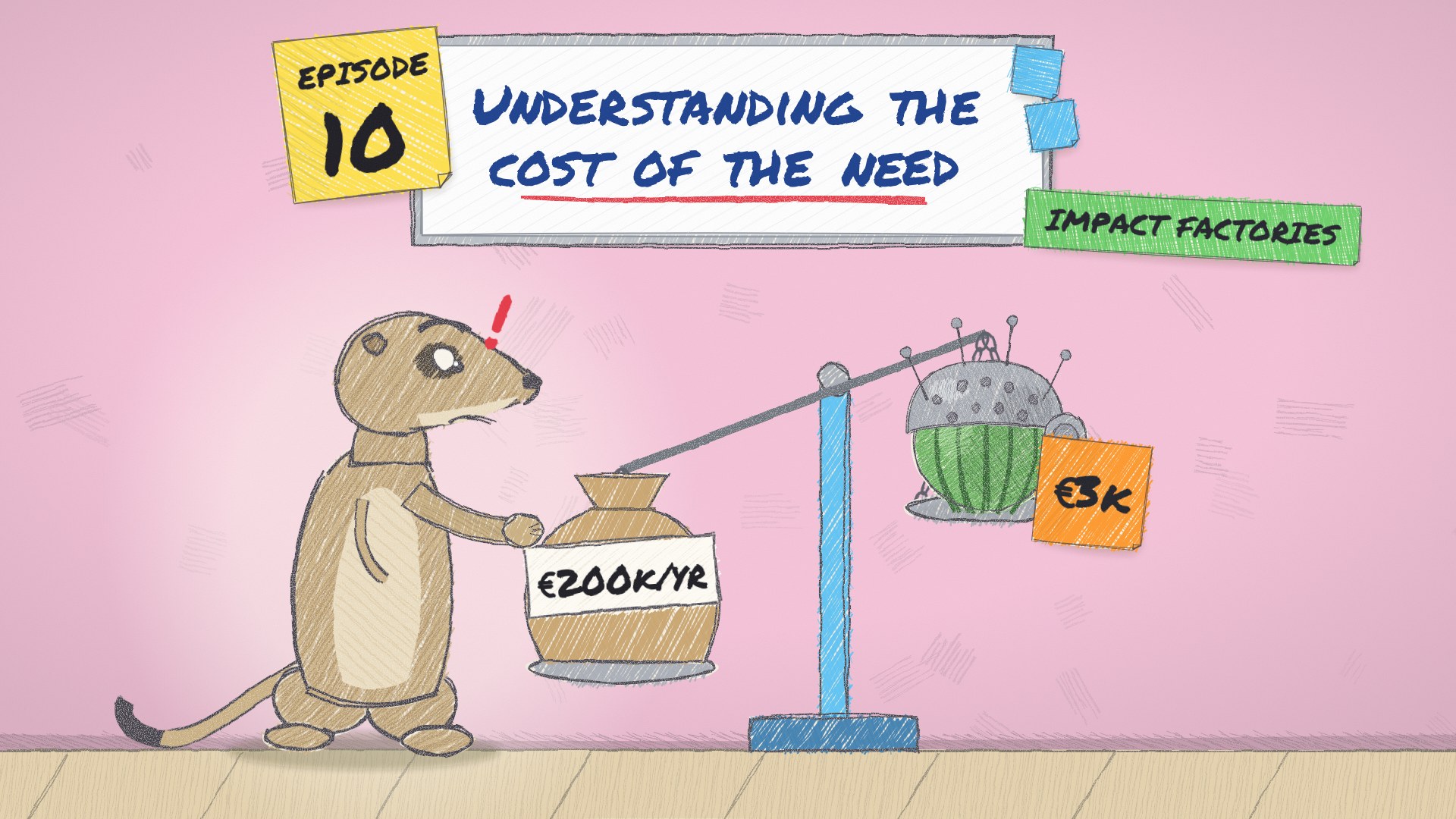
Laura writes the calculation in big numbers on a loose sheet of paper, slides it across the table to the edge of the frame, in front of Lisa, and reads it out so that Lisa can correct it. “Thirty people, three hours, six times a month. So that comes to about 540 hours of work a month just to handle the corrections. If we assume an average hourly cost of 30 euros, these corrections cost at least 16,200 euros a month, which is close to 200,000 euros a year.”
The silence lasts. Laura doesn’t fill it. Lisa keeps her eyes on the sheet, then on a point farther off, behind the camera, where Laura stands without moving.
“And that figure doesn’t include the indirect losses,” Lisa says at last. “Such as the fact that these errors delay other projects in progress. Constantly correcting mistakes wears down their motivation and creates a climate of frustration.”
Laura’s pencil goes back to the three underlined words at the very top of the guide, and she lowers her voice. “And for the teams themselves?”
“Morale, of course. When you keep redoing things, you feel you’re never really moving forward. It drains people’s emotional energy, and it ends in resignations.”
“And with the other departments?”
Lisa presses her lips together. “It hurts our professional image. We’ve already had informal feedback of that kind: some departments complain that our HR teams aren’t rigorous enough, which I know isn’t true. It’s just that they’re overloaded because of these corrections, on top of the understaffing that followed the departures, departures that were indeed caused by people being fed up.”
Laura turns to the last page of her guide. It holds the consideration questions, the ones aimed at how interested Lisa and her organization are in investing in an answer to the need. “Have you already tried any approaches to overcome this challenge?”
Lisa sits up in her chair. “Yes, I’ve attended several communication training courses where I learned useful techniques, such as rephrasing what someone says to confirm understanding and linking information to concrete elements. For instance, with the confusion around bi-weekly, giving precise dates could have made expectations clear from the start.”
She taps the file twice with her fingertips before going on. “These methods have certainly brought an improvement, but the problem persists. Not everyone on the team has had access to the training, and extending this approach to everyone would be a huge cost for the company.”
Laura reaches the fifth question, on how the problem has evolved: Lisa has already answered it, once again, and Laura skips it. The sixth is about investment. That one she isn’t sure about, and she asks it anyway. “What investments have been made to address this problem? Who was involved in those initiatives?”
Lisa’s palm stays on the file while she answers. The only thing funded was communication training, for herself and one other colleague; it was at her own request, and she got the CEO’s approval to attend. “The courses were useful, but limited in scope. They cost about 1,500 euros per person, a total of 3,000 euros, and they lasted three days, which also took up working time.”
“And the rest of the team?”
“Unfortunately, the training wasn’t extended to the whole team because of the cost and the difficulty of organizing it. It would have meant an investment of about 30,000 euros if we had wanted to train the entire HR department.”
Laura underlines 3,000 and copies the 200,000 from the loose sheet just below it. Between the two lines, she writes, “Not negligible. But next to the corrections? One-off fix or strategic initiative?”
She looks up at Lisa. “Have any other initiatives been considered or discussed, such as buying new tools or hiring a consultant to analyze your processes?”
“We talked about investing in a collaborative tool that could structure our meetings better and make shared note-taking in real time easier. The project would have cost about 10,000 euros, but it was put on hold for lack of budget. Instead, we went for a free solution, but it isn’t intuitive and few people really use it.”
In the margin, Laura writes, “Real investment? Proof they’re ready to spend money on solving it? Impossible to tell here.” Then, “Training: tax break? If the company gets part of it back, the real commitment weighs less.” Underneath, “Awareness all the same. Modest amounts next to the consequences of the problem.”
She works through the last planned questions one after the other, down to the bottom of the third page. Then she thanks Lisa and promises to share the conclusions with her. The camera stops. Lisa tucks her file under her arm.
Once Lisa has left, Laura writes her conclusion under the figures. Although the costs invested so far are low, they show a certain consideration for the problem, but not yet a real strategic will to solve it at its root.
Every day for two weeks, the team members share their interview experiences, so as to learn from the field together and get better in practice. A follow-up question that shut a door, a question that got someone talking: it all goes on the table.
Meeting after meeting, the team becomes more skillful and dares to probe further, so that no interpretation or hypothesis crossing the interviewer’s mind during the exchange is left in doubt.
On the healthcare side, the decision has been made to get closer to the patients themselves, to obtain more qualitative, concrete information about their needs.
Élise, a patient with language disorders after a stroke, tells Sophie about a recent family gathering. Her sentence takes a long time to come, word after word, and Sophie writes it down as it is. “I wanted to tell a funny story that had happened to me, but when it was my turn to speak, the subject had already changed.” Élise shrugs one shoulder, and Sophie holds her pen still for a moment before writing a single word under the sentence: “isolation.”
Lucas, another patient, talks to Julien about phone calls, which have become a source of anxiety. “Every time the phone rings, it’s as if my heart stops. I know I’m going to have to fight to be understood.” He describes the frequent misunderstandings and the fatigue that follows. Julien listens to the end without interrupting, thanks him for his frankness, then writes in his notebook, “Look for solutions,” and draws a box around the words.
Julien gathers the third account in a completely different setting. Mathis, a worker in an assembly plant, describes an incident during a safety inspection. “An alarm went off, but with all the machines running, it was almost impossible to hear. Luckily, there was no accident that day, but it made me realize how vulnerable we are.” Under the box, Julien adds, “Alerts you can perceive even in the noise.”
Two weeks in the field now fit into notebooks and recordings, and the team gets together in its meeting room to pool them and analyze them. The sun comes in through the large windows and lights up the fingerprints on the interactive screen at the end of the table, where nobody has put anything up yet. Everyone talks about their interviews at once, until Sophie stands up.
She has her notes in her hand and doesn’t look at them once. “When I visited a production plant, I had a striking conversation with a worker, Arthur. He told me how hard it was to communicate effectively in the constant noise of the machines. And he said something that stuck with me: our headset could revolutionize the way they work. ‘Imagine, no more need to shout or make exaggerated gestures to be understood.’ He saw huge potential, and he was very keen on the idea of testing our technology.”
“Gestures, like the ones I made playing the worker in the role-play?” Cassandre says quietly.
“The same ones.” Sophie brushes her left temple with a fingernail. “He put me in touch with his management, but I haven’t yet heard back about a meeting. Talking with him, we identified that his main goal is to assemble the parts he’s given right first time, while respecting the safety standards. It sounds simple, but in his environment it’s a real challenge.”
Julien, who hasn’t looked up from his screen since the session began, asks, “Doesn’t he have instructions? Even a build-it-yourself dresser comes with some.”
“That’s what I asked him: why the assembly instructions, which are designed to guide exactly this kind of work, weren’t enough. He explained that his plant does a lot of custom work; a large share of the tasks has to be adapted at the very moment his manager passes the order on to him out loud. That’s where the problems start.”
“Hold on,” Laura says. “The order comes in out loud, in the middle of the machines?”
Sophie walks over to the interactive screen, picks up the stylus and writes as she talks. “The symptoms he described to me have heavy consequences. Misreading the instructions often leads to assembly errors. When that happens, two people usually have to step in to correct the error, and each correction takes them ten minutes on average.” On the screen: 2 × 10 min. “With the average hourly wage in their plant, estimated at 18 euros gross an hour, that’s a direct cost of 6 euros per correction.”
Marc spins his screwdriver between two fingers. “Six euros. That’s the price of a blown capacitor.”
“Wait,” Sophie says. “These corrections tie up people who should have been moving on with other assemblies. On average, the plant produces about 200 assemblies a day, and each assembly brings in an average profit of 25 euros. If a correction delays the production of an assembly, that’s a direct loss of 25 euros in lost earnings on top of the cost of the correction.” She writes 6 € + 25 € and circles the total. “Arthur told me that about 5 percent of assemblies have to be reworked every day, that’s 10 assemblies a day. That comes to a total cost of 310 euros a day, or nearly 6,820 euros a month from corrections alone.”
Marc whistles through his teeth. “Three hundred ten a day. Now it shows up on the bill.”
“And that figure,” Sophie goes on, “doesn’t take into account the more indirect consequences, such as customer dissatisfaction caused by delays, or the tensions in the teams because of these repeated errors. Arthur could see clearly how our headset could solve part of these problems by improving communication and reducing errors. It’s a concrete example where our technology could have a measurable, significant impact, for the workers and for the company alike.”
Max waits for the stylus to stop squeaking. “That’s an interesting analysis, Sophie, but I have a question. You’re talking about 6,820 euros a month in correction costs. That sounds substantial, but to check whether it’s really significant, I’d like to know: what’s the plant’s monthly revenue? If it’s a drop in the bucket next to their income, they may not be motivated to invest in a solution.”
Sophie sets the stylus down on the ledge, then picks it up again. “Unfortunately, I couldn’t get their exact revenue. But talking with Arthur, I thought it more relevant to focus on the margin they make, because that’s what’s left to them after covering all their fixed and variable costs.”
She writes a new line. “The plant produces about 200 assemblies a day. If we take an average margin of 25 euros per assembly, that means they generate a daily profit of about 5,000 euros; over a month of 22 working days, that’s a total profit of about 110,000 euros.”
Max writes the two numbers one under the other on his pad.
“And compared with the corrections?” Paul asks.
Sophie draws a line under the two rows. “So if we compare those 6,820 euros a month of correction costs with the total profit of 110,000 euros, it comes to a little over 6 percent of their margin. That isn’t negligible, especially considering that these losses could be reduced through better communication.”
Max reads the line a second time and scratches his head. “That said, these figures are very low for a plant… We’ll still need to check them properly, and see what ‘plant’ means here. But if these figures are right, it’s indeed a significant proportion, especially in a sector where every point of margin counts. Good catch, Sophie.”
“Six percent, is that enough to get a plant manager to open his wallet?” Julien asks.
“To convince this plant’s management, we’ll still need an estimate of their overall revenue,” Max says. “That will let us put the problem in a wider context and check whether it’s a priority for them. Also, if your headset can help reduce the problem, it’ll probably never reduce it by a hundred percent.”
Marc points his screwdriver at the circled total. “Right now we’re reading the power draw of the whole board at once. We don’t know which component is running hot.”
“Right,” Max says, and he turns to Sophie. “What you’ve just presented is convincing, but I wonder: could we tell apart the symptoms you’ve identified? Some may have a much bigger impact than others, or at a different stage of the production chain. It could help us prioritize and convince the plant by highlighting the most costly problems.”
This time, Sophie leafs through her notes. “Not all symptoms weigh the same on their costs or their productivity, that’s true. Let’s take the ones I noted. On one side, there are the assembly errors, which need at least two workers to spend an average of 10 minutes correcting each one. With 10 incorrect assemblies a day, or 220 a month, that comes to about 73 hours a month of time lost just on corrections. If we value that time at the average hourly rate of 18 euros, that’s 1,320 euros a month for these corrections alone.”
“And the other symptoms?” Max asks. “Like the lost earnings from production time blocked by the corrections?”
“Each correction delays an assembly that could have been produced. With 220 corrections a month and an average margin of 25 euros per assembly, we lose 5,500 euros of margin every month, simply because production time is diverted.”
Max adds it up out loud, bent over his pad. “So these two symptoms alone, the corrections and the lost earnings, come to 6,820 euros a month, exactly the total you gave.”
Sophie opens a third column. “Then there’s the longer lead time for customers. That can lead to penalties or discounts granted to unhappy customers. Arthur told me that about 10 percent of orders suffer this kind of delay, which is about 440 assemblies a month. Offering an average 10 percent discount, or about 25 euros per assembly, means a loss of 11,000 euros a month.”
Max turns from his pad to the team. “So, to sum up, the corrections, the lost earnings and the penalties for delays already add up to nearly 17,800 euros a month, 16 percent of their margin. That’s starting to make a solid argument. But does the plant perceive all these impacts in the same way?”
Sophie looks at the three columns, then at Max. “I don’t know. I’ll need access to Arthur’s management to go further on that, and we should also dig a bit more to see whether the company is really ready to invest in this kind of project.”
Laura waits until Sophie has sat down before speaking, her notebook held tight against her chest. “Same obstacle elsewhere. When I visited the hospital unit that treats stroke patients, I was able to talk with the caregivers. They identified several symptoms that hold back the goal they’re trying to reach. Improving communication with patients who have lost the use of speech, by letting them express their needs, take part in decisions that concern them and regain some autonomy.”
“And you can put a number on that?” Paul asks quietly.
“We tried. The interview was quite long, because with this kind of problem, emotion makes objective framing difficult. We came away with three symptoms, based on one patient in the unit, and tried to put figures on them from the caregivers’ point of view.”
“Only the caregivers?” Julien asks. “So we’ve got the thermometer, but not the patient yet.”
“To start with.” Laura opens her notebook flat on the table. “First symptom: the patient can only answer by blinking, which considerably limits the richness of the exchanges. The nurse explained that this constraint hugely lengthens the time needed to understand what the patient needs. Each exchange takes about 10 extra minutes on average, and these exchanges happen at least 3 times a day. With 30 days in a month, that’s 15 hours of nursing time lost a month. If we value that time at an average hourly rate of 25 euros, it costs about 375 euros per patient per month.”
“And for those fifteen hours, she isn’t with another patient, huh?” Cassandre says.
“That’s just it. Nurses are a scarce resource, and misusing their time affects the hospital’s capacity to take in other patients.” Laura moves to the next line. “Second symptom: despite their efforts, the caregivers sometimes make mistakes in interpreting the patient’s answers. A misunderstanding can lead to pointless actions, such as preparing an unsuitable meal or giving care that isn’t a priority. The nurse told me these mistakes happen about once every two days, and each mistake takes about 30 extra minutes to put right, which comes to 7.5 hours a month. That’s an additional cost of 187.50 euros and a loss of precious time.”
“An unsuitable meal, for someone who can’t say so,” Sophie murmurs. She finds Élise’s sentence in her notes.
“Which brings me to the third,” Laura says. “The patient himself feels immense frustration at being unable to communicate freely. This frustration sometimes leads to episodes of stress or agitation, which need extra intervention from the caregivers. The nurse estimated that these episodes happen 3 to 4 times a month and need about 20 minutes of extra attention each time. That’s 1.25 hours a month, a cost of 31.25 euros a month. But the impact goes beyond the financial: it also affects the relationship between the patient and the caregivers, adding to their mental load.”
Max uncrosses his arms and lays his pen across his pad. “Laura, the examples you shared are interesting, but something strikes me. Three to four crises a month for a patient who seems to need constant care sounds low to me. Is the nurse you interviewed really the one closest to him day to day? If she isn’t regularly at his bedside, she may be missing important details.”
Laura finds a line she circled back at the hospital. “The nurse I spoke with is the unit’s lead nurse. She supervises the care and has an overall view of the patients, but she isn’t the one who gives this patient direct care. In fact, she told me herself that her colleagues, the ones who look after him several times a day, could give me much more detailed information.”

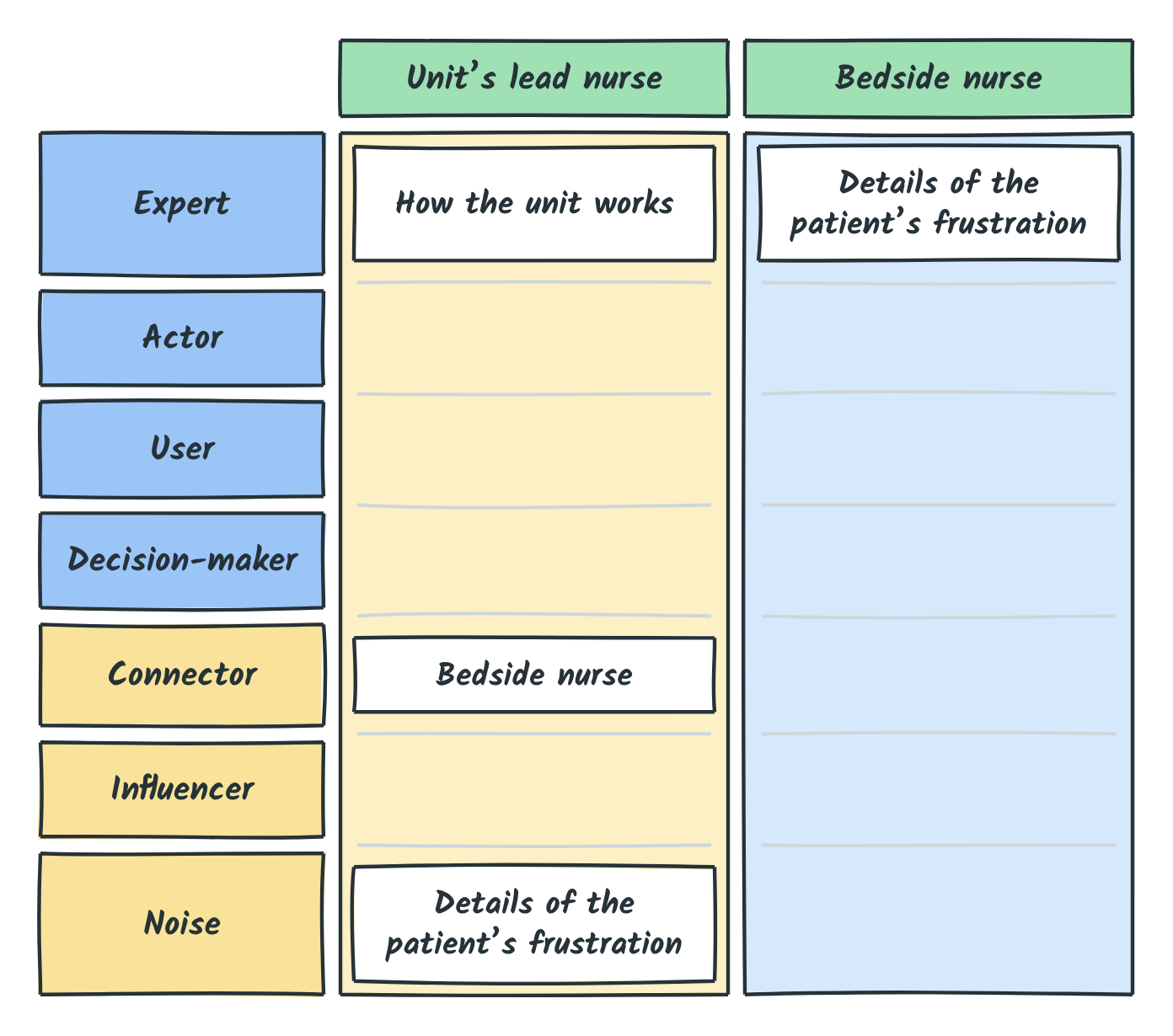
Marc leans over the grid. “So your lead nurse is an expert on how the unit works, a connector to the bedside nurse, and noise on the details of the patient’s frustration. Three hats on one head. And the expert on those details is the bedside nurse.”
“And have you been able to get in touch with those nurses?” Max asks. “They could surely give us more precise data on how often the symptoms really occur.”
“Yes, the lead nurse was very proactive. She put me in touch with two nurses on the team who follow this patient very closely. One of them has already agreed to an interview. I think it’ll let us refine the information we’ve gathered so far. These colleagues are on the front line, and I’m convinced they’ll have even more concrete examples to share.”
“Good,” Max says. “This new information should help us quantify the symptoms better and understand their impact. Keep going in that direction, Laura. I suggest you widen the scope of your questions if you can. There may be symptoms the lead nurse didn’t mention.”
Noon is approaching, and nobody suggests stopping. Since the start of the morning, each person has presented their observations and the others have gone back over their figures. When the list of symptoms runs off the bottom of the screen, Max stresses the importance of prioritizing these symptoms by their frequency and their measurable impact.
“Hold on,” Laura says. “Some symptoms seem less critical, but they can have significant long-term consequences, on quality of life or on performance at work. My patient’s frustration costs only thirty-one euros a month.”
Julien turns his laptop around for the others. Throughout the debrief, he has been building a table to list the contacts they’ve met. It shows the names, each person’s role in their company, their level of legitimacy with regard to the problems they described, and their influence within their organization.
One column collects the relevant information each person has given them, symptoms and cost estimates included; the last one, the names of new contacts these people have recommended to take the investigation further.
Cassandre scrolls down the last column, which keeps getting longer. “We won’t be able to follow up on all of them, huh?”
Julien opens his notebook to the margin where he keeps count of the months of cash, looks at the column, and shuts the notebook. “Not all at once, anyway. We don’t have the fuel for every road.”
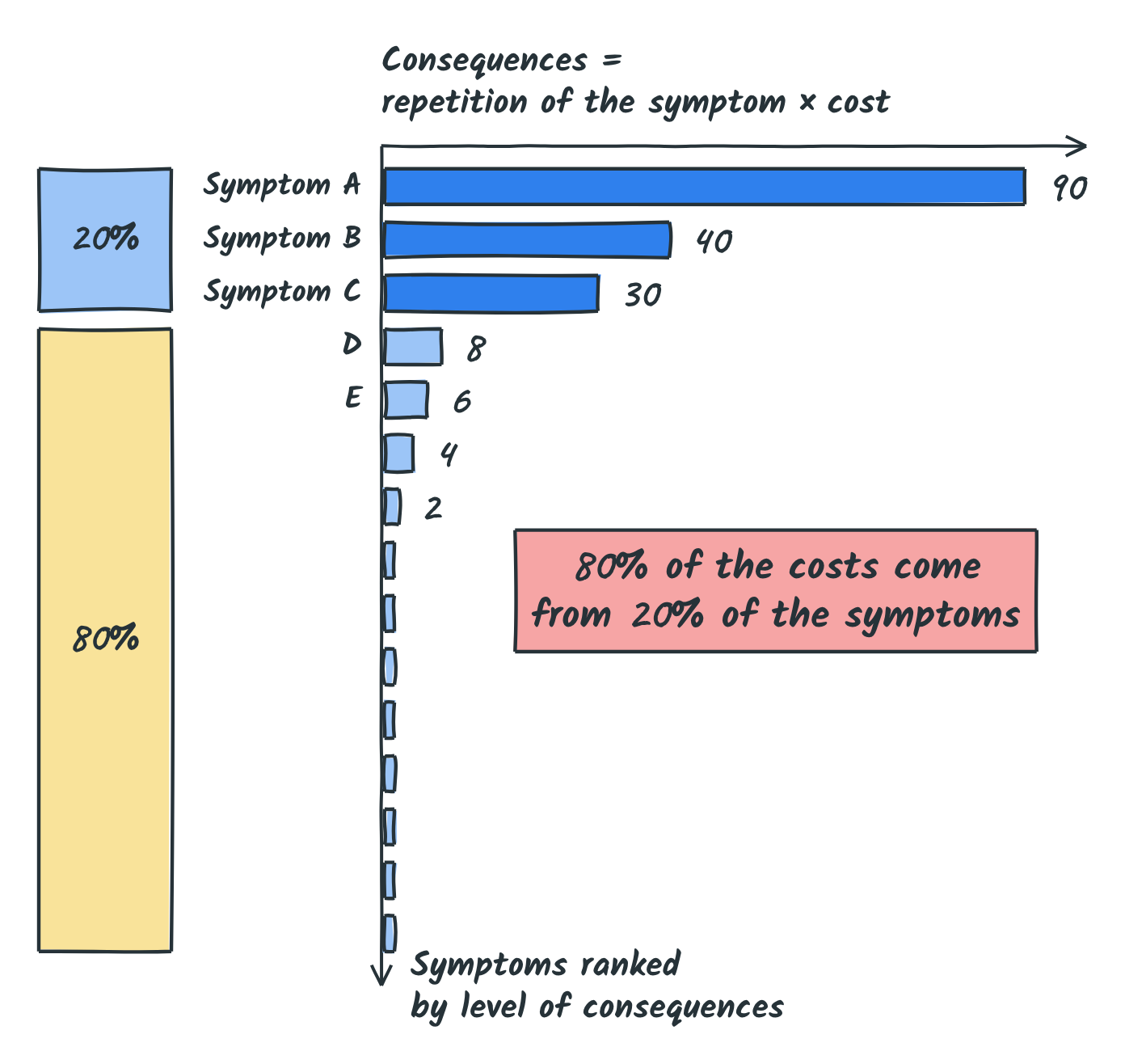
Max asks Julien to share the file with him. A few minutes later, a chart comes up on the meeting room screen, and Max titles it “Pareto.” He gets up to point at the data. “The Pareto principle, or the 80/20 rule, states that 80 percent of effects come from 20 percent of causes. Applied to our symptoms here, it means that most of what stops the people we interviewed from reaching their goals comes from a small number of specific symptoms.”

“Like our bugs,” Éric says. “It’s always the same three that crash the demo, basically.”
Max points to the left of the chart, where the bars are tallest. “Look at this symptom: instructions misunderstood in a noisy environment. This one problem generates nearly half of the total costs. If we focus our efforts on this precise point, we could achieve a significant impact with a relatively targeted investment.”
“That’s Arthur,” Sophie says.
Max’s hand slides to the right, over the lower bars. “These symptoms, important as they are, generate smaller consequences. That doesn’t mean we ignore them, but they shouldn’t be our immediate priority for the people we’re talking to.”
Julien finally looks up. “So we only focus on the symptoms with the biggest consequences?”
Max comes back and sits down. “Not only those, but they should guide our first actions. Once we have positive results on the major symptoms, we can widen our field of action. It’s a strategy to maximize our impact quickly. And knowing the priorities of the people we’re talking to also lets us estimate how much importance they’ll give our proposal.”
The session is coming to an end. Max looks around the table. “What are you taking away from these interviews? And where do you each stand?”
Éric folds his screen halfway down and plunges in. “I hadn’t understood the importance of choosing goals the other day, and working on the symptoms has opened my eyes. Take the case of workers who don’t react to an audible alarm because of the background noise, and the case of key information lost during a shift change, also because of the noise. Depending on how we define the goal, our perception of the problem can change radically.”
“Mathis’s alarm, huh?” Cassandre says.
“That one, basically. If we consider that the goal is ‘hearing the sound of the alarm,’ then the symptom is clearly that the workers can’t hear that alarm, and the difficulty comes from the background noise. But if the goal is ‘working in complete safety,’ then the symptom becomes the inability to perceive a vital alert. And the difficulty becomes the lack of means to communicate alerts effectively when there’s noise, with visual or scent-based means, for example.”
Max slaps the table once with the flat of his hand, and he smiles. “Yes. If there’s one thing to remember here, it’s that depending on the indicator behind the goal, the costing of the obstacles, of the need and of an associated solution can change radically. And in my experience, those who don’t take the time for this analysis spend an enormous amount of energy for unsatisfying results. There’s a good reason why only one startup in ten manages to survive.”
Julien reopens his notebook to the page with the formula. Under Severity × Frequency × Consideration, the line has stayed empty for two weeks. He writes on it, “Which indicator, behind which goal?” In the margin, the count of months of cash is waiting for the next number to be struck out.