At the entrance to NUMA, two hosts hand each new arrival a sheet of stickers: one for a first name, then little flags to show which languages you speak. Sophie raises an eyebrow when she sees that Esperanto is one of the options. Tonight is a networking event: you walk up to strangers, drink in hand, and introduce yourself. Sophie is hoping to leave with a name, just one, someone who could get MelonsNet moving again.
By day, young companies share the desks in this coworking space in the heart of Paris. At this hour, under strings of LED lights, screens scroll through futuristic demos above a crowd in which Sophie doesn’t recognize a single face. She peels off the same flag and sticks it back on, twice. Julien writes his name and, right next to it, draws a tiny melon. Sophie smooths her sticker onto her chest and leans toward him, half dare, half encouragement. “Ready to socialize?”
“As ready as we’ll ever be,” Julien says, scanning the room. They drift off toward different groups, swallowed by the hum of a dozen languages.

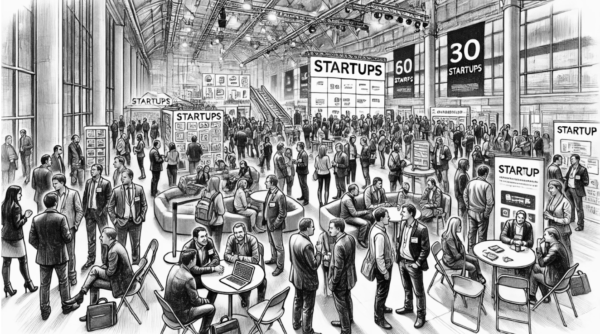
Sophie works her way through the entrepreneurs, slipping from one group to the next whenever a conversation leaves an opening beside someone she doesn’t know. She opens every conversation the same way. “What exciting project brings you here tonight?” She listens to each answer all the way through, then follows up with sharper and sharper questions. “How did you get past your first challenges?” Or, “What strategies are you considering to grow?”
People tell her about seed rounds, the very first money a startup raises, about resignations waiting to be handed in, about doubts whispered between drinks. Some are still at the stage of a PowerPoint hidden in a desk drawer. Others have already raised funds and changed course once or twice, which they call surviving a pivot. By the third pivot story, Sophie is laughing along with everyone else and has stopped fidgeting with her sticker.
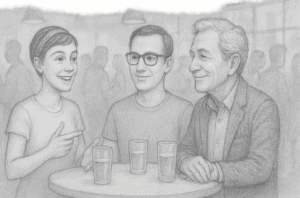
A little off to the side, around a high table, a small group is laughing quietly. That’s where she notices Max, though she doesn’t know him yet. He stands in the middle of the others, composed, a cup in his hand, his smile calm and his eyes attentive. He doesn’t say much, but when he speaks, the others go quiet, and when the group finally breaks up, only he remains.
She hesitates for a second, then steps up to the high table. “Hi, I’m Sophie. I’m working on a project called MelonsNet.”
He tilts his head slightly. “Interesting. Tell me more!”
In a few sentences she sums up the mind-reading headset they’re building, how it started, what they’re aiming for. He listens without a word, then stops her in the middle of a sentence. “Tell me, Sophie, what need are you really trying to meet?”
Sophie opens her mouth, then closes it, and her hands sketch a headset around her own head. “Our mind-reading headset is built on cutting-edge sensors, inspired by Jonathan Wolpaw’s research on brain-machine interfaces. They pick up the brain’s electrical activity and translate it into digital signals, a bit like an EEG, the brain-wave test they run in hospitals, only more complex.”
Max says nothing, so she keeps going, faster. “Then we built a machine learning interface that interprets those raw signals. We rely on deep neural network algorithms, like the ones Yoshua Bengio has explored, to refine the predictions in real time.”
Max takes a sip from his cup while Sophie fills the silence. “Our filter system is inspired by Marvin Minsky’s work on emotions. Basically, we don’t transmit every thought, only certain categories. Emotions, intentions… That’s what makes our headset unique. We don’t just read electrical signals. We interpret mental patterns, structures of thought. We capture the essence of what the user means, the moment they think it.”
Max keeps the same warm smile. She’s done. He doesn’t answer. One second, two, five. Sophie stands frozen, her fingers tight around her glass, the way you wait for a verdict.
Then, almost gently, “That’s impressive, really. You know your subject, I can tell.”
He pauses. “But… what need are you trying to meet?”
Sophie sets her glass down on the high table. “Well, our headset breaks down barriers between people, improves mutual understanding, reduces conflict… Ultimately, it contributes to humanity.”
Max puts down his cup. “I see. But have you identified any concrete use cases?”
Sophie is already ticking off, on her fingers, two situations where someone would actually use the headset. “Of course! In meetings, for example, it could help participants understand each other. And imagine diplomatic negotiations, where every nuance counts… The possibilities are endless.”
Max’s face doesn’t move, and Sophie shifts her weight from one foot to the other while he lets a short silence pass before asking, “Are any diplomats or meeting facilitators already using your headset?”
Sophie looks down into her glass. “No… not yet. The headset isn’t far enough along for that.”
Max doesn’t take his eyes off her. “And have you talked to them? To find out whether they’d be interested, even in theory?”
She shakes her head, and her voice drops a notch. “No… without a prototype, they wouldn’t see the point…”
Max waits until she looks up again. Then, without raising his voice, he asks, “So how do you know your headset will really meet those needs?”
Sophie says nothing, and behind her someone bursts out laughing and glasses clink, but all she can hear are her own sentences, which she replays one by one like an exam handed in too fast. The technology, humanity, meetings she imagined. Despite the technical possibilities, their definition of specific needs may not be solid enough.
Julien, who has been listening a few steps away, comes over. Sophie makes the introductions, and Max congratulates the pair on the impressive progress of their project. Then he glances at his watch, starts, and apologizes: he has to go. He hands each of them a card, scribbles an email address on the back, and, late as he is, takes the time to look each of them in the eye before he speaks.
“Promise me you’ll stop by the incubator. We house startups like yours there and advise them. I can really help you get through this crucial stage.” Then he disappears between two groups while Julien turns the card over in his fingers, reads the address, and slips it into his pocket.

Julien yawns as they leave NUMA, his sticker still on his chest, and out on the sidewalk they agree to debrief at the office tomorrow, to sort through their discoveries and ideas and make real progress toward fundraising.
Back home, in the quiet apartment, Sophie calls her sister, who is looking after her son these days, and asks her to pass a message to the little one before he falls asleep. “Tell him that next weekend I’m spending time with him. We’ll go to the zoo.” She hangs up, sets Max’s card on the kitchen table, circles Saturday on the calendar on the fridge, and looks at the card for a long moment.
The next day, at the MelonsNet office, Julien starts the fifteen-minute team ritual the way he does every morning: everyone recaps the day’s objectives and any sticking points that need help or require pushing back certain deadlines. When their turn comes, Sophie and Julien tell the team about meeting Max the night before, without settling anything in front of everyone. They’ll decide what to do about it within an hour of the meeting.
One of the developers raises his hand from the back of the group. “We need to recalibrate the headset. We found a nasty problem. When someone gets too close, the headset confuses the wearer’s signals with those of the person walking by.”
Julien writes “recalibration” on the whiteboard, in the column for sticking points, and underlines it twice.
With the ritual over, Julien and Sophie shut themselves in a meeting room, where Sophie turns a cup of coffee in her hands without drinking from it, her eyes fixed on the grain of the table. “Max really threw me with his questions about use cases. I get that he wants concrete examples, but he kept coming back to it as if it were the only thing that mattered.”
She puts the cup down, a little too hard. “We’re inventing a use that doesn’t exist yet. We’re creating a technology that will give rise to new needs, the way smartphones did before us and humanoids are starting to. And he’s asking us to talk to users who won’t be able to picture what our technology can do. He’s a little off base…”
Julien shrugs. “Off base? He’s not even in the ballpark. What’s the point of focusing so hard on use cases when our product isn’t even ready? We’re still finishing the headset, and he already wants concrete proof of use. He wants to taste the cake before it’s out of the oven. He didn’t get what we’re doing…”
Through the glass wall, Sophie watches the developers bent over the headset between two monitors, where they’ve already started on the recalibration. “Then again, he works with startups… and we both know we missed something. Maybe we’re missing an anchor, something solid to structure our development.”
Julien shakes his head. “There are also plenty of dream sellers in incubators. Look at all those public programs. They brag about how many startups they support, never about the jobs created or the real impact. Their pitches, those quick presentations in front of investors, are always about the funders, the institutional partners… never the customers or the actual results. They’ve gotten really good at raising public money on the taxpayers’ dime.”
Sophie cuts in, “All of them?”
Julien rubs the back of his neck. “Not all of them. But a lot of the time, they hire former entrepreneurs who failed and are still looking for the magic formula. So they try out methods on the newcomers, counting on their naive energy. We’d be guinea pigs, that’s what. Before we jump in, let’s take the time to dig into Max’s incubator a bit. Okay?”
Sophie nods slowly. “You remind me of an American friend of mine. He used to tease me about our French incubators. According to him, while theirs, like Y Combinator, YC for short, are run by successful entrepreneurs, ours hire the ones who failed. He found that almost reassuring, he’d say with a smile, because it meant we weren’t really a competitive threat.”
Julien half smiles, and she goes on with her eyes on her cup. “He also said that in the United States, big companies buy up startups as soon as their valuation, the price investors put on them, takes off. Here, we wait for them to crash so we can buy them cheap. He’d heard about Bernard Tapie and was impressed that someone could ride that cultural quirk all the way to success as an entrepreneur.”
She lets a moment pass. “He compared it to a prestigious engineering school that picks its students starting with the worst ones.”
Julien sits up in his chair. “Americans can be pretty arrogant. We’re not that bad in France… And I’m sure they do the same thing. He only looked at the biggest players, the ones with deep pockets, to reach that conclusion.”
Then they split up the research, each of them bent over a screen. They comb through press articles, testimonials from former incubator startups, and track records of past support, looking for what Max and his incubator are really worth.
Julien scrolls through page after page for long minutes, then stops short and turns his tablet toward Sophie, a finger on one line. On the screen: Vonaroga, the incubator Max runs. Its success rate is remarkable, and iconic startups got their start there, some of them now known around the world.
Julien drops the tablet on the table. “We can’t stay stuck in this confusion.”
Sophie takes out Max’s card, the one that spent the night on her kitchen table, and dials. A few minutes later, Max has set up a meeting with them in a hospital café, where he happens to be right now.
Julien frowns. “A hospital? What kind of meeting is that?” Sophie, for her part, is already reaching for her jacket.
An hour later, they push open the door of the hospital café, where trays and white coats cross paths in front of the coffee machine with the buzz of a train station. Max is waiting for them at a table in the back, under a whiteboard hanging on the wall, a steaming cup in front of him and his phone face down beside it. Julien barely has time to pull out a chair before he dives right in. “We must have missed something when we met. We didn’t understand how you expect us to validate a use case if the headset doesn’t work yet.”
Max listens in silence, hands folded in front of him, then unfolds them. “You’re going through a complex phase, but it’s a classic one for founders of innovative startups.”
He looks from one to the other. “There are several types of founders. Some start with a promising technology but are still feeling their way on the business side.”
“That’s us,” Sophie murmurs.
Max goes on without stopping. “Others have a clear idea of the market, a business vision, and they’re looking for the tech that could make it real. Some identify a need, more or less clearly defined, and try to solve it. And then there are those who have neither tech nor a specific need, but they have incredible energy, a knack for bringing people together and adapting, and they’re betting on running into the right opportunity at the right time.”
His eyes settle on Sophie. “In your case, yes, the technology is there. What you’re missing is a clear, tangible, urgent need. A problem that really deserves to be solved.”
Julien scratches the back of his head. “We’re pretty visual people… Could you draw us a diagram of that?”
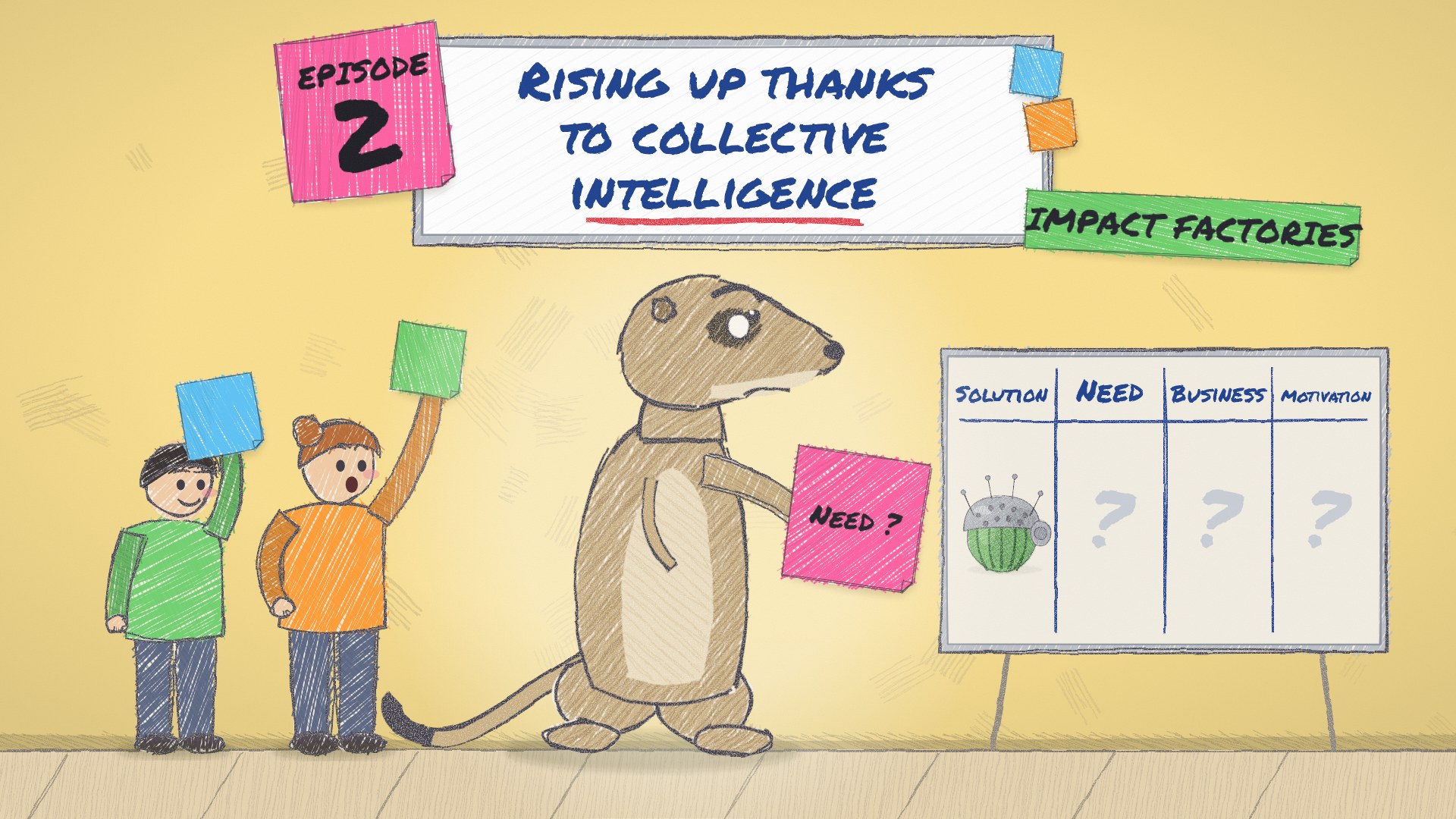
Max picks up a marker, stands, walks over to the whiteboard, which is still blank, and draws four columns: Solution, Need, Business, Motivation. “These are the four pillars most projects are built on. Every startup starts out strong on one or two of them.”
He writes MelonsNet in the Solution column, then underlines Motivation with a heavy stroke. “Your technological solution is ambitious, and your team’s energy is obvious. But the other two columns, need and business, in other words the problem to solve and the way to make a living from it, are almost empty.”

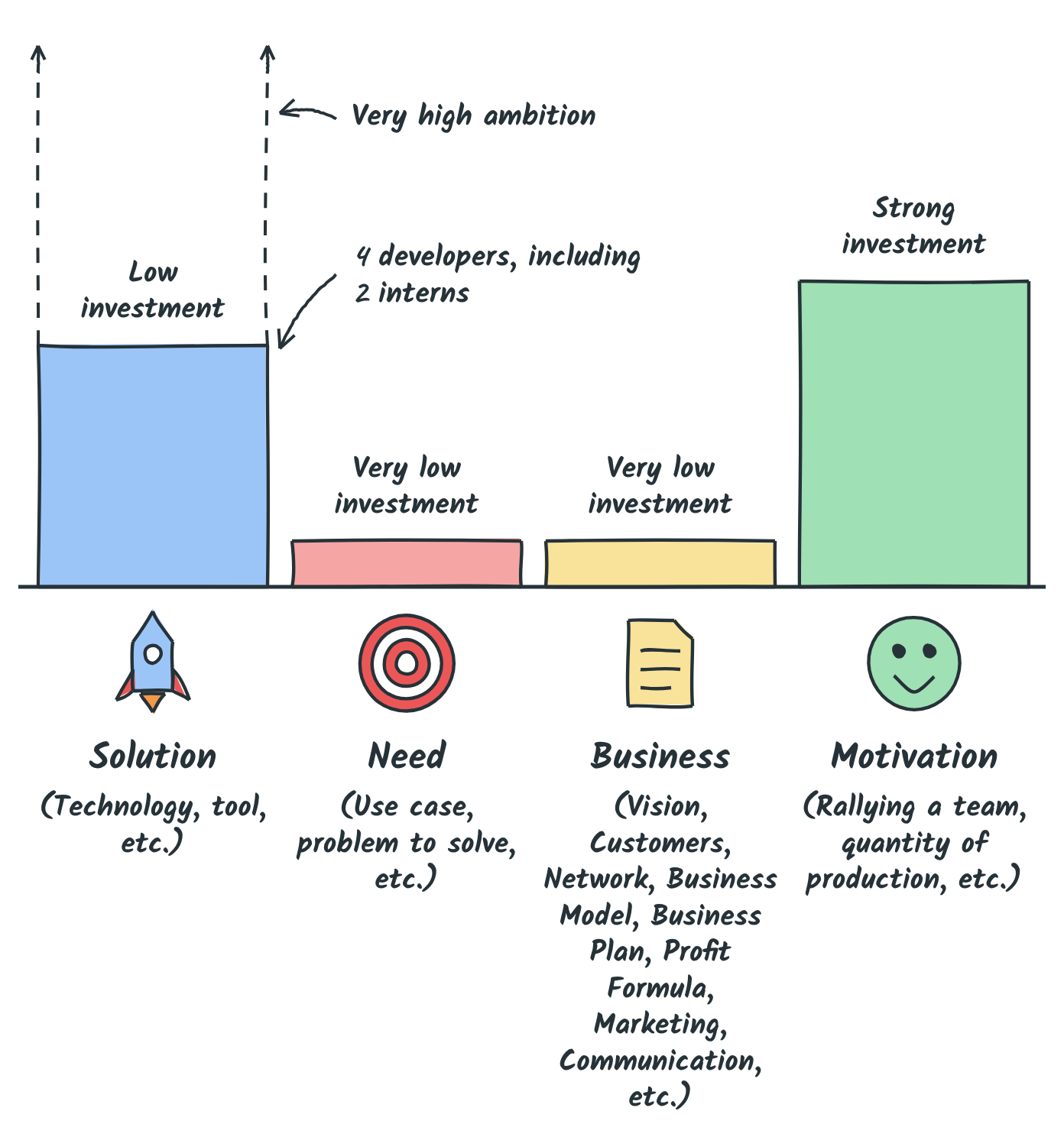
Sophie stares at the two columns. “Almost empty… We haven’t talked to a single user yet.”
Julien crosses his arms. “No users, no customers. So who pays in the meantime?”
“Exactly,” Max says. “There are two main families of startups. The ones that live off their customers from day one, which we call bootstrappers. And the ones that need heavy investment, often to finance research and development, R&D, or because they’re going after a low-margin mass-market model.”
He taps the Solution column with the tip of the marker. “You’ve positioned MelonsNet as a deep tech startup, one built on a scientific breakthrough. But if we’re being honest, even your strong point, R&D, is under-resourced. Two full-time developers, two rotating interns… that’s very thin.”
Sophie straightens up to object, but Max gets there first. “You were lucky to find brilliant interns who are available outside the academic calendar. But it won’t be enough.”
Nobody speaks, and from the counter comes the clink of a cup against its saucer. Julien keeps his arms crossed, his eyes on the table. “I understand your point, Max, but it doesn’t solve the real problem. How do you expect us to get users interested if the headset isn’t even finished?”
Max holds his gaze. “Julien, this isn’t about selling it or getting people to use it right now.”
Julien raises an eyebrow. “I never said anything about selling.”
Max taps the marker against his palm. “You talked about interest in a finished headset. Getting people interested, selling: that’s not far off. But that’s not the point. This isn’t about getting to a product before going to find users. It’s about investigation. Exploration before you develop anything at all.”
He turns to Sophie. “How can you know what your future users expect, in terms of features, performance, ergonomics, if you haven’t identified a concrete use case?”
“We can’t,” Sophie says.
Max nods. “Right. It’s not the product that should drive your decisions, it’s the information you gather in the field. That’s what maps out the road. That’s what sets the course and gives meaning to your deadlines.”
Max turns back to Julien. “And even selling, since the idea gets under your skin: it’s entirely possible to sell a product that doesn’t exist yet, as long as you show a clear vision and inspire confidence. Take the Airbus A380. When they pitched that plane to the airlines, it was nothing more than a project on paper.”
“No prototype?” Julien asks.
“No working mockup, no prototype. Just simulations, financial models, and an ambitious vision. And yet they convinced several airlines to sign firm orders.”
Julien uncrosses his arms and leans across the table. “How?”
Max turns back to the whiteboard and draws three arrows, one for each step. “The Airbus teams started by identifying what the airlines needed, like carrying more passengers over long distances while bringing down the cost per seat. Next, they showed how the A380 would meet those expectations thanks to its unprecedented size and its energy efficiency. They even used economic models to prove that the long-term operating costs would more than make up for the initial investment.”
Max points the marker at Julien. “They weren’t selling a plane, Julien, they were selling a solution to real problems.”
Julien lets out a short laugh. “A paper airplane that lands firm orders.”
Max comes back and sits down across from them. “What I’m telling you is that you can do the same thing. If you fully understand your users’ real needs, you’ll not only be able to steer your development, you’ll also start building a relationship of trust with your future customers, even if the product isn’t finished yet.”
Julien and Sophie exchange a look, Sophie nods first, and Julien turns to Max. “Okay, we see where you’re going with this. But where do we start, to get this investigation going?”
Max lays the marker on the table. “To identify a need, you have to meet people. Not necessarily the ones who have that need directly, at first, but at least people who can give you leads or point you toward the right people to talk to.”

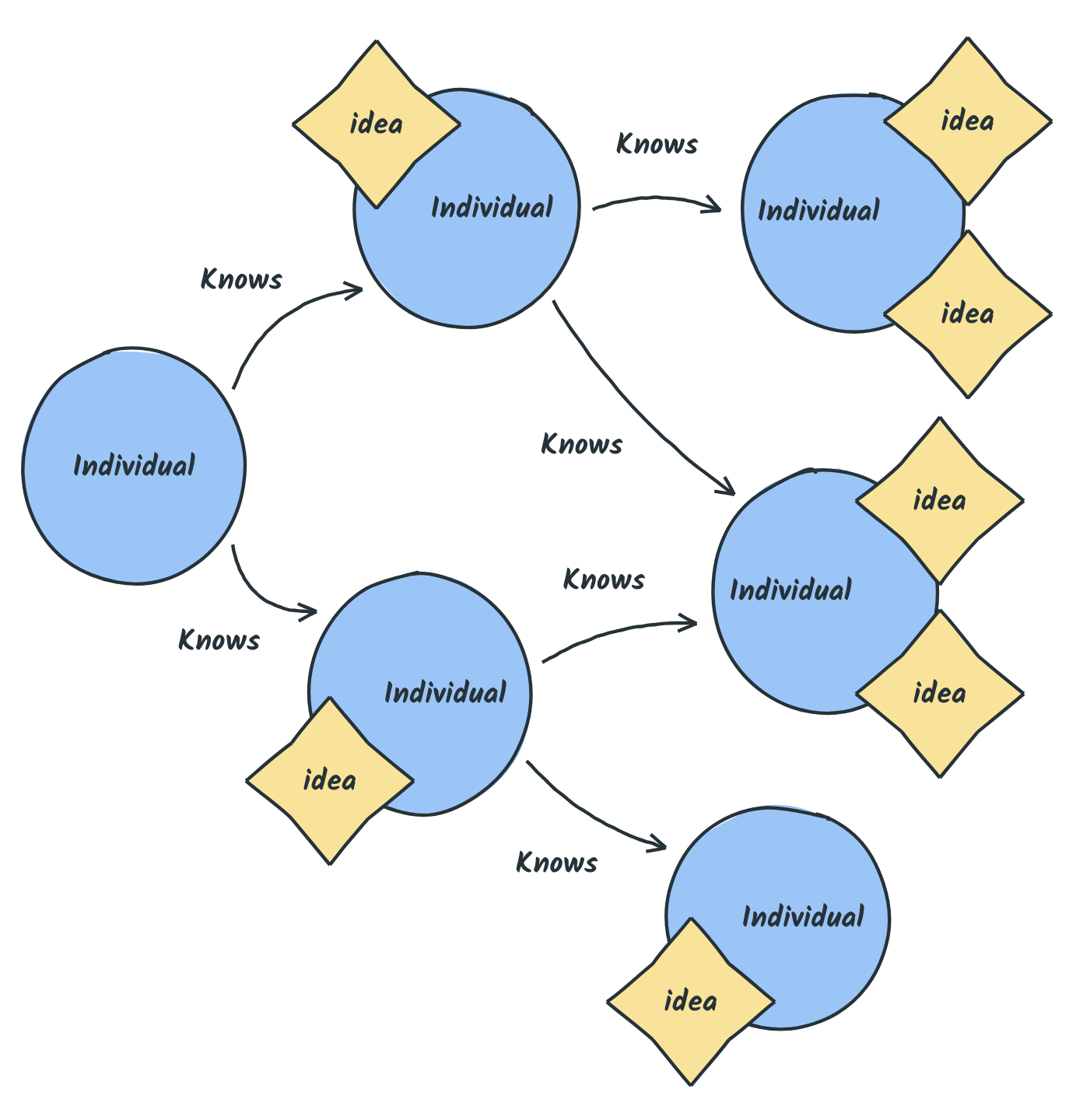
Sophie thinks back to the dozens of faces at NUMA. “People who point you somewhere… We don’t know many of those, not in this business.”
Max stands up and waves over a man who has just walked through the café door. “This is Léo. I asked him to come by, because he’s already launched several innovative companies through our incubator. When I told him about you earlier, he said he happened to be in the neighborhood.”
Léo walks over, smiling, and shakes Julien’s hand, then Sophie’s. “Hi, I heard you could use some advice to save your company. I’d be glad to help.”
Stories from entrepreneurs and product managers
Neither of them can get the company back on its feet alone. Entrepreneurs describe here what a network, an incubator or a community changed for them.
🎥 Watch the videos
Lydian Feneck (in French), founder of Gamearly, explains how neglecting a community-driven approach can lead to missing a product’s true value.

Sébastien Tricoire (in French), CTO of Cezigue, explains how incubators unite communities to maximize entrepreneurs’ chances of success.

Anil Narassiguin and Pierre Vidal (in French), co-founders of FlyRenov, explain how personal challenges can become an opportunity to build a network.

Bertrand Lafforgue (in French), CEO of Konverso, explains the importance of personal networks in achieving success.

Paul Benoit (in French), CEO of Qarnot Computing, explains the organic approach to building a network around a project.

Christophe Remillet (in French), co-founder of OneVisage, explains how professional experience can serve as a driver for network growth.

Lara Gervaise (in French), co-founder of Virtuosis AI, builds her network through continuous experimentation around her product.