

Léo pulls out a chair, spins it around in one move, and sits facing them, forearms folded over the backrest. He has an athlete’s build and the deep voice of a man in his fifties who has done a lot of public speaking. Under the table, Sophie’s foot never leaves the strap of a gray backpack.
Max takes on a solemn tone. “Let me introduce Léo. A serial entrepreneur with ten unicorns to his name.”
Julien’s eyes widen, magnified by glasses a little too large for his narrow face. Skinny shoulders, wrinkled shirt, jeans too long: his perpetual-student frame looks even slighter next to Léo’s muscle. Dark circles ring his eyes, and on reflex he pushes back the unruly lock of hair that falls over his forehead. “Ten? Ten companies valued at over a billion?”
Léo bursts out laughing. “Hang on, Max, are you trying to make me sound like Elon Musk? Let’s fix that right now, before they picture rockets in my backyard. Serial entrepreneur just means I’ve started companies one after another.”
Max holds back a smile and keeps his ceremonial tone. “Still! At sixteen, while studying engineering and already the youngest in your class, you launch a medical startup that shakes up the whole field.”
Léo raises both hands, like a cop stopping traffic. “Okay, let’s be honest: yes, I cofounded that company while I was in school, with my uncle, who knew the field inside out. I was far from the genius behind it. But yes, we released software that let caregivers centralize patient follow-up and, above all, identify commonalities between rare cases. It helped speed up research on certain cancers. That part, I’ll admit, we can be proud of.”
Julien lets out an admiring “wow.” Sitting next to him, Sophie has the same studious pallor. A few strands escape from her brown bun, tied up in a hurry. She touches her left temple with a fingernail, as she always does when she’s thinking, bites the inside of her cheek, then nudges Léo on. “And how old were you again?”
“Seventeen, and Max takes a year off me; that’s friendship for you. But relax: at that age I was mostly a geek in a T-shirt who never slept. And honestly, I made every mistake in the book.”
Max picks up where he left off. “And then, at eighteen, you come up with the concept of ‘intuitive online learning.’”
Léo cracks up, shaking his head. “Yeah… that one was fun. I was convinced French education was stuck in the 18th century. I wanted to build something that generates lessons live, based on the questions the student is asking. Great idea, big buzz, and… big panic in the government when kids ended up skipping three grades in one year. We got the TV debates on ‘do we still need high school?’ and the whole circus. Spoiler: I also nearly got lynched by the unions.”
This time Sophie laughs out loud. “Seriously?”
Léo shrugs. “Seriously. And guess what? I got kicked out of my own company two years later. Too many operational mistakes, not enough process. It stings, but it teaches you.”
Max counts on his fingers, as if reading off a list. “Then urban mobility, AI, and even coaching managers…”
Léo cuts him off again. “Max, enough with the superlatives. Yes, I’ve worked on some cool stuff, and yes, there have been wins. But behind every success there are sleepless nights, last-minute pivots, and some brutal knocks. Me, a legend? I’m a guy who likes to try things… and who’s survived long enough to tell you about the worst moments.”
Sophie raises an eyebrow. “Pivots?”
“Changing course overnight.” Léo punctuates it with a wink, and the whole table bursts out laughing. Between sentences, though, Léo flips his phone over, glances at the screen, and sets it back facedown on the table, and he’ll do it several times within the hour.
Now it’s Sophie and Julien’s turn to lay out their journey, their vision, and the blind spots slowing them down. Léo listens, arms crossed on the table, eyes narrowed. Around them the café hums: the clink of cups, the shrill beep of a microwave, the warm smell of coffee. By the radiator a mother rocks a newborn, a hospital orderly trades a few words with a colleague, smiling, and farther off a dish cart rattles across the linoleum.
Julien wraps up by coming back to the need to test their idea in the field. Léo brings his hands together, then opens them, palms up, the way you’d turn over a card. “What if we tested it now?”
Sophie blinks. “Now? Here?”
“Yes. Why not run a little focus group right here?” Léo nods toward the room. “Look around you: there are caregivers, patients, visitors from all walks of life. You won’t find a better place for on-the-spot feedback. A sheet of paper, a pencil, two or three well-framed questions… and you’ll find out fast what resonates, what bothers people, what intrigues them.”
Sophie holds her breath and tries to catch Julien’s eye. Under the table, her hands close around the backpack, picked so that no one would notice it, where the prototype lies. “In a hospital?” Her voice wavers. “But we don’t know anyone, and we could be bothering people for nothing. And we’d show our concept to a whole group of strangers before we’ve secured our intellectual property? There was that startup in Lyon that got beaten to market after a simple clinical demo. A resident secretly filmed their device. The video ended up on a biomedical forum in Shenzhen, and three months later a clone was making the rounds at the MEDICA trade show, in Germany…”
Julien goes pale, and his hand joins Sophie’s on the strap. In that bag, too, is the money from the house he sold in secret. “Léo, it’s too risky, the whole thing could go up in smoke. One selfie, one recording of our conversations, and we lose years of R&D.”
Nobody says a word, until Julien takes a breath and turns to Léo. “Sorry, but what exactly do you mean by a focus group? And how could it help us?”
Léo pushes his phone aside with his fingertips. “A focus group is essentially a guided discussion session with a small group of people. It’s used to gather opinions and reactions on a topic or a product, a service, or an idea, before going any further. It helps us detect potential needs, understand expectations, and gather opinions through collective intelligence. It’s a fast, direct way to get qualitative feedback that can be crucial for refining a product.”
Julien nods. “On-the-spot feedback, basically.”
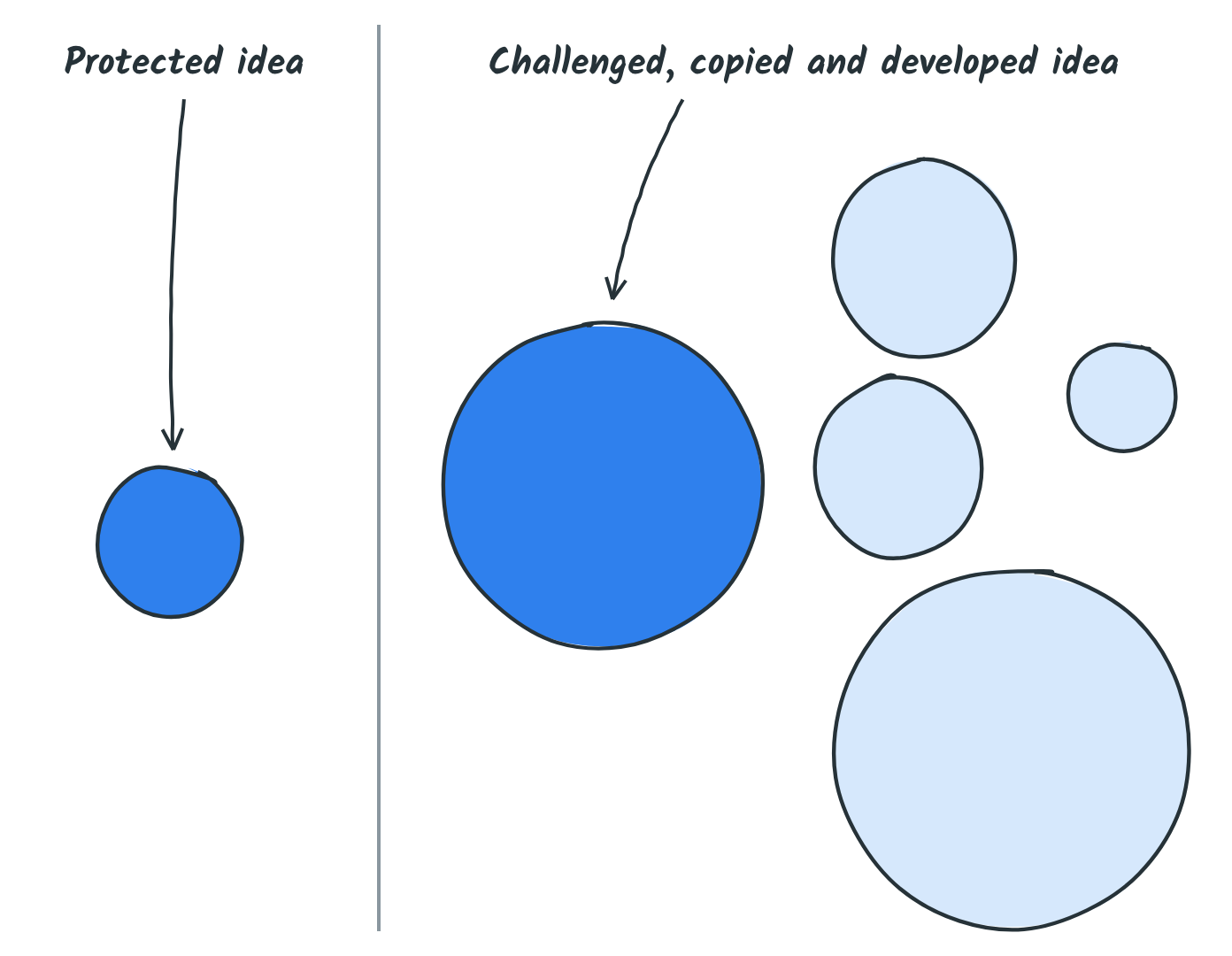
Léo turns back to Sophie. “Your fears are legitimate. But remember: an idea is like a seed carried by the wind. Lock it in a chest to ‘protect’ it, and it dries up. Plant it and water it before everyone else, and it sprouts and becomes an oak.”
Sophie doesn’t let go of the strap. “A seed can be picked up. And replanted somewhere else.”
“That’s exactly the problem, because in this business nobody can patent the wind: trends blow everywhere. Whatever you dream up this morning, dozens of teams somewhere are already dreaming it up too.” Léo taps the table with his index finger. “Look at Kodak. In 1975, engineer Steven Sasson built the very first digital camera. Management kept the prototype under lock and key so as not to cannibalize film, their bread and butter. While they were locking the idea away, Sony, Canon, and the rest went digital. The result: in 2012, Kodak filed for bankruptcy, overtaken by the people who’d turned the same idea into a product, then into a market.”
Julien frowns. “They had the invention, and they shelved it?”
“Shelved it.” Léo spreads his hands. “So the real value isn’t in the bare concept, but in our ability, and our speed, to shape it, test it in the field, and turn it into a sustainable model. In other words, let’s grow the tree instead of collecting seeds.”
Julien lays his palm flat on the bag. “But we’ve developed the technology, it’s not just an idea! The tree is in this bag!”
Léo keeps his cool, but his voice hardens a notch. “Julien, hats off: building a mind-reading headset with five people, two of them interns, in two years, by stacking open-source building blocks, code anyone can pick up… that’s remarkable. But you have to tell a technological gem from a product that actually sells. Remember Magic Leap One.”
Julien looks up. “The augmented reality glasses?”
“Technically stunning. More than $3 billion raised and ‘light-field’ optics straight out of a sci-fi movie, where the virtual image takes on the depth of a real scene. And yet, with no clear use and no affordable price, barely a few thousand units left the warehouses before the company laid people off in droves. Meanwhile Meta Quest 2, a virtual reality headset, made do with humbler parts, but with a crystal-clear proposition: play and socialize in VR without a PC. The result: 10 million headsets sold in under two years.”
He nods at the bag. “Your prototype is a homemade Magic Leap: brilliant, fascinating… but fragile. And while the five of you tinker on open-source foundations anyone can use, giants (Neuralink, Meta, Microsoft, Tencent) are funding teams of a hundred engineers. They order their own ASICs, custom-designed chips, and buy entire production lines.”
Sophie takes her hand off the strap. “And us, with nine months of cash?”
“Without a clear commercial direction, you’re taking a risk. Who will use the headset, for what immediate benefit, at what price, and with what after-sales service? Without those answers, you’ll stay ‘the likeable pioneers’ everybody mentions… and that the heavyweights leave behind.”
Sophie and Julien fall silent, and over at the counter the microwave goes off again, three sharp beeps.
Léo leans in. “Remember: an idea that succeeds is worth far more than a perfectly secured idea that never leaves the garage. The whole point is to find the right balance between protecting your concept and testing it in the real world to validate and improve it. And when you go talk to those people, focus on their needs, not their opinions.”

Julien points a finger. “Wait. You’re telling us to focus on the needs of the people we talk to, but at the same time their opinions are secondary? Isn’t that a contradiction?”
“No. Watch the people you talk to and you’ll quickly see there’s a difference between what they tell you, what they do, and what really, factually bothers them!”
Julien tilts his head. “Like what?”
“A user might criticize your headset’s ergonomics, too heavy, badly adjusted, and still use it often from the very first working version he gets his hands on, because it meets a crucial need for him. And opinions can be swayed by all sorts of things: reluctance to offend, lack of perspective on their own needs, or even their mood that day.” Léo flips his phone over again, sets it back down. “That’s why it’s essential to tell factual needs from mere opinions, and above all not to talk about your solution. Henry Ford is credited with saying, ‘If I had asked people what they wanted, they would have said faster horses.’”
Max, who has kept quiet, gets up and grabs a flyer from the cafeteria counter. He pulls a marker from his pocket and, on the emptiest part of the paper, draws two columns: Exploration on the left, to understand the problem, Validation on the right, to test the solution. Under each, he writes two questions. “There. Remember this: we’re still in the left column. Jump straight to the right, and you’re testing the bandage before you know the wound.”
| Exploration | Validation |
| “What part of your shift is the most exhausting?” | “Do you understand the interface?” |
| “What are you already trying to do to solve this?” | “Is the headset too tight?” |
Julien rubs the back of his neck. “But if we don’t show anything, they’ll think we’re selling hot air.”
Léo shakes his head. “Showing it first is like serving a soufflé before asking if your guests are lactose intolerant. Today, we listen.”
Then he faces Sophie. “Imagine your headset is already perfect. What problem would it solve here?”
Sophie opens her mouth, then closes it: it’s Max’s question at NUMA, in different words. She touches her left temple, and nothing comes.
She tries to catch Julien’s eye, and he glances down at the bag, then back up. “Despite the risks?”
“Despite the risks.” Sophie opens her notebook on the table. “We’re looking for high-value use cases for the headset: specific situations where someone would really need it.”
“In other words, finding out if anyone wants it.” Julien sits up. “And fast.”
Sophie puts a finger on the page. “This is the crucial step: desirability. Without it, our invention will never become a viable business.”

Léo flips his phone over one last time. “I’ve got another meeting. Another bet. We’ll talk.” He leaves the hospital, and Max says he’s going to visit a patient he knows; before he goes, he slips them a piece of advice about running the session. Still at the cafeteria table, Sophie pencils a list in her notebook of what they want to learn. Julien watches her. “Where’d you get this focus group method? We haven’t run a single one since the project started.”
Sophie keeps her eyes on her list. “I took a user research module in college. I didn’t realize how much it mattered while we were buried in the technical side. Now we need to understand the real situations where our headset will create value.” She lifts her pencil. “A headset that reads minds is first of all a way to be understood without speaking. Let’s start there.”
They decide to turn the focus group into a real ideation workshop, a session where people come up with ideas together: collect a range of situations where communication breaks down, then see how their technology could restore it.
“And we bet on a variety of profiles,” Sophie adds. “Caregivers, workers, visitors: they’ll bring up use cases we’d never have imagined. And, who knows, needs that are still hidden.”
Julien balks. “Factory workers, in a hospital?”
“Patients and visitors have jobs, outside of here.”
Sophie takes her laptop out of the bag, without moving the prototype, and types a first draft: “Do you like our headset?” She stares at the question for a long moment, deletes it, then pencils the traps to avoid in the notebook’s margin: confirmation bias, desire to please, authority effect… Julien reads the list upside down. “Desire to please, authority effect, I get those: you say what the other person wants to hear, you fall in line behind the boss. Confirmation bias… I think I get it, but can you spell it out? It’s about not steering the answer with the question, right?”
Sophie pushes back from the keyboard. “Partly, yes, but more precisely, it’s our tendency to notice only what confirms our ideas. It creeps in everywhere: in how a question is worded, the tone you use, even the examples you give. If I ask, ‘Do you like our headset?’ I’m triggering that bias, because I’m already implying the headset deserves to be ‘liked.’ To avoid it, you have to explore the user’s experience, without trying to validate our solution.”
Under the heading “Open questions,” she types two suggestions: “How do you feel when you communicate along the production line?” and “What situations frustrate you the most?”
“These questions invite people to describe their day-to-day,” she goes on. “Then I follow up: ‘Can you tell me about a specific case?’ or ‘How did you solve that problem?’ During those questions, I never mention the headset; otherwise we fall right back into the trap.”
She taps the screen with her pencil. “And we watch our own reactions, too. No pleased tone when someone agrees with us, no rephrasing that steers the answer. That’s how you defuse confirmation bias.”
So as not to steer the answers from the start, they decide not to reveal their product until they’ve asked their first questions. They’ll open on the general challenges of communication in noisy or stressful workplaces, and only in a second stage bring the conversation around to the specifics of their headset. Sophie revises the question along those lines: “Are there situations in your work environment that slow you down because of poor communication or difficulty passing on information?”
Julien reads over her shoulder. “And when you talk about open questions… How is that one not closed? To me, a question is a question.”
Sophie types two examples, then swivels the screen toward him:
- Do you already use communication headsets at work?
- What bothers you most about your current communication tools?
“The first is a closed question: you get a yes or a no, and you’re stuck inside that frame. The second is open: it invites the person to tell their story, to criticize, to add nuance.”
Julien looks at the two lines, then nods. “Okay… And what if someone just says ‘everything’s fine’?”
“Then you follow up.” Sophie lets go of the keyboard and acts out the exchange. “What makes ‘everything’s fine’? Can you describe a time when the tool really helped you? Or, on the other hand, a time when it held you back? Every follow-up reopens the field instead of closing it.”
Julien opens his own notebook and writes: Open questions: who, what, how, why… never yes/no. Then he raises his pen. “What about this one: ‘What aspects of your communication tools would you like to see disappear or change?’”
“Perfect.” Sophie types it in. “With that, we’ve got an open question, and we minimize confirmation bias: participants are no longer trying to validate our idea, they’re describing their own. Plus, it’s shorter than mine. Questions have to be short and clear, so we don’t lose participants or put them in a situation they’d find humiliating, where they wouldn’t dare take part fully.”
She adds, “And the people who don’t dare often go quiet because someone else is talking too much. There’s another trap in focus groups, a subtler one: group bias. As soon as a charismatic voice speaks up, everyone starts orbiting around it, and the original ideas vanish.”
Julien crosses his arms. “You think we’ll have a celebrity in the room? Aren’t you being a perfectionist?”
Sophie holds his gaze, without raising her voice. “It’s not perfectionism, Julien, it’s prevention. Group dynamics can be unpredictable: all it takes is one person, even without meaning to, taking up too much space, and the others censor themselves.” She lets a second go by. “You, for instance, the moment someone hands you a mic.”
Julien uncrosses his arms. “Touché, so how do you gag me?”
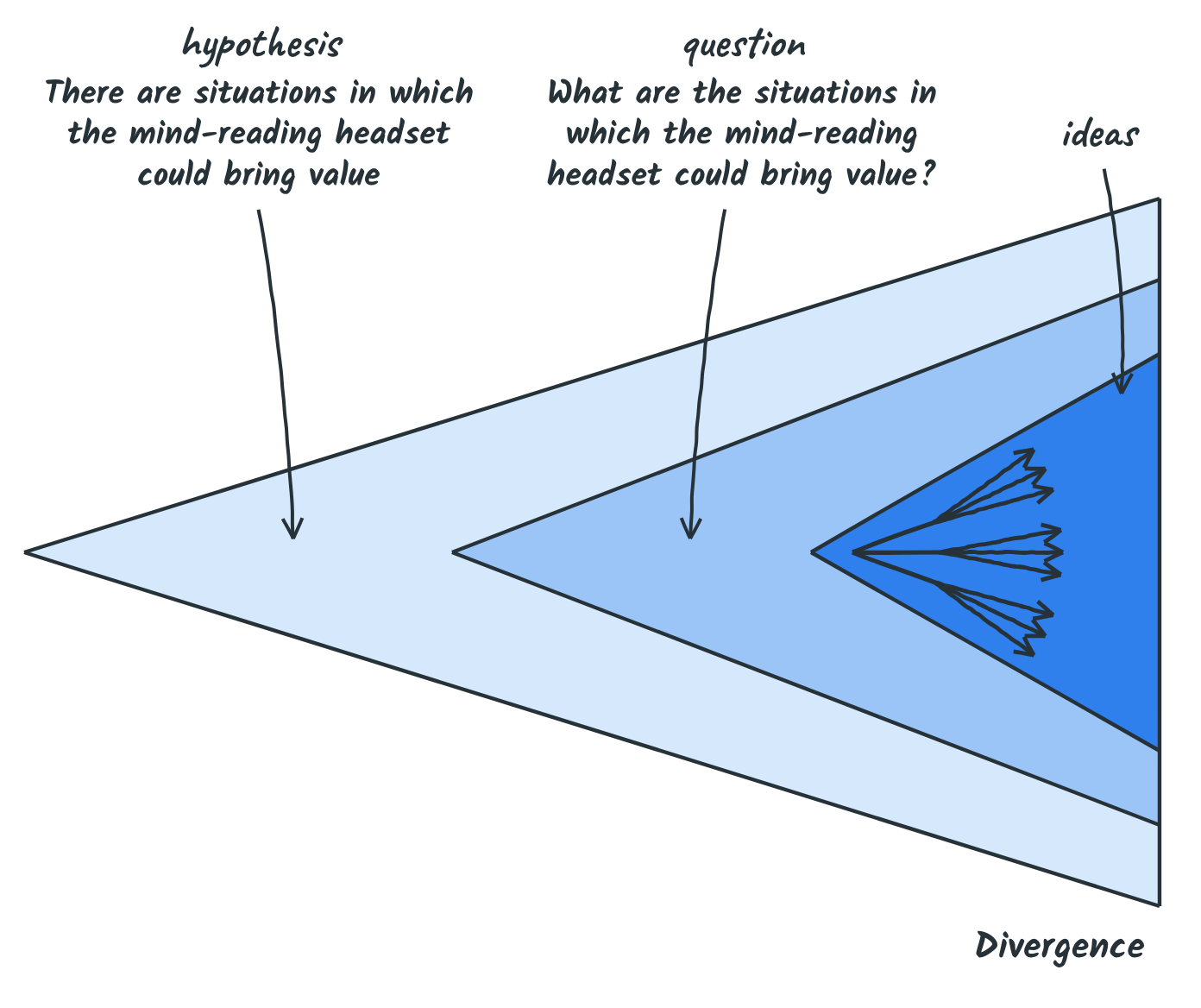
“That stuck with me from college, we spent two weeks of hands-on sessions on it. First, you run each question in three stages. Stage one: divergence. You open the floodgates; everyone throws out every idea that crosses their mind, even the craziest ones, with no censorship or comment, using Post-its. Quantity comes first.”
“So everybody gets it off their chest, and nobody criticizes?”
“Exactly, and next comes clarification: you group the Post-its, you rephrase. You ask, ‘What exactly do you mean?’ You spot duplicates, you pin down the fuzzy parts.”
Julien takes notes. “And after the sorting, who decides?”
“Everybody: that’s the third stage, convergence. You select and prioritize. You compare, you vote, you decide.” Sophie half closes the laptop. “That rhythm, and using Post-its before speaking, keep the most influential speaker from imposing their vision: everyone first gets the space to think, then to clarify, then to choose together.”
Julien smiles. “A play in three acts, where everyone has a real part. And for once, I’m not the lead.” He closes his notebook over his thumb. “And afterward? They go home and we lose them?”
This focus group is only a start. Sophie adds a line at the bottom of her list: collect each participant’s contact details and ask for their consent to get back in touch later. The goal: ensure ongoing follow-up and build up their database, for future analysis.
For running the session, they take Max’s advice: Sophie will lead the first part while Julien takes notes, then they’ll switch roles for the second half.
To thank the participants, they come up with a little game: a free trial of the headset, where each person thinks of an object the headset has to guess. “Fun,” Julien says, “and it shows what our technology can do.” Sophie hesitates. “At the end, then. And on the flyers we just write ‘surprise gift,’ so we don’t wreck the workshop from the start by influencing the discussion.”

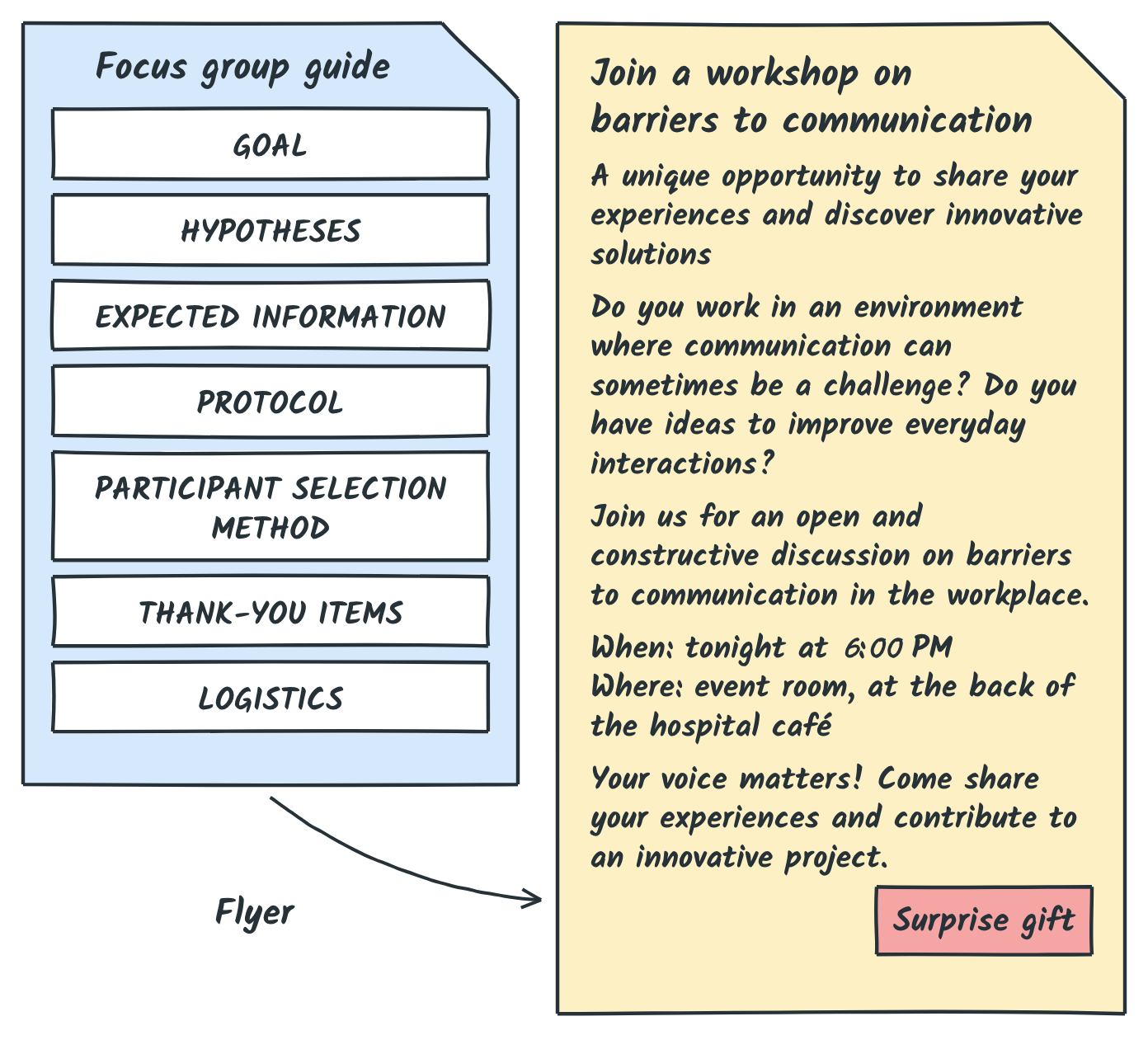
With the plan in place, Sophie and Julien get to work, and Max joins them. At the front desk, he greets two staff members by their first names. Thanks to him, they print flyers on the hospital’s printers and hand them out on every floor, inviting staff and patients to an event room tucked away at the back of the café.
Before the appointed time the room stays empty, and Julien checks the clock more than once; then, right on time, he holds the door open and lets in about twenty participants. The room, on the hospital’s ground floor, has a large sky-blue wall that he and Sophie have prepared in a rush; two long vertical strips of removable tape mark out the columns for the day’s questions.
Facing this makeshift board, a round table stands in the middle, flanked by two rectangular tables where everyone can settle in comfortably. A video projector hangs from the ceiling, switched off: they want discussion with no screen in between.
The hubbub dies down as Sophie steps into the middle of the room. “Thank you for coming. You’ve probably seen our flyers about a workshop on ‘barriers to communication.’ Concretely, we’re working on a device that will eventually make instant transmission of information easier. Before we go any further, we need to understand your daily realities: where words get lost, where the message gets distorted, why misunderstandings slow down your work. Today, you’re our scouts.”
She points to the blue wall. “This wall is yours. During our discussion, you’ll write your ideas on Post-its, as many as you like. We’ll start with a first question, which you’ll answer in several phases. In this first phase, no criticism: we’re after quantity before quality. You can also build on someone else’s idea with a new Post-it.” With a gesture, she shows them the pads of multicolored squares, and the markers set out beside them.
The participants settle in at the tables, markers and Post-its in hand. Sophie touches her temple with a fingernail, then asks the first question, “In your work, are there situations where communication slows you down or distorts information?” Julien starts a ten-minute timer.
Everyone bends over a first Post-it; a nursing assistant holds his marker in the air for a moment before writing. Nobody talks; the only sound is felt tips squeaking on paper.
Once their idea is written, the participants get up one by one to stick it on the wall, where it stays in plain view, and within a few minutes the blue has nearly vanished under yellow, pink, and orange squares.

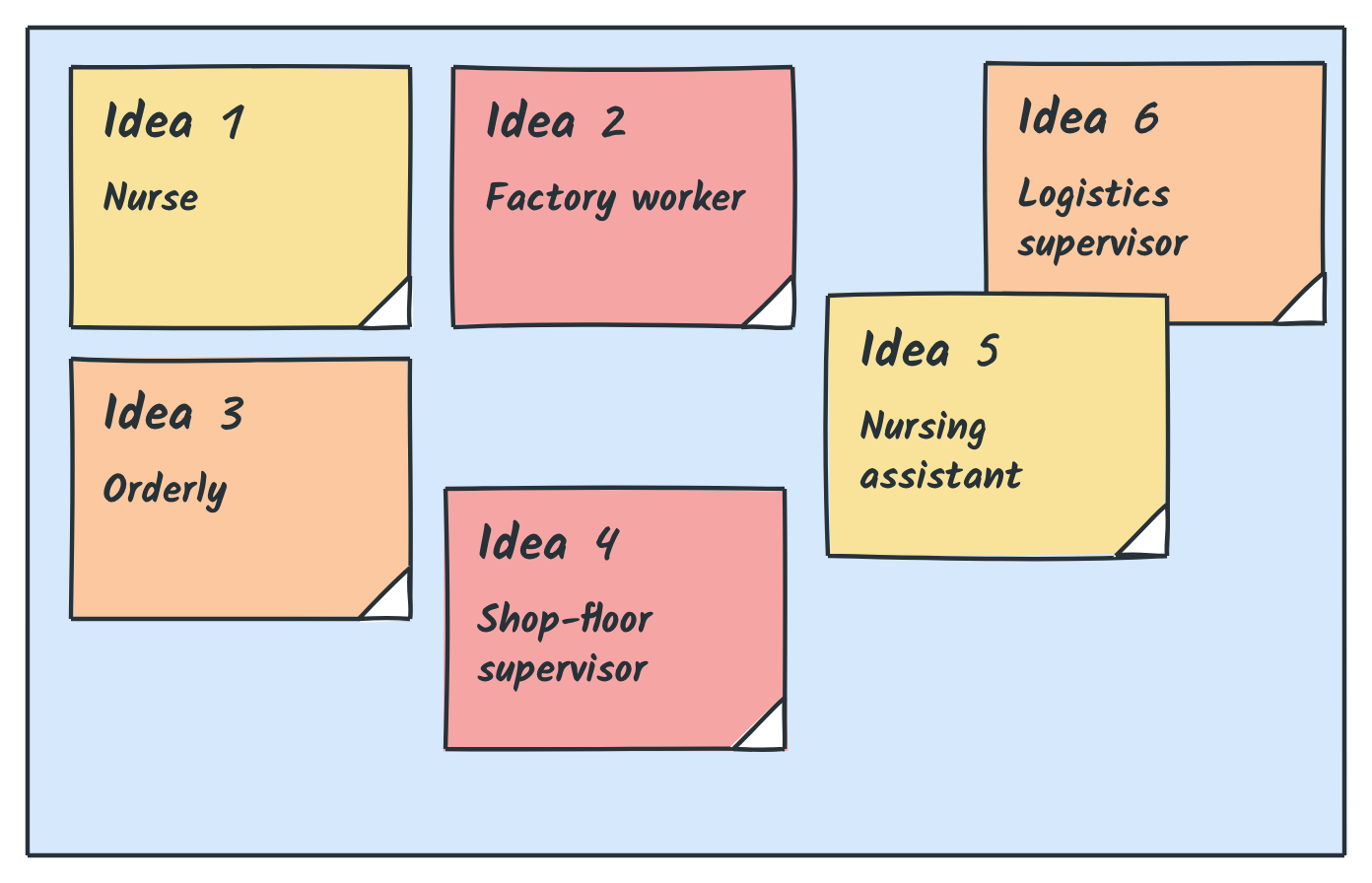
The timer goes off, a short chime that bounces off the walls, and Sophie steps forward. “Phase two, with three tasks: sharing, clarification, collective sorting. Everyone presents their ideas. While someone is presenting, the others ask whatever questions they need to understand. Above all, no judgment! And if two Post-its say similar things, or share a theme, put them together. Who wants to start?”
The room hesitates, then a worker in blue coveralls finally stands up, crosses to the wall covered in colored squares, and puts a finger on one of his Post-its. “The racket from the machines gets in the way of communication.” He speaks loudly, without hesitating.

A nurse tilts her head. “What machines?” Around her, people exchange blank looks, and Sophie raises a hand. “Sorry, let’s stop for a second. We don’t know each other, so let’s do a lightning round of introductions: names, roles, contexts.” The group gets acquainted: nurses, factory workers, engineers, and family caregivers. Some wear a hospital badge, others a patient’s wristband, others still have come to visit a relative.
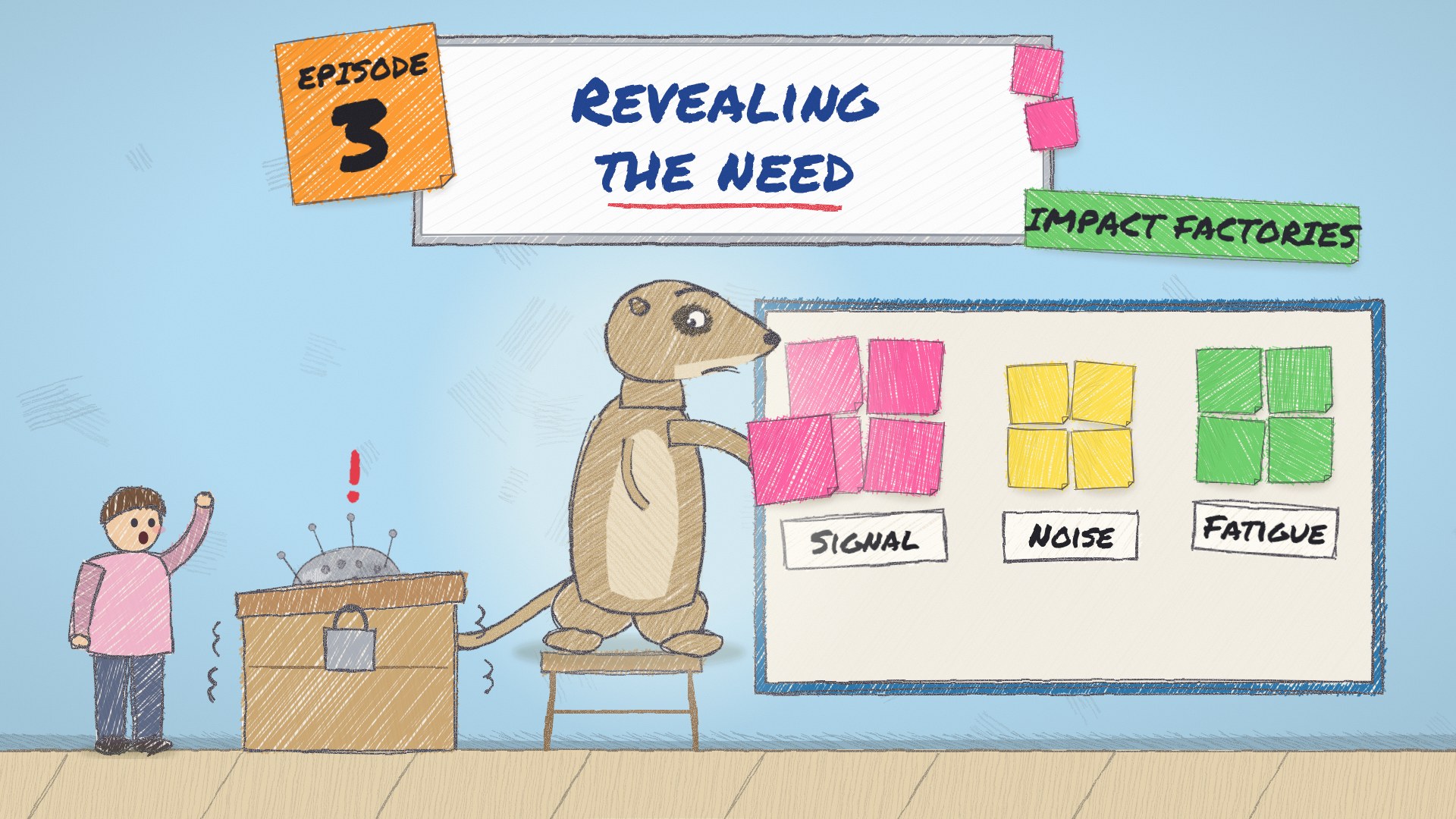
With introductions done, the sharing picks up again. A maintenance engineer immediately asks, “What kind of noise bothers you most? The alarms, the line itself, the carts?” The worker describes the nonstop rhythm of the presses and the sharp clang of metal boxes dropping into the bins. Two nearby Post-its, one about alarms, the other about auditory fatigue, migrate over to join his, and a first cluster forms in the middle of the wall.
The nurse takes over and points to a pale yellow square. “Between the monitoring alarms and patient calls, we keep repeating the same instruction.” An orderly adds that he often has to raise his voice, which only adds to the confusion, and the two of them place their notes side by side, just below the worker’s cluster.
Farther along, a shop-floor supervisor raises her hand and walks over to an orange Post-it. “Visual fatigue,” she reads. “Warning lights come on everywhere; after a while, nobody pays attention.” She distinguishes a critical indicator, which demands action, from a simple notification. The nurse recognizes the same problem in the cardiology hallways: she peels off her second Post-it and places it under the supervisor’s, and a “Visual Signal” cluster takes shape.
Standing by the wall, Sophie adjusts the squares. With each clarification a Post-it moves, and little by little the scattered notes draw together around themes no one has named yet.

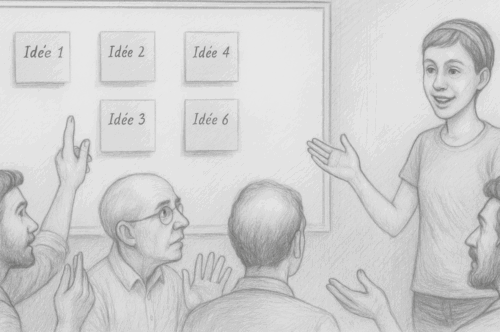
Sophie announces the last phase of the first question: convergence. The participants finish grouping the Post-its by theme or type of idea, while continuing to challenge their content: you push back to sharpen it. The link between “constant alarm” and “auditory fatigue” sparks a lively debate; the Post-its migrate again, merge, or split. Julien, who’s taking the notes, writes without looking up. Sophie proposes the names of the themes: Noise, Visual Signal, Auditory Fatigue.
A logistics supervisor moves her Post-it for the fifth time. “Oh, actually, my idea goes with Visual Signal,” she says, laughing. She finally leaves it in that group, then adds another, inspired by the people around her.
Then comes the second question, the one where they unveil their project to link the theme to their technology, and Sophie lowers her voice. “We’d now like to tell you about a prototype… a mind-reading headset, capable of turning neural signals into words and images.”
Whispers run from table to table. A man in a wrinkled jacket jumps to his feet, his chair scraping the floor, slams the table, and knocks over his paper cup of coffee. “Your gadget is an open door to a totalitarian regime! You’re lining pockets that are already stuffed… Bunch of condescending fools with your degrees!” Before anyone can step in, he walks out and slams the door, and the coffee runs to the edge of the table, then drips onto the floor.
Julien clears his throat, and another participant, a composed man in his fifties, raises his head. “Do you realize the road you’re taking us down? Thought totalitarianism stops being a dystopia if your headsets ever see the light of day.”
Sophie answers in an even voice. “Our code is based on technologies that are accessible to everyone. We’re repurposing these existing technologies to meet concrete needs. We want to regulate these uses, not open Pandora’s box.”
A few faces stay closed, but from the back of the room a voice rises. “In Gutenberg’s day, people sabotaged the presses, claiming they threatened the established order. Today, printing is the foundation of our culture.” Others give a weary nod: there’s no point fighting progress.
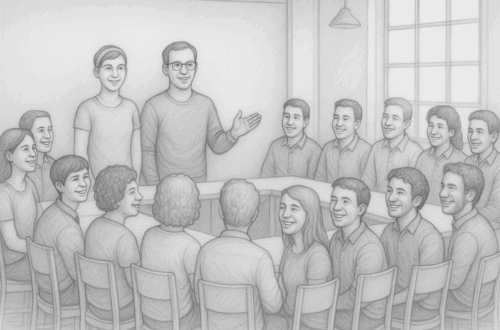
No one sits back, and Julien, who’s leading now, takes a deep breath. “If you’re willing, let’s move on to brainstorming: every idea, no sorting. Same exercise as before.” Among the opponents still in the room, one starts covering the wall with grim Post-its that twist each idea to expose its threat. Sophie leans toward Julien. “If he keeps this up, nobody will dare write anything.”
The opponent’s Post-its stay up, but the hospital staff dive in anyway, one story after another. A nurse says, “We have a patient, a former musician, who lost his speech after a stroke. Imagine if he could share his thoughts again.” A doctor picks up the thread. “For our trauma patients, this headset would change their care. It would give them a voice where they no longer have one.”
Patients and visitors see other uses. An HR director explains, “Where I work, ideas get lost in meetings as soon as two people talk at once. This headset could transform our brainstorming sessions by capturing ideas in real time, without interruptions.”
A factory worker chimes in. “At the plant, it’s so loud that talking is often impossible. We end up using hand signals. With this headset, communication would become smooth and efficient.”
Voices rise, and a patient, a former teacher, raises his hand. “What if we put this headset in schools, to help children with communication disorders?” One of the skeptics shoves back his chair: a mind reader aimed at kids is more than he can take. He jumps up, fuming, and the door slams behind him for the second time that evening.
At the end of the session, Sophie and Julien take down the contact details of the participants who want to be contacted again. A physical therapist comes over. “I’d be glad to show you our rehab center. You could test the headset there in real-world conditions.”
The HR director hands them her card. “Come see how we work. I’m sure you’ll discover other possible applications.”
On their way out, Sophie holds the card between two fingers and glances at the door that slammed twice. “A musician, trauma patients, a factory, schools… We hadn’t pictured a single one of those possibilities. And a few hours ago, we didn’t know anyone here.”
Julien nods. “For the first time, I feel like we’ve got a real support network. We’re not alone on the dock anymore.”
Sophie slips the card into the backpack’s front pocket, right up against the prototype. “We’ve got our work cut out for us, but I think we’re onto something, Julien.”
Julien swings the bag over his shoulder without checking the zipper. “Yes, and we’re going to do everything we can to make it work.”
Stories from entrepreneurs and product managers
The focus group did not give the answers they expected, but it opened the door to the field. Entrepreneurs describe here how they went looking for the need where it is actually lived.
🎥 Watch the videos
Thierry Carlin (in French), CEO of Helio Water, shares how his communication campaign helped validate the need.

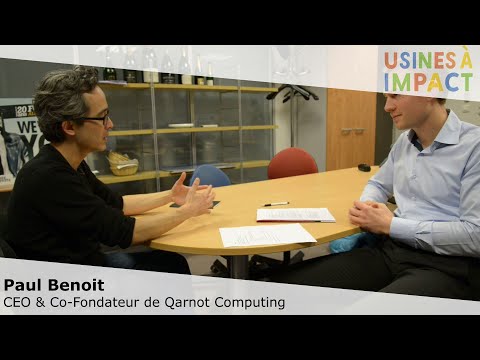
Paul Benoit, CEO of Qarnot Computing, addressing the need through rational thinking.
Sébastien Tricoire, CTO of Cezigue, testing manually before implementing.

Thibaud Artur de la Villarmois, founder of Angel, on experimentation as a way to reveal the need.