

Second part of a four-part series on how much politics decides the fate of a product. The first showed that no market-leading product escapes a public envelope.
The back room
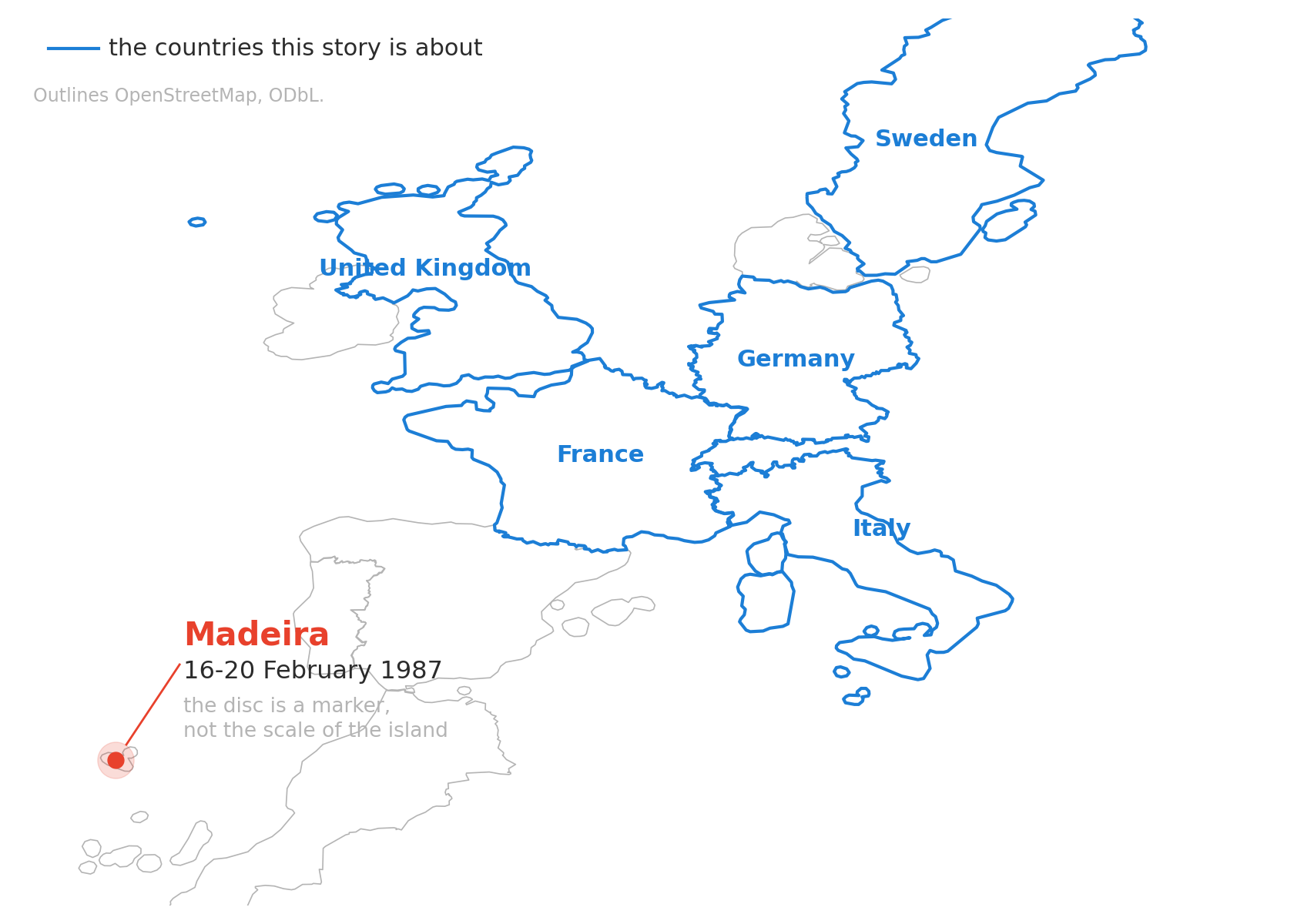
Monday 16 February 1987, Funchal, island of Madeira.
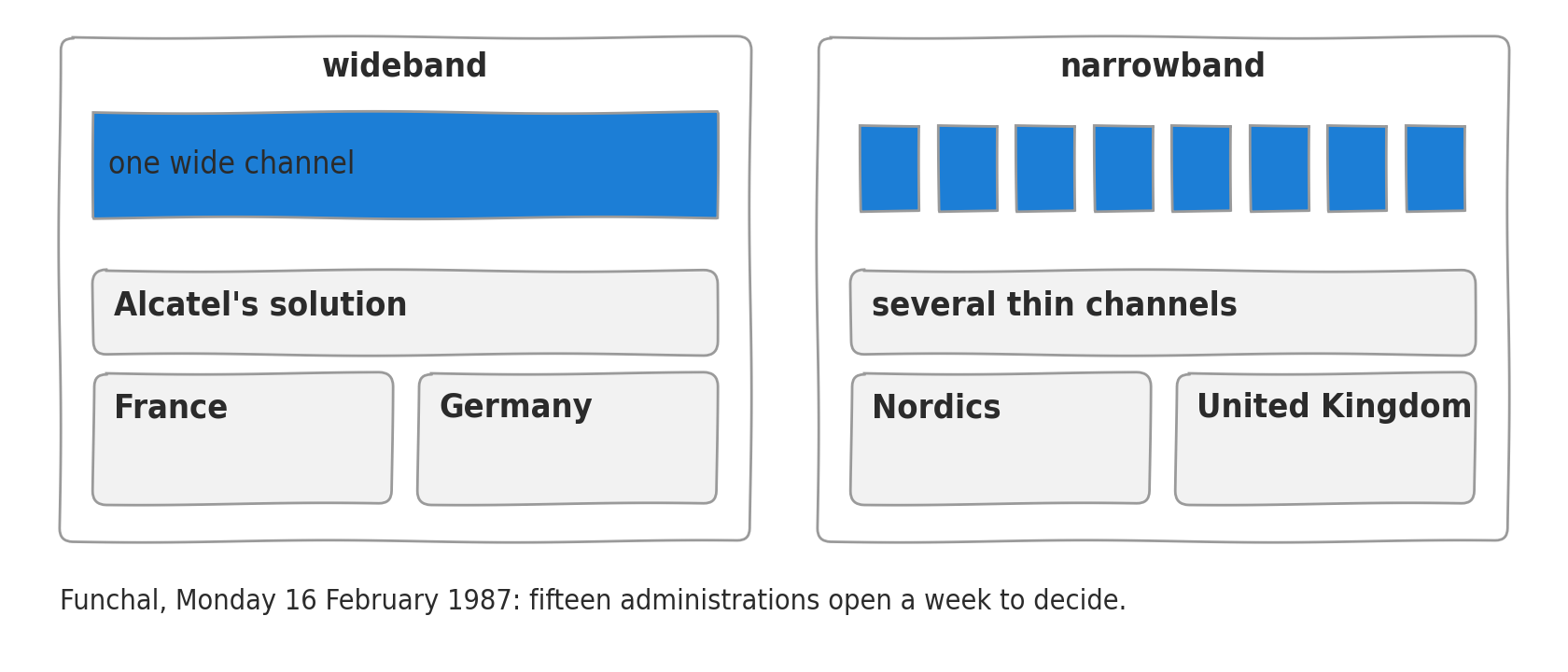
Fifteen European telecommunications administrations open a week of meetings to choose the radio technique for the future common mobile telephone. Two solutions are in contention: the first, wideband, is Alcatel’s, and France and Germany both back it. The second, narrowband, is carried by the Nordic countries and by the British.
Each country has sent a delegation, and each delegation holds two kinds of people. Engineers, split into small groups, who discuss the parameters one at a time; and a head of delegation, who sits in the plenary, the only meeting where every country sits together, where the specification is adopted and where each country has one vote. The ministers have not come, although they are the ones who decide their country’s solution. The group meeting here is called Groupe Spécial Mobile, and it will give its initials to the standard under discussion: GSM.
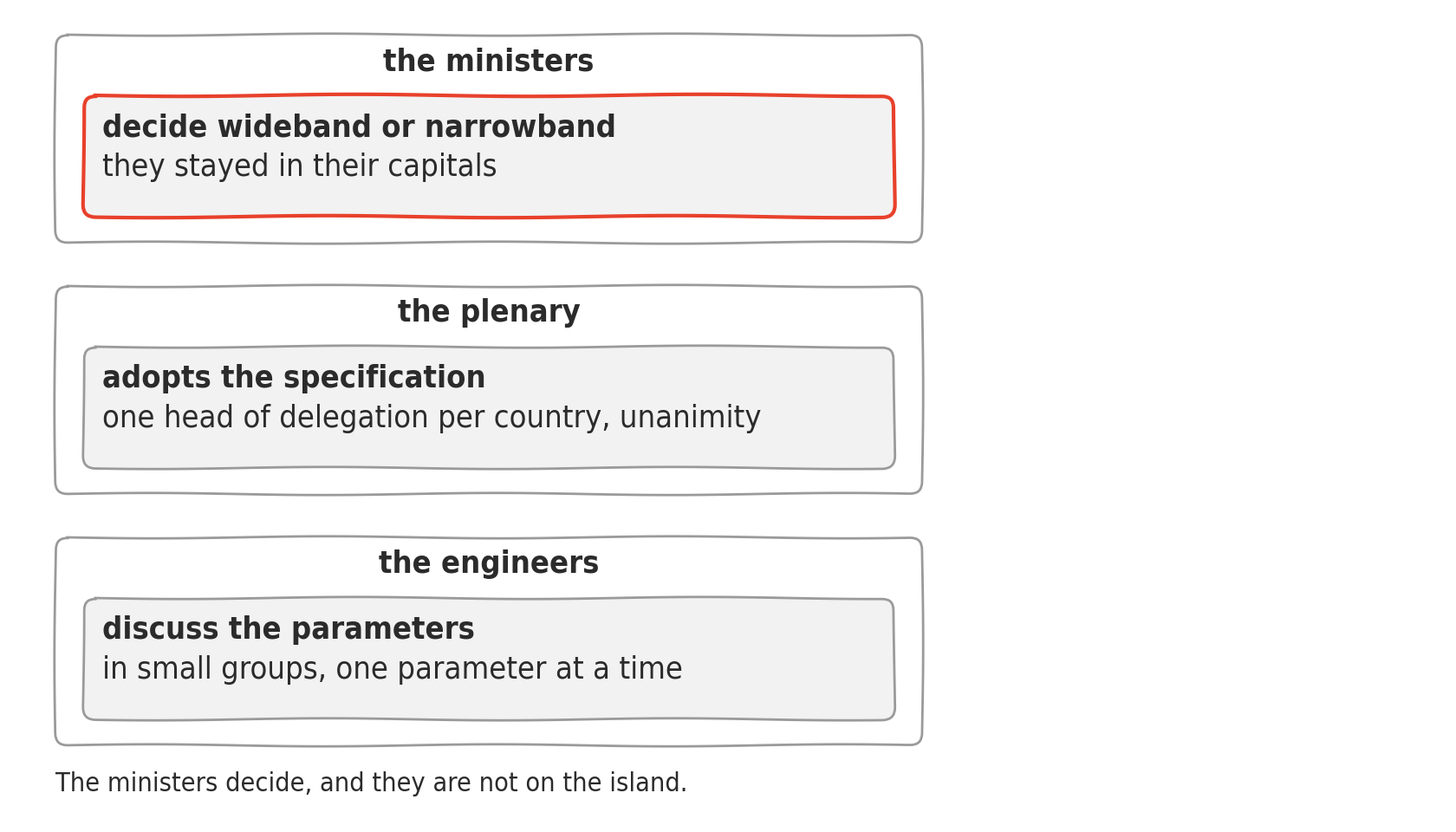
Before the opening session, Philippe Dupuis, the head of the French delegation, takes his partners aside. He has come to negotiate a compromise. In fact, on the previous Friday, Alcatel had learned what was being prepared in Madeira and had gone to the French government at the highest level. The instruction fitted on one line: France will defend Alcatel’s solution and no other, whatever the experts say. Since the plenary decides only by unanimity, his single vote is now enough to prevent any decision.
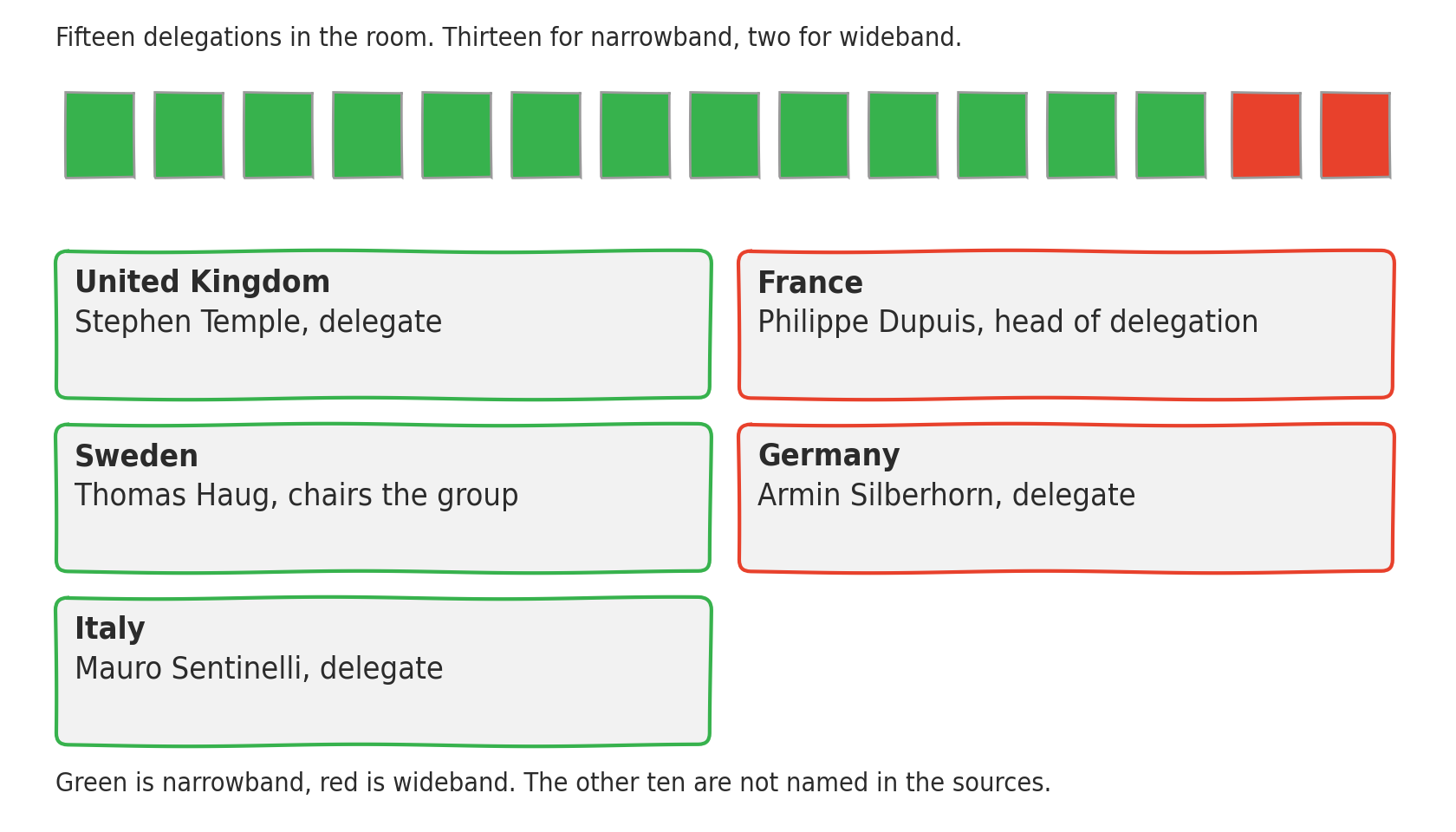
The plenary can therefore no longer settle the choice between the two solutions. Its chairman, the Swede Thomas Haug, runs through the minor items to fill the time. On Wednesday, a tour de table gives thirteen delegations for narrowband and two against. Politics is blocking.
On Friday, the last day, Stephen Temple, the British delegate who tells the story of this week in his book on the history of GSM, settles with Haug’s agreement into a room at the end of the corridor. What happens in that room has no agenda, no minutes and no witness. Since one vote is enough to block everything in the plenary, the delegations come one at a time to negotiate here what they will not get in there, and what is settled here goes back to the plenary to be adopted. Temple compares the place to a doctor’s surgery.
The Madeira package, or how a standard is negotiated like a treaty
Back to Wednesday, the evening of the tour de table. The partners meet in the hotel lobby at eight. Armin Silberhorn, the German delegate, and Philippe Dupuis arrive last, grim-faced: their governments have just hardened the instructions, wideband or nothing. Haug throws up his hands. There will be no agreement, then, he says.
Temple pushes the narrowband solution, which his experts judge better for handheld sets and for the battery life that British manufacturers hope to sell to the general public. The German expert wants more telephone channels per radio frequency than the British, who are asking for eight, because a smaller capacitor is enough to feed the burst of transmission once the channels thin out on a single frequency.
The Swiss want a system that works in valleys where the radio echo comes back late, and the Swedes defend a variant they alone support, hoping to trade it against the one their Norwegian ally is proposing. Everyone reasons correctly, defends a national industry, protects the investment their laboratories have already made, and behaves exactly as theory predicts. The whole thing seizes up.
The choice between the two solutions is out of their hands, because it rests on an approach that can only lead to deadlock with so many players. Temple finds a lever: the specification of the standard, that is, the document listing the requirements the solution has to meet.
He invents two things that week that will weigh more than the vote: two rules so that everyone leaves with something rather than with a complete disagreement. What is being decided that week is the system on which European mobile telephony, and then the devices that came out of it, would rest. Nobody in the room knows it yet.
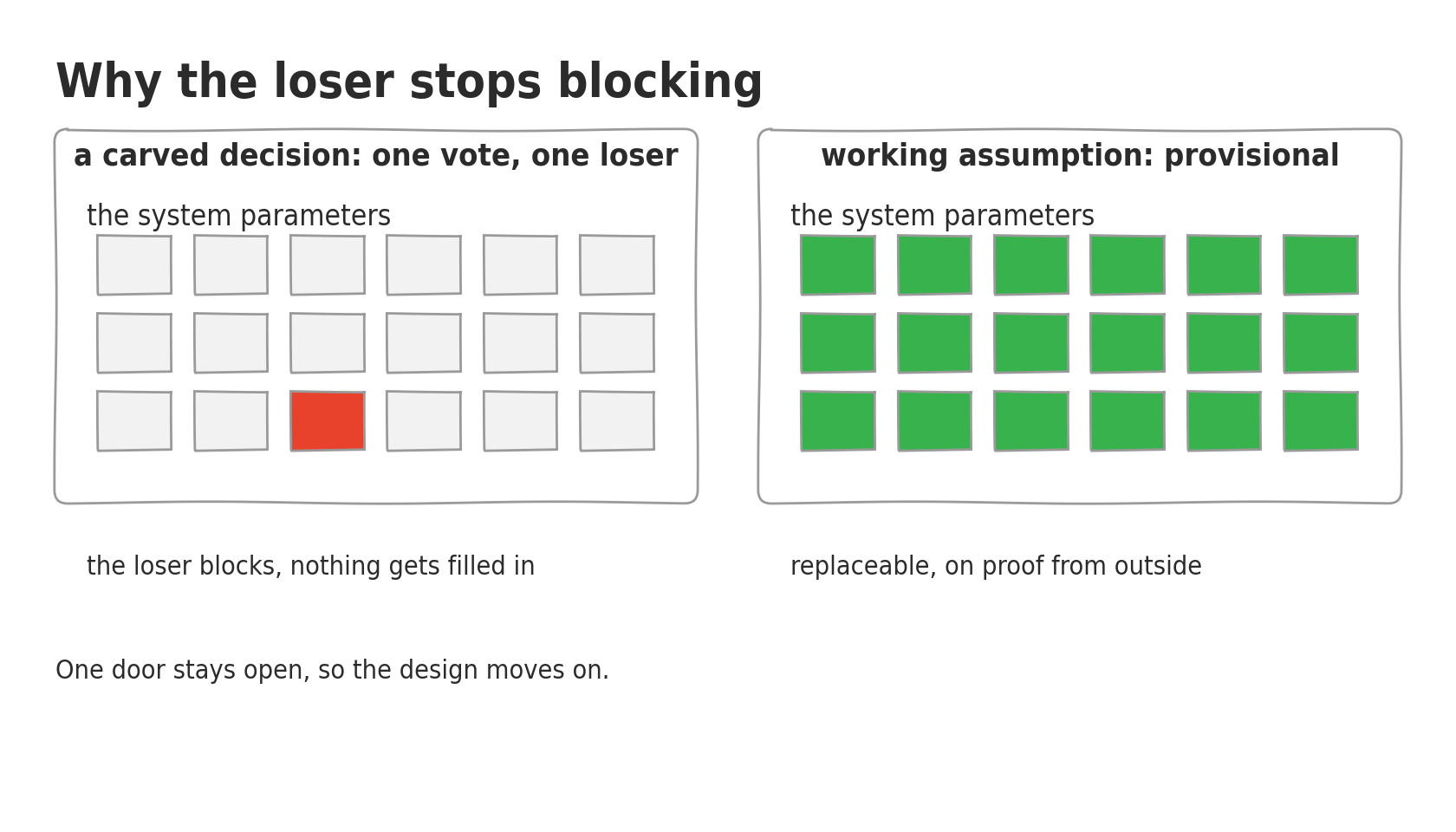
The first rule is the working assumption. It governs the passage from the small groups to the plenary. Until then, each value was voted on as a final choice that steered the solution directly, and a delegate whose value lost had every reason to block, since he lost for good. The working assumption takes that reason away. The group stops asking which solution to pick and works parameter by parameter: for each one it adopts the best value known that day and records it as provisional. Anyone who wants to replace it later may do so, on three conditions: bring proof, have established it outside the plenary, and show that their value does better, not merely as well. Temple compares the result to slow-setting cement: the shape has taken, it can still be corrected, but the effort needed to do so grows by the day.
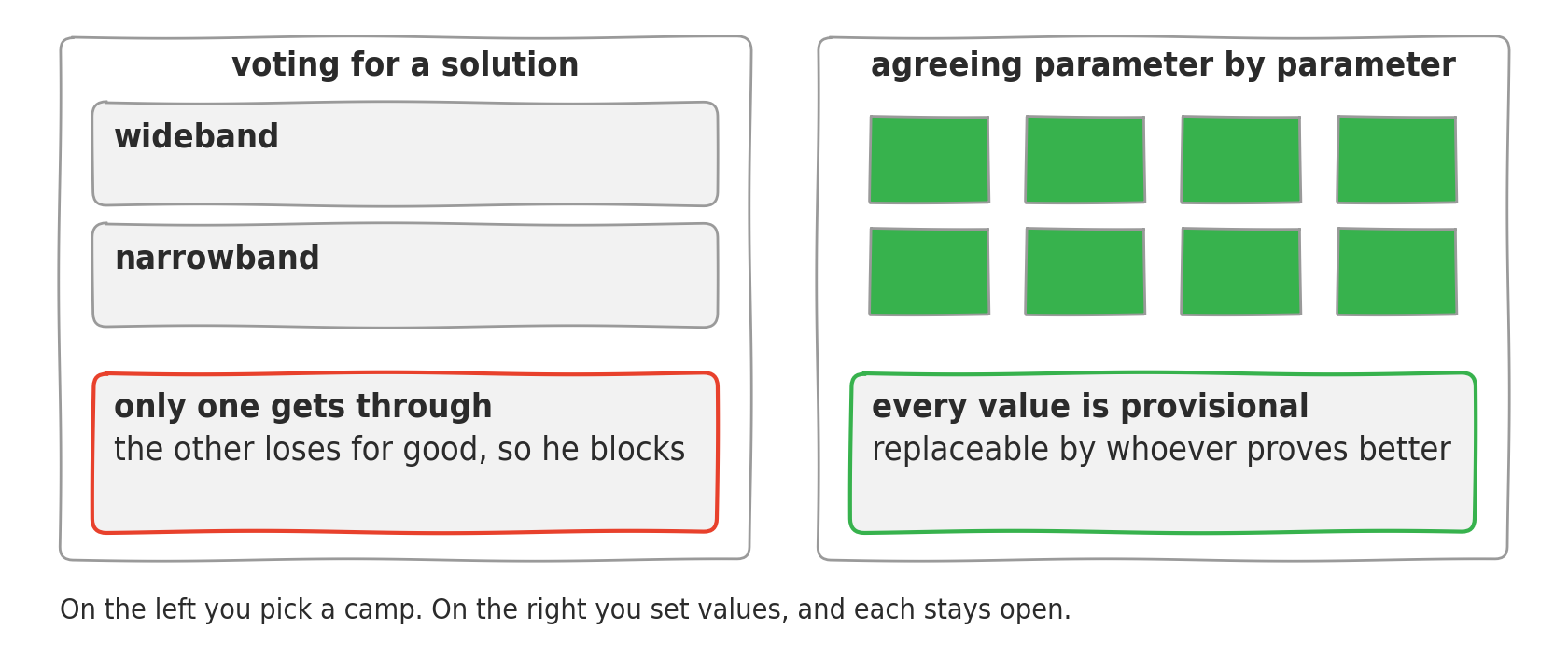
Take an example. Each radio frequency has to be shared between several conversations, and the number has to be fixed. The German expert wants more, the British eight, because a pocket telephone gains battery life that way. The group records eight. The German has not lost for ever: if he comes back with measurements made in his laboratory showing that another number does better, the value changes. Every parameter of the standard is handled this way, in parallel, and no delegation has the best answer on all of them: each loses here and keeps a chance there, which is what makes the rule acceptable.
The loser of the day accepts the decision, since he keeps a chance of coming back with his trials, and the design moves on without waiting for him to be convinced. A mistake can be corrected later without reopening the whole agreement. Alain Maloberti, who has chaired the group in charge of defining the radio system since 1985, would say years later that without this rule the GSM specification could not have been written.
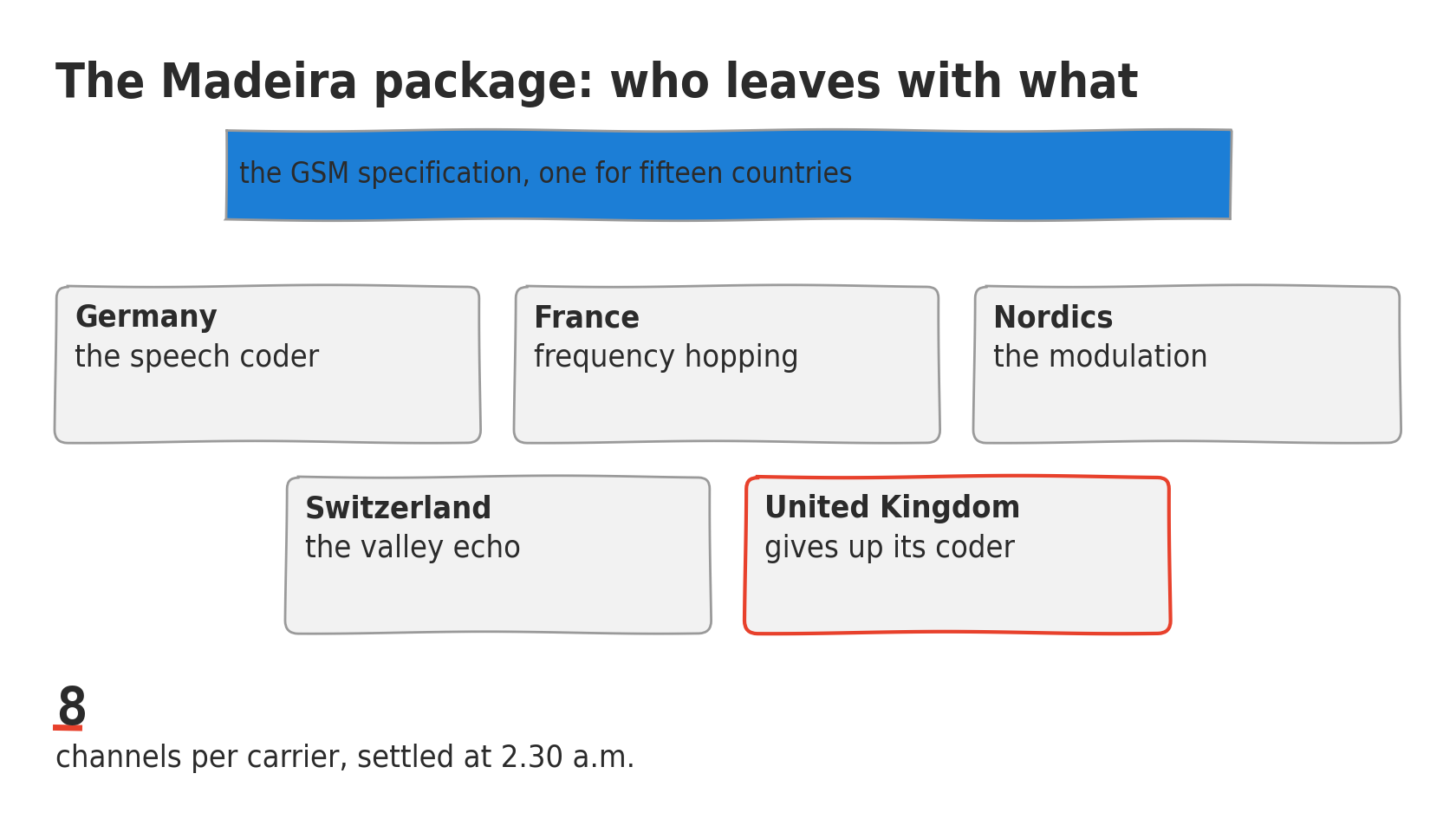
The second rule is package bargaining. Temple proposes it just before the morning break and calls it the package, explaining to the room that everyone must leave with something. The Germans take the speech coder, the software that compresses the voice before sending it, the one from the equipment maker PKI. The French take frequency hopping, which Dupuis cares about personally, the Nordics take the modulation method that had come out ahead in the Paris trials, and the Swiss get the parameter that handles the echo in their valleys.
The United Kingdom gives up the speech coder from British Telecom’s research laboratories. Temple recounts that Robin Potter, the engineer from those laboratories who sits in the expert group, withdraws his own proposal so that the package holds. Back in London, British Telecom reproaches him for having abandoned an in-house technique in favour of the Germans’. He explains Temple’s approach, and the fact that without these compromises everyone would have lost. The compromise is the price of the package. Whoever proposes it has to lose something visible, otherwise nobody else agrees to lose anything.
That left the number of channels.
The experts shut themselves in that evening and grant nobody anything. Temple goes down to see them around eleven at night. Three hours of argument, nothing gained. He tries a negotiator’s move: on a parameter with three options, the Swedes, alone on the third, have hinted they would drop it if their Norwegian allies’ option went through; so why not narrow the choice to two. The experts all turn on him and accuse him of bringing politics into a technical discussion. He would recount that in half an hour he had achieved unanimity on exactly one point: the problem was him. He goes back at it anyway, question by question, until he isolates the German expert on the only point that still interests him at that hour. He gets eight.
The experts’ meeting ends at half past two in the morning, and the famished delegates go down to the kitchens to find nothing but tins of sardines.
The whole world got eight channels per carrier frequency, and every GSM telephone ever built carries that number, settled in a discussion between two men, one of whom had just cornered the other in a hotel room in the middle of the night.
The historian Léonard Laborie establishes the rest: the reversal came from industry itself. The chairman of Alcatel-Thomson-Radiotéléphone realises that the process set in motion by the majority has become irreversible, reports this to the group’s leadership, and the leadership agrees to drop its demands. The plenary had no power to settle anything; it made the majority irreversible, and it was that fact which made the instruction give way. On 19 May 1987, the ministers of France, Germany, Italy and the United Kingdom sign the text in Bonn.
What could no entrepreneur have done alone? He does not get into the room: the seats belong to administrations. Nor does he invent the rule that organises the room. Alcatel got that week the best thing an industrialist can get, namely the instruction of a head of government, carried into the room by two national delegations and defended to the end. Temple got a method of arbitration. The method won.
The club
Back up fifteen months. An agreement existed before Funchal that no European text records: France, Germany and Italy had signed among themselves a cooperation on digital cellular, outside the European Community and outside CEPT, the conference that brings together Europe’s telecommunications administrations. This agreement of the three let them arrive at meetings with positions already settled. Temple writes that it was becoming harder and harder to fight, meeting after meeting, against views pre-coordinated by three administrations that talked to each other before talking to him.
Mauro Sentinelli, the Italian delegate, wants the British brought in and drops the idea to Temple over dinner one evening in London, taking him aside between two tables. Temple is willing to join, but only once the group has adopted the five evaluation criteria he has been defending for months, the grid on which the competing solutions will have to be compared, and he says so to Sentinelli without dressing it up. Christian Schwarz-Schilling, the German posts minister, likes the idea of a system running from Milan to London, while the director general of French telecommunications wants first to extract more from British Telecom.
The United Kingdom will end up joining this club, and without Temple having decided it. It gets in over three moments, between the autumn of 1985 and the summer of 1986, and none of the three looks like what one imagines of an international negotiation: an office accident, a legal opinion set aside, and a corridor bargain that will not be honoured.
The first moment is the office accident. A minister on a visit speaks from a brief his officials prepare, which sets what he may say. In the autumn of 1985, a reshuffle puts Leon Brittan at the head of the Department of Trade and Industry, and the new minister leaves at once on a courtesy visit to Bonn. Some months earlier an Italian minister had come to London, and it was Temple who had drafted the brief for his British host. He had written in it that the United Kingdom would not join the agreement of the three until the GSM group had adopted his five criteria. For Bonn, Brittan’s office asks for a brief by the next day, marked urgent. Temple and his colleague Greg Faulkner, the diplomat who follows the file with him, are both abroad and unreachable, in an age without mobile phones. Two junior officials who do not know the file dig out the Italian brief, replace Italy with Germany, and send it to the embassy.
In Bonn, the diplomats find an agenda with nothing positive in it: on market opening, London and Bonn are poles apart. The only subject that might please the German minister is digital cellular, and even there the brief bristles with reservations. Nobody answers in London. In the well-understood interest of Anglo-German relations, the embassy removes the reservations and adds a little enthusiasm. Brittan reads his brief, walks into Schwarz-Schilling’s office and declares that the United Kingdom would be delighted to join the agreement, the very one Temple had been refusing to join for a year. The Germans, whose delegate had been describing a reluctant United Kingdom for months, are caught off guard. Back at his desk, Temple reads the report telegram with disbelief.
The second moment is a legal opinion set aside. In the months after Bonn, the United Kingdom joins the agreement of the three not through a new text but through an annexe, which the four ministers have to sign. As a matter of routine, the annexe goes to the department’s lawyers. The answer comes a few days later and does not target the annexe: it targets the original agreement. Three administrations in a monopoly position coordinating on a technique is the kind of arrangement Europe’s competition authorities watch for, and signing the annexe would amount to subscribing to it. The lawyer who handled the file recommends not signing. Temple calls her. His argument: a newcomer cannot demand that the club change its rules before admitting him. Can she at least put a figure on the risk of legal action? She declines to give a figure and declines to cover any risk-taking at all. Following her advice would mean staying outside. A note goes up to the minister responsible, sets out the case for and against, and recommends overriding it and signing. The annexe comes back with the British signature.
The third moment is a coffee break. In July 1986, Temple and Faulkner sit at Odense, in Denmark, at the meeting that oversees CEPT’s telecommunications work. Two matters bring them there. The first is a new agreement on terminal approval, the procedure by which one specimen of a device is tested so that the whole series is authorised across Europe, instead of one test per country. Temple spent a year writing that text and stands for the chairmanship of the committee that will apply it; France puts up a rival candidate, but the room leans towards him. The second is the French signature on the cellular annexe, which still has not arrived. During a break, Faulkner offers him a trade: withdraw your candidacy in favour of the Frenchman, in exchange for France’s signature.
Temple lets his coffee go cold. Then he withdraws his candidacy in favour of the French candidate, under the disbelieving eyes of the other delegations, and settles for the vice-chairmanship, which is to say, he writes, all the work and none of the power. Before leaving Odense, the head of the French delegation assures the British that the agreement has gone up to the director general and has been signed.
A month later, no signed copy has arrived in London. Temple calls Dupuis, who admits, embarrassed: the director general of French telecommunications, on whom his delegation depends, has refused to sign, because he wants to extract one more concession from British Telecom. The word given at Odense bound only the man who gave it. The chairmanship is surrendered, the card is played, and only the bluff is left. The head of the French delegation had said the agreement was signed; Temple and Faulkner take him at his word. Faulkner sends the three capitals a warm telegram rejoicing that everyone has signed, and then they turn up at the next meeting, in Rome, as full members.
Five weeks after Madeira
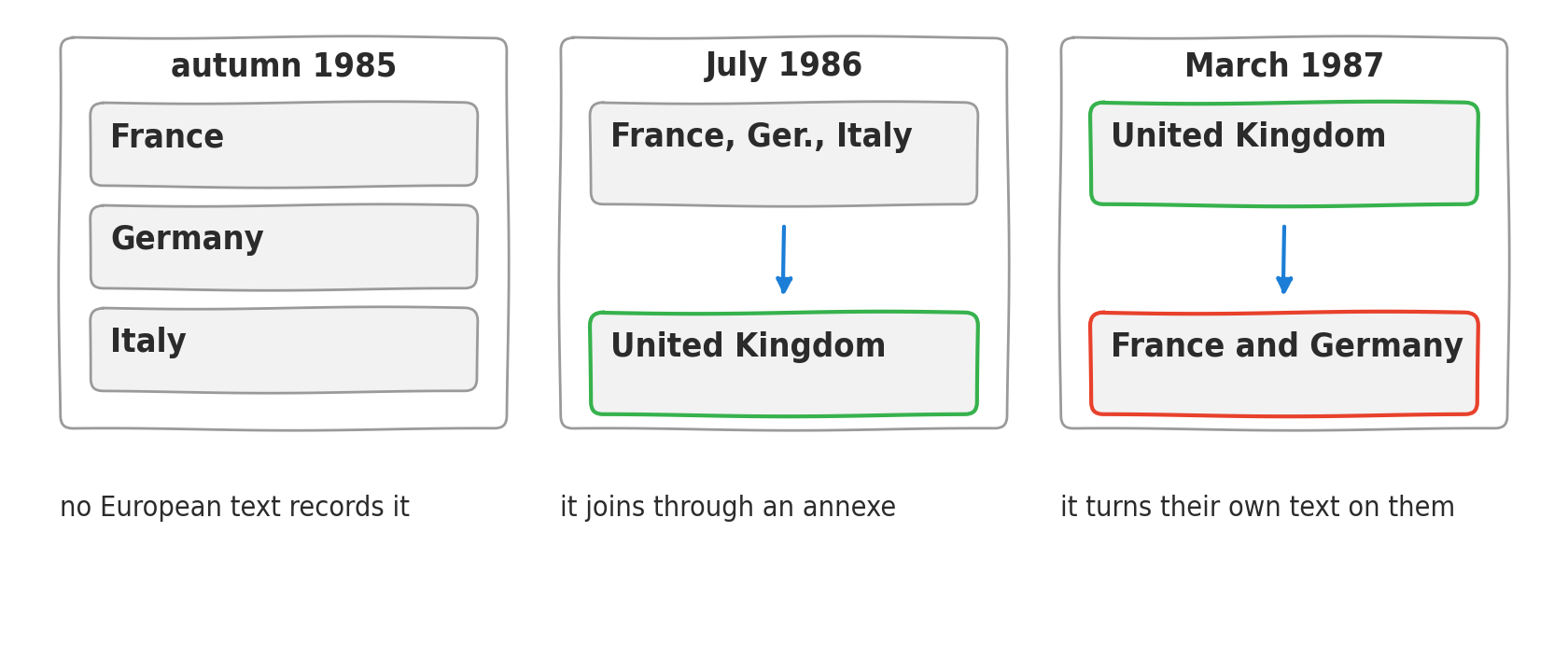
Since Funchal, Paris and Bonn have been negotiating as a pair, and Dupuis takes no part in it: his own hierarchy has removed him from the file. On 25 March 1987, a Franco-German meeting was supposed to fix a common line. Over lunch, the French propose new comparative trials between the two solutions, which nobody had the means to fund, and a German procurement official replies that he has budget left. The two delegations leave with trials to pay for and without the hard line Bonn had imposed in February. The United Kingdom, Temple writes, is reduced to the role of spectator. Shut out of the tête-à-tête, Temple looks for something that could bring the other two back to the table, and he goes to reread the agreement of the three, the one his country joined through the annexe. The obligation is written there in black and white: each administration undertook to work with the other three. Not with one of them.
On Monday 30 March, Temple (United Kingdom) writes it to Silberhorn (Germany) in a note in diplomatic style whose substance fits in one sentence: a Franco-German arrangement breaks the undertaking given between four. Silberhorn receives it without pleasure, concedes that Temple is right, and asks which of the two agreements prevails, the one between four or the one he has with the French. He does not wait for the answer. Silberhorn arranges the order of the calls so that his own minister hears the British argument before the French one. Geoffrey Pattie, the British minister, obliges on Friday 3 April at eight in the morning. On the other end of the line, Christian Schwarz-Schilling leaves the wideband camp and states his preference for narrowband. Then he makes a commitment: France and Germany stop negotiating as a pair, and everything will from now on be handled between the four countries.
The text they sign on 19 May fits on a sheet twenty-one centimetres by twenty-nine, and their four countries undertake in it to support the GSM specification at home. Geoffrey Pattie signs for the United Kingdom, R. Panella for Italy, Marcel Roulet for France, Christian Schwarz-Schilling for Germany. Look for the law in that object and you will not find it.
That is how Alcatel lost the standard. The network that prevailed did not belong to the industrialist, richer though he was, better connected, able to reach a head of government on a Friday evening. It belonged to four civil servants who had tied their hands to one another, three of them in the autumn of 1985, the fourth by signing the annexe.
The man who wrote a decision the state signed
Back up twelve years, change country, keep the same house.
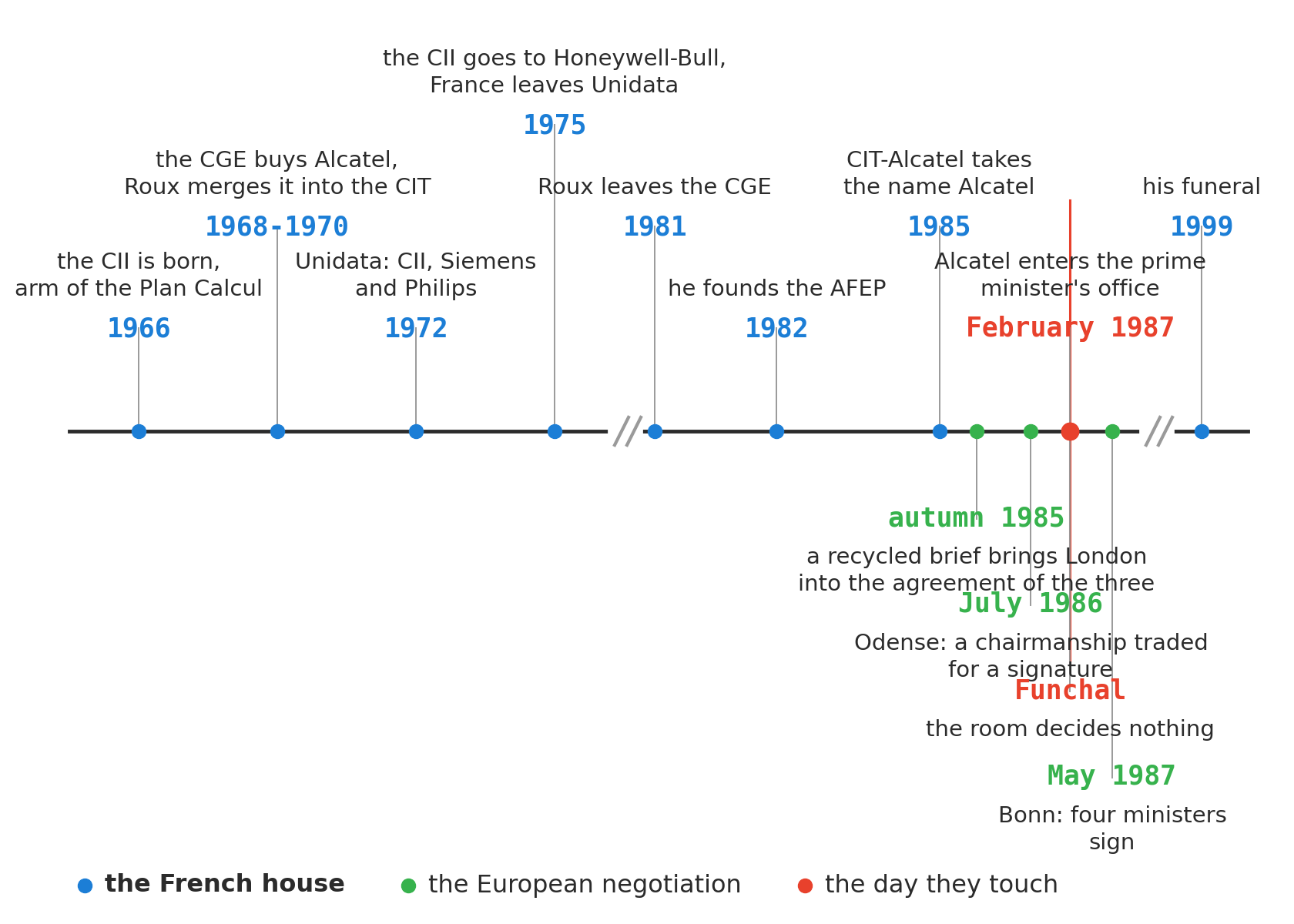
France is funding a national computing industry in the early 1970s. The Compagnie internationale pour l’informatique, the CII, born in 1966 from the pooling of the computing activities of Thomson, the Compagnie générale d’électricité and Schneider, serves as the instrument of the Plan Calcul, and Georges Pompidou and his government push a European alliance, Unidata, which joins it to Siemens and Philips. On paper, France has an Airbus of the computer.
Ambroise Roux runs the Compagnie générale d’électricité, a shareholder in the CII, and he does not want this alliance. The journalist Tristan Gaston-Breton reports his reasoning in one sentence: the alliance starts in computing, it will end up reaching components, and even the telephone. Roux is fighting a rapprochement between his competitor Thomson, Philips and Siemens, in sectors where he operates himself and from which he expects most of his growth.
Jean-Pierre Brulé, who runs Honeywell-Bull, prefers a merger with the CII to the arrival of a European competitor, and Michel d’Ornano, the industry minister, leans towards the same merger, which promises the CII access to the American market.
Roux opens no public campaign. He holds a shareholder’s position, which he exercises from the inside and without a press release, and he also has direct access to those who decide. He had advised Pompidou on economic questions. He chaired the economic committee of the main employers’ federation.
Valéry Giscard d’Estaing enters the Élysée in May 1974. As finance minister in 1970 he had authorised the sale of Bull to Honeywell. His government abolishes the computing delegation on 2 October 1974, then negotiates in early 1975 directly with Honeywell-Bull, without inviting the chairman of the CII. On 20 May 1975, the CII merges with Honeywell-Bull, and France withdraws from Unidata. The consortium disappears in December. The German partners speak of betrayal.
Two things.
The French computing industry passes under an American umbrella, and the public bill explodes. Until 1974, the Plan Calcul cost around three hundred million francs a year, paid to the CII in subsidies and study contracts, with the state also undertaking to steer the orders of government departments and state-owned companies towards it. From 1975, the reorganisation around Bull raises that budget line to two billion francs a year, most of it paid between 1975 and 1977. Leaving a European project cost more than staying in it.
Then Ambroise Roux leaves the CGE and founds the Association française des entreprises privées, whose founding members hold their first council on 12 October 1982. It refounds an association created in 1969 that the nationalisations had emptied, and it counts thirty-six affiliates at the time. Jacques Chirac, François Pinault, Michel Pébereau and Jean-Louis Beffa are all at his funeral, in April 1999. The press called him the godfather of French capitalism. A man had just turned his personal influence into a permanent institution, and the institution outlived him.
Alcatel comes from that house. In 1968, the CGE takes control of a small Alsatian telecommunications equipment company called Alcatel. Two years later Roux, by then chairman of the CGE, merges it with the CIT, the group’s telephone arm, to refocus it on the telephone. The whole becomes CIT-Alcatel. In 1985 it absorbs Thomson’s telecommunications and takes the name Alcatel. It is this house that walks into the prime minister’s office in February 1987.
Three questions for your next product review
The previous part proposed one question to add to the agenda, right after the customer question: which public decision opens or closes my market, on what horizon, and who holds the pen? Here are three more, which come before it, and which fit on half a page of a notebook.
Where is the rule of my market written? A technical committee, a trade association, an administrative working group, a qualification scheme. Name the room. Write its name down. If it does not exist yet, your market is young, and you have just learned something useful.
Who sits there for my industry, and since when? Duration counts for more than size. Four civil servants bound to each other for sixteen months beat an industrialist who knew how to walk into the prime minister’s office on a Friday evening.
By what date will it be too late? A specification that will appear in the Official Journal in four years is closing today, in a meeting room where the coffee is lukewarm and where somebody is settling a parameter you will discover too late. The day you read it, all that will be left is to comply with it.
Gather the answers in a four-column grid: the forum, who sits there for your industry, the closing date, and the name of the person who follows the file at your company. One line per rule, and one read-through at the product review twice a year. If the fourth column stays empty, you already know the result.
This grid does not call for a lobbyist. It calls for someone whose job is to reread it twice a year, in front of the product review.
What remains is how one gets into that room at all. Nobody goes alone: it takes suppliers who attest to a capability, customers who attest to a need, institutions that lend their letterhead. That is the subject of the next part.
What this article rests on
The back room and the Madeira package
- Léonard Laborie, « Concurrence et changement technique. De la norme au marché, la trajectoire unique de la téléphonie mobile en Europe depuis les années 1980 », Histoire, économie & société, 2008/1, pp. 91-101
- Svenolof Karlsson and Anders Lugn, history of Ericsson written with the Centre for Business History, on the Funchal meeting
- Stephen Temple, Inside the Mobile Revolution, chapter 13, a week in Madeira can be a long time
- Thomas Haug, The Road to GSM, twenty years of GSM workshop, March 2007
- Stephen Temple, personal page, origin and status of the GSM account
The club
- Science Museum Group, official UK copy of the Bonn declaration, 1987
- Stephen Temple, Inside the Mobile Revolution, chapter 6, the quadripartite agreement
The man who wrote a decision the state signed
- Encyclopedia of European digital history, Unidata or the European IT misunderstanding
- Tristan Gaston-Breton, Le Plan Calcul, l’échec d’une ambition
- Le Plan Calcul, France’s attempt at digital sovereignty, chronology 1974-1975
- Plan Calcul entry, budget allocation before and after 1975
- French Senate, report no. 331 (1997-1998), cost of the Plan Calcul conventions
- History & Business, Ambroise Roux, the godfather of French capitalism
- Biographical entry, Ambroise Roux, head of the CGE from 1970 to 1981
- AFEP, history page of the association, founded in 1982
- The Conversation, 28 rue d’Astorg, the other address of French employers’ influence