
Second episode of a seven-episode series on the weight of politics in the success of a product. The first showed the trace of a public decision behind six products. Whether that trace explains anything is another matter.
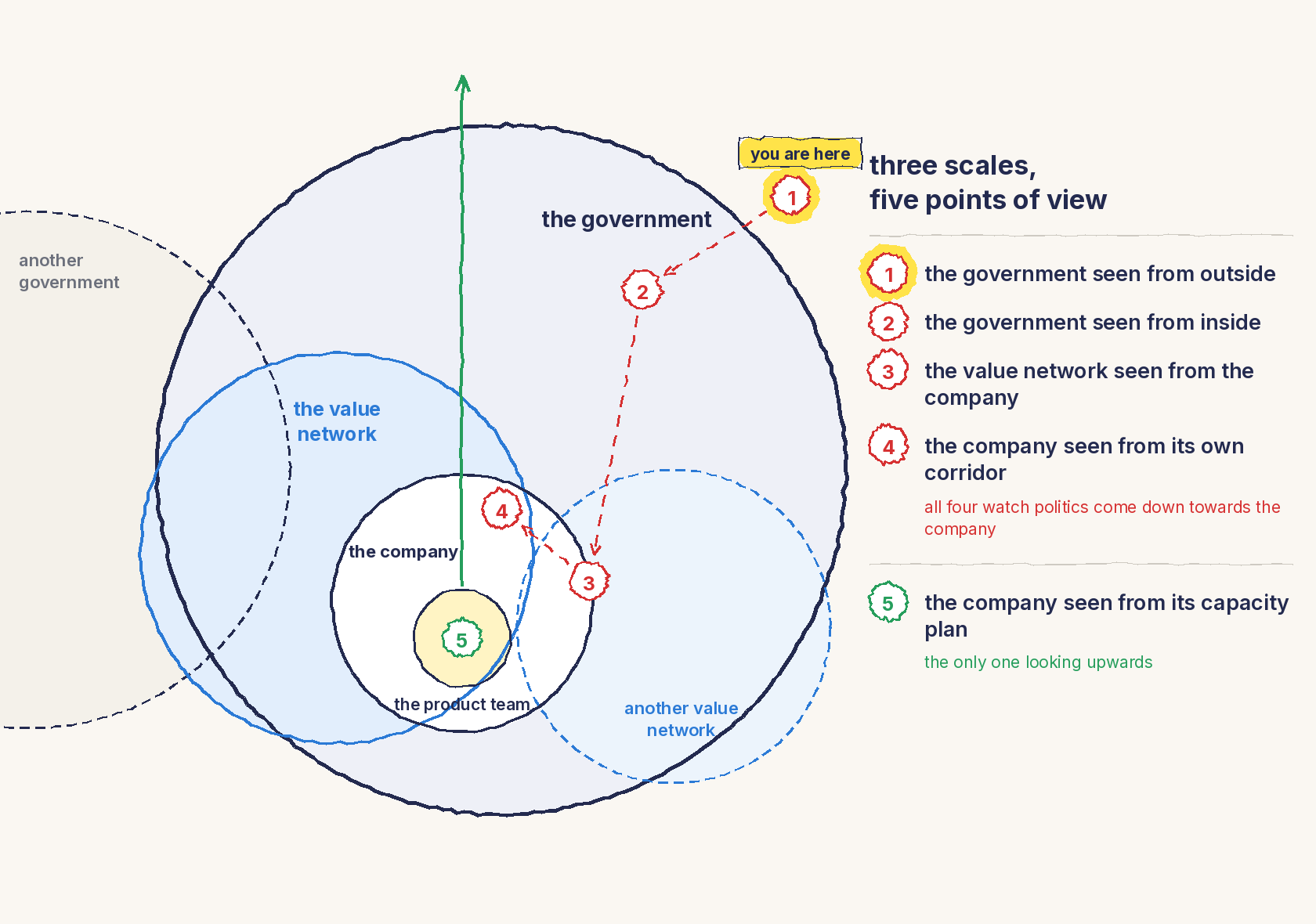
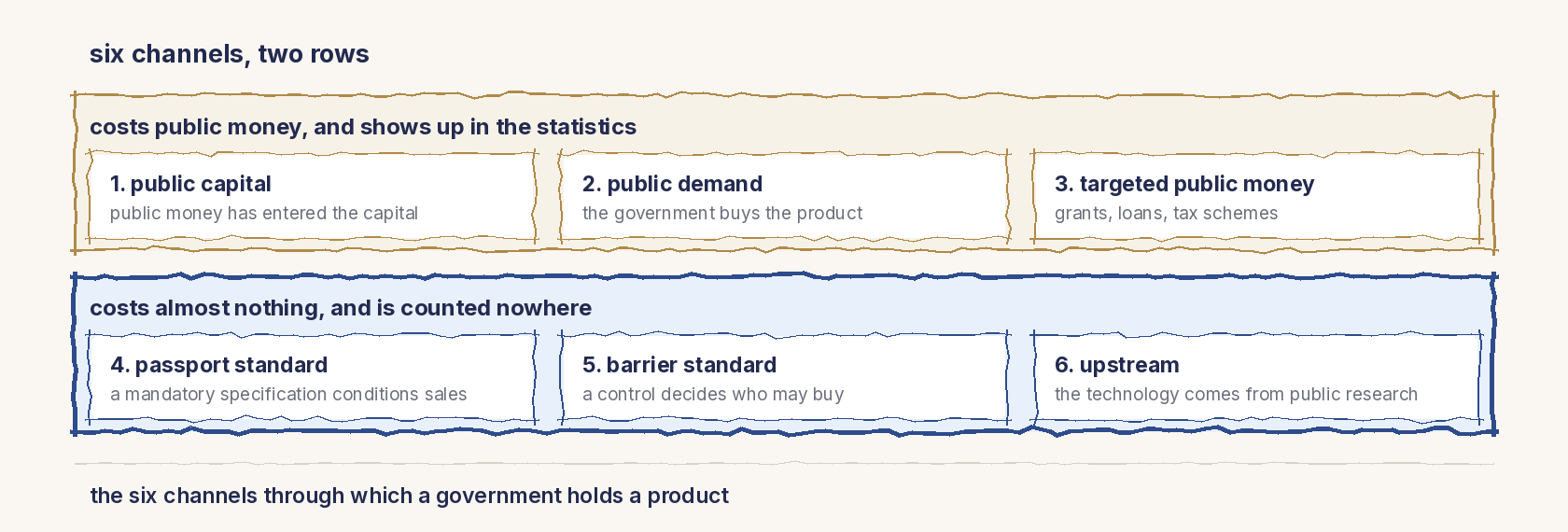
The previous episode followed six cases, from the cable sent to Atlanta in June 1943 to the length of cars set by an Indian budget speech, and drew a map from them: six channels through which a public decision reaches a product, in two rows, the one that costs public money and the one that does not. That map is the starting point here. Here it is.
Fine, but liberal economies don’t do this, do they?
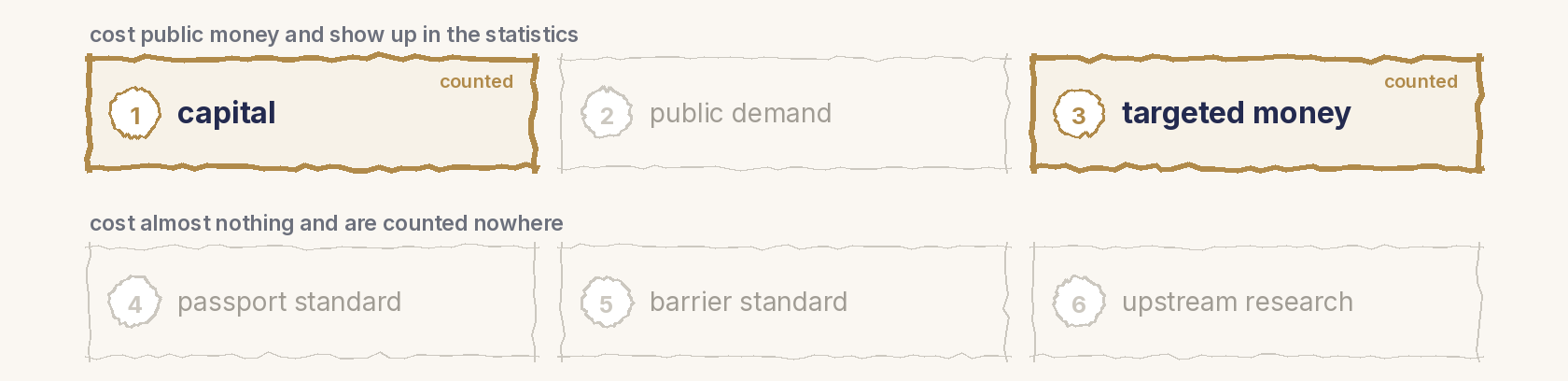
The map of the ground has two rows. The top row costs public money, and it is the only one anyone knows how to count. The Center for Strategic and International Studies (CSIS), a Washington research center, did so for eight economies in a study funded by the US State Department: in 2019, China devoted at least 1.73 percent of its gross domestic product to industrial policy, and France, South Korea, Japan, Germany, Taiwan, the United States and Brazil between 0.33 and 0.67 percent.
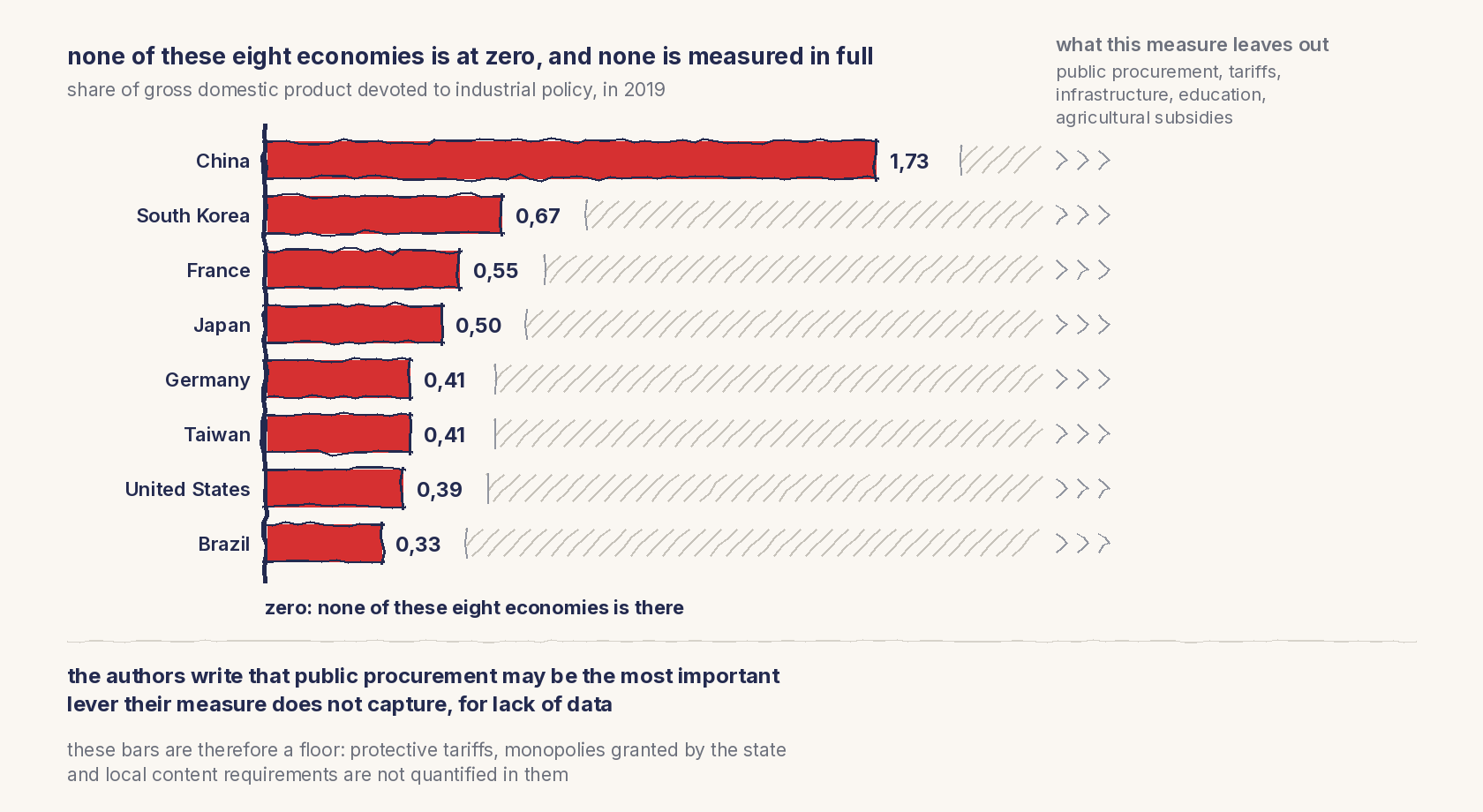
These figures do not say whether industrial policy weighs heavily. They say that none of these economies is at zero, and that the channel changes from one country to the next: research and taxation for France, Korea and the United States, state funds for China, public banks for Brazil, Germany and Japan. A country without a plan runs its industrial policy through the tax credit and the public bank. Germany, which refuses to plan, runs it through KfW, its public development bank: what a plan would write into a document, it decides loan file by loan file.
They are also a floor. The authors leave out public procurement for lack of data, noting that it may be the most important tool they do not capture, and they do not attempt to quantify protective tariffs, state-granted monopolies or local content requirements. They also set aside infrastructure, education and agricultural subsidies. If industrial policy looks marginal in the accounts, it is because the accounts only see the checks.
The lever the CSIS cannot count, public procurement, is the second box on the map, public demand, and it launched an entire industry in the country that most loudly claims the market. In 1962, the Massachusetts Institute of Technology designed the Apollo guidance computer for NASA around integrated circuits, electronic components that combine several transistors on a single chip, still new and expensive at the time. Apollo bought 200,000 of them, at 20 to 30 dollars each, and remained their largest customer until 1965, when orders for the Air Force’s Minuteman missile moved ahead. Here, the government steps in as a buyer.
So the accurate formulation is not that every government plans champions. Some do so explicitly, others not at all. Ricardo Hausmann and Dani Rodrik put it differently: governments are doomed to choose, even when they believe they are funding public goods that benefit everyone. Réka Juhász, Nathan Lane and Dani Rodrik give the simplest example. An infrastructure budget can enlarge a port or extend the road network, and different producers benefit depending on the choice; if it is the port, it will be built near the copper mine, the steel plant or a future green hydrogen site. Workers’ skills are just as specific to each sector, and the government has to decide which vocational training it funds first. The neutral option does not exist.
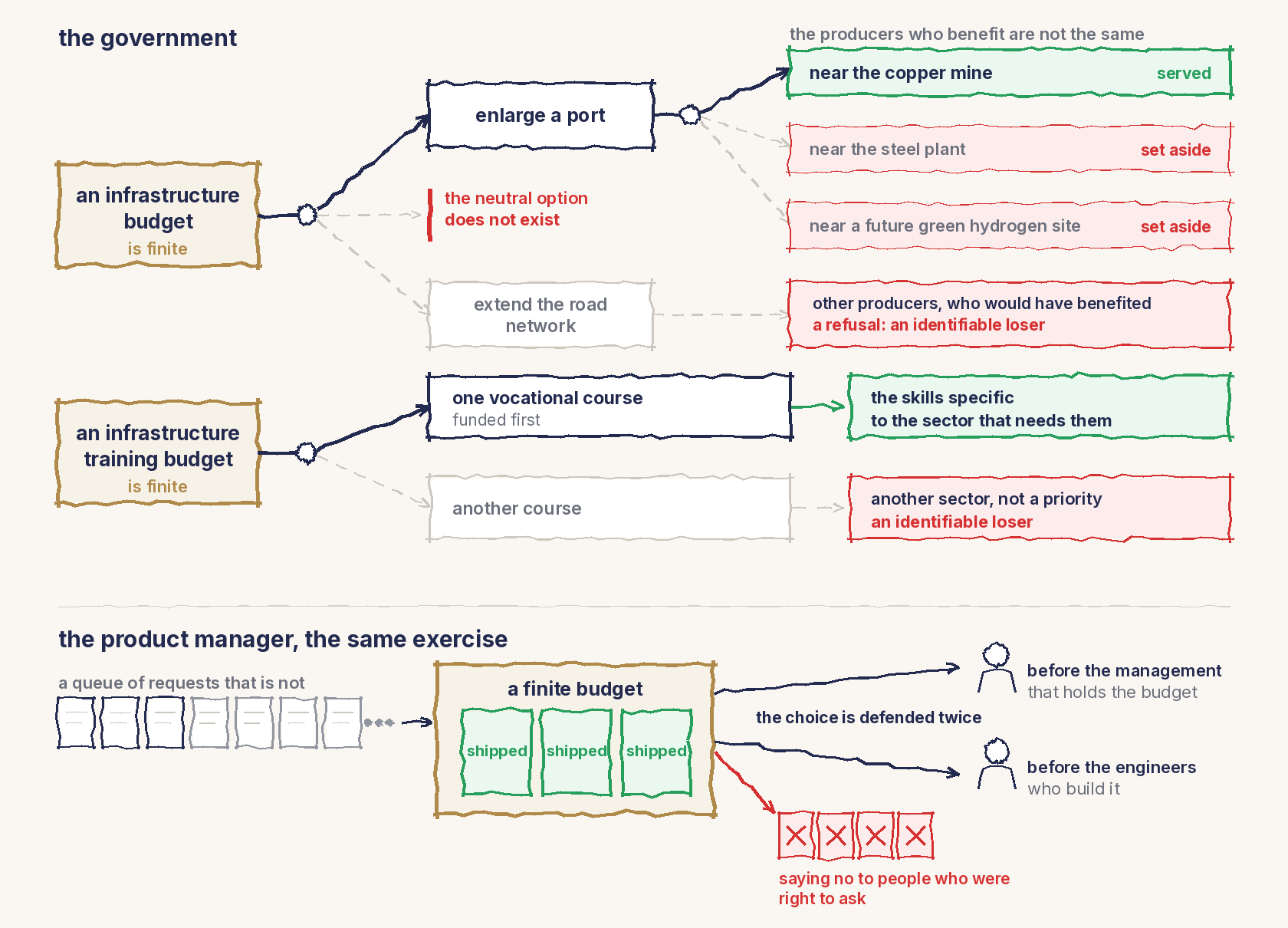
For the construction firm that builds it, the port is public demand. For the mine that uses it, it fits none of the six boxes on the map: the government buys nothing from the mine, it builds equipment shaped for its activity. These choices also escape the CSIS counter, which sets aside infrastructure and education.
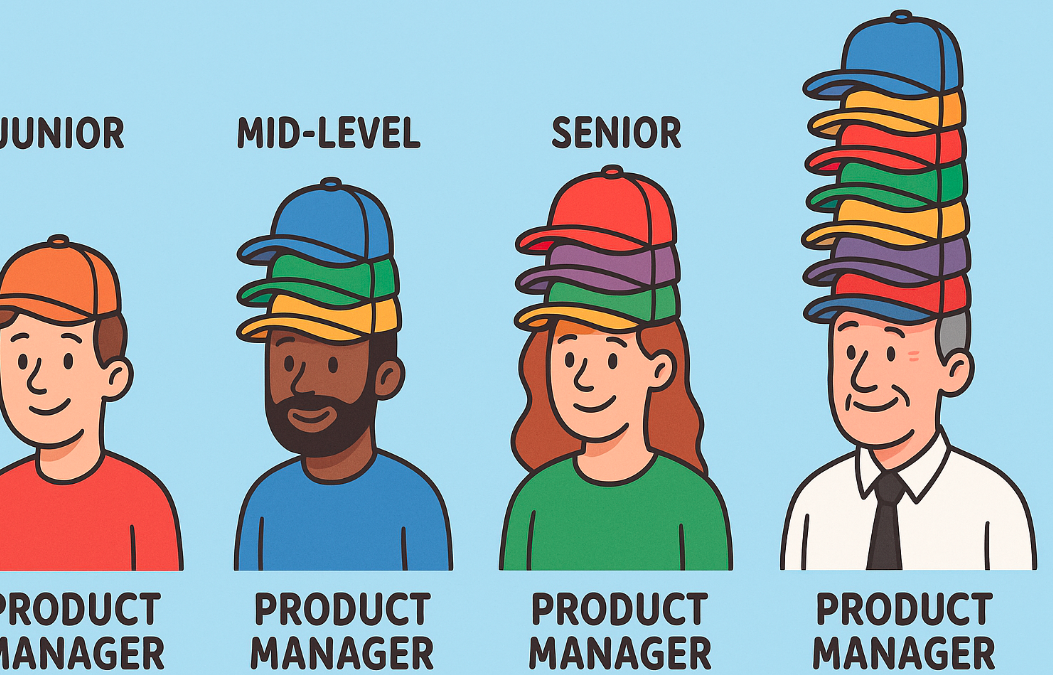
Any product manager will recognize the exercise. A finite budget, a queue of requests that is not, and the discovery that prioritizing mostly consists of saying no to people who were right to ask. A government arbitrates between a port and a road the way you arbitrate between two features, knowing that every refusal manufactures an identifiable loser. A government that swears it does no industrial policy then looks like a product manager who swears he has no roadmap: he ships something anyway, and that something was chosen. That choice has to be defended twice: before the management that holds the budget, and before the engineers who build it.
One question stays open. If every government mechanically advantages its own producers, and none can abstain, why does world trade not collapse into a general bidding war? Because governments negotiate with each other what they allow themselves against each other. Quotas capped by agreement, retaliation rights authorized rather than seized, disputes arbitrated in Geneva.
The moment to test the argument against itself
Here is the objection that should be forming, and I would rather carry it myself than leave it to you. That a company was helped does not prove the help explains its success. Perhaps it would have succeeded without. Perhaps the help even arrived because it was already succeeding.
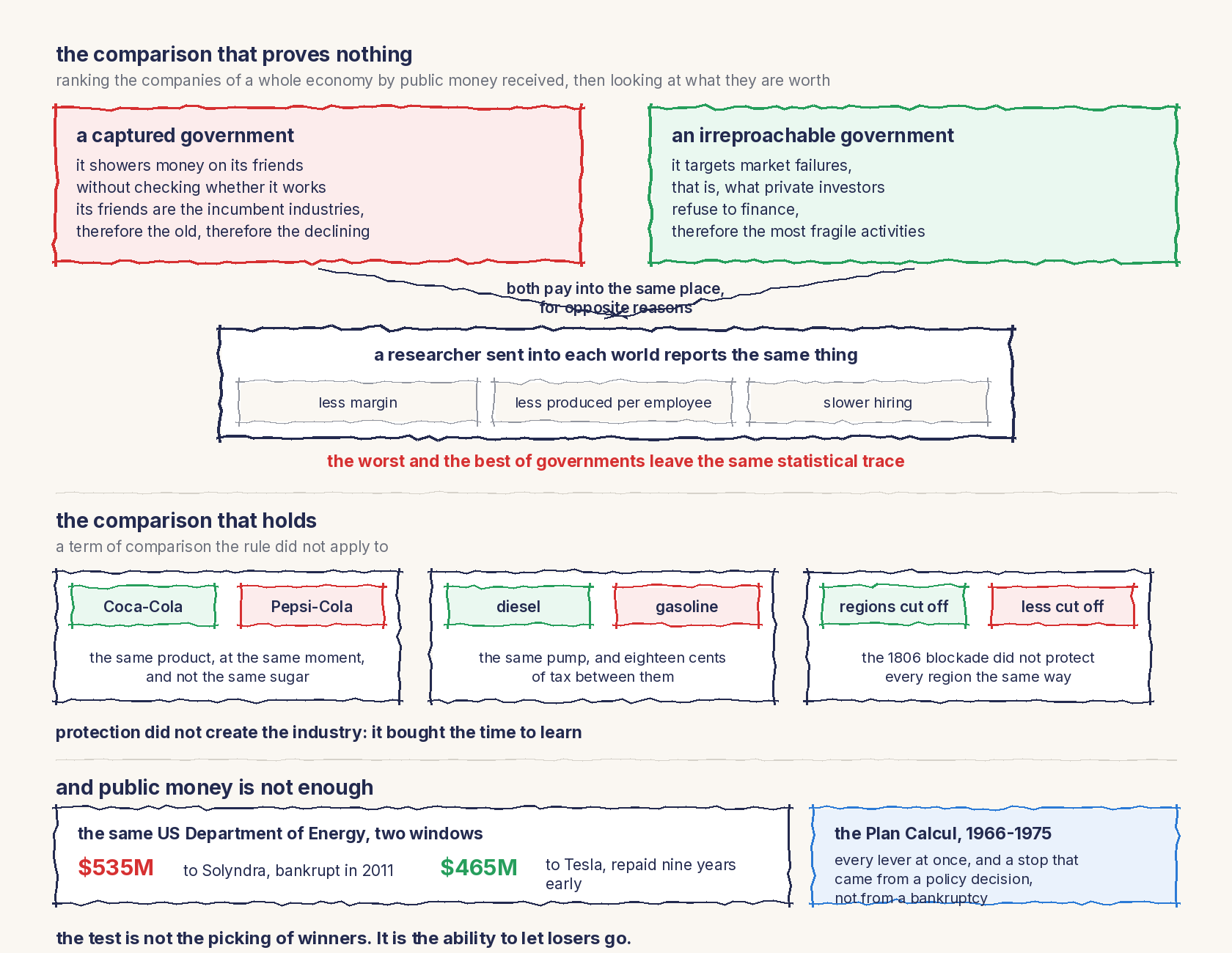
The objection reaches further than it looks. Réka Juhász, Nathan Lane and Dani Rodrik put it in 2024 in a literature review, that is, a stock-take of everything research has published on industrial policy. Their reasoning runs through two imaginary worlds, built to be as far apart as possible. In the first, a government captured by private interests showers money on its friends without checking whether it works, and its friends are the incumbent industries, therefore the old ones, therefore the declining ones. In the second, an irreproachable government targets market failures, meaning precisely the activities private investors refuse to fund, therefore the most fragile ones. The corrupt and the virtuous pay into the same place, for opposite reasons.
Send a researcher into each of those worlds. He ranks companies by the public support they received, sets against it what we know how to measure, margin, revenue per employee, headcount growth, and reports the same thing from both sides: the companies at the top of his ranking earn less margin, produce less per employee and hire more slowly than those at the bottom. The worst and the best of governments leave the same statistical trace.
That result does not say public money damages companies. Nor does it say governments only help lame ducks: Coca-Cola, Nokia and TSMC were not lame ducks. It says that one particular comparison proves nothing, the one that ranks the companies of a whole economy by money received and then looks at what they are worth. So nobody can conclude from the mere presence of support that the support worked. Not its supporters, not its opponents, not this article.
That is not the comparison made here. Coca-Cola is not read against all American companies, but against Pepsi, which sold the same product at the same moment and did not get the same sugar. Diesel is not read against the French economy, but against gasoline, taxed eighteen cents more at the same pump. The footprint shows in these cases because there is a term of comparison the rule did not apply to. Whether that term holds is the next question.
Napoleon closed the continent to British goods in 1806 and, without meaning to, delivered the most elegant of these experiments. At that date, the English textile industry was crushing a French competition that still spun cotton by hand. The blockade did not protect all French regions equally, since geography and smuggling cut some off from English products far more than others, and the best protected ones invested in mechanical looms, learned to use them and trained workers. The blockade lifted. They kept the lead for decades. Protection did not create the industry. It bought the time to learn.
Other cases have been studied with the same rigor, from the Korean heavy industry push of 1973, which nobody wanted to finance at the time, to British and Italian regional aid, with incomparable political regimes and different instruments. The effects point the same way. They last decades.
Now the opposite objection. Alberto Mingardi reproaches this kind of demonstration with mistaking a spillover for an intention. His example is the touchscreen. Wayne Westerman, a doctoral student at the University of Delaware, defended a thesis funded in part by a National Science Foundation grant, like two thousand others every year, then founded the company whose technology would end up in phones. Does that make the touchscreen a product of industrial policy?
Mingardi answers no. Public money came first. It did not aim. Writing what DARPA, the US defense department’s advanced research agency, was trying to obtain by funding that work would be committing exactly the fault he charges others with.
His criticism holds, and it does not move the argument of this article: the argument is not about the government’s intention, it is about the company’s dependence. That public money was aimed elsewhere does not make the company any less dependent on it. Words matter here, because they guide actions and consequences.
The point deserves to be driven the other way too: public money is not enough. The French Plan Calcul, launched in 1966 to create a national computing champion, pulled every lever at once, company mergers, a public research institute, state orders and a European alliance, and none of them sufficed. It stopped in 1975, when France pulled out of the European consortium Unidata and merged its national computer company with Honeywell-Bull. The stop came from an industrial policy decision, not from a bankruptcy, which is another way of saying that public inconstancy kills more reliably than the absence of money.
And the same American Department of Energy guaranteed 535 million dollars to Solyndra, which went bankrupt in 2011, and lent 465 million to Tesla in 2010, roughly the same sum, repaid nine years early. Two windows of the same department. Two opposite outcomes. Hence the formulation that beats every debate about whether governments can pick winners: the test is not the picking of winners. It is the ability to let losers go.
What happens when the government leaves
If a public presence counts, its withdrawal should count too. We were given two full-scale tests, and they do not reveal the same consequences. They are worth examining.
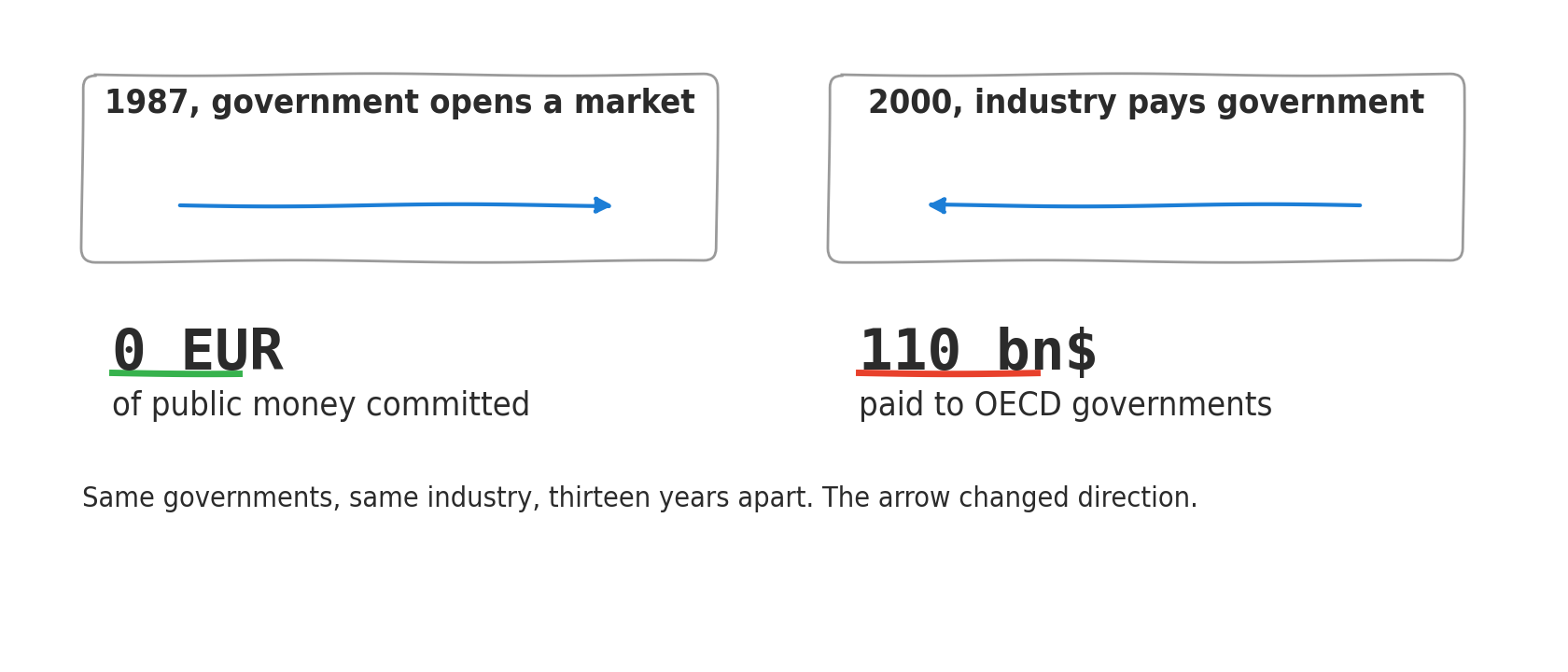
First test, the auctions of the year 2000. Thirteen years after creating the mobile market by reserving a frequency band, the same European governments turned back to the same industry, no longer to open a market for it, but to take money from it. On 18 August 2000, the German auction of third-generation licenses closed at a little over 99 billion marks, around 50 billion euros, and the finance minister publicly welcomed an unexpected windfall for paying down public debt. In the United Kingdom, licenses had gone four months earlier for 22.5 billion pounds. The table of awards published by the OECD allows a total to be struck: added together, the third-generation licenses sold in its member countries brought in on the order of 110 billion dollars, of which 51 for Germany alone and 35 for the United Kingdom. One German operator handed back a license it had paid 8.4 billion euros for, one French operator would write off 7.1 billion of debt tied to that acquisition, and rollout investment slipped by several years, at exactly the moment the next generation was being decided. That is a heavy weight to place on operators and on their capacity to invest.
Europe dominated the second generation of mobile telephony. It has never dominated a single one since. Same governments, same industry, opposite decision, opposite result.
Second test, and it points the other way. The Japanese ministry of industry judged for itself that most of its research projects of the 1980s and 1990s had not produced substantial results. Japanese companies had acquired their own technical capabilities, so the government’s role in their competitiveness had become marginal. Accordingly, in 2000, the ministry reorganized its projects around social needs rather than technologies chosen in advance, and paired its health program with a regulatory reform of the sector. The Japanese case shows that one form of support has an expiry date, and that the government changes window rather than leaving.
A government that withdraws therefore does not mechanically kill its companies. It removes an option from them and transfers the risk onto their balance sheet. Sometimes they absorb it. Sometimes they disappear.
What this article rests on
What eight economies spend
- DiPippo, Mazzocco, Kennedy, Goodman, Red Ink, CSIS, 23 May 2022
- Réka Juhász, Nathan Lane and Dani Rodrik, “The New Economics of Industrial Policy”, NBER Working Paper 31538, p. 5, on the port, vocational training and the phrase “doomed to choose” taken from Hausmann and Rodrik (2006)
- Computer History Museum, “1962: Aerospace systems are the first applications for ICs in computers”, for the 200,000 circuits of the Apollo guidance computer and Minuteman, the largest consumer by 1965
- Computer History Museum, “ICs Rocket to Success”, on the cost of early integrated circuits
The work the method rests on
- Juhász, Lane, Rodrik, The New Economics of Industrial Policy, Annual Review of Economics 16:213-242, 2024
- Alberto Mingardi, “A Critique of Mazzucato’s Entrepreneurial State”, Cato Journal 35(3), Fall 2015, pp. 603-625
- Réka Juhász, Nathan Lane and Dani Rodrik, “The New Economics of Industrial Policy”, NBER, working paper 31538, note 2, on Reagan, Pinochet and Thatcher
South Korea in 1973
Plan Calcul and Unidata
Solyndra and Tesla
Funchal and GSM
- Léonard Laborie, “Concurrence et changement technique. De la norme au marché, la trajectoire unique de la téléphonie mobile en Europe depuis les années 1980”, Histoire, économie & société, 2008/1, pp. 91-101
- Ericsson
- From 2G to 3G, The Evolution of International Cellular Standards
- GSMA, twentieth anniversary press release
- Nokia, post by Pekka Lundmark, thirty years on
The third-generation auctions
- Patrick Lenain and Sam Paltridge, “After the Telecommunications Bubble”, OECD, working paper 361, ECO/WKP(2003)15, table IV.1 page 17
- European Central Bank, Monthly Bulletin, September 2000, box on the implications of the UMTS auctions
- heise, 2025