Sophie bursts out laughing in front of the room’s interactive screen, where Julien’s table still shows the names brought back from the field; Julien doesn’t look up from his laptop. “Do you realize, Julien? At the start, we were so wrapped up in developing the technology that we’d forgotten the essentials. We’d skipped the interviews and the market studies, and… are you listening to me?”
The team has gone to lunch and left their chairs askew. Sophie tries Julien again, then nudges his shoulder, and he jumps, apologizes, and turns his screen toward her: an email has just come in. It’s from Marie, the investor they met a week earlier, and it’s full of praise for the technology they’re developing.
They read it twice, the second time aloud, and Julien stops at the next-to-last paragraph to read it a third time, more slowly.
Wrapping up the debrief will have to wait. They just write down the next step: gather all the data from the interviews, and draw from it the top five symptoms they could position themselves on.
In the next-to-last paragraph, Marie sets a condition for becoming a shareholder: they must manage to form a partnership with a big corporation to support the development of the technology. She explains that investing without such backing is too risky, because the technology is still in its infancy.
Sophie, leaning over Julien’s shoulder, grips the back of his chair. “This is incredible, Julien! If we can land that partnership, everything could speed up for us!”
Julien gets up and walks over to the interactive screen. “We’ve explored quite a few leads,” he says. “But if we had to focus on the companies where the consequences are the most costly, I’d say we should prioritize these three.” He points at three names at the top of the table. “Max’s Pareto, applied to our contacts.”
Sophie rolls a pen between her fingers. “If we want to maximize the impact of our solution, we have to focus where the financial stakes are highest. We need to contact the management of each of these companies.”
“A big corporation is an ocean liner,” Julien says. “You still have to find out who’s at the helm. We don’t know anyone up there.”
“Then we ask someone who knows people,” Sophie answers.
A few days later, they have an appointment at the Pitié-Salpêtrière hospital with Ahmad, a senior doctor.
His office is as much a lab as a consulting room. On the shelves, a row of jars holds brains of different sizes, some cut into sections as thin as slices of bread. At the foot of the shelves, in neatly arranged cages, white mice run in their wheels without ever stopping. The walls disappear under brain scans and neural diagrams.
Ahmad, in his white coat, shakes their hands for a long moment. “Welcome. I’m delighted to be able to help you. Your project intrigues me a great deal, and I’m always fascinated by innovation.” He invites them to sit around a large table cluttered with medical documents.
As they had planned, Sophie speaks first. “Thank you for seeing us. We’re hoping you can point us toward strategic partners among the big corporations, people who could help us move our project forward.”
Ahmad lets her finish, a pen lying across his notepad. “I understand what’s at stake for you. Finding the right partner isn’t easy. Just give me a minute.” He bends over his notepad, turns two pages, then looks up. “What if you looked at software rather than limiting yourselves to medical hardware?”
Julien and Sophie exchange a look. “What do you mean?” Julien asks.
“Kangaroos Computing.” Ahmad taps his notepad. “One of my daughter’s friends has a mother who works there, in the research and development department. They’re more and more interested in medicine, especially for applications in simulation and modeling. They’re experts in advanced software. Maybe they could be interested in your project.”
Sophie has already taken out her notepad and written the name in capitals. “That’s an excellent idea. Could you put us in touch with her?”
“Of course.” Ahmad gets up to grab his phone from the desk. “Let me send her a message right now.” He looks for the number, finds it, and types his message standing up, his thumb quick.
Behind them, the mice are still running.
“That could be exactly what we’re looking for,” Julien says, his eyes on the cages, while Ahmad types. “A partner like Kangaroos Computing would bring us technical expertise in simulation, and real clout in the market. Our ocean liner, maybe.”
Sophie adds, pencil in hand, “And their interest in medicine could mean they’re ready to invest in cutting-edge technologies like ours.”
The corridor is long, and they walk its length without talking. Sophie walks fast, her notepad open to the page where the name Kangaroos Computing is underlined twice. When she turns around to Julien, his face is closed off. “Are you feeling all right?”
“It’s not my health, Sophie.” He speaks without looking at her, one hand on the back of his neck. “Ahmad has just turned us down, even though the caregivers in the focus group were so enthusiastic. He’s sending us to someone else, who may send us somewhere else again. We’re going to wear ourselves out going around in circles like this.” He nods toward the door they’ve just closed behind them. “Like his mice.”
Sophie waits until they’re through the glass exit doors to answer. Outside, she closes her notepad. “I don’t know whether you slept badly or the pressure is getting to you, but this is the first time we’ve been redirected. And Ahmad’s contact seems serious. Let’s give ourselves a chance before jumping to conclusions, all right?”
The meeting with Emma is arranged very quickly, hard on the heels of Ahmad’s message. At Kangaroos Computing, not a sound comes through the glass walls. She receives them in a modern, bright office, around a glass table. Julien holds his backpack on his lap; Sophie has laid her hands flat on the table.
“Emma. Fifty years old,” she says with a smile, “and still the same wonder every time a line of code turns into matter. I grew up between a family woodworking shop and an applied math lab; I was bound to end up marrying the two. After Polytechnique and a detour through MIT, I spent a decade shaping the geometric engine that beats at the heart of many civil aircraft.”
“The geometric engine?” Sophie asks.
“The part that computes curves and surfaces. Without it, no wing,” Emma answers. She mimes planing a board. “Today I run R&D at Kangaroos Computing: 1,140 engineers spread over three time zones. And one simple goal: to give designers the same precise touch as a craftsman, without the slightest constraint of the physical world. I often say I don’t make software; I make workshops where the impossible becomes just one more prototype. And if your headset can help us, then you’ve come to exactly the right place. Your turn.”
Sophie clears her throat. “Sophie. I’m thirty-two, I’m a robotics engineer, trained at INSA Lyon, and I specialized in precision servo-control systems.”
“Machines that keep correcting their own movement?” Emma asks.
“That’s it. My obsession? Getting mechanics and the cortex to talk to each other. I spent the last five years at SoftRobotics steering collaborative arms that can react to a nerve impulse rather than to a joystick.”
Julien doesn’t wait to be given the floor. “Julien. A neuroscientist by training, I defended my thesis at the Collège de France on algorithms that decode motor intention. Put simply: turning a cloud of neural spikes into digital instructions.”
“Spikes?” Emma asks.
“The tiny electrical discharges of neurons. Sparks, if you will. Before MelonsNet, I spent three years at INSERM, where I trained a deep neural network to predict the start of a speech sequence… before the vocal cords even vibrate.”
He takes his laptop out of his bag, then the headset, which he sets on the glass table. The charcoal gray is reflected in the glass. Sophie spreads her hands on either side of the headset. “Allow me to introduce our creature. Its sensors are directly inspired by Jonathan Wolpaw’s work on brain-computer interfaces. We pick up cortical waves a bit like an EEG… but with a resolution ten times finer.”
“The electrode cap they put on patients in the hospital,” Julien says.
Sophie goes on. “Each electrode records the micro-potentials, translates them into digital pulses, then sends them to our learning pipeline.”
Julien picks up the thread without a glance at her. “The heart of the system is a deep neural network modeled on the architectures explored by Yoshua Bengio: a compressive autoencoder that learns continuously. It cleans up the noise, detects patterns, refines its predictions every millisecond. In real time, we get a vector that describes the user’s intention: move, speak, select.”
Sophie keeps her hands around the headset. “And we don’t pass everything on,” she continues. “Our filter builds on Marvin Minsky’s legacy: emotion recognition and the categorization of thoughts. We let the essentials through, the emotion and the intention, and block the rest. The wearer chooses, with a simple mental ‘yes,’ to share or to hide. That’s what makes MelonsNet unique. Anyone can pick up electrical impulses; we translate them into mental patterns.”
“And what does that mean for us?” Emma asks.
Sophie slides the headset toward Emma. “Imagine a designer, immersed in his model with one of your 4D headsets, who thinks about tilting an aircraft wing; the wing turns at once, with no controller or mouse. Or a surgeon in training who changes the size of an implant with a simple flicker of thought.”
Emma hasn’t taken a single note since the start, and her eyes go from the neural graphs scrolling on Julien’s laptop to the headset in front of her. When Sophie falls silent, Emma sits up and lets out a laugh. “Luckily I’m an engineer,” she says, shaking her head. “Otherwise I’d have thought I was listening to Klingon; I understood every other word.”
Julien laughs too, a little too loudly. Emma wipes the corner of her eye with a fingertip. “Joking aside, your passion shows, and it inspires confidence. I meet theorists every day. You two are capable of turning an ambitious idea into an industrial reality.”
She pushes back her chair and speaks while looking at the headset rather than at them. “Your technology could revolutionize far more than medicine. Imagine the impact in computer-aided design. Our software is already used to model complex systems, from trains to bridge infrastructure. But today, even with our 4D headsets built in, our users still have to navigate through menus, click on icons, set up every element…” She pauses, then looks at them. “Imagine that, instead, objects took shape as you think, directly in the designer’s working environment.”
“No more mouse,” Julien says. “Just the head.”
Emma grabs her phone at once and calls her teams to start a collaboration, and within a few hours she has brought in several heads of Kangaroos Computing’s strategic divisions to study the feasibility of a structured partnership. They arrive one after another and sit wherever there’s room; one of them has to fetch a chair from the hallway. On the wall screen, someone brings up a model of a bridge, then a railroad car.
Emma stands, one hand on the back of her chair. “Kangaroos Computing would like to fund all the specific development needed to integrate your headset into our software.” She turns to the division head sitting on her right, who is scrolling through a spreadsheet on his tablet. “Of the twenty or so engineers we expect to bring on overall, about ten will be needed for a year to adapt the technology to our environment and make it a fully working option. The budget will be substantial.”
Then she sits back down, facing them. “And I have another proposal. Move your team directly into our offices.”
“Here?” Julien says.
Emma taps the table at each point. “You’d have privileged access to our infrastructure and our experts. You’d leave your current offices, which cuts your fixed costs. And you’d be right next to the teams who will work on integrating the headset.”
Sophie and Julien don’t look at each other while the proposal takes shape; on the wall screen, the bridge slowly rotates, and nobody around the table says the word “patient.”
Outside, where it’s still light, Julien slings the backpack over his shoulder and stops in the middle of the plaza.
“A partner like that,” he says. “We should be jumping for joy.”
“We should.” Sophie opens her notepad again to her interview notes and holds it out to him: the caregivers, Élise, Arthur and his plant. “Except this partnership clearly steers the headset toward industrial use, far more than toward the medical applications that got us started. And everything they want moves away from the data of the interviews we’ve carried out so far.”
“So we’ll have to choose.” Julien looks at the glass facade, where their reflections look tiny. “Follow this path, or find a balance between the two worlds.”
They call Max from the sidewalk, the phone between them on speaker, and Max picks up on the second ring and offers to meet them the next day to talk it over.
The next day, Max’s office seems smaller to them than the room at Kangaroos Computing where they were the day before. A flip chart stands in a corner, next to a plant that needs water. Late in the afternoon, Sophie and Julien sit down across from him; on the laptop screen turned toward them, Léo, who has joined by video call, raises his hand to show he can hear them.
Sophie angles her chair toward Léo’s screen. “We don’t know what to think of the situation anymore. On the one hand, we’ve found really interesting needs among the patients and the workers, but we don’t have the funds to go further. And on the other hand, the money is there for us, but we haven’t investigated the need yet. And we’ve already invested so much time in our investigation with the focus group and the interviews… that investment could go up in smoke!”
Max listens without interrupting her, then presses both hands flat on the table. “I understand, Sophie, but first of all, you should know that you must never make a decision for the future on the basis of past investments. That’s a beginner’s mistake! It’s the direction you’re heading in that must guide decisions; the right investment to make is the one most likely to take us from the present state to the target state, in other words to make our activity last.”
“You don’t drive by looking in the rearview mirror,” Julien says.
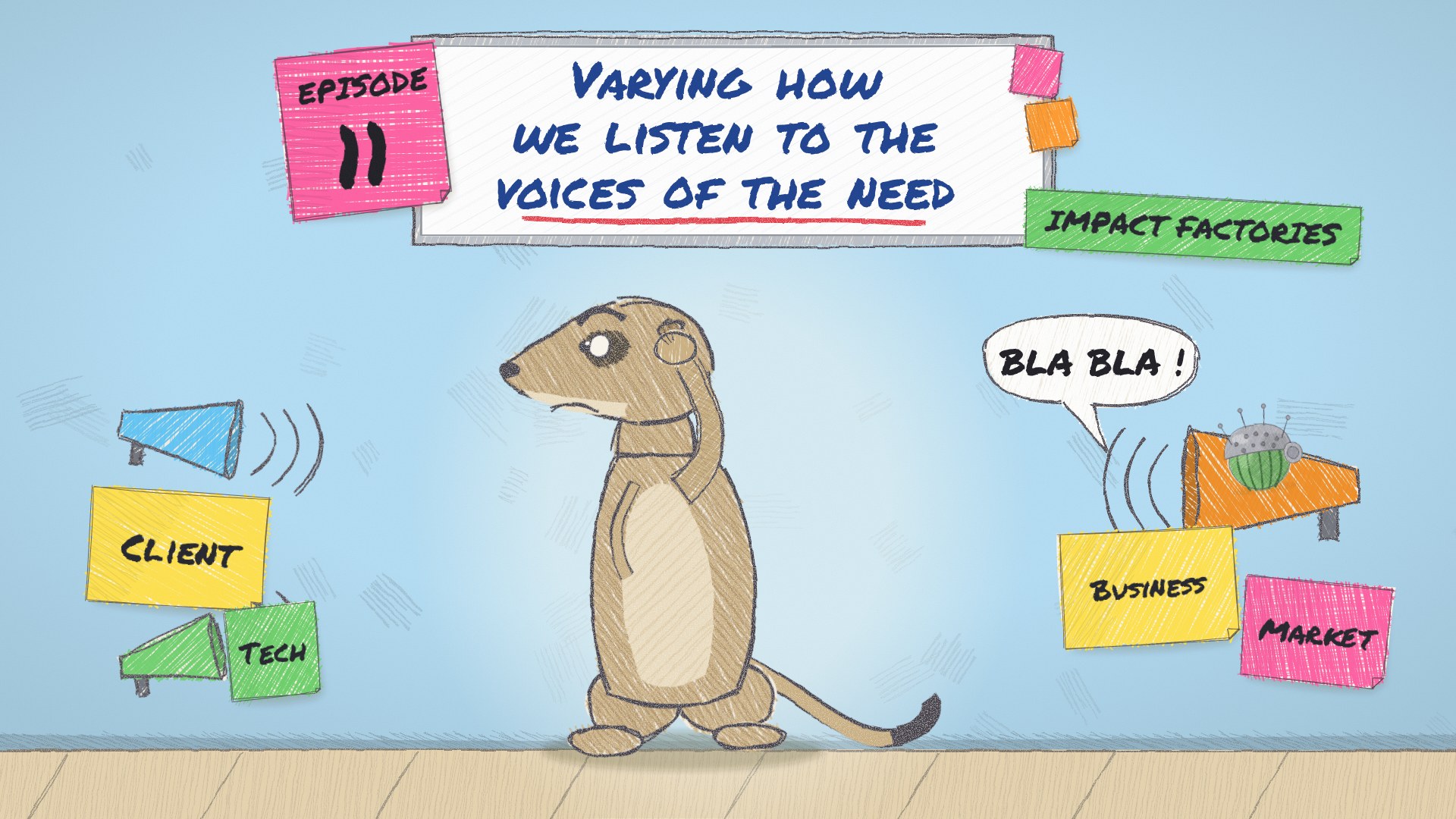
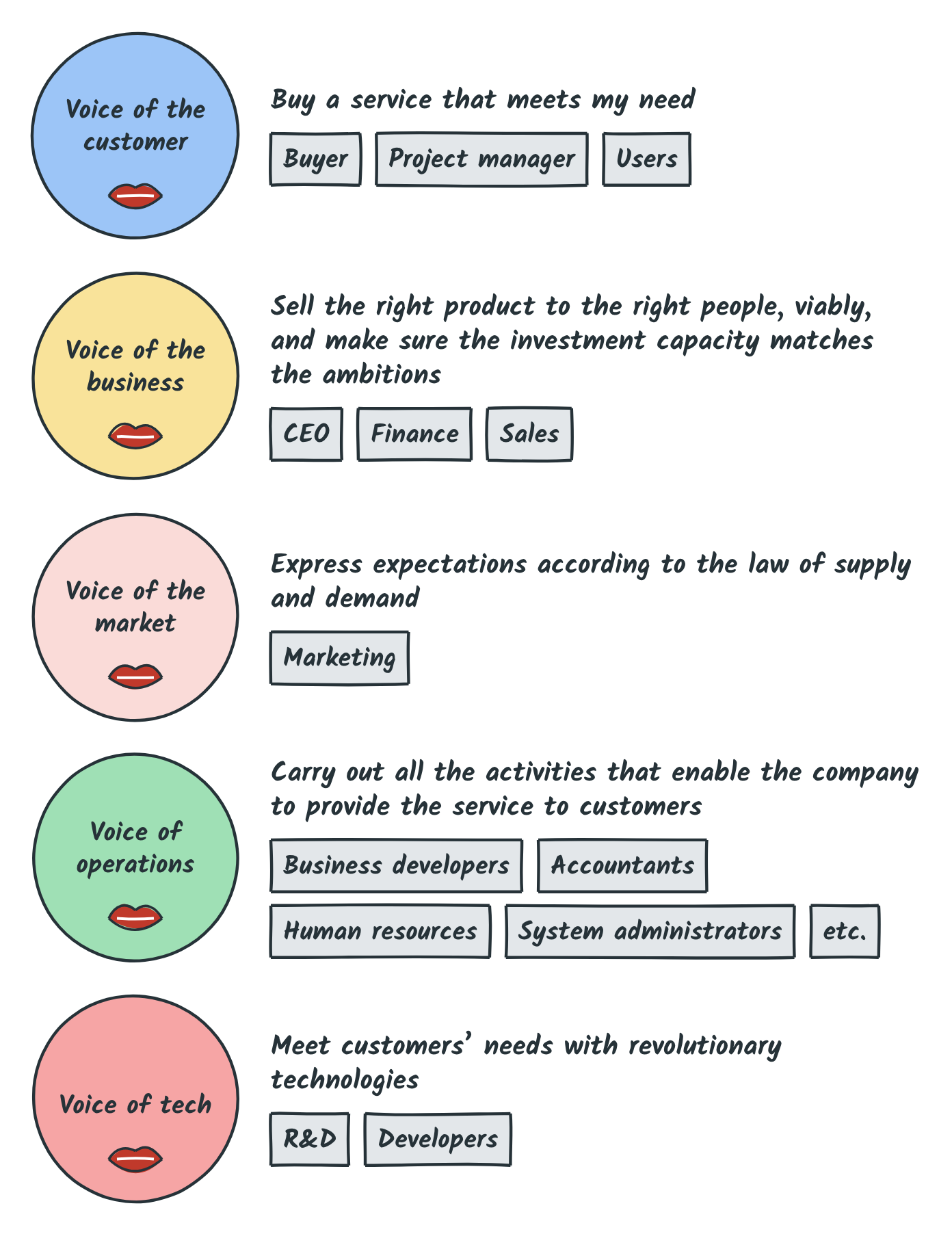
“Right. Never mind if it feels as though the earlier investments were wasted. Besides, let me point out that it’s thanks to the work you’ve done that you’ve gotten this far.” Max twirls his pen between his fingers, then gets up and picks up a marker in front of the flip chart. “You see, in Lean Management, we often talk about three essential voices: the voice of the customer, the voice of the business and the voice of operations. But if we want to go further, we need to add two other crucial dimensions: the voice of the market and the voice of technology. Sometimes one voice shouts louder than the others…” He draws five circles and writes a name in each.

“Lean, like your Andon at Toyota?” Julien asks.
“Same family.”
Sophie narrows her eyes at the circles. “I’ve heard of these voices before, but I’ve always found it vague. What do you mean by that?”
“Each voice, when it leads on its own, gives you a way of building the product.” Max points at the first circle. “Let’s start with the one you already know. The sales-driven approach is the one where you follow customers’ requests as closely as possible. You build the product according to their direct feedback. It’s the track I’ve had you on since we met.”
“Driven by sales,” Sophie says. “The interviews, the focus group, everything we’ve just done.”
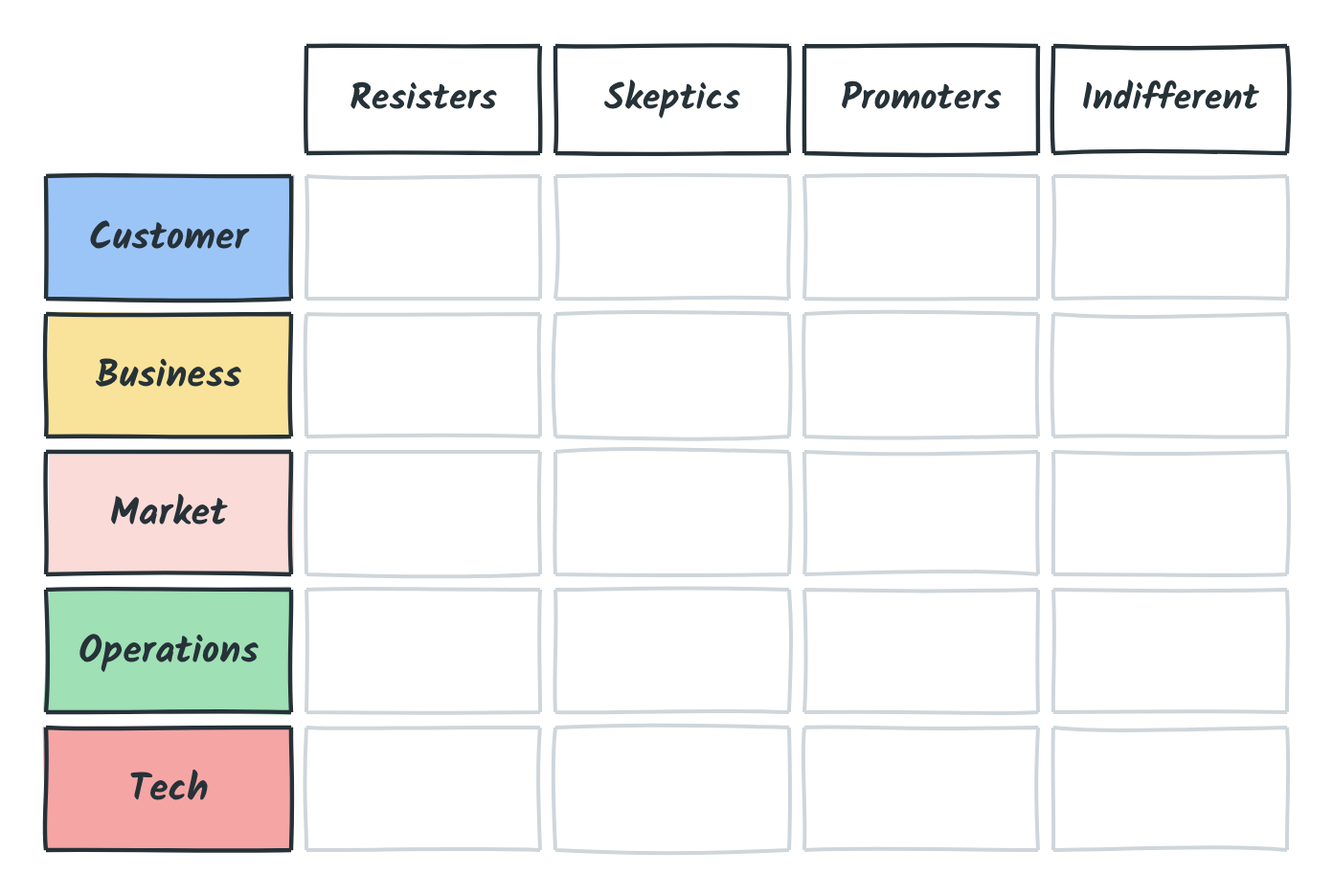
“All of it. When the product is being adopted, it’s also by paying attention to the voice of the customer that we can categorize stakeholders by their interest and their influence: the resisters, the skeptics, the promoters, the indifferent, and so on.” Max draws a grid under the circles, four columns, five rows. “By understanding these different perspectives, we’re better equipped to develop products that meet our customers’ expectations and needs. But the danger is that we spend our time chasing specific requests, without ever really building a long-term vision and ending up with a product that interests several players.”

Julien folds his arms. “It can quickly become a trap: if we just answer immediate needs, we risk missing more strategic opportunities… We’d be doing custom jobs on an assembly line.”
Max points his marker at him. “Right. It can turn the company into a service company rather than a product company. At the opposite end, you have the tech-driven approach. There, technology calls the shots. You bet on innovation, sometimes without any real demand for it. You focus on what you can do, on technical feats and possible advances, and you hope it will be useful one day. It’s a bit like dangling a hook in the ocean and waiting to see whether a fish bites. It can happen.”
Julien looks at the backpack leaning against the leg of his chair. “We brought our hook with us.”
Sophie uncaps her pen. “It’s like artificial intelligence. For years, billions were invested without there necessarily being a specific product to get out of it right away. AI developed as a technological building block that might one day fit into products that didn’t exist yet. Some saw it as a race for innovation cut off from commercial reality, but today those investments are paying off. AI has become a key element in a multitude of sectors, from industrial automation to medical assistance and content creation.”
Julien unfolds his arms, but his eyebrow stays raised. “And what if the fish never bites?”
Max laughs. “If the innovation doesn’t eventually meet a need, you end up with a revolutionary product… but a useless one that will never see a return on investment.”
“And the voice of the company, then?” Sophie asks. “The one you call the business, on your drawing?”
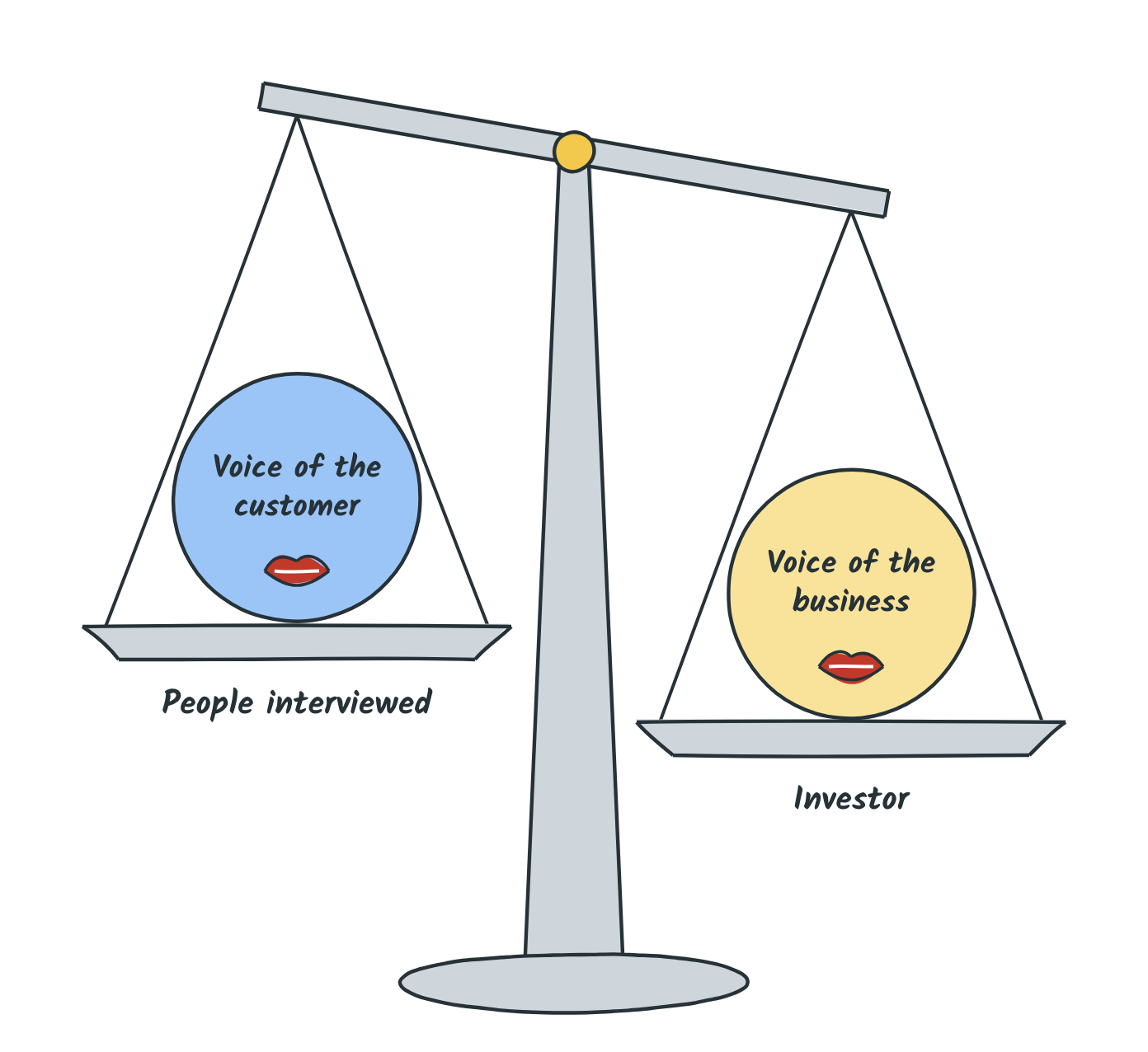
“Same one: what the company wants for itself.” Max moves on to the third circle. “Then there’s the business-driven approach. It represents the interests and priorities of your company. What are you looking for? Growth? Innovation? Stability? A funding round? If the goal is profitability, every choice is made to maximize profits and minimize costs, or quite simply to meet shareholders’ expectations. It’s also by listening to the voice of the business that you’ll identify the stakeholders whose support you need, especially to get the means to act. It’s effective, but you can quickly forget customers’ real needs and how the market is changing.”
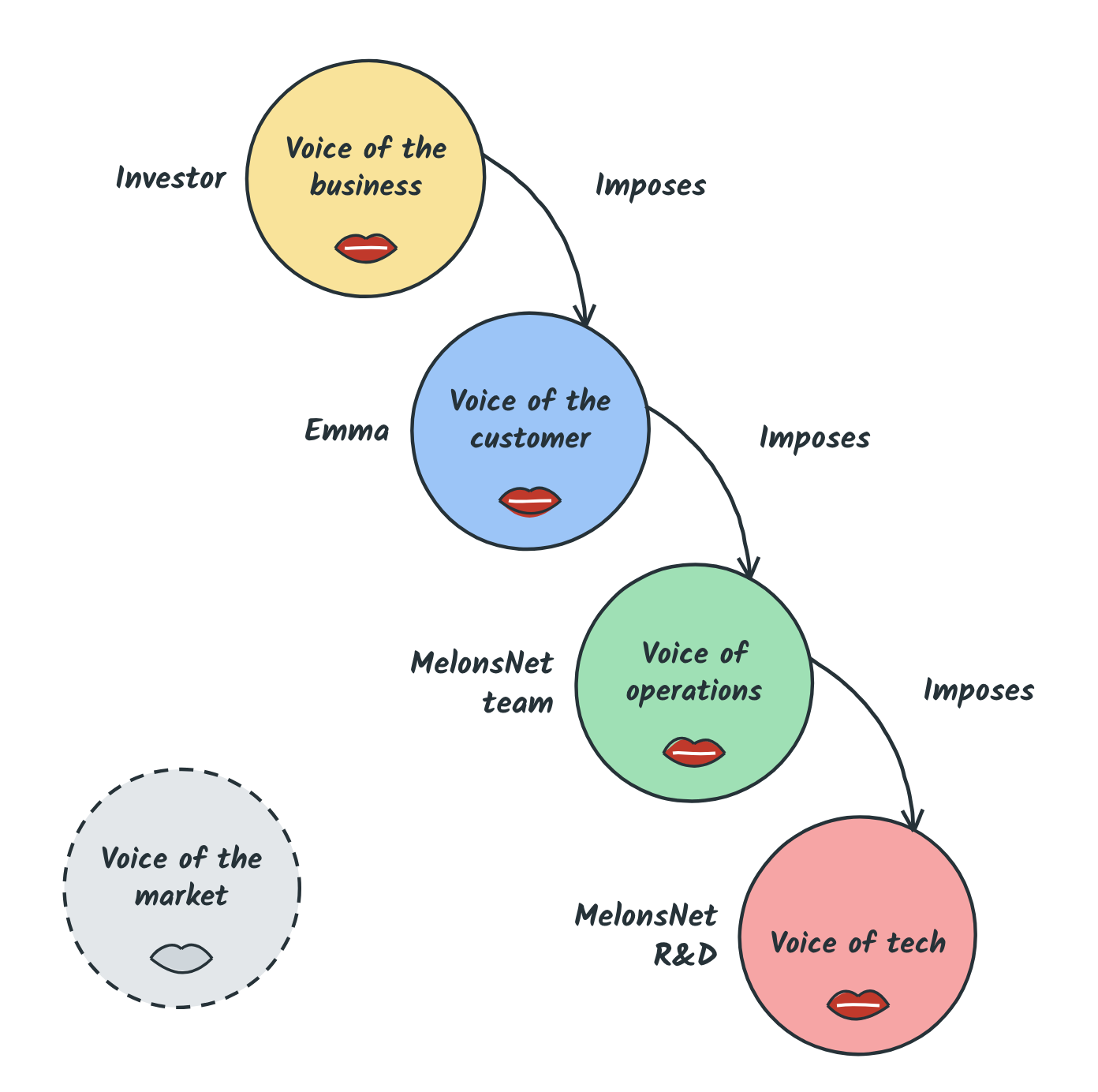
Julien has his elbows on his knees. “That’s the voice we heard from the potential investor, forcing us into a partnership with a key-account customer! And that voice obliges us to listen to a new customer’s voice, which speaks through Emma.”
Max draws a scale in the corner of the flip chart, one pan lower than the other.

He counts the fourth voice on his fingers. “The market-driven approach is the one that relies on a fine understanding of trends and opportunities. You adapt the product to the competitive context, to changes in society and to emerging expectations.”
Sophie puts her pen down. “But isn’t that just chasing trends?”
“If it’s done badly, yes. But used well, it lets you be responsive and relevant.”
Julien’s eyes go back to the circles. “And the fifth?”
Max comes back to the table and touches his laptop screen, below Léo’s face. Léo pulls back. “And finally,” Max says, “there’s the data-driven approach. Here, every decision is based on data. You analyze user behavior, you optimize, you test continuously. It’s extremely effective, but it can lock us into incremental improvements, without ever daring to break with the past.”
“The thermometer, without the patient,” Julien says.
Max nods. “And there’s the question of how interpretable the data is, depending on the company’s maturity, which can lead to a situation where analyzing the data leads to faulty reasoning. I often link the voice of operations with data-driven, because it really comes down to delivering the service.”
Julien frowns. “What do you mean by operations?”
Max sits back down on the edge of the table. “Take software sold B2B, for example.”
“Business to business,” Sophie says. “Like us with Kangaroos.”
“Like you with Kangaroos. The customer doesn’t just interact with the interface. They’re also in contact with the sales teams who negotiate the contract, the legal department that frames the relationship, the accounting department that handles invoicing, the support team that solves technical problems. There are also the system administrators who sometimes carry out certain manual tasks to activate or customize certain services, and even the teams in charge of onboarding and training.”
“Everyone behind the counter,” Julien says. “Not just the storefront.”
“All these people make sure the promised service is actually delivered, whether it takes the form of a tangible product or an entirely intangible service. These players are called on to complete what the product cannot do automatically. That wider dimension is what makes up the voice of operations, in my view.”
“So the support people just follow orders?” Sophie asks.
Max folds his arms. “No. And above all, these people are a gold mine of information. They pick up feedback firsthand, interpret customers’ frustrations and expectations, and collect valuable data through their communication and management tools. That’s why I make a direct link between the voice of operations and data: this voice isn’t limited to execution, it’s able to feed decision-making. When you have doubts about which indicators to choose, and therefore about how relevant your interpretation of the data is, operations are the right people to consult.”
Julien has stopped writing. He leafs through his notebook to the page with the formula and reads aloud the line he added at the end of the debrief. “Which indicator, behind which goal?”
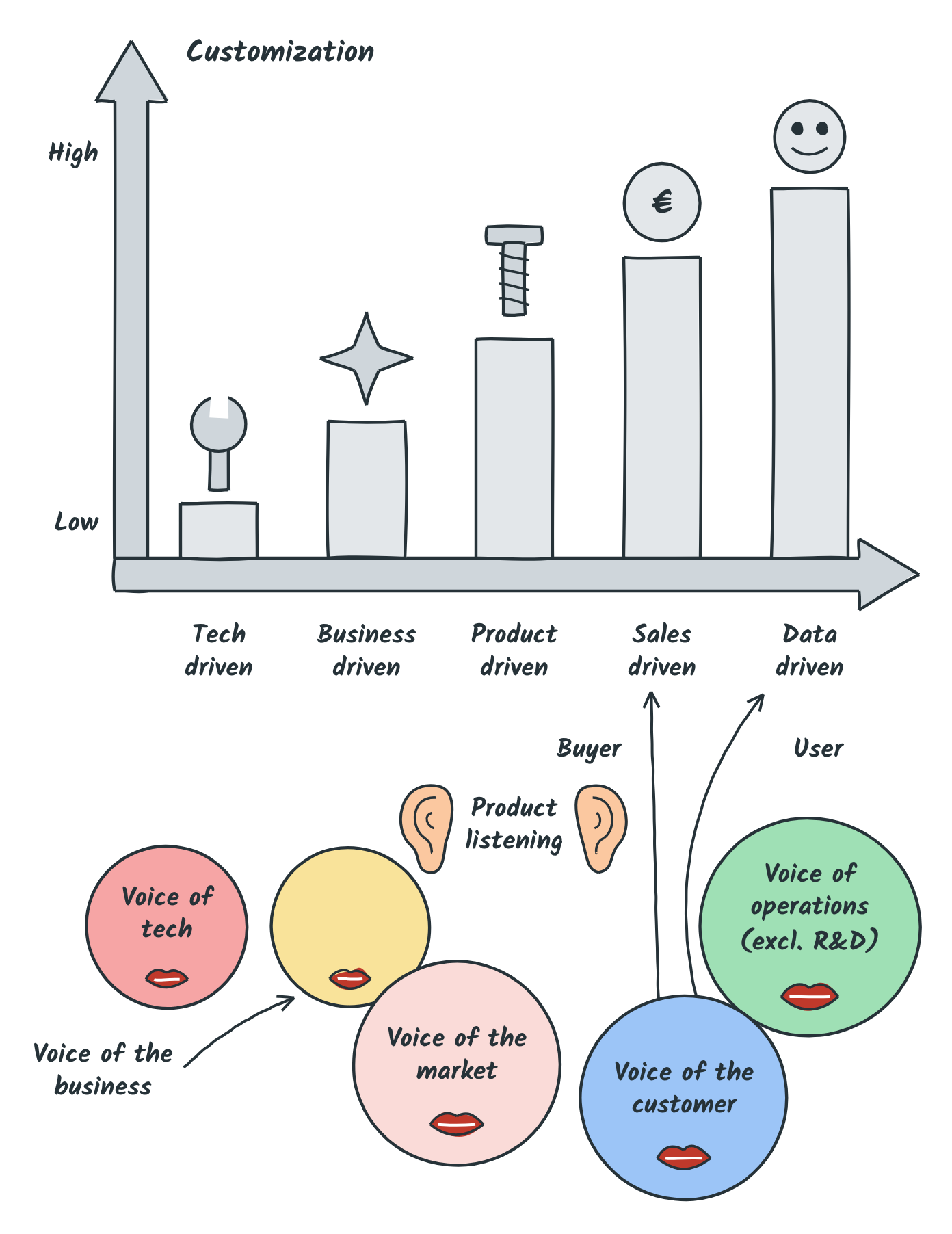
“They’re the ones to ask.” Max unfolds his arms. “Besides, it’s also this voice that guarantees a company can really keep its commitments. In a sales-driven approach, R&D is added to operations, because the point is to meet each customer’s specific needs. In the product approach, the data is complemented by interviews, prompted feedback, focus groups and so on, to serve a set of customers on the basis of the opportunities identified across the targeted group of customers.”
“Prompted,” Julien says. “We go fishing for opinions instead of waiting for them to bite. And which one is the product approach?”
“The last one. Patience.”
Max goes back to the flip chart and draws a horizontal arrow, from “low” to “high” customization, on which he hangs the approaches one by one.
“What about a plant like Arthur’s?” Sophie asks.
“At Arthur’s plant, it’s even broader. You could also consider that operations cover all the activities that make it possible to deliver the service to the customer. That is, all the processes that turn inputs, whether raw materials, labor or information, into concrete outputs, in other words the finished product. That covers aspects as varied as production, assembly, equipment maintenance and, more broadly, all the processes that contribute directly to creating value.”
Julien counts the approaches on his fingers and has to start over. “So each of these approaches has its strengths and weaknesses. Which one is right, then?”
Max lets a few seconds go by, the marker against his lip. “None in particular… and all of them at once. The product-driven approach is precisely the right balance between all these forces. You build a product that relies on technology while being economically viable, aligned with customers’ needs and relevant to how the market is changing. Balancing these five voices according to the context is vital to survive and succeed in the market. You have to build them in from the very start of your product development, and keep adjusting and reassessing them at every stage of the life cycle of the product or of your company.”
In the middle of the flip chart, he draws two ears and connects them to the five circles.

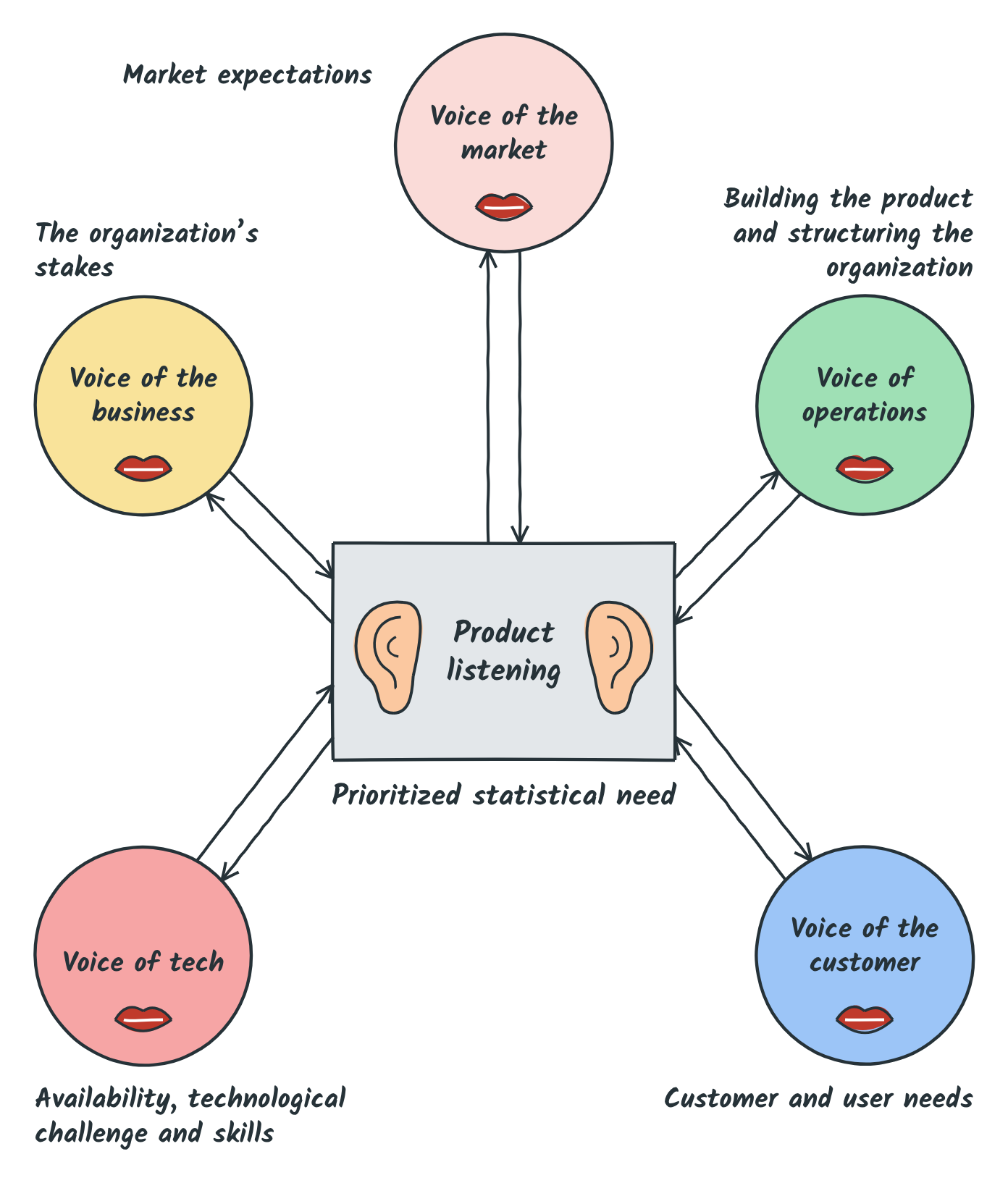
Sophie looks at Julien before speaking, but he says nothing. She brushes her left temple with a fingernail. “In our case, we really bet on the voice of technology at the start. We need to bring all these voices back into every decision about our product. Still, it’s odd in our situation, because it’s the voice of the business, through the investor, that forces us to listen more to the voice of a single customer. That’s not really balanced…”
“True, you have an indicator that is vital for your company, your runway, and it constrains you enormously.” Max moves from the circles to their own figures and writes an 8 in red marker. “You now have less than eight months of cash. That’s not much, especially when you know it’s advisable to have at least 12 to 18 months of runway to approach a funding round safely. Below that threshold, investors get cold feet and the company risks negotiating from a position of weakness.”
Julien opens his notebook to the margin where he keeps recounting the months, crosses out the last number and writes “less than 8” underneath. “Runway,” he says. “Like the one planes take off from. And ours is getting shorter. All right, at the moment, it’s the voice of the business that’s shouting loudest! But it’s leading us straight into focusing on a single customer. Isn’t that dangerous?”
Max draws a chain of arrows, from the investor to Emma, from Emma to their team, from their team to their R&D, and leaves the market off to one side.

“I agree,” Max says. “Maybe you should consider a modular approach to your technology, one that could adapt both to Kangaroos Computing’s needs and to your original ambitions in medicine, for example.”
“A common trunk,” Julien says, “and parts you swap depending on the customer.”
On the screen, Léo moves closer to his camera, until his face spills over the edges of the frame; he hasn’t said a word since the start. “Hang on, Max. Genericity means a one-size-fits-all product. Thinking about it at your stage of development is a costly constraint, and a risk. You can’t deduce genericity from needs you haven’t even started to understand. Genericity comes after you’ve moved forward in a direction that seemed relevant.”
Sophie shakes her head at the screen. “Still, Max’s idea holds up. There are situations where a company doesn’t need to understand each individual customer, because it focuses on a generic need. Take screws and bolts. Unless they want to address a niche, the manufacturers of these products don’t need to know exactly how each customer is going to use them. They simply know these products have to be robust and reliable.”
“Bolts have always been used to fasten parts together, that’s the use case!” Léo answers. “But I’m sure that if you look into what bolts are made of, and into their shapes and sizes, you’ll come across very precise use cases.”
Max caps his marker. “Frankly, I see where Léo is going. Before imagining a generic solution, you need to target a need. You can’t conclude that needs lead to the same solution when you don’t know them well.”
“Some companies do very well by being generic,” Julien says. “Jira, for example. Everybody uses it.”
“Spoiler: they didn’t start out that way.” Léo jabs a finger at the camera. “Today Jira has indeed become one of the main project-management and issue-tracking tools on the market, by being very generic. But Atlassian, the company behind Jira, was founded in 2002 as an IT services company. So they did choose to answer the individual needs of all their customers. It was after that period of learning their customers’ needs that they developed and launched the Jira product. But once again, they started out as a services company, not as a product company.”
“A startup like ours,” Sophie asks, “where does it start? Driven by the product, or by sales?”
“In reality,” Léo answers, “the approach companies choose varies over time, depending on the problems they face. In the startup world I know, at the beginning it’s about identifying a niche; that actually means the company doesn’t have enough perspective and data to really be product-driven. So it positions itself between the two approaches, product and sales. At the same time, companies have to steer between offering off-the-shelf solutions and highly customizable products. That’s where the subtlety of their strategy lies: finding that balance to satisfy as many customers as possible while staying economically viable.”
Max nods at the screen. “A services company offers something highly customizable but not optimized, so expensive and slow to deliver. The level of genericity of the product must depend on the value and the cost of that genericity.”
“The tailor versus off-the-rack,” Julien says.
“More or less,” Max says. “It was Atlassian’s experience that allowed the designers of Jira to go toward high genericity. At that point, its designers could have decided to be less generic; they could have imposed a simple model with a fixed, predefined workflow. They would have addressed a niche of customers. I’m convinced they would have been forced to go that way if they hadn’t had the experience of the services company. But instead, they invested in developing a process editor. That made development more complex and expensive, but it let them address a wider variety of customers.”
“A process editor,” Léo says, “lets each customer draw their own steps, instead of putting up with the tool’s.”
“Where do we fit in?” Sophie asks.
Max picks his marker back up. “You have to decide on your positioning so as to do just enough with the resources at your disposal, taking into account the external levers you have, and with the level of genericity customers are ready to accept. They’ll have to invest time and resources in customizing the product so that it fits their needs perfectly. Some companies prefer off-the-shelf solutions, while others look for that flexibility to adjust the tools to their unique processes.”
Léo rubs his chin. “I’ve seen the same thing at several companies I’ve worked for. What’s interesting, when you start from a niche, so with the sales approach, is that the more you widen your field of action afterward, the more complex your product becomes. And at some point the quality of service goes down, because changes become hard to make. Bottom line: bugs, development times that get longer, inconsistencies in the specifications and so on.”
Julien has his eyes on the margin of his notebook. “A house you add a room to for every child. After a while, not a single door closes.”
“You got it,” Léo says. “You have to bear in mind that this approach of learning in the field also takes you through cycles of redesigning the product, and that’s normal! The moment when you decide to redesign your product in light of everything you’ve learned is what we call paying off the product debt and the technical debt.”
Nobody has turned on the light, and in the office Léo’s screen has become the only lamp; he logs off first.
Julien already has his coat on when Max takes his keys off the hook and offers to drive Sophie home. She accepts, and the car drives across town as the shop windows light up one by one.
Sophie waits for a red light to ask her question. “Max, why are you helping us so much? We didn’t take the time to apply to your incubator, you already have lots of people to support… Julien and I rely on you so much, and you’re always there, without ever asking for anything in return. It’s often made me wonder…”
The light turns green, and the silence lasts for two intersections. Max keeps his eyes on the road. “Sophie, I told you the other day I was single because my work took up all my time, didn’t I?” He says nothing until the next intersection. “The truth is, there’s more to it than that. My brother has been quadriplegic since a car accident ten years ago. We were inseparable, business partners even. Since his accident, I’ve spent a large part of my free time looking after him.”
Sophie lets go of the strap of her bag, which she has been twisting since they set off.
Max slows down. “Seeing my brother in that state, unable to speak, it’s painful… When I saw your mind-reading headset project, I told myself it could change his situation. Imagine being able to communicate with him again, even in a limited way!”
Sophie reaches toward the dashboard, then draws her hand back. “Max, it’s incredibly generous of you to help us so much, given everything you’re already handling.”
Max smiles, his hands on the wheel. “And you know, Sophie, the energy you put into this project inspires me. It makes me feel that anything is still possible.”
She looks out the window rather than at him; in the reflection, her cheeks have taken on the color of the red light. She laughs. “But Max, we’ll probably have to give up on medicine. We may never treat quadriplegic patients…”
They’ve arrived. The engine is still running.
Max glances at Sophie. “We’ll see how things turn out. Maybe you’ll widen the use cases one day? You’ve already switched targets several times in a month…”