
-
 Introduction
Why this book
What led to writing Impact Factories, and why as a novel.
-
 Introduction
What is an impact factory?
The working definition the whole story rests on.
-
 Introduction
What you are about to read
What the book is about, who lives in it, and the questions it will put to you.
-
 01
Chapter 1: Surviving a breakup with the solution
“Did you know that every click, every search, every purchase you make is already being tracked, analyzed, and…
-
 02
Chapter 2: Rising up thanks to collective intelligence
At the entrance to NUMA, two hosts hand each new arrival a sheet of stickers: one for a…
-
 03
Chapter 3: Revealing the need
Léo pulls out a chair, spins it around in one move, and sits facing them, forearms folded over…
-
 04
Chapter 4: Categorizing information sources
The next morning, Julien and Sophie call an emergency meeting with their team. Around the table, Laura, the…
-
 05
Chapter 5: Navigating the irrationality of human need
The meeting has changed hands without anyone really deciding it. Laura steps back and leaves the whiteboard to…
-
 06
Chapter 6: Following the red thread of the goal
Cassandre has opened her mouth to ask a question. Léo sees it coming and raises a hand. He…
-
 07
Chapter 7: Avoiding the white box trap
Léo opens the meeting room door, Max on his heels. The members of MelonsNet are already standing around…
-
 08
Chapter 8: Beware the shining crystal
The room is still buzzing with compliments about the shortbread when Léo stands up. The team is refilled…
-
 09
Chapter 9: Questioning the need
Annonay, 1782. In the fireplace, the fire crackles softly. Joseph watches the ashes rise, drawn upwards by something…
-
 10
Chapter 10: Understanding the cost of the need
The camera is already rolling when she sits down. Laura stays behind the lens, out of shot. "Hello,…
-
 11
Chapter 11: Varying how we listen to the voices of the need
The debrief board is still covered in the names brought back from the field. Taking stock of how…
-
 12
Chapter 12: Convincing the sponsors to move forward
The next day, Julien and Sophie take time to talk things over in a café near the office.…
-
 13
Chapter 13: Looking for concrete ground truth beyond the voices
They start by reading, before they call anyone. Emma keeps her promise and puts them in touch with…
-
 14
Chapter 14: Identifying the success indicators to track
The week drags on for Sophie and Julien, set to the rhythm of an avalanche of paperwork. They…
-
 15
Chapter 15: Understanding the system
The metro rumbles beneath their feet as Sophie and Julien squeeze into a packed carriage. It is the…
-
 16
Chapter 16: Understanding culture to assess motivations
Mars, 23 September 1999. After nearly ten months traveling through the immensity of interplanetary space, the Mars Climate…
-
 17
Chapter 17: Consolidating knowledge to move forward
It is Friday morning, and there is a palpable energy in the air. The whole team can't wait…
-
 18
Chapter 18: Killing ambiguity
Olivia waits until everyone is settled again, then speaks calmly: "Third and last step of this sequence: evaluation.…
-
 19
Chapter 19: Scripting the system
After this aside on handling ambiguity, Olivia walks slowly up to the wall covered in Post-its, as if…
-
 20
Chapter 20: Getting to know the actors
The following week, the interview guide is carefully prepared: it follows the steps of the CUX, but leaves…
-
 21
Chapter 21: Finding the tensions in the system
During the break, they find a quiet corner of the offices. Julien and Sophie try to reach Max…
-
 22
Chapter 22: Detailing processes and their requirements
In the hallway, the school bag is waiting by the door. "Come on, Jonas, hurry up, we're going…
-
 23
Chapter 23: Confronting views to hit the mark
On the very evening the contract is signed, Sophie meets Max for a rather special dinner. He has…
-
 24
Chapter 24: Identifying actionable levers
On Max's recommendation, Sophie, Laura and Julien go to a lecture at a university. The lecture hall is…
-
 25
Chapter 25: Evaluating the levers
The bell rings again, echoing off the walls of the lecture hall. Little by little the conversations die…
-
 26
Chapter 26: Organizing experimentation
Julien spreads butter on his still-warm bread; the coffee machine gurgles in the kitchen. As he does every…
-
 27
Chapter 27: Adopting a learner’s mindset
San Francisco, 2007. Drew Houston sits down in his small flat, cluttered with cables and laptops. A USB…
-
 28
Chapter 28: Communicating the results
Sophie's phone vibrates among the pastries. She puts it on speaker and holds it between herself and Julien.…
The debrief board is still covered in the names brought back from the field. Taking stock of how far they have come, Sophie suddenly bursts out laughing, realizing how…
Read this episode again
The next day, in a café near the office, the two cups go cold between Julien and Sophie without either of them taking a sip. Sophie stirs hers with her spoon. “How are we going to tell them without demotivating everyone?”
Julien’s notebook lies open next to his cup, to the margin where he keeps counting and recounting the months of cash: “less than 8.” Last night it was still only a “probably.” This morning, the decision is made.
To secure MelonsNet’s future, they have to raise funds; and they will only get those funds by meeting the requirements of the one serious investor who has come forward. That means focusing all their efforts on a single customer, Kangaroos Computing, at the risk of calling weeks of investigation into question and unsettling the team.
Julien drums his fingers on the table. “We’re asking them to pivot abruptly… To give up, at least for now, everything we’ve built together.”
Sophie puts her spoon down. “It’s strange… Why do we see the conversation with Emma differently from the other interviews? After all, we were looking for viable use cases. This one may be more imposed than the others, but it still answers the question we started with.”
Julien looks out the window at the street, then runs a hand over the back of his neck. “What bothers me isn’t the partnership itself… It’s this solution-oriented approach. Emma was quite directive in what she asked for, and I have a huge amount of respect for her, really. But…” He stops for a moment. “By talking directly about features, the way we did last time, I’m afraid we’ll fall back into the habits that have already made us fail. If we just list technical points like integration with their CAD software, or better sensors for the brain interface… we risk missing the real issue.”
“So what’s the real issue, as you see it?” Sophie asks.
Julien looks at her. “Shouldn’t we focus instead on what these changes actually bring to Kangaroos Computing and its customers? On the impact, rather than on the list of features?”
Sophie wraps both hands around her cup. “You’re right. That’s what Max has been trying to teach us since we met him. What Emma presented to us is indeed a very ‘solution-output’ approach. She talked to us about the specific features she wants, like the integration with the CAD software or better sensors.”
“Laura’s cake,” Julien says. “Emma has ordered the cake from us, and we still don’t know what the party is for.”
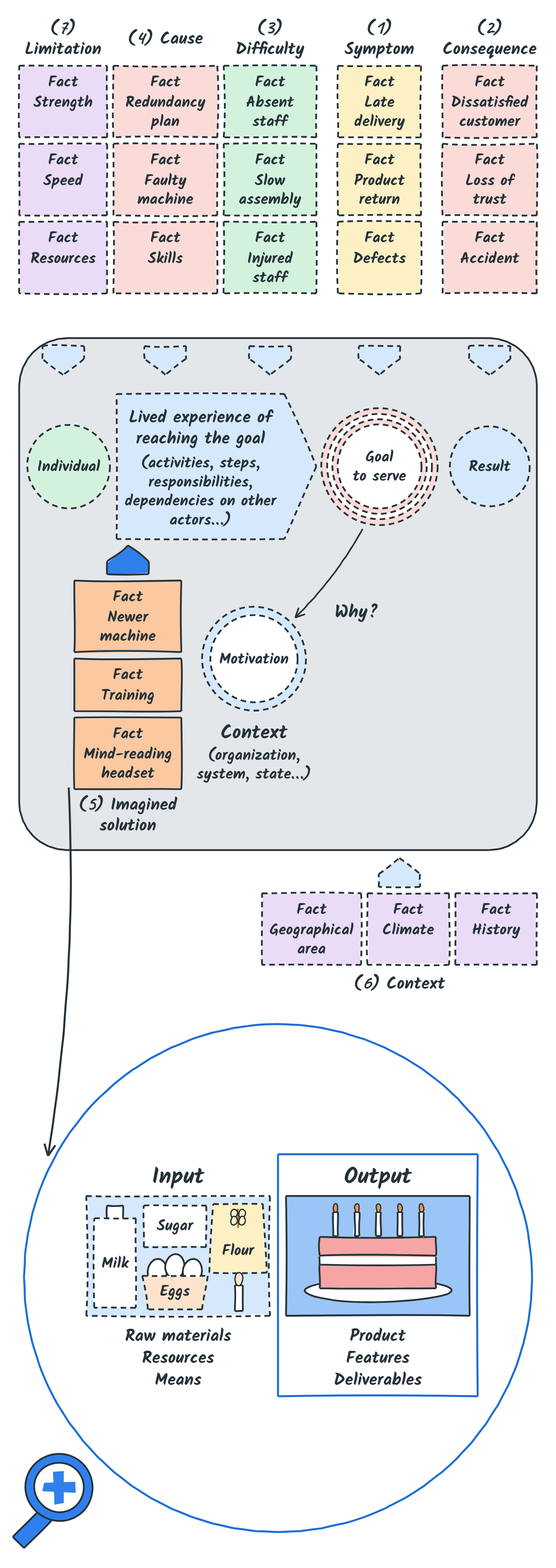
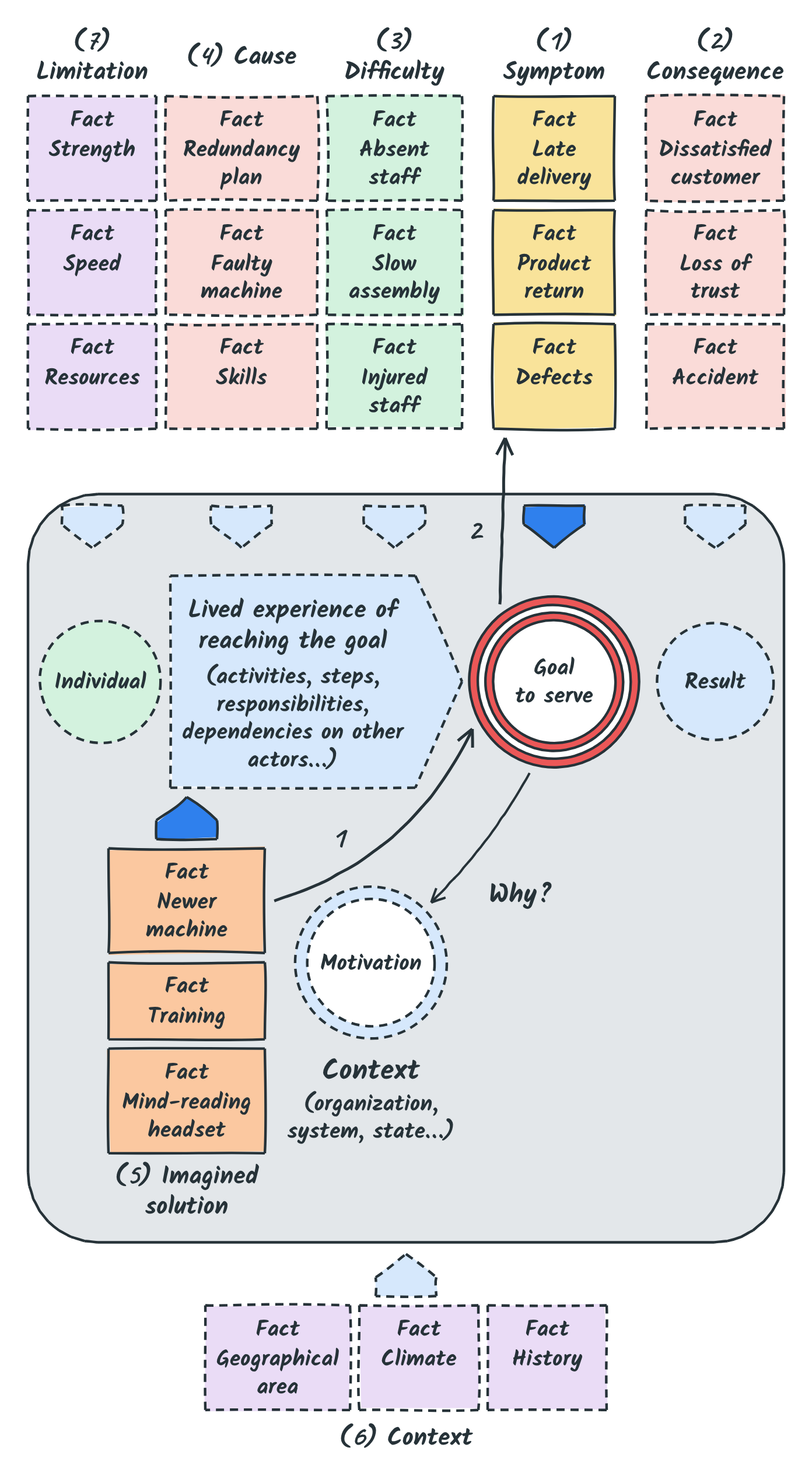
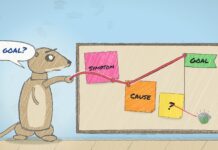
“At least Arthur talked to us about his plant, not about our sensors,” Sophie says. She sets a finger on the table, between the two cups. “What we have to do with Emma is work back from her outputs to the goal she is really trying to reach.” Her finger slides up toward the far edge of the table, then back. “Once we’ve identified that goal, we can come back down and assess the symptoms that are holding her back from reaching it.”
Julien copies the path into his notebook, one arrow going up, one arrow going down, and checks the time. The team meeting is getting close, so they leave the two full cups on the table and head back to the office without a word, Julien with his notebook under his arm.
Everyone is already seated in the meeting room when they walk in, Éric behind his screen, Marc with a screwdriver in his hand, Cassandre and Paul side by side, Laura at the end of the table with her notepad. Julien stays standing by the whiteboard, his notebook in his hand, and sets out the facts. “Kangaroos Computing is ready to fund a specific development of the headset, which would give us financial stability. That funding would be topped up by a private investor.” He lets the silence hang and looks from face to face. “But it means we focus all our efforts on this one project.”
In his notebook, under the arrows from the café, he has written down the objections he expects: the weeks of exploratory work, the original vision fading away, an order dictated by a single customer.
Cassandre has her hands flat on the table, and she’s smiling. “It’s good news, huh? We’ve got both an investor and a customer who believes in us enough to put real resources on the table. It means we can move forward calmly, instead of chasing funding that never comes and wondering why we come to work every morning.”
Éric lowers his laptop screen halfway. “One customer, but a real one. Stability at last, basically.” Paul nods, Marc turns his screwdriver between his fingers without objecting, and Laura has already uncapped her marker.
Julien closes his notebook on the list of objections, then opens it again to a blank page. “So the real question is how we turn this opportunity into a success. How should we structure the work? How can we make sure every development is aligned with a clear vision?”
Laura gets up and goes to the whiteboard, her notepad held tight against her chest. “What we need is a goal that brings us all together. Something that works as our compass.”
“A North Star,” Julien says. “The one you keep in sight when you can’t see the coast anymore.”
Sophie turns to him. “I agree. If we have to focus all our efforts on this project, we need to know precisely what we have to achieve for Emma to be truly satisfied, in the service of Kangaroos Computing’s interests. We have to identify the goal to serve, against which the result can be measured over time.”
She takes the marker from Laura’s hand and draws two arrows on the whiteboard, the first from the solution to the goal, the second from the goal to the symptoms.
Julien frowns at the first arrow. “But if she already has a very clear idea of her outputs, how do we work our way back to the goal?”
Laura takes back her marker. “At Amazon, before they even start developing a product, product managers have to write a mock press release aimed at customers. The idea is to project yourself forward: if the product were already finished and launched, what arguments would make customers want to buy it? How would we present it to bring out its unique proposition? This document forces the team to think from the outset about the real value of the product and its concrete benefits, and therefore to think about the goal it serves.”
“A press release for a product that doesn’t exist?” Paul asks quietly.
“That doesn’t exist yet.” Laura writes a headline on the whiteboard, in big letters. “For example, for our headset, we could imagine a press release headlined ‘Multiply your productivity tenfold in the design phase!’ This kind of exercise pushes us to answer fundamental questions: what problems are we solving, and why should customers choose us?”
Julien squints as he rereads the headline. “Is there anything shorter? Nobody reads a whole press release, any more than they read the manual.”
“Exactly,” Laura says. “There’s an even more concise variant: imagining a Twitter post. In 280 characters at most, how do we explain our product in a way that hits home? It’s an even more demanding exercise, but it forces you to focus on the essentials.”
Cassandre does the math with the tip of her pencil. “Two hundred eighty characters, that’s less than two text messages, huh?”
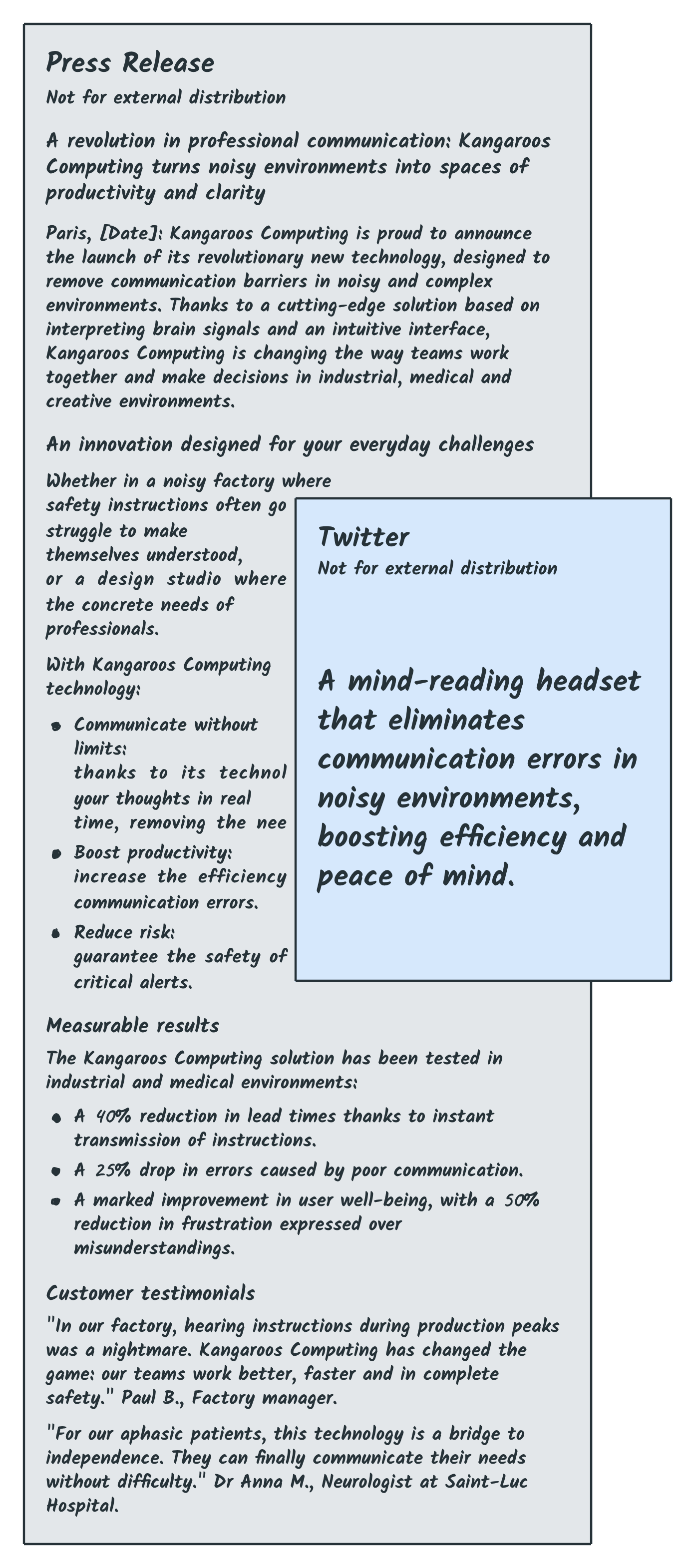
Laura points her marker at Cassandre and goes back to her seat, her notepad open in front of her. “In fact, what we’re doing here is expressing the value of the product through measurable elements, like an increase in productivity or a reduction in errors.”
“And then what do we do with those numbers?” Éric asks. “Pin them on the wall, basically?”
“And if you think about it, those measures are in the end the specification of the goal to reach,” Laura answers. “They clearly define what the product has to accomplish to be considered a success, and they act as our compass throughout its development.”
Marc stops turning his screwdriver; he hasn’t said a word since the meeting began. “What’s interesting in our situation is that our customer wants to satisfy its own customers with our technology, which puts us in a B2B2B model.”
“Three B’s, huh?” Cassandre asks.
“Two amplifier stages,” Marc answers. “Our signal goes through Kangaroos before it reaches their own customers. If we work on this press release with Kangaroos Computing, it will let us put ourselves in their customers’ shoes, understand the goal they are trying to reach by combining our headset with Kangaroos Computing’s products. And be clear about the symptoms and consequences we are positioning ourselves on.”
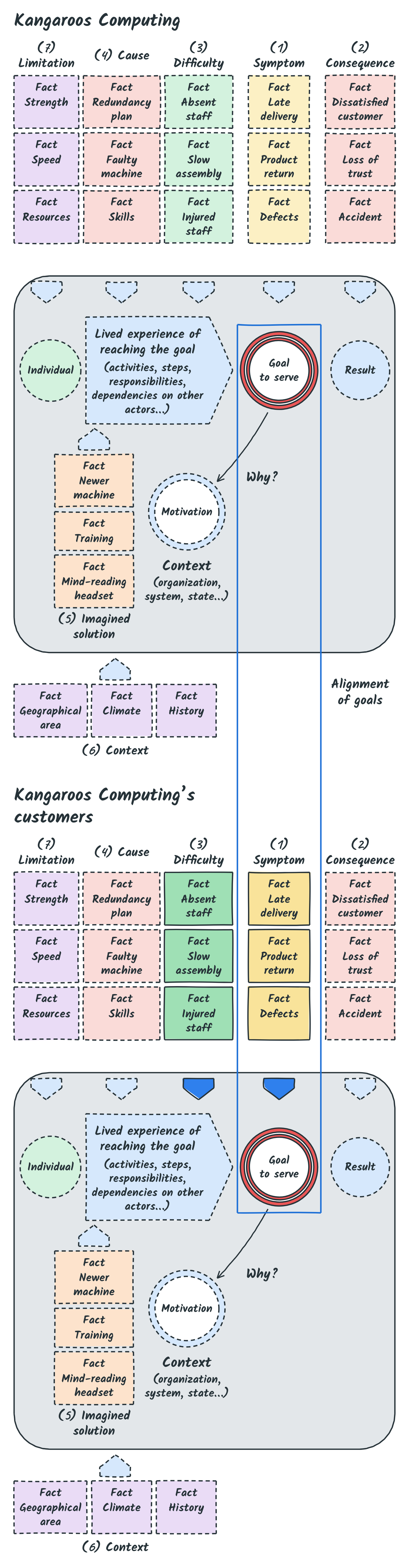
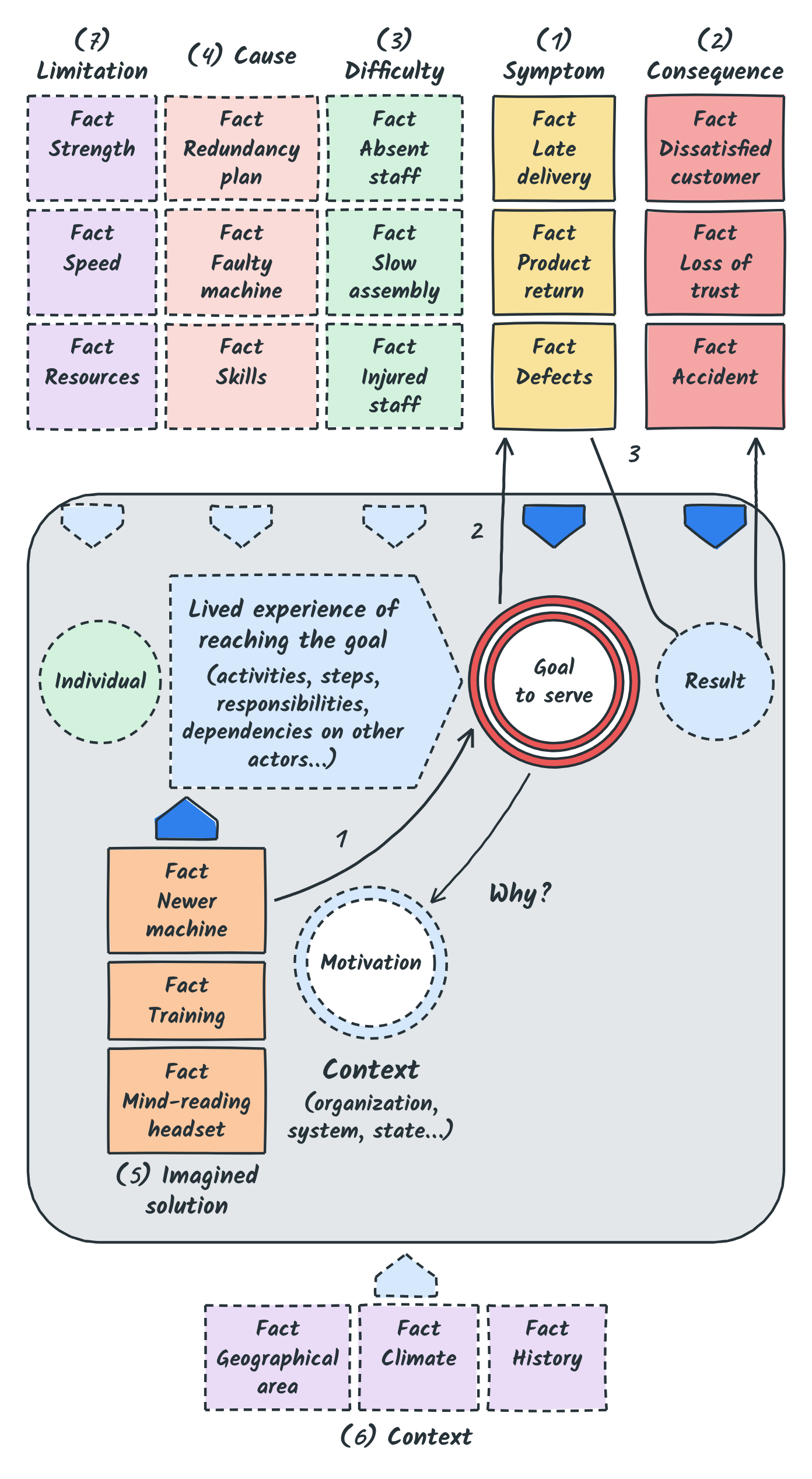
Julien flips back through his notebook to the page from the café. “So rather than getting bogged down in specific feature requests, we have to get back to the essentials: why does Emma need this technology, and how does she plan to use it? That will then let us identify the right levers to pull.”
The office next door is free. Sophie and Julien shut themselves in right away to call Emma’s assistant, the phone on a stack of boxes, on speaker, in an empty room with nothing but a printer that’s turned off. After two rings, a warm voice answers. “Good morning, Emma Lévy’s office.”
Sophie leans toward the phone. “Good morning, this is Sophie Courtier from MelonsNet. We had a very productive first conversation with Emma the day before yesterday. We’d like to take the discussion further on the potential of our headset in her project. Would it be possible to set up a meeting with her in the next few days?”
There’s a sound of typing at the other end of the line, then the assistant hesitates. “Emma has a busy schedule, but I can try to find a slot. What would be the precise purpose of this meeting?”
Sophie glances over. Julien leans in toward the phone. “We want to clarify her priorities and understand how best to adapt our solution to her specific needs.”
The typing starts again and goes on for a long time. Then the assistant comes back on the line. “Very well, I can offer you a meeting next Tuesday at 10 a.m. Does that work for you?”
“Perfect, thank you very much,” Sophie replies. “We’ll be there.” Julien writes “Tuesday, 10 a.m.” in his notebook, across from the margin where he counts the months of cash.
On Tuesday, at 10 a.m., Julien and Sophie wait a few minutes in an elegantly furnished room at Kangaroos Computing, with a window running its whole width. The pale-wood oval table is too big for three, and beyond the glass the rooftops of the city stretch all the way to a construction site whose cranes stand still.
Emma strides in, a thick file under her arm, shakes their hands and sits down, the file closed in front of her.
Sophie smiles. “Thank you for making time for us. We know how busy your schedule is.”
Emma opens a hand toward them. “It is. So let’s get straight to the point! Your turn.”
Julien wrote his question in his notebook back at the café. He doesn’t read it. “Last time we spoke, you mentioned specific features you’re looking for. We’d like to understand your expectations in more detail, to make sure our solution really meets your needs.”
Emma opens her file, takes out a sheet and slides it toward them. “Here is the summary specification of our flagship product.” She taps the table at each point. “Our goal is clear: to provide the highest-performing CAD tool on the market. We have to keep our position as leader. So we need you to develop the Think Connector, which lets users control our applications with the headset.”
Sophie reads the sheet twice, brushes her left temple with a fingernail, and writes in the margin of her notepad, “The need expressed as a solution, oriented toward the output rather than the real goal.” She crosses out the start of a question, begins another, and looks up at Emma.
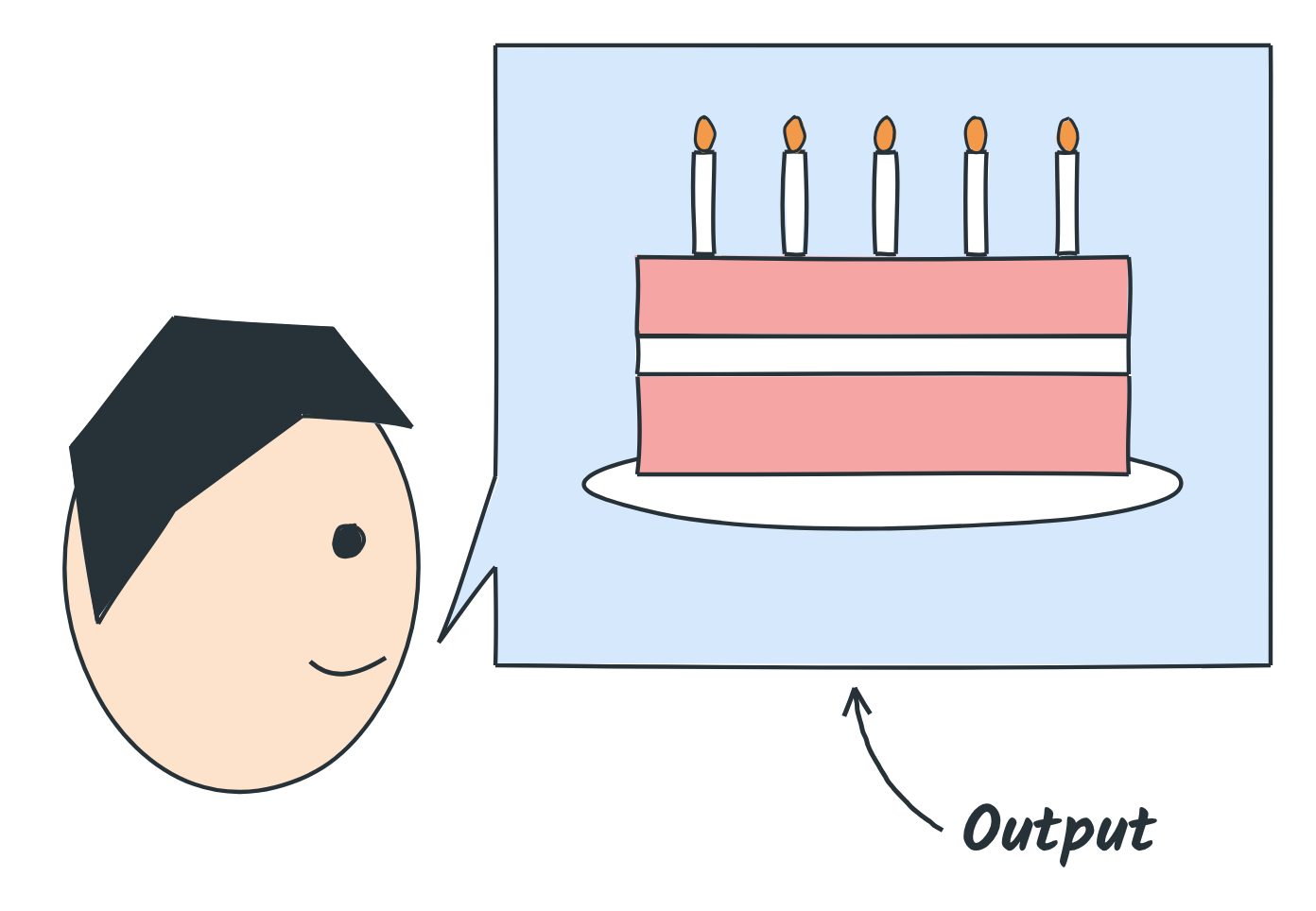
“When you talk about performance,” Sophie asks, “which aspect exactly are you referring to?”
Emma’s finger stops on the table. Sophie keeps her eyes on her. “What we need to understand is why you are looking for more performance. What goal does it serve? What are the concrete obstacles holding that ambition back? And above all, how does that hurt your customers?”
Emma pushes the sheet back toward the file. “Why don’t you trust me? We know that the Think Connector is what needs to be developed. Your generation has a serious focus problem.”
She folds her arms and looks from one to the other. “I’ve been working here for more than twenty years. I’ve seen this company change, I’ve climbed the ladder one rung at a time and I’ve proved myself. Theorists with questions? I meet them every day. Honestly, I find it hard to understand why you are questioning my expertise.”

Julien speaks before the silence can settle, his hands open on the table. “Emma, that’s not the point at all. We have immense respect for your work and for what you have achieved. Kangaroos Computing sets the standard in its field, and that’s why we’re here.”
Emma keeps her arms folded; she stares past them for a few seconds, then takes a breath and turns back to Julien. “So what’s the problem? You don’t have the skills?”
Julien leans back in his chair. “It isn’t a question of mistrust. There are billions of ways to implement what you call the Think Connector. If we want our headset to fit seamlessly into your applications and really serve your customers, we need to understand in detail both the use and the context.” He waits a beat. “Tell me, have you had a contractor come to your house recently?”
Emma raises an eyebrow. “As it happens, we had a new kitchen installed recently. Why?”
Julien sits forward. “Before he came to install it, you explained to him what you wanted, didn’t you?”
“Yes, of course. We chose our kitchen from a catalog.”
Julien waits for her to go on, and when she doesn’t, he continues. “And after telling him what you wanted, you let the contractor come and take measurements, to make sure the kitchen would fit the actual space?”
Emma laughs. “Yes, and in fact we had to scale back our ambitions… The room wasn’t as big as we had imagined.” She unfolds her arms. “Now you’re talking to the woodworker in me.”
“That’s exactly our problem,” Julien says. “Today, we’re like that contractor. You’re giving us an overall vision of what you want, but we need to come and ‘take the measurements’ in your company. Not in terms of physical dimensions, but by understanding precisely how the headset will be used in real conditions. The risk for us isn’t the size of the room, but the gap between the imagined solution and the actual use. And in our case, a misjudgment wouldn’t just mean a readjustment… it would cost us precious development time.”
Emma presses both hands flat on the table, and when she speaks again, she’s no longer smiling. “Very well. Recently, a competitor launched a revolutionary glove that lets you model ten times faster than before.” She looks them in the eye. “We have started losing customers because of it.”
Sophie writes a line in her notepad without looking at it. “All right, speed is a problem, but is it really the only factor that sets Kangaroos Computing apart from its competitors?” She raises her pen toward Emma. “Let’s imagine your tool became as fast as this competitor’s. Would you then be on par with them? What about reliability, the accuracy of the simulation, or the collaborative side?”
Emma takes her time answering, and nobody hurries her; her eyes go to the window, where a cloud is crossing the pane. “Historically, we’re known for reliability and precision. That’s our strength, and it’s what built our reputation.” She lowers her voice. “But the truth is that not all our customers push our solution to its limits. For many of them, the difference with the competition isn’t obvious, isn’t tangible from day to day. And in that context, speed becomes a deciding factor.”
“Could you give us an example?” Sophie asks. “A point in your customers’ work where it really matters?”
“Take the initial modeling phase, for instance. Every minute counts there.” Emma spreads her hands above the table, as if around a board. “At that stage, our customers use our tool to illustrate their ideas and make it easier to talk things through in their teams. It’s a pivotal stage that doesn’t need maximum precision, and it’s where many ideas emerge. Our software then plays a key role by letting them quickly assess the constraints attached to each idea and decide which one deserves to be prototyped. Faster modeling would make that process much smoother and more efficient.”
Julien writes down his question before asking it. “To get a better grasp of your needs, could you share a specific use case where speed was a deciding factor?”
Emma’s finger starts tapping the table again. “One of our former customers, now with our competitor, recently explained to us why he had made that choice. He was working on a critical project and needed a prototype urgently. With our software, modeling and validating the constraints would have taken him about ten days, which is our usual lead time. But our competitor, thanks to its famous glove, let him do the same modeling and test the constraints in just two days.”
“What about quality?” Sophie asks. “Did he have any complaints there?”
“That customer told us clearly that it isn’t a question of precision or quality. On those points, he still trusts us. But the time factor was decisive. That project couldn’t wait, and he chose the solution that met his immediate need.” Emma puts the sheet back in the file. “If we want to avoid losing other customers like him, we absolutely have to rethink our approach to offer comparable speed, or even better.”
Sophie closes her notepad on her finger. “The priority use for the headset is the initial phase in your customers’ processes.” She opens the notepad again. “One last question, Emma: have you identified the customers or segments that would benefit most from this advance?”
Emma thinks for a moment. “Not precisely, but I can put you in touch with our marketing and sales departments. They’ll have data on the priority segments.”
In the elevator, they say nothing. On the sidewalk, in front of the glass facade where their reflections look tiny, as on the day of their first visit, they both start a sentence at once, stop, and Sophie lets Julien go first. He hitches his bag up on his shoulder. “Okay, we’re making progress. But we’re really going to have to explore these use cases with Emma’s teams.”
Sophie nods, already immersed in her notes.










 CC BY-SA 4.0