




You built the team, met the deadlines, hit the targets. Then the product never found its market, and a weaker competitor took the place. One force explains part of these failures, and product teams are rarely taught to read it: politics.
One Thursday evening, the demo works. The prototype holds up, the team applauds, the committee signs off, and you go home certain you have done your job all the way through. You hired the right people, broke the work into steps the team could keep, delivered what was promised at every milestone, and defended the budget in front of management twice that year. Everyone around the table knows what that Thursday evening cost them.
Then six months go by, and the product from that Thursday evening has not found its market. The customers you were promised do not sign. Nobody calls back. Next year’s budget goes to another project, while a competitor whose weaknesses you know better than they do wins, one by one, the contracts you had been chasing since the first day of market research.
So, have you ever been through this? How did it feel?
In that situation, facing a product that will not take off, you feel the ground slip away. You did everything right. The methods were sound, the team worked, the deliverables were there. Nothing was missing. The impact simply never came, and nobody can tell you why.
The day I closed my startup
I had that feeling in 2020, when I closed Lion-up, the startup I had founded three years earlier to make it easier for small firms and large industrial groups to work together. With my team, I had played every role at once: chief executive, technical lead, developer, salesperson. Selected by Y Combinator for its Startup School programme, I had spent two years of hard work getting to a first solution that interested customers.
Then came the day of the announcement. Some partners still tried to talk me into carrying on, convinced the idea had potential. The revenue was not there. I handed Lion-up over to one of my customers and turned the page.
I drew two lessons from it, and it took me time to accept the second. The first is about my own craft. Like a good engineer, I had started from a solution without taking the time to understand the need: my interviews and tests were not worth much, for lack of product management skills I have built since. The second is about what surrounded Lion-up. The public ecosystem did not carry it, and the Strasbourg incubator had turned me down three times.
Fifteen years on both sides of the table
Nearly fifteen years of working life have shown me products from both sides of the table: among those who buy and decide, and among those who build and sell. I worked or did internships at the French defence procurement agency (DGA), at Thales, Dassault Aviation and Alcatel. Later, I joined Outscale, the cloud subsidiary of Dassault Systèmes, as a product manager.
Alongside my job at Dassault Aviation, I also wrote: 450 articles on the blog shyrobotics.com, interviews for the magazine Planète Robots, then three years of research into innovation that became a book, Smart World, in 2017. That second job opens doors an employee rarely walks through. Colin Angle, founder of iRobot, Massimo Banzi, co-founder of Arduino, and many others told me about their projects from the inside.
From all those projects told from the inside, one finding keeps coming back. Excellent products never broke through, while average products made their way.
The force we overlook
Now, when a well-made product fails to break through, we first look for a familiar culprit: a strategy built on a wrong assumption, a need misunderstood, a market misread. That one we can handle.
Product discovery, the set of interviews, observations and tests that check a need with real customers before a team commits months of building or sets out to conquer a market, exists precisely for that culprit.
But there is the other case, the one with no name: the feeling that the universe has turned against you, that some higher force has set out to steer your project away from the impact it should have had. A public grant moves to another desk. A key account signs with its shareholder’s supplier. A sponsor leaves the company and takes the file with them.
That force has a name: politics. Not the kind on television panels. Here the word means the decisions taken by others, above the team or around it, that set what a product has the right, the means and the time to become.
The word makes product teams run. We file it under corridor intrigue or party debate and keep our distance, because we cannot see which levers to pull. Yet this force works on several floors: the company’s own politics, with its trade-offs and internal alliances; the group’s, when the company belongs to something bigger; and, more opaque, the politics of states, which set the rules long before a product exists, often by years.
Three scales, five points of view
The series walks down those floors, from the most distant to the closest. You are at the centre. In the product team.
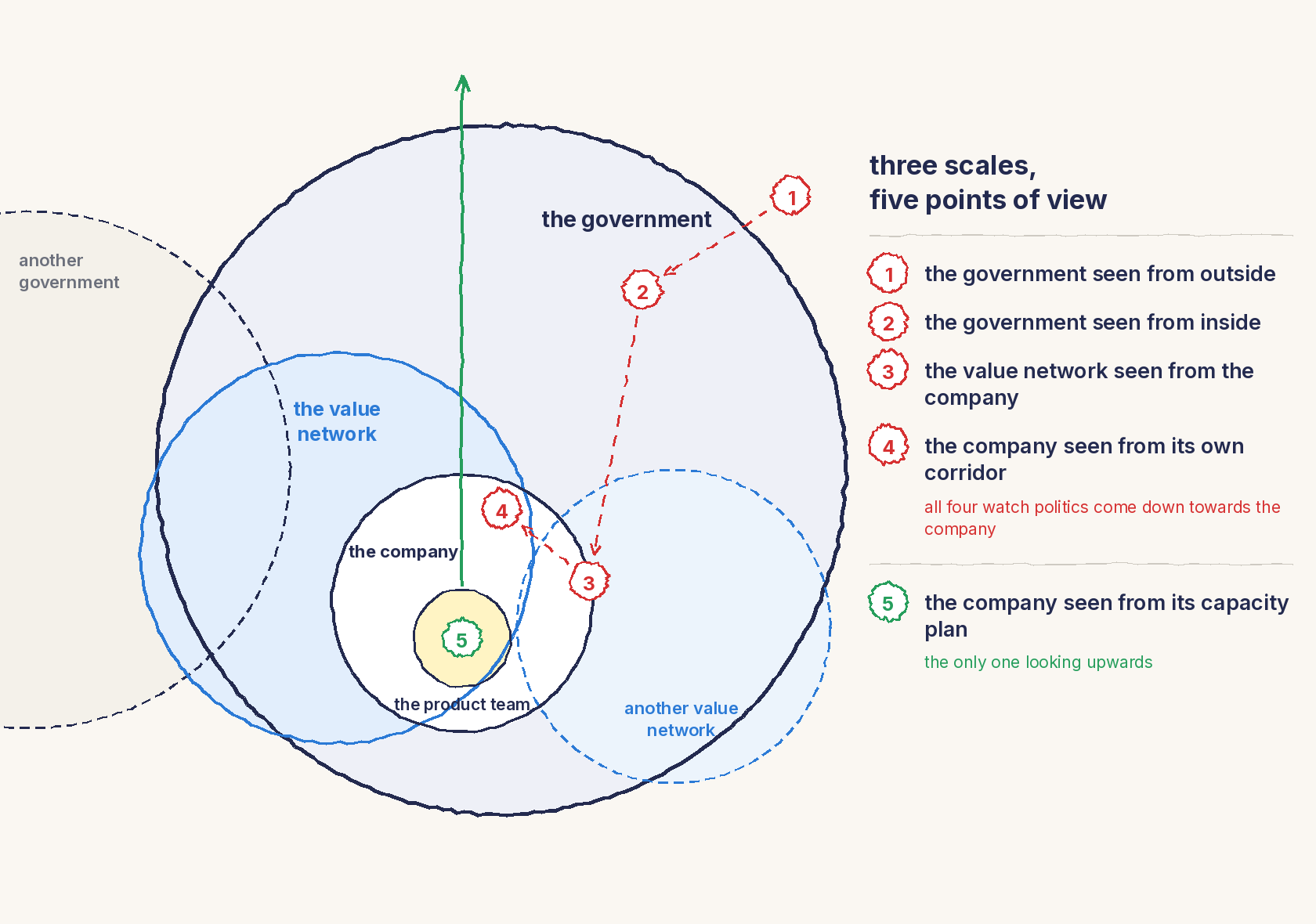
Government first, seen from outside and then from inside, because it is the scale you see least and the one that decides earliest. The value network next, meaning the customers, suppliers, funders, laboratories and trade federations a product depends on, and which can carry it or drop it. The company last, seen from its own corridor, where the group’s trade-offs are also played out.
Then the last point of view turns the gaze around. It starts from the capacity plan, the work to be done set against the people available to do it, and looks upwards: what the company does with the time politics buys it.
Two episodes then complete the journey. The eighth draws the line between network and politics: a network carries trust, politics carries obligation. The ninth asks whether open source is a political tool or the backbone of a network.
Each episode shows politics at work on a case, sometimes going back as far as 1943: Coca-Cola bottles demanded by an army at war, the bankruptcy of Solyndra despite a public loan guarantee, the Taiwanese ground Nvidia stands on, a mobile payment kiosk, an American launcher carrying Galileo satellites, those of the European navigation system. Each time, a different channel.
Finally, one page brings together the instruments of the nine episodes in a sheet each team fills in with its own data, with no outside research.
The missing question
Back to that Thursday evening, to the successful demo, and to the day I closed Lion-up.
The question missing that Thursday evening, as on the day Lion-up closed, was not about the quality of the work. It fitted on one line: who, outside this room, can decide the fate of this product, and may already have done so?
That question is what the series teaches you to ask early enough for the answer to still change something.
Sources
- Qui est David Leblanc, l’auteur de Usines à Impact ?, Impact Factories
- La politique fait le produit (page de la série), Impact Factories
- The author’s own account, September 2026
- Quiet meeting room (Unsplash), Wikimedia Commons, Breather via Unsplash
- Quand l’État se retire, le risque passe sur votre bilan (épisode 2), Impact Factories




.jpg)