
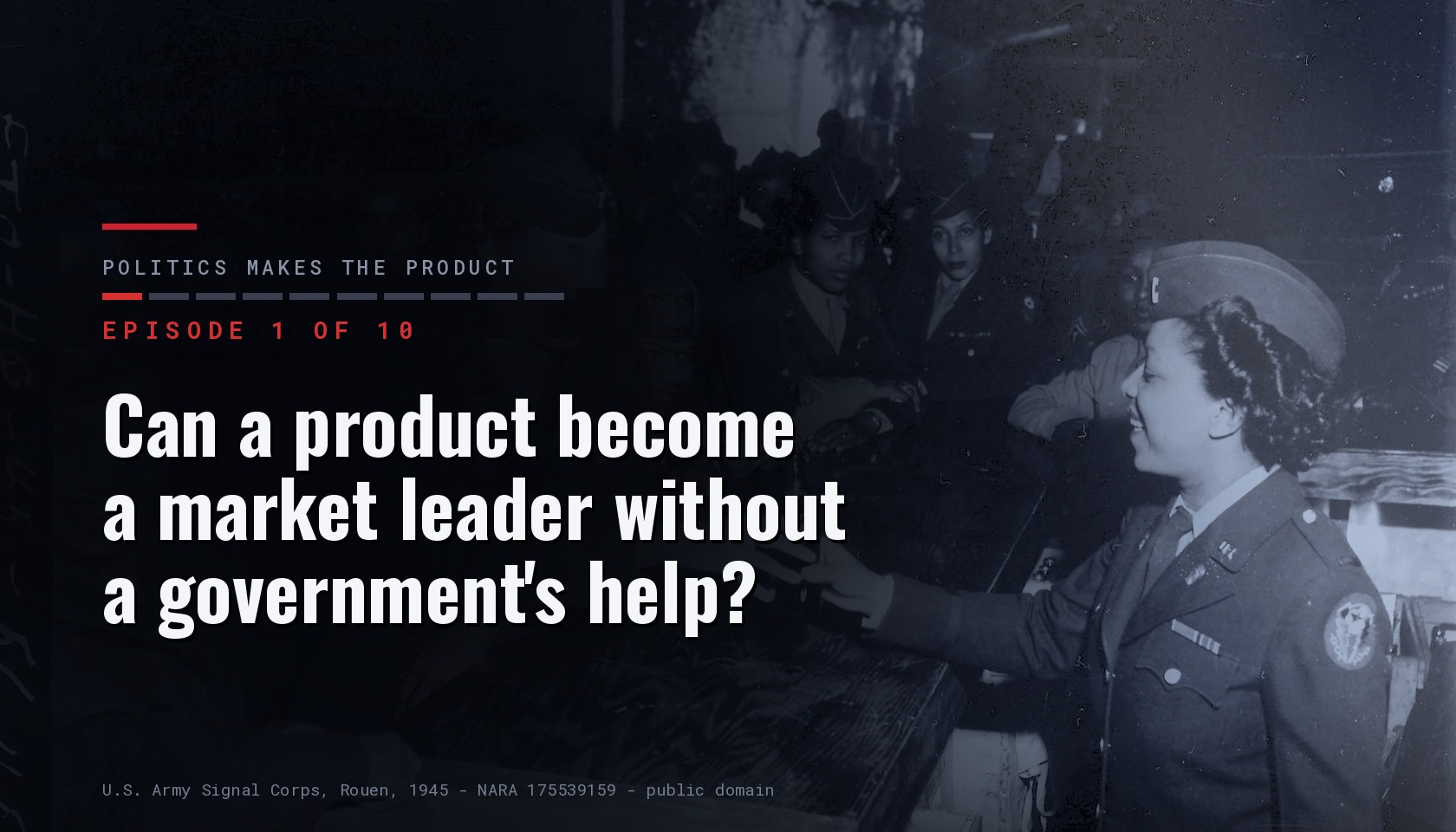
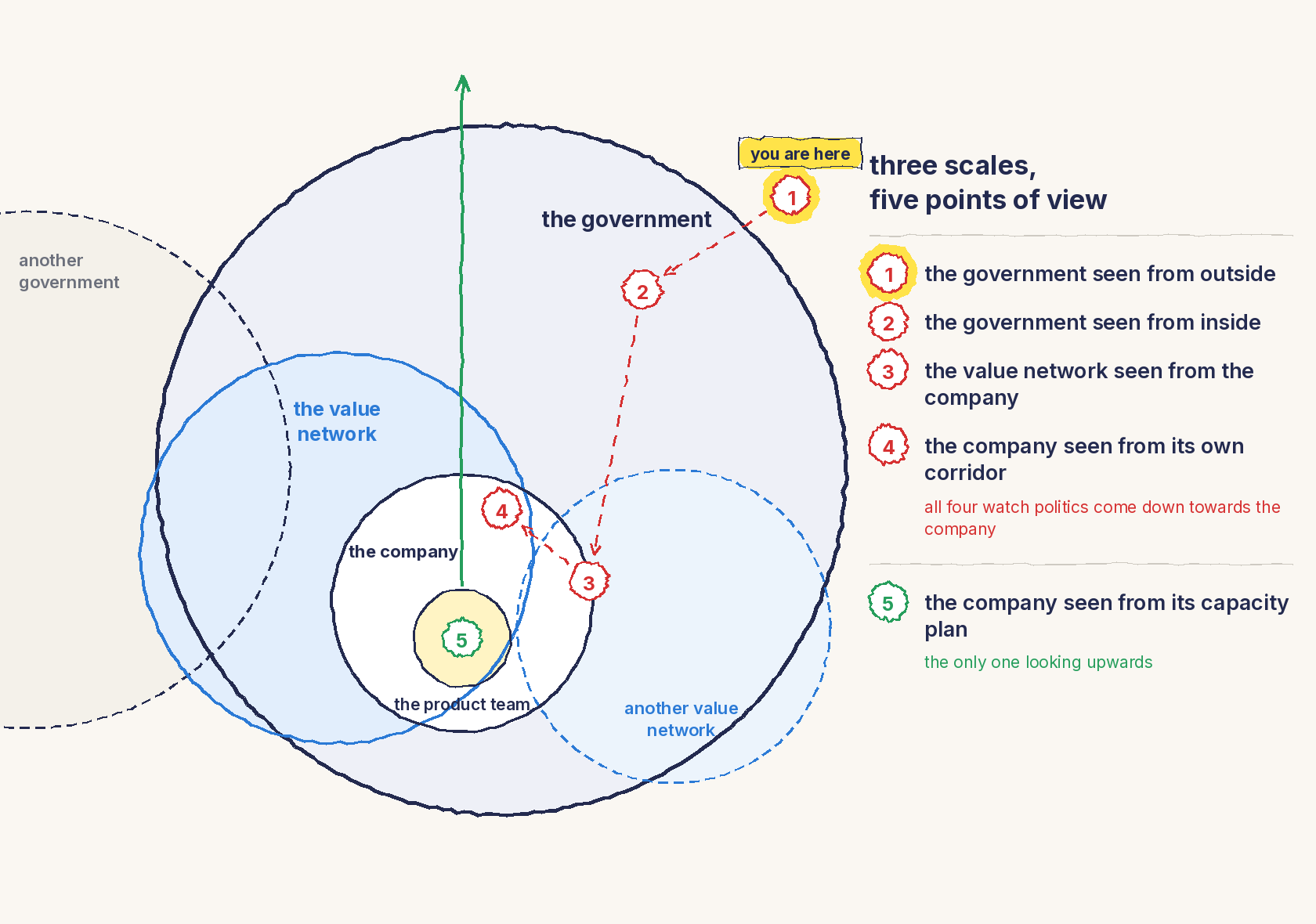
First episode of a ten-episode series on the weight of politics in the success of a product. We start with the most distant scale, the one made of governments, because it is the one you see least and the one that decides earliest.
The cable of June 1943
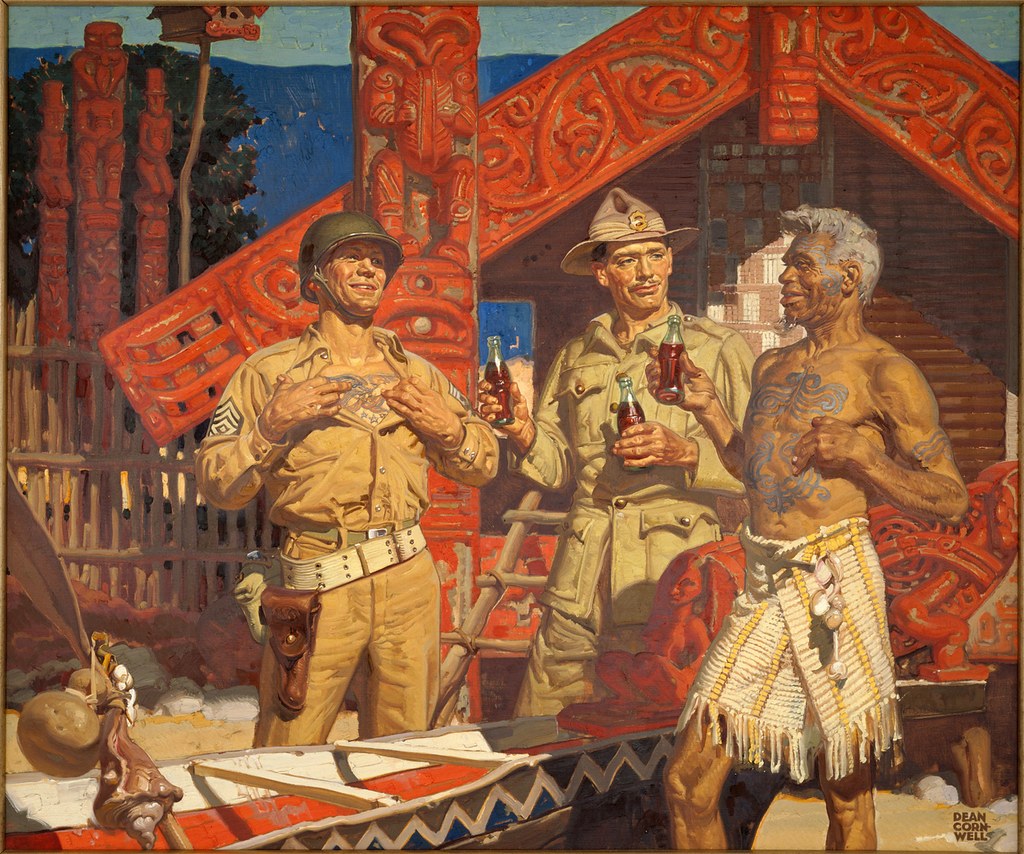
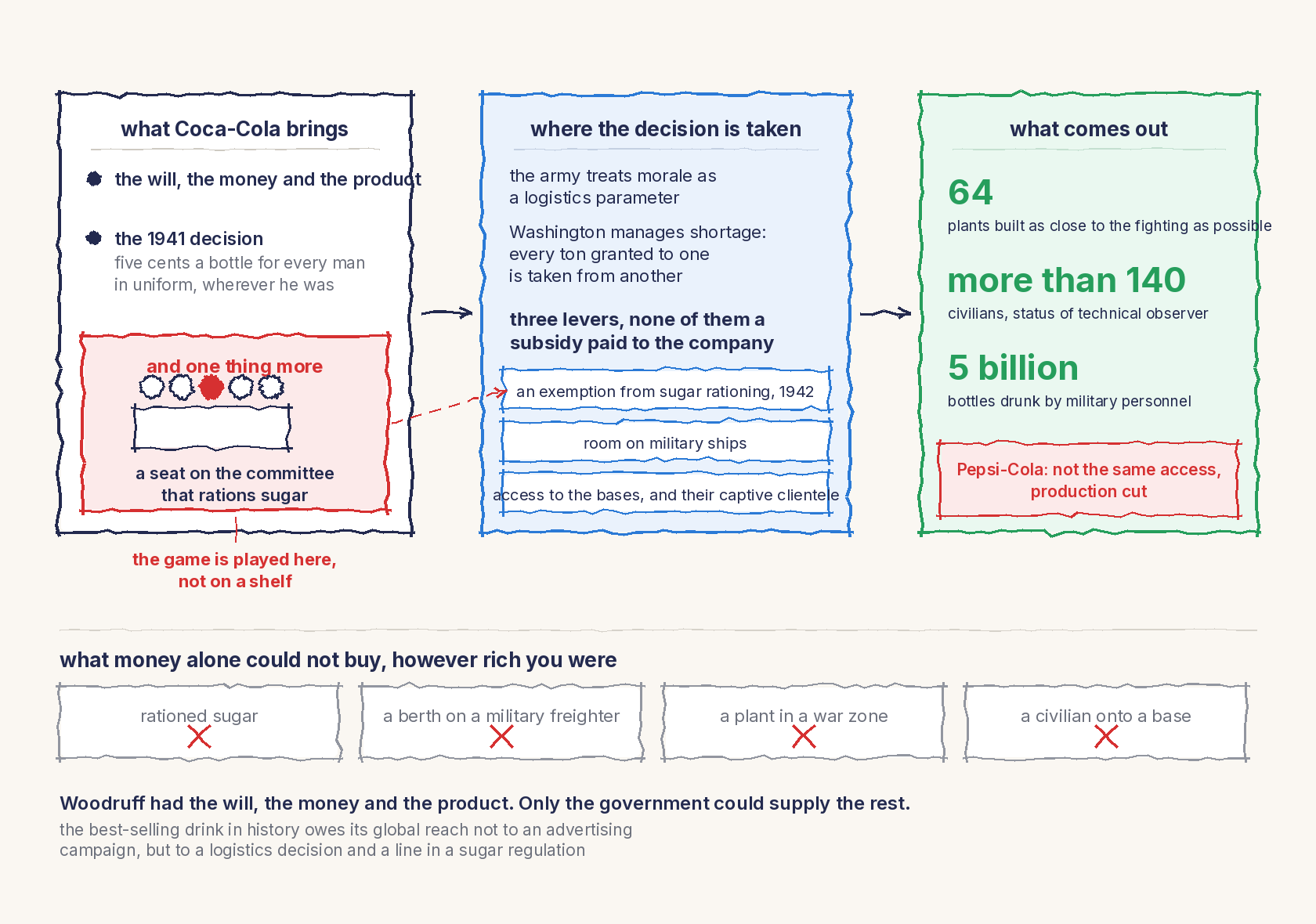
On 29 June 1943, a cable left Allied headquarters in North Africa for Atlanta. A cable, at the time, was an urgent message sent by telegraph. It asked for no ammunition, no fuel, no penicillin. It asked for three million filled bottles of Coca-Cola, the complete equipment for ten bottling plants, and resupply twice a month.
Why would an army at war ask for soda?
Because the army treated the morale of its troops as a logistics parameter, on the same footing as rations. A cold sweet drink, identical to the one you drank at home, beats a speech. Robert Woodruff, then running Coca-Cola, had made a decision two years earlier that was commercial genius: every man in uniform would get his bottle for five cents, wherever he was, whatever it cost the company. The army wanted morale and simple logistics. Coca-Cola wanted two things: an entire generation of consumers won while they were in uniform, and industrial plants in countries where it had none.
The government, though, was managing shortage. Sugar was rationed, and every ton granted to one was taken from another. To let Coca-Cola sell, Washington pulled three levers, none of which was a subsidy paid to the company: an exemption from sugar rationing, granted from 1942 for sales to the army and to retailers serving soldiers; room on military ships, without displacing other cargo; and access to the bases, meaning a captive clientele of several million people.
Six months after the cable, a company engineer opened in Algiers the first of sixty-four plants, built as close to the fighting as possible, in Europe and in the Pacific. They were run by more than a hundred and forty civilian employees to whom the army granted the status of technical observer, uniform included. The soldiers called them the Coca-Cola colonels. Military personnel drank more than five billion bottles before the end of the war.
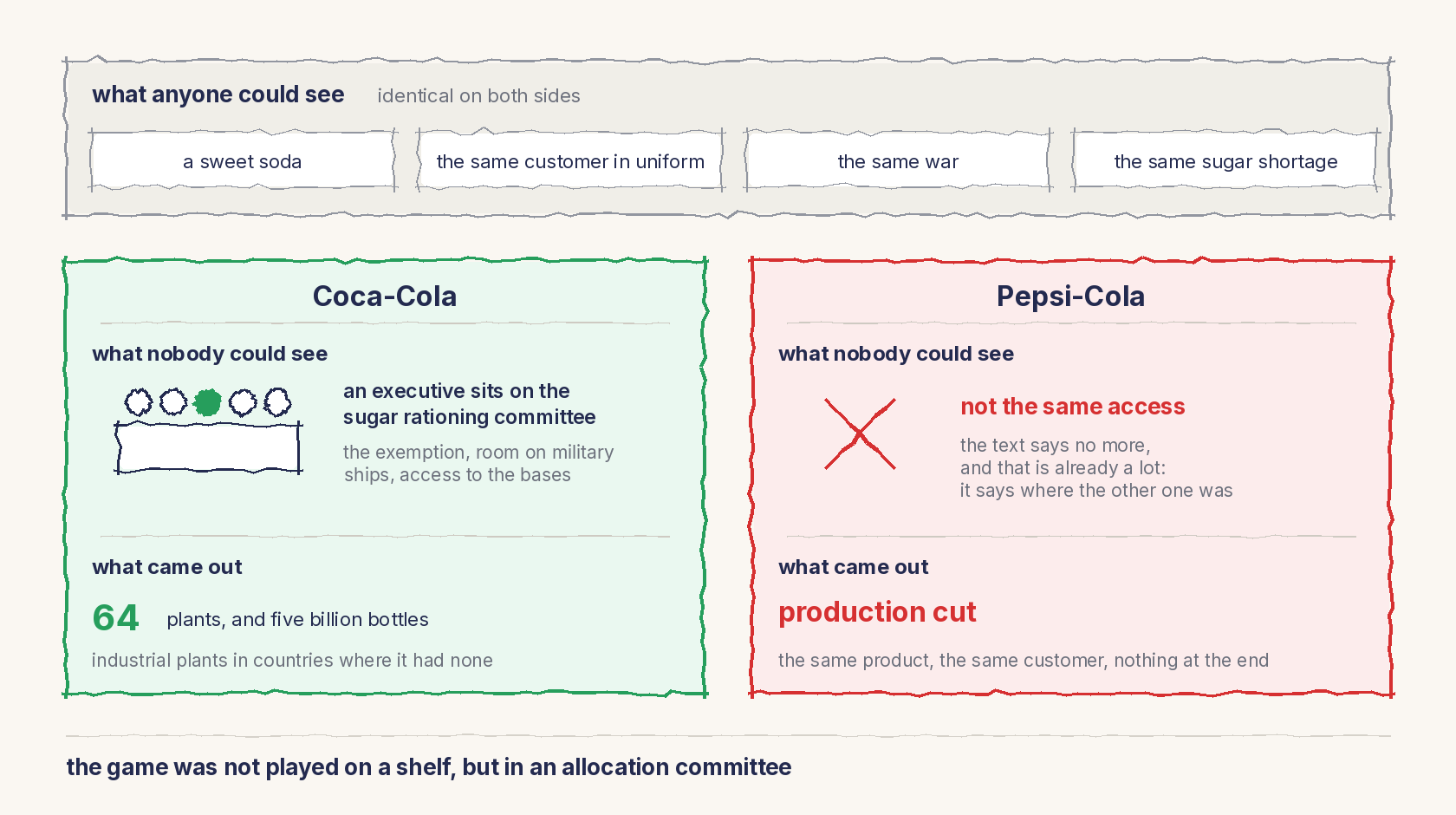
Like every public decision, this one had losers. Pepsi-Cola did not get the same access and had to cut production, while a Coca-Cola executive sat on the committee in charge of sugar rationing. That detail describes the ordinary workings of a war economy, and above all it shows where the game was played: in an allocation committee, not on a shelf.
What could a founder never have done alone?
A private industrialist, however immensely rich, cannot buy rationed sugar. He cannot get his crates loaded onto a military freighter. He cannot build a plant in a war zone, nor walk his civilian employees onto a base without military status. Woodruff had the will, the money and the product. Only the government could supply the rest.
The best-selling drink in history therefore owes its global reach not to an advertising campaign, but to a military logistics decision and a line in a sugar regulation.
Why this belongs on a product manager’s desk
Yes, this is a long way from the discovery work that product management articles usually cover, and that distance is the point: it marks a job the product literature neglects, which is influence. The argument here has three parts. First, no company has reached global leadership without a political envelope around it, and what changes from one country to the next is the channel used, never the existence of the envelope. Second, the rule often beats the check, which distorts how product teams read their own market when they concentrate on tuning their delivery machine. Efficiency does help competitiveness, innovation and therefore differentiation, but the best team with the best product is not automatically the one that wins. Third, that envelope is sometimes withdrawn, and it is better to know in advance what that feels like.

Here is the map of the ground we will cover.
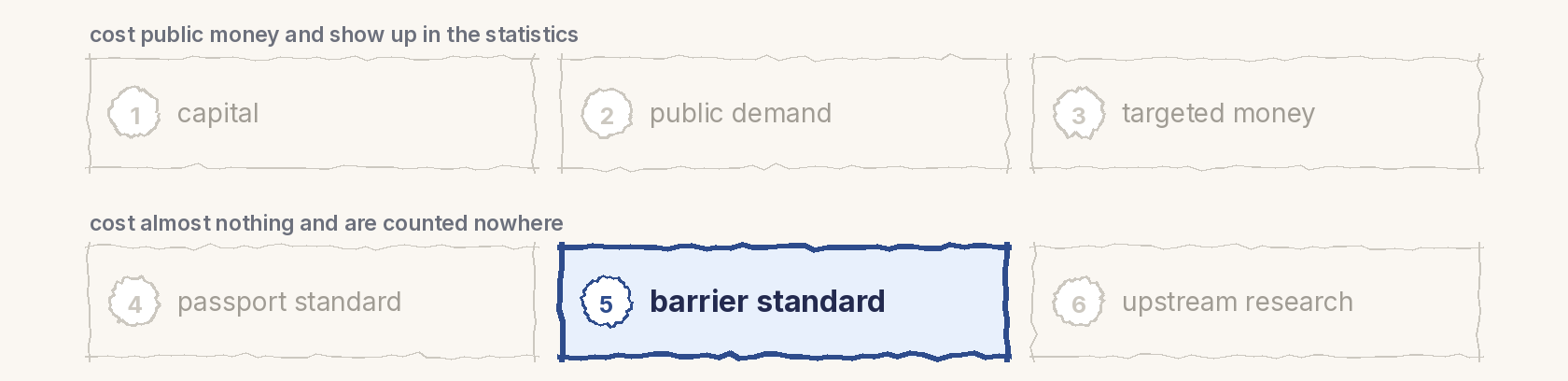
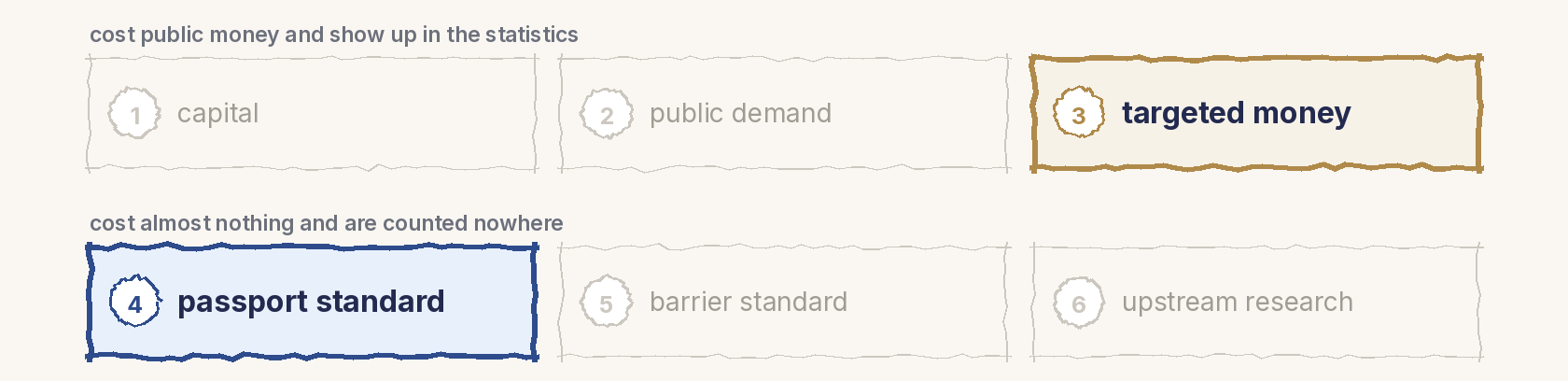
Six channels, two rows
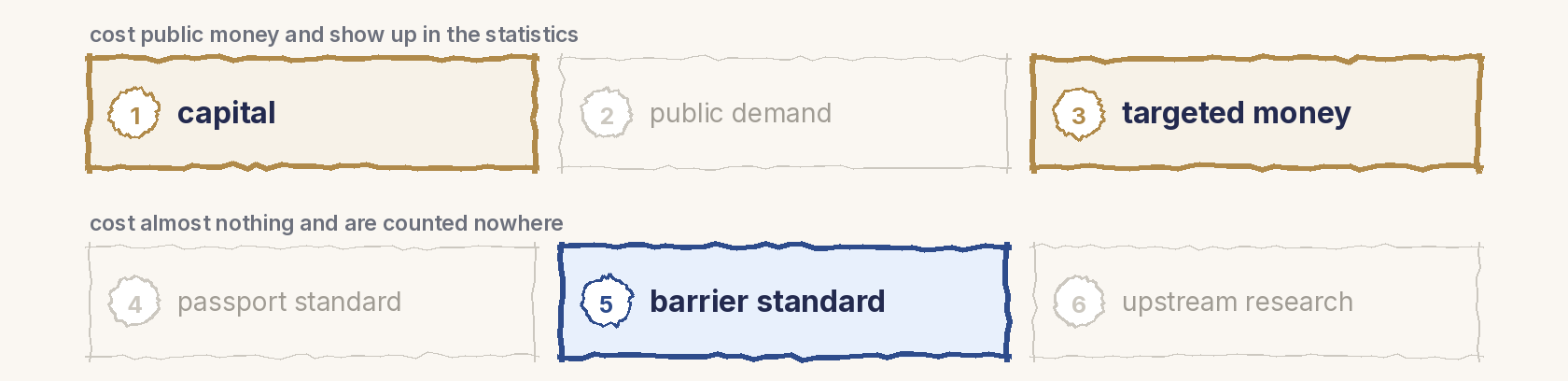
Pick a channel, then add others to see how they combine.
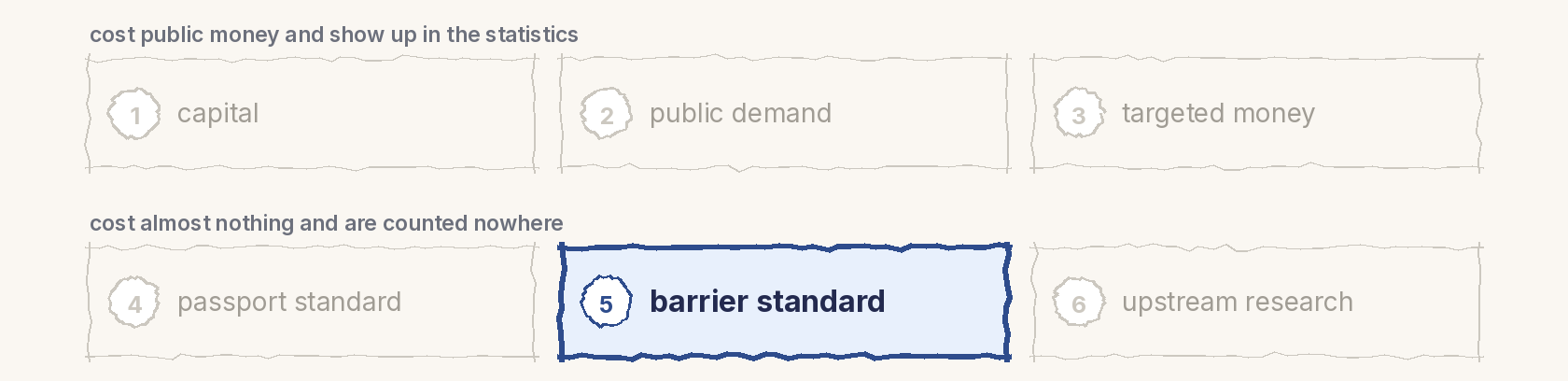
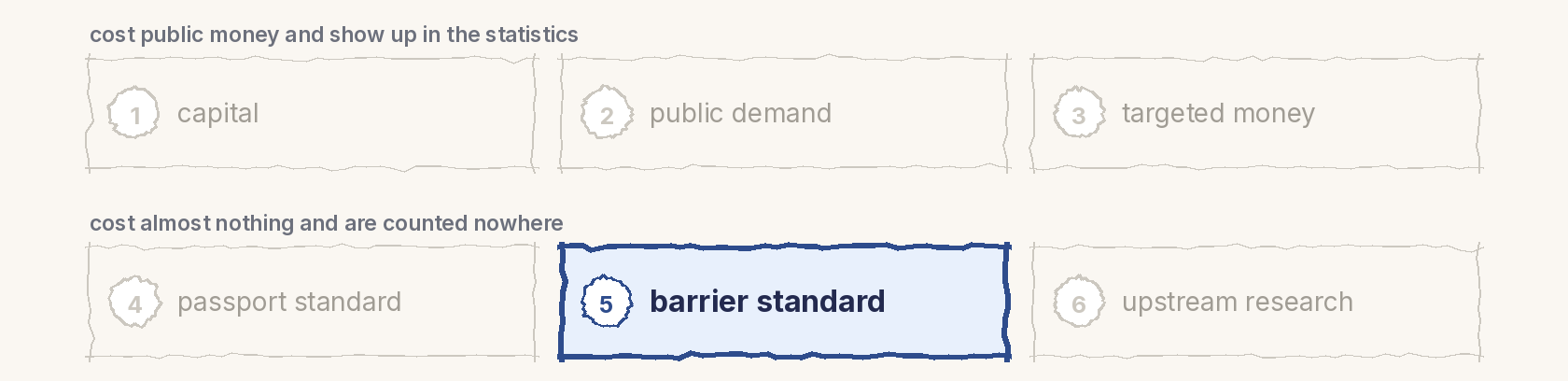
The six channels through which a government holds a product
A grayed-out channel does not mean the combination is impossible: only that no case documented in this series brings it together.
It is through the bottom row that most of the examples in this article pass, and it is the one no international comparison measures.
The cable of 1943 travels through two of these channels: public demand, with the military bases and their captive clientele, and the barrier standard, with a sugar rationing system that shut Pepsi out.
Bananas, or twenty years of negotiation over a one-euro fruit
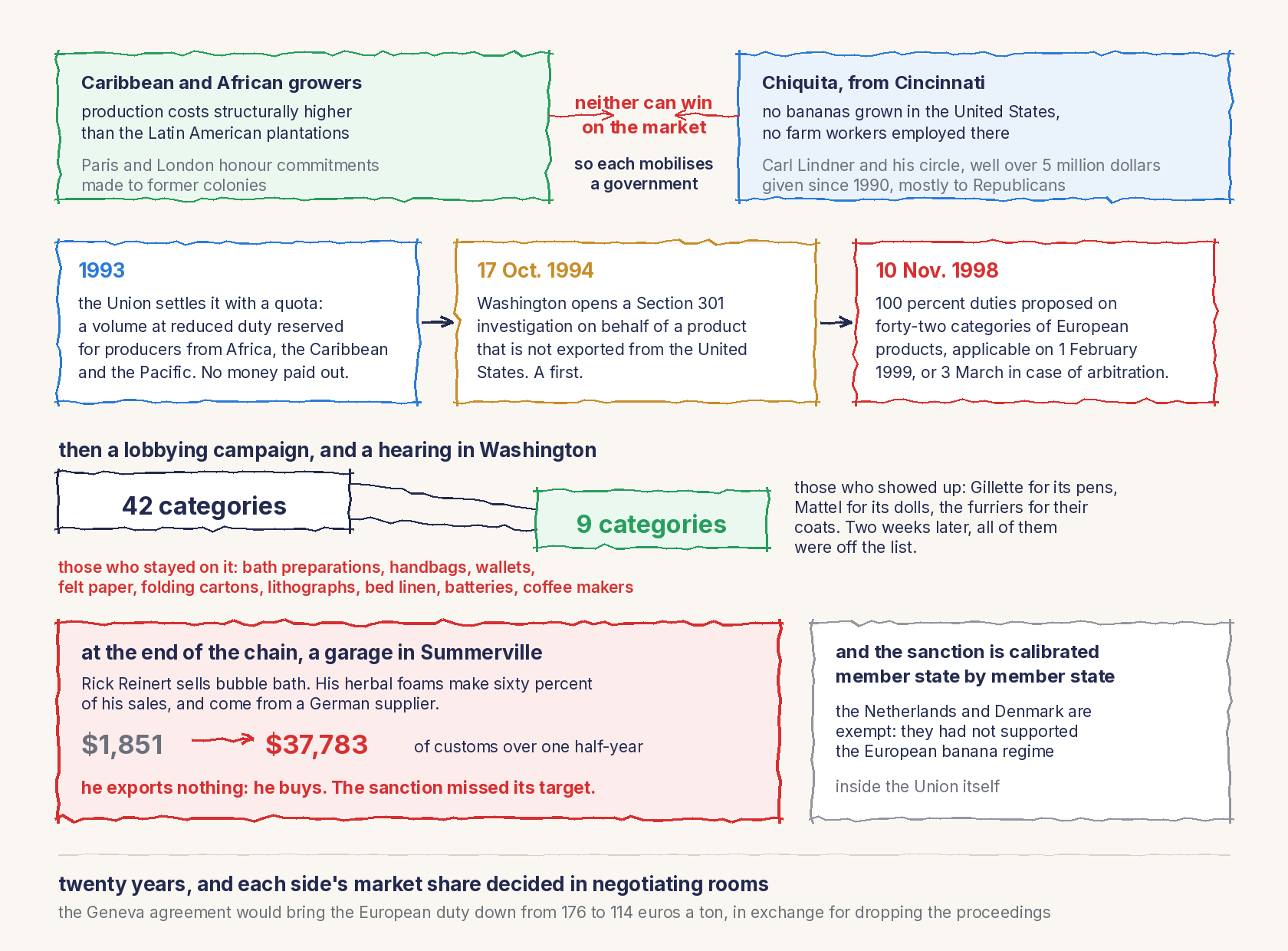
In the early 1990s, Europe was about to open its single market. Until then, each country handled its bananas its own way. France and the United Kingdom protected production from their former colonies and their territories, in the Caribbean and in West Africa. Germany, which had no banana-growing colony, freely imported the cheapest bananas in the world: those from Latin America, grown at scale and sold mainly by American groups. Chiquita alone held 45 percent of the German market.
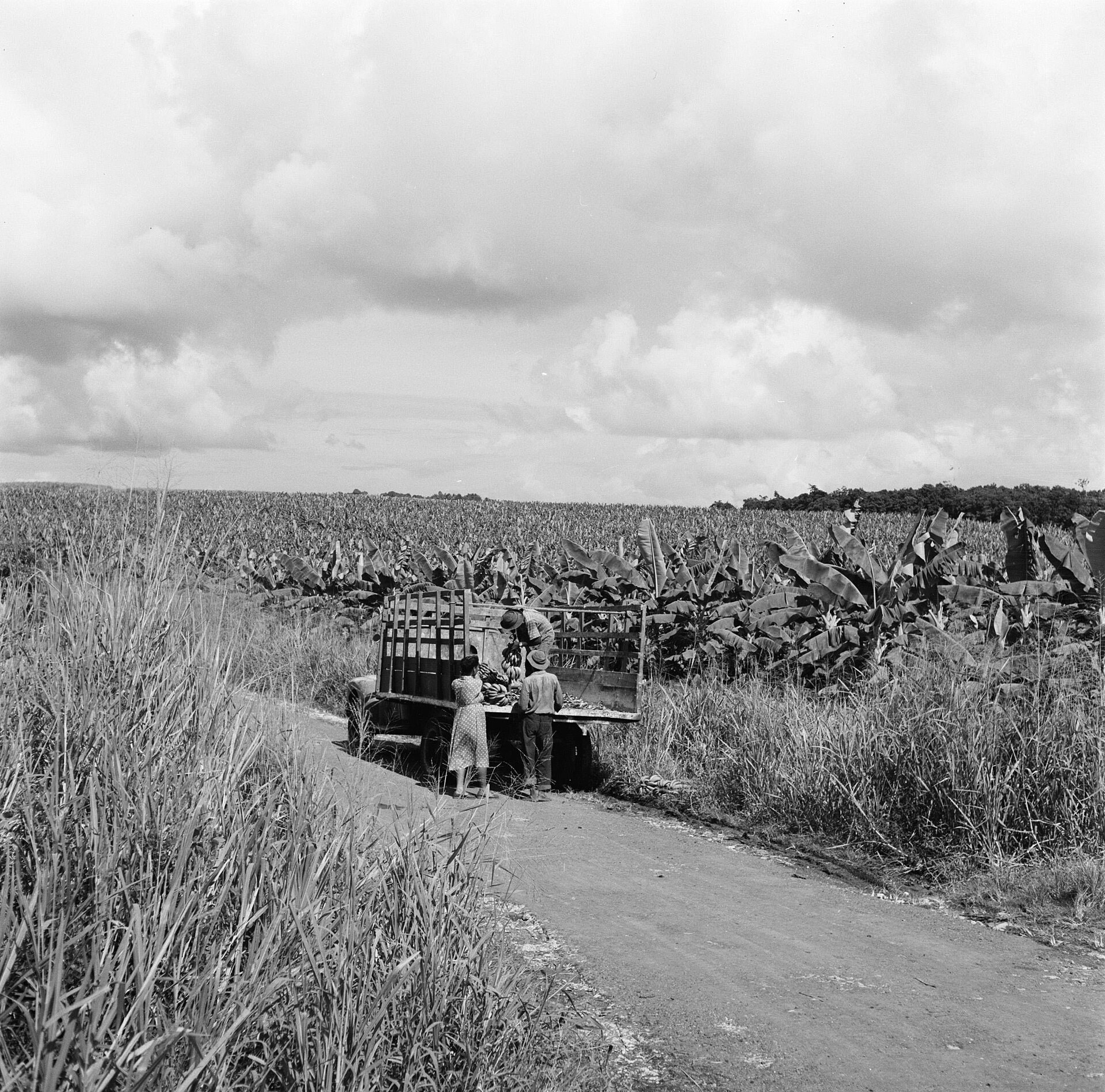
What was each side defending? Caribbean and African growers wanted to survive, with production costs structurally higher than those of the huge Latin American plantations. Paris and London were honoring commitments made to former colonies for which they remained responsible. German distributors wanted their cheap banana. Carl Lindner, chairman and chief executive of the banana multinational Chiquita Brands International, wanted Europe.
Lindner ran Chiquita from Cincinnati. By 1984 he had taken control of the famous company, formerly United Fruit. Although he grew no bananas in the United States and employed no farm workers there, he carried real weight in American politics: since 1990, he, his family, his companies and their executives had given well over 5 million dollars, mostly to the Republicans, and to the Democrats at strategic moments.
In 1993 the European Union settled the matter with a common market organization, meaning a single set of rules for the whole continent. The instrument paid out no money: it set a quota, a volume allowed in at reduced duty, reserved as a priority for producers from Africa, the Caribbean and the Pacific. Everyone else paid more.
The Americans did not like it. Mickey Kantor, the United States Trade Representative, opened on 17 October 1994, at Chiquita’s request, a Section 301 investigation, the procedure that leads to trade retaliation, on behalf of a product that is not exported from the United States. A first. It triggered one of the longest trade disputes in the history of the multilateral system, repeated rulings against Europe, and American customs sanctions that struck back at European products with no connection to bananas.
On 10 November 1998, the American administration proposed 100 percent duties on forty-two categories of European products, applicable on 1 February 1999, or 3 March in case of arbitration, if Europe did not give way. Then came a lobbying campaign. Gillette pleaded for its pens, Mattel for its dolls, the furriers for their coats, and two weeks after the hearing all of them were off the list. On 3 March, without waiting for the arbitration to conclude, Washington held up the customs clearance of more than 500 million dollars of imports and demanded bonds covering a 100 percent duty, which earned it a ruling against it in turn. Arbitration brought the amount down to 191.4 million, a little over a third. On 19 April, Charlene Barshefsky, by then the Trade Representative, published the final list: nine categories only: bath preparations, plastic handbags and wallets, felt paper, folding cartons, lithographs, cotton bed linen, lead-acid batteries and electric coffee makers. Pecorino, greeting cards, chandeliers and cashmere sweaters, all on the November list, had come off it.
Meanwhile Rick Reinert was selling bubble bath, a business that looks a long way from any of this. He had started it in the family garage in Summerville, South Carolina, with his wife, whom he had met during his military service in Germany. His herbal foams, lavender and rosemary, made sixty percent of his sales. They came from a German supplier. His customs bill went from 1,851 dollars to 37,783 over the second half of the year. When he called the Trade Representative’s office, he was told they were surprised he was still importing, and that he should have shown up at the Washington hearing, like Gillette and Mattel.
The whole principle of trade retaliation is to hurt exporters, who will then go and complain to their own government. Reinert exported nothing. He bought.
The Netherlands and Denmark were exempt, because they had not supported the European banana regime. Washington calibrated its sanction member state by member state, inside the Union. Then an agreement signed in Geneva with eleven Latin American countries brought the European duty down from 176 to 114 euros a ton, in exchange for dropping the proceedings.
What could a founder never have done alone?
No grower in Guadeloupe, however good, closes a structural cost gap against a plantation of several thousand hectares through sheer productivity. No American group, however powerful, brings down a European quota by commercial force alone. So both camps did the only effective thing: they mobilized a government. For twenty years, each side’s market share was decided in negotiating rooms far from any shelf, and the bill landed on the desk of a man selling bubble bath.
Chicken and pickup trucks
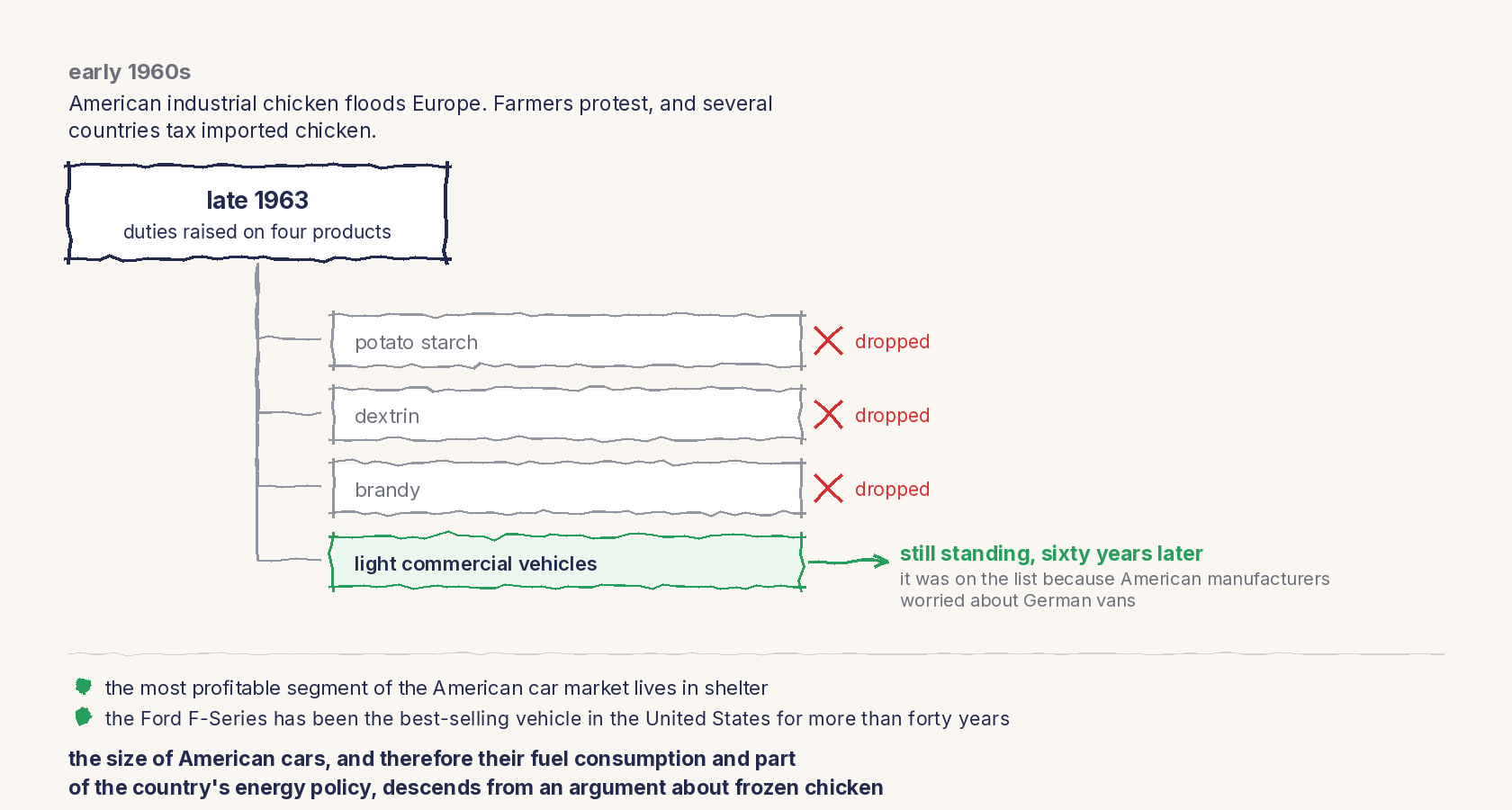
In the early 1960s, American industrial chicken production exploded and flooded Europe. European farmers protested, and several countries taxed imported chicken.
In late 1963, Lyndon Johnson hit back by raising duties on four European products chosen to hurt, with light commercial vehicles taxed at 25 percent: potato starch, dextrin, brandy and light commercial vehicles. The last one is on the list because American manufacturers and their union were worried about German vans arriving on their market.

Washington eventually dropped the first three duties. The fourth is still standing, sixty years later. The most profitable segment of the American car market has lived in shelter: the Ford F-Series has been the best-selling pickup in the United States since 1977, and the country’s best-selling vehicle for more than forty years.
The size of American cars, which drives their fuel consumption and therefore part of the country’s energy policy, descends from an argument about frozen chicken.
The T-shirt, or how a quota built a national industry
In the 1970s, European and American textile industries were losing ground to Asian producers. They employed a great many people across entire regions, and that weight converts into political weight. Northern industrialists were asking for time. Their governments wanted to avoid a wave of closures, while the exporting countries of the day, Japan, South Korea, Hong Kong and Taiwan, wanted to keep selling.
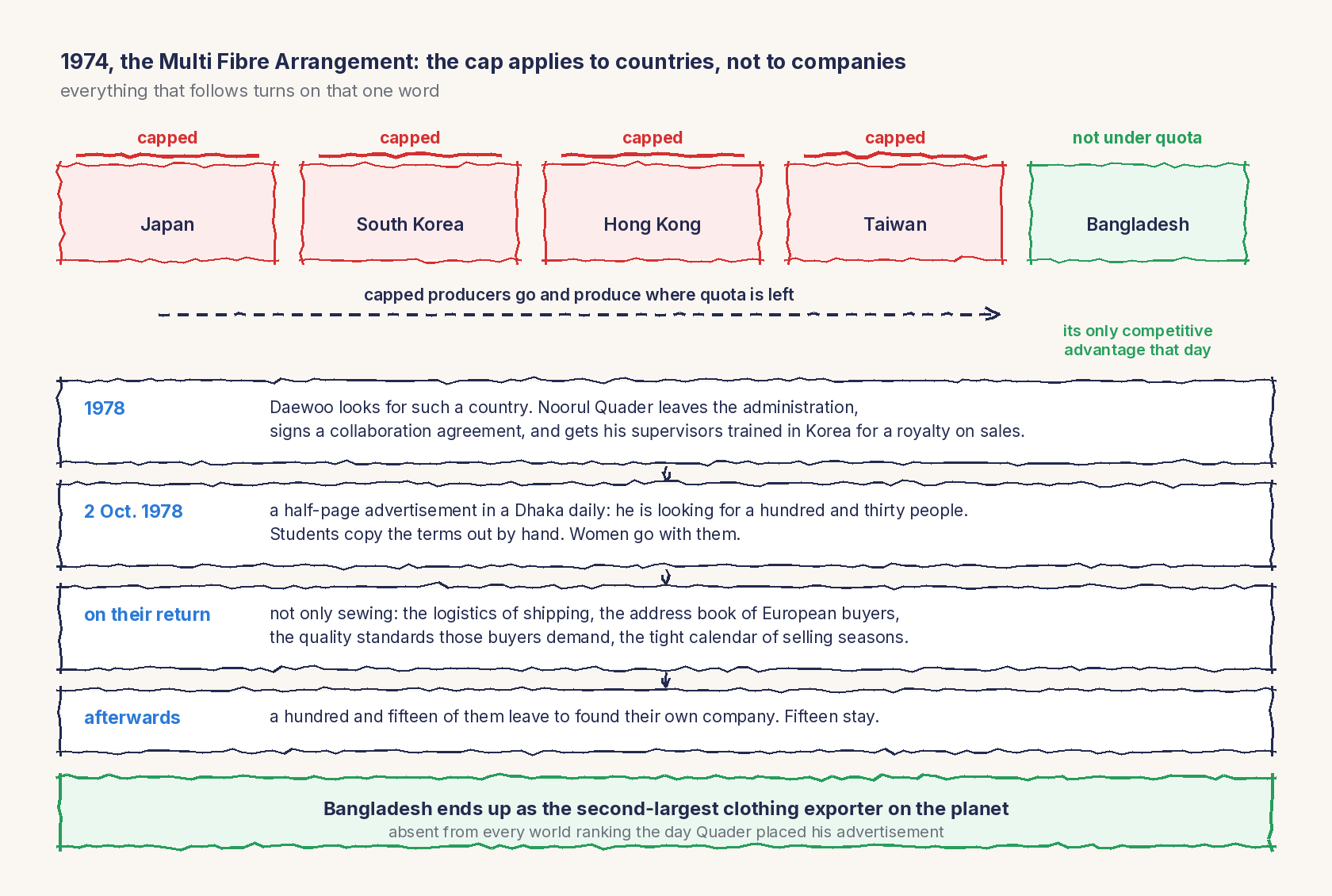
From 1974 to 1994 the Multi Fibre Arrangement, then until 2004 the WTO agreement that replaced it, allowed importing countries to cap textile exports from developing countries. A quota, here, caps the number of garments a given country is allowed to ship to another. Everything turns on one word: the cap applies to countries, not to companies. So at the very moment the rest of world trade was being liberalized, textiles moved under a control that handed out a quota per exporting country rather than a ceiling on total imports. Capped producers then did the only rational thing: they went to produce where quota was still available.
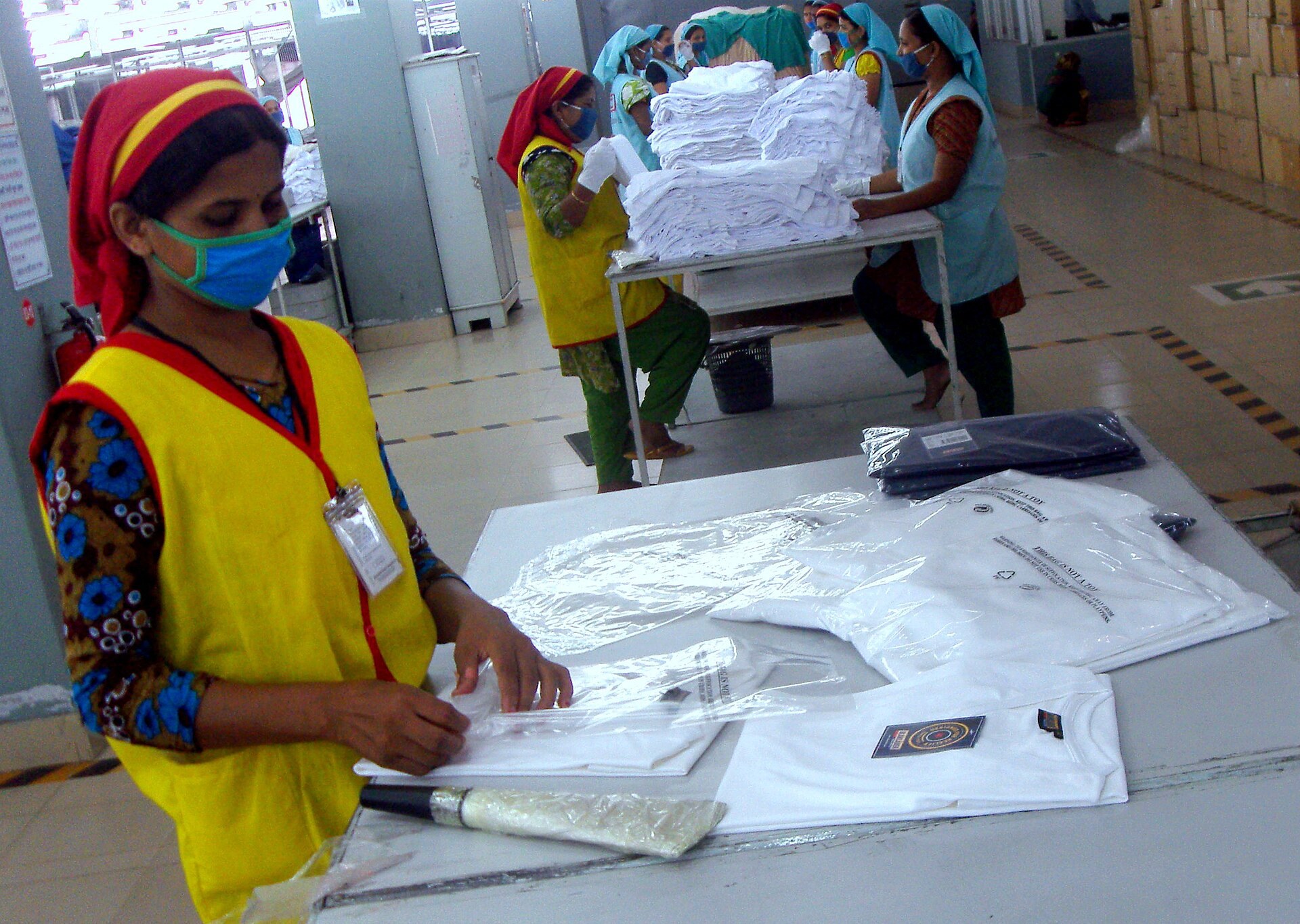
Daewoo, a Korean conglomerate, was looking for such a country. Noorul Quader, a former civil servant who had been the first establishment secretary of Bangladesh’s provisional government during the 1971 war of liberation, left the administration and went looking for an industry to build in a country that had almost none: Bangladesh. Quader signed a collaboration agreement with Daewoo in 1978, and Daewoo trained his Bangladeshi supervisors in Korea, in exchange for a royalty of 3 percent of the sales of Quader’s company.
On 2 October 1978, he ran a half-page advertisement in a Dhaka daily. He was looking for a hundred and thirty people. The advertisement drew a crowd at the university canteen, where students copied the terms out by hand. Women went with them, the first Bangladeshi women sent abroad for training.
They came back with more than sewing skills: with the logistics of shipping, the address book of European buyers, the quality standards those buyers demand, and the tight calendar of selling seasons. A hundred and fifteen of them would later leave the company to found their own. Fifteen stayed. Yung Whee Rhee, an economist at the World Bank, went to interview them on site and wrote the reference account of that start.
Bangladesh, absent from every world clothing ranking at the moment Quader placed his advertisement, ended up as the world’s second-largest clothing exporter, behind China, with millions of jobs and a social transformation nobody had planned. And the price of your T-shirt.
What could a founder never have done alone?
Turn the question around, it is more interesting that way: no investor in the world would have chosen Bangladesh in 1978. No reliable electricity, no modern port, no trained workforce, no industrial tradition, a country seven years out of a war. The country’s only competitive advantage that day sat in a line of regulation: it was not under quota. Nothing else. A sentence written in Geneva to protect European spinning mills built a national industry on the other side of the world.
Diesel, or the government as shareholder, tax collector and regulator at once
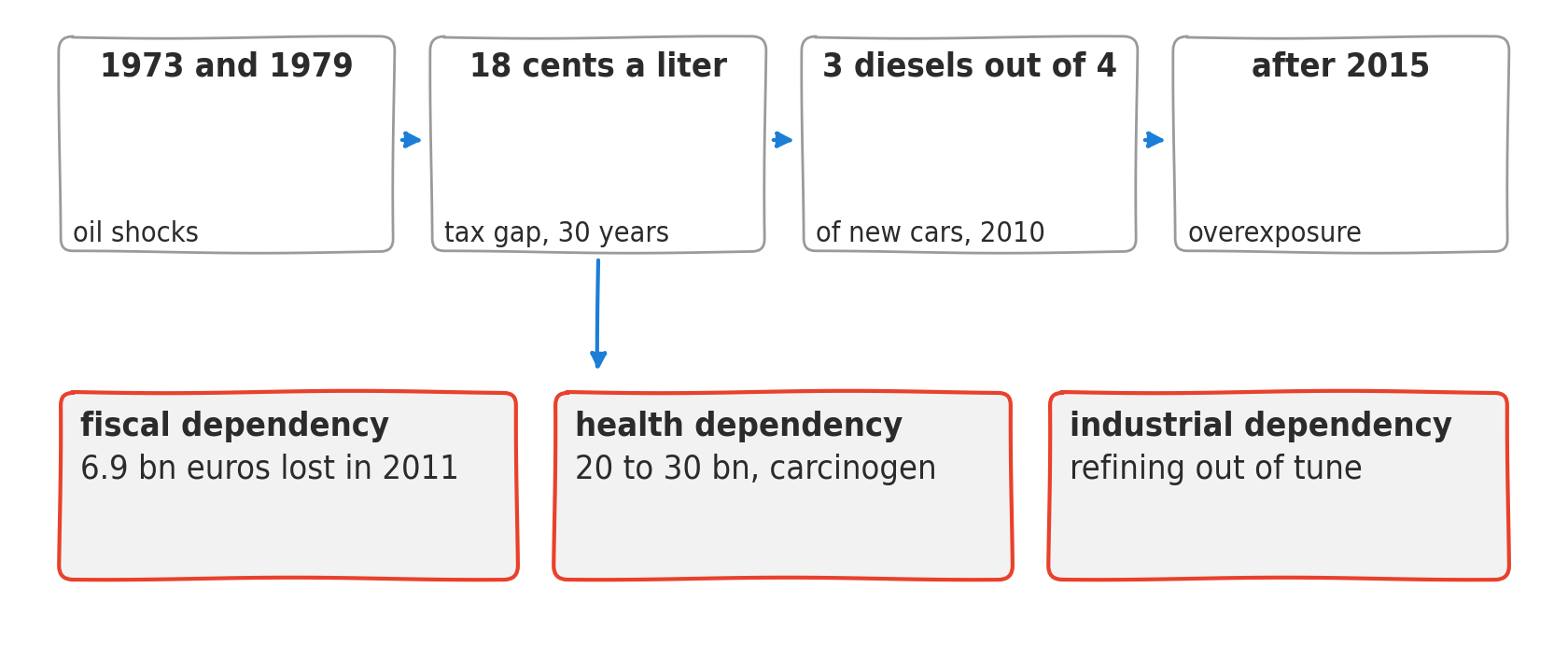
Two oil shocks, in 1973 and again in 1979, left France with an import bill it did not know how to pay. Diesel burns less per kilometer than gasoline. Road hauliers run on diesel, and their fuel bill ends up inside the price of everything that moves around the country.

The hauliers wanted cheap fuel, and they knew how to shut a country down in three days. The government was trying to cut its oil consumption and hold down the cost of transport. Carmakers wanted a market. Renault, above all, was nationalized in 1945 and remained until 1990 a régie, a state-owned company with a statute of its own, which a law then turned into a public limited company so that Volvo could take a stake in it. It remained a publicly owned company until its 1996 privatization, and still counts the state among its reference shareholders today, a stake that, as the economy minister put it in 2015, lets it weigh on the company’s strategic decisions. The French government does not arbitrate this market from outside. It plays in it.
The decision and its instrument: no subsidy, no order book. A fuel tax gap, held for decades, of around 18 cents per liter between diesel and gasoline, at a time when the European average was around 12.
On 17 December 2012, the Cour des comptes, France’s national audit office, sent the ministers of the economy and of ecology a formal letter on energy tax expenditure, which it made public the following 1 March. A tax expenditure is revenue the state gives up by taxing one thing less than another. The court’s reproach was that the administration did not even count this gap among its tax expenditures. Delphine Batho, then ecology minister, replied in February. She wrote that the differential “results mainly from the choice made by France” and by other European countries after the two oil shocks, the choice of a tax regime favoring a diesel car fleet. She added that the policy had initially aimed to reduce road transport consumption in order to loosen the country’s energy dependence. A ministry acknowledged in writing, before its own state’s audit judge, that it had manufactured a consumption preference.
Christian de Perthuis received the file straight afterwards. He chaired the committee on environmental taxation, which ruled on 18 April 2013 that the gap could not be justified against the environmental costs of the two fuels.
This produced an advantage cut for road professionals that spilled over onto private buyers, who do the arithmetic at the pump. But it also let French carmakers place a considerable industrial bet: they invested in a technology their domestic market was asking for and that taxation made unbeatable. They became excellent at diesel, and their domestic market soon asked them for little else. By the early 2010s, close to three out of four new registrations were diesels.
Then the bill arrived, and it ran into the billions. Taxing diesel less than gasoline deprived the state of 6.9 billion euros for the single year 2011, according to the customs administration’s estimate, and around eight billion counting the reduced rates granted to fishing and farming. The court put the health cost at 20 to 30 billion, three to four times the lost revenue. In June 2012, the World Health Organization classified diesel engine exhaust among carcinogens. And the French refining base, calibrated for another era, found itself out of tune: the country imports diesel while exporting its gasoline.
After 2015, taxation converged and regulation turned against diesel. Since an order of 21 June 2016, the French government has classified cars by their emissions of particles and nitrogen oxides: a recent gasoline car gets the Crit’Air 1 sticker, a diesel of the same generation gets no better than 2, and low-emission zones, urban areas where traffic is restricted according to that classification, sort vehicles by the sticker. French carmakers discovered they had specialized in exactly the technology public policy had sold them.
What could a founder never have done alone?
No carmaker can open an 18 cent per liter gap at the pump and hold it for thirty years. That lever moves the behavior of millions of buyers, and it belongs to the government alone. Carmakers did not create diesel demand. They served it, very well, until the day the hand that had created it took it away.
Here the government holds three roles at once: shareholder in a carmaker, collector of the tax that steers the market, and regulator of public health. Those roles pull against each other, but the preference they sustained also produced a real industrial result. In May 2000, PSA fitted the Peugeot 607 2.2 HDi with the first particulate filter installed on a production car, a device that traps soot in the exhaust: the diesel specialist went after soot, the weak point of its own technology. Stellantis, PSA before 2021, has topped the ranking of patent applicants at the Institut national de la propriété industrielle, France’s patent office, fourteen times in twenty years, and European Union companies keep the world lead in automotive research and development. That excellence did not protect jobs: between 2010 and 2023, French automotive manufacturing went from 425,500 to 286,800 jobs counted as full-time, a fall of a third, while the rest of French manufacturing lost only 1 percent. The day the public health regulator weighed more than the other two roles, it found an innovative industry, specialized in exactly the technology it now had to rein in.
Rules draw the product too
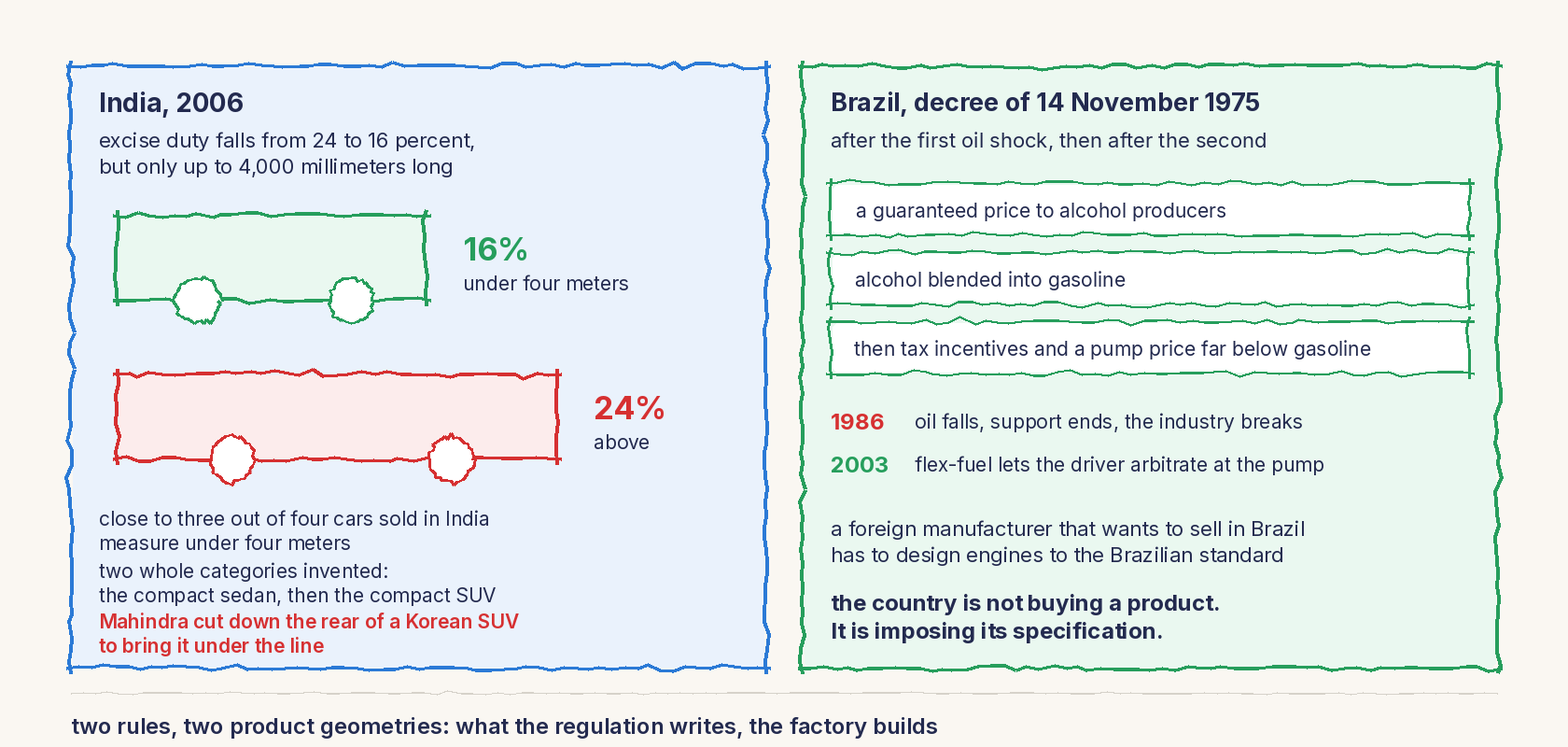
In India, a budget speech set the length of cars. In 2006, finance minister P. Chidambaram cut excise duty (the tax paid at the factory gate) from 24 percent to 16 percent, but for small cars only. To qualify, a model could be no longer than 4,000 millimeters, with an engine capacity (the total volume of the engine’s cylinders) of no more than 1,200 cubic centimeters for gasoline and 1,500 for diesel. The minister was counting on industry to make India a hub for small, fuel-efficient cars. The measure stuck as the four-meter rule.
In 2022, 73 percent of cars sold in India, close to three out of four, measured under four meters. Manufacturers invented two whole categories to fit inside the constraint: the compact sedan, then the compact SUV. The first compact sedan, the Tata Indigo CS, was an Indigo already on sale with its trunk cut short, and Mahindra cut down the rear of an SUV from its Korean subsidiary SsangYong to bring it under the line.

In Brazil, a decree set the fuel, and engines followed. It dates from 14 November 1975, after the first oil shock: the state guarantees a price to alcohol producers and organizes its distribution for blending into gasoline. After the second oil shock, it adds tax incentives to buy alcohol-powered cars and a pump price far below that of gasoline. From 1986, the fall in oil prices and the end of support broke the industry, and the 1989 shortage of alcohol at the pump left drivers wary. The revival came in 2003 with flex-fuel engines, which let the driver arbitrate at the pump.
Today, a foreign manufacturer that wants to sell in Brazil has to design engines compatible with the Brazilian standard. The country is not buying a product. It is imposing its specification.
Six cases, six times the same trace, and each time a rule written before the product existed. We could stop here and conclude. That would be going too fast: the fact that a company was helped does not prove the help explains anything. That is what the next episode is about.
What this article rests on
The cable of June 1943
- The Coca-Cola Company, “The Chronicle of Coca-Cola: A Symbol of Friendship”, for the cable dated 29 June 1943, the clause forbidding it to displace other cargo, the three million bottles, the ten plants, the engineer sent to Algiers and the sixty-four plants
- United Service Organizations, interview with the company archivist, who attributes the cable to General George Marshall rather than to Eisenhower
- “Quench Warfare”, HistoryNet, on the 1942 letter campaign, the sugar rationing exemption for sales to the army, and the company executive appointed to the rationing committee
The banana dispute
- European Commission, case file on dispute WT/DS27
- WTO, press release Press/591, Lamy welcomes the agreement ending the long banana dispute, December 2009
- Donald Barlett and James Steele, “How to Become a Top Banana”, Time, 7 February 2000, on Lindner, Kantor, Barshefsky, the lists of 10 November 1998 and 19 April 1999, and the case of Rick Reinert
Chicken and pickup trucks
The T-shirt and Bangladesh
- Yung Whee Rhee, “The catalyst model of development: lessons from Bangladesh’s success with garment exports”, World Development 18(2), 1990, pp. 333-346, the reference for the 130 trained in Pusan and the 115 departures
- Desh Garments, founder’s page, on the joint venture with Daewoo and the number of leavers, a figure that diverges from other sources
- The Daily Star, “Desh Garments, a pioneer’s gift to his country”, on the advertisement of 2 October 1978 and the career of Mr Noorul Quader
French diesel
- Céline Antonin, Avantage fiscal sur le gazole : une fin programmée, OFCE, 2017
- French Senate, report l13-600, which reproduces Delphine Batho’s February 2013 reply to the Cour des comptes and the 6.9 billion euro estimate for 2011
- Actu-Environnement, 1 March 2013, on the formal letter sent on 17 December 2012 to the ministers of the economy and of ecology and made public on 1 March
- Citepa, March 2013, “La Cour des Comptes recommande de réduire l’écart fiscal entre le gazole et l’essence”, on the 6.9 billion estimated by customs, the eight billion including reduced rates, and the gap never listed among tax expenditures
- French National Assembly, written question 27181 from Lucette Lousteau, answer published in the Journal officiel on 2 July 2013, on the committee chaired by Christian de Perthuis
- L’argus, “Filtre à particules : le pot de la discorde”, 23 February 2011, on the first production particulate filter, fitted by PSA to the Peugeot 607 2.2 HDi in May 2000
- L’argus, 3 March 2026, on the INPI ranking: Stellantis, PSA before 2021, first fourteen times in twenty years
- European Commission, Joint Research Centre, 2025 EU Industrial R&D Investment Scoreboard, 22 December 2025, on EU companies’ world lead in automotive R&D
- Insee Analyses no. 116, “La filière automobile manufacturière en France entre 2010 et 2023”, for the fall from 425,500 to 286,800 full-time equivalent jobs
- Banque des Territoires, 13 February 2026, on the comparison with the rest of manufacturing, where employment fell 1 percent over the same period
- French Ministry of Ecological Transition, “Certificats qualité de l’air : Crit’Air”, on the order of 21 June 2016, the pollutants covered and the use of the sticker in low-emission zones
- French Ministry of Ecological Transition, vehicle classification table: no diesel car in class 1, Euro 5 and 6 diesels in class 2, Euro 5 and 6 gasoline cars in class 1
Renault
- French National Assembly, answer to written question 7145
- French National Assembly
- French National Assembly, question to the government no. 3385 and Emmanuel Macron’s answer as economy minister, Journal officiel of 26 November 2015: the aim of the state as Renault’s shareholder is to weigh on the company’s strategic decisions
- French Senate, report no. 317 (1989-1990) by Roger Chinaud on the bill on the status and capital of the Régie nationale des usines Renault: 1945 nationalization, shares distributed to employees from 1970, conversion into a public limited company so that Volvo could take a stake (in French)
India and the four-meter rule
- P. Chidambaram, budget speech 2006-2007, point 137, Indian Ministry of Finance, on the excise duty reduction for cars of 4,000 mm at most
- Team-BHP, “How the sub-4m segment has shaped India’s automotive landscape”, 23 August 2022, member contribution, for the 73 percent share of 2022 sales, the Tata Indigo CS and the SUV shortened by Mahindra
Brazilian fuel
Note on the one translated quotation: Delphine Batho’s reply is quoted in translation. The French original reads « résulte principalement du choix opéré par la France », in the Senate report l13-600 listed above.











 CC BY-SA 4.0